
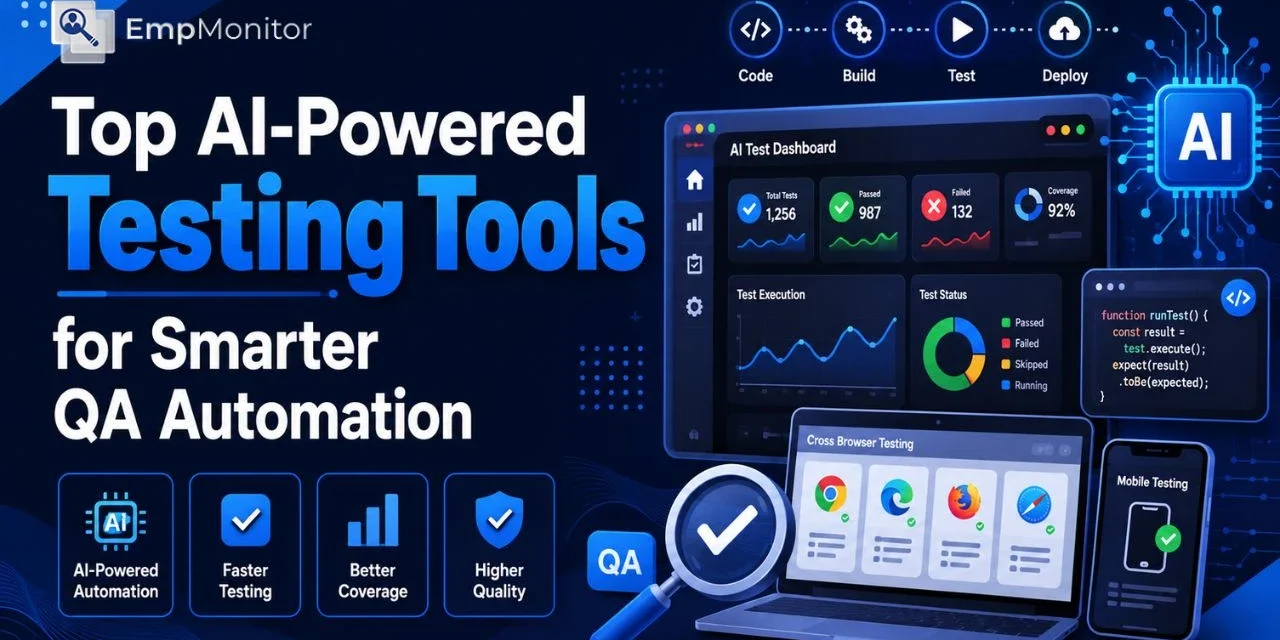
Most QA teams don’t have a testing problem. They have a maintenance problem. The top testing tools exist precisely because keeping automated tests stable while your app changes constantly is genuinely exhausting. False positives pile up, CI/CD pipelines stall, and engineers spend more time fixing broken tests than finding real bugs. After reviewing dozens of platforms across real enterprise use cases, this guide breaks down the five tools actually worth your attention right now.
Behind the ranking
Each option was assessed using publicly available information pulled from official product pages, customer case studies, and reviews across review platforms and software directories. Only tools with a documented track record in QA automation made the cut, so you won’t find anything here that’s purely theoretical.
→ See the full research breakdown
- Functionize – Best for enterprise QA testing and autonomous testing platforms
- Tricentis Tosca – Best for enterprise software testing and continuous testing
- Checksum – Best for automated end-to-end testing and CI/CD pipeline testing
- Cypress – Best for front-end automated testing and end-to-end testing
- Testrigor – Best for enterprise test automation and manual QA team support
The Difference the Right Top Testing Tools Make
Picking the wrong tool doesn’t just slow you down. It creates a compounding problem where flaky tests erode team confidence, false positives bury real defects, and release cycles stretch longer than anyone planned for. The right platform changes that completely.
Keeping automated tests stable as your application evolves is where most teams feel the most friction. A tool that self-heals broken tests and adapts to UI changes without constant human intervention isn’t a luxury. It’s what separates a QA process that scales from one that collapses under pressure.
From what experienced QA teams consistently report, the payoff shows up in a few places: a higher defect detection rate with fewer bugs escaping to production, faster test execution through parallel runs, and broader test coverage across all the code paths and user flows that actually matter.
The 5 Best Top Testing Tools: Quick Comparison
Information presented in this table derives from official company sites and third-party review aggregators.
| Company Name | Years Operating | Team Size | Headquartered In |
| Functionize | Est. 2014 | ~100 | San Francisco, CA |
| Tricentis Tosca | Est. 2007 | 400+ | Austin, Texas |
| Checksum | Est. 2022 | 18 | San Francisco, CA |
| Cypress | Est. 2015 | ~94 | Atlanta, Georgia |
| Testrigor | Est. 2015 | 50-249 | San Francisco, CA |
-
Functionize – Best for Enterprise QA Testing and Autonomous Testing Platforms
What Is Functionize’s Business Model?
Functionize builds an AI-native software testing platform where specialized agents handle the heavy lifting of complex user workflow automation. The platform trains on over 30,000 data points across eight years of enterprise use, which is how it hits 99.97% element recognition accuracy (that kind of precision is rare at enterprise scale). It also cuts flaky tests by 80% and lets non-technical team members spin up tests up to 90% faster than traditional scripting. Honestly, the self-healing capability combined with single-click root cause detection is what makes it stand apart from most platforms in this category.
Why Is Functionize a Contender for Top Testing Tools?
Functionize directly tackles two of the most painful QA problems: tests that break every time the UI shifts and the maintenance backlog that follows. The platform’s combination of automatic test healing and machine learning-driven element recognition means QA teams spend far less time firefighting and far more time actually validating software quality.
From the User Reviews:
Functionize is identified as a Strong Performer in the Forrester Q4 2025 Wave Report on Autonomous Testing Platforms, which builds real trust with enterprise buyers. From what the client results show, McAfee dramatically cut testing time from hours to minutes, and GE Healthcare reduced a 40-hour testing process down to 4 hours, a 90% labor saving that’s hard to ignore.
-
Tricentis Tosca – Best for Enterprise Software Testing and Continuous Testing
What Is Tricentis Tosca’s Business Model?
Tricentis Tosca is a continuous testing platform built for enterprise environments running sophisticated, multi-technology stacks. They cover 160+ technologies with a codeless, model-based testing approach that deliberately separates test logic from technical details. Their patented Vision AI technology adds self-healing capabilities to UI tests, which reduces the maintenance burden that kills most large-scale testing programs. With over 2,500 enterprise customers, including Fortune 500 names like Vodafone, Accenture, and McKesson, they’ve clearly proven this at scale (think enterprise pricing to match).
Why Is Tricentis Tosca a Contender for Top Testing Tools?
Tricentis Tosca addresses the challenge of running continuous testing across multi-technology enterprise environments without drowning QA teams in maintenance work. Their model-based approach means test logic stays clean and adaptable even as the underlying application changes, which is exactly what DevOps and cloud-native teams need.
From the User Reviews:
Tricentis has earned recognition from Forrester, Gartner, and IDC simultaneously. That’s a signal the platform delivers across multiple evaluation dimensions, not just one analyst’s checklist. From what the research shows, their 2025 TrustRadius Top Rated awards and finalist status in The AI Awards suggest consistent performance that users and analysts alike are willing to publicly back.
-
Checksum – Best for Automated End-to-End Testing and CI/CD Pipeline Testing
What Is Checksum’s Business Model?
Checksum is a focused testing platform that generates and maintains end-to-end tests by learning directly from real user sessions. Three specialized agents do the work: an End-to-End Agent producing production-ready Playwright tests, a CI Agent that generates 50 to 200 tests per pull request, and an API Agent that covers thousands of endpoints automatically. What stands out is that tests live in your own repository as real code, so there’s zero vendor lock-in. The fact that Checksum reached $2M in revenue without external funding suggests strong product-market fit (bootstrapped and profitable is rare in this space).
Why Is Checksum a Contender for Top Testing Tools?
Checksum targets one of the most frustrating bottlenecks in CI/CD workflows: the gap between code changes and adequate test coverage. Their system automatically heals broken tests in roughly 70% of cases without any human intervention, which keeps pipelines moving without adding to the QA team’s workload.
From the User Reviews:
Client case studies point to real, measurable outcomes, including annual savings ranging from $200K to $500K and manual testing time reductions of around 40%. Teams using Checksum consistently report building 200+ end-to-end tests faster than they expected, with production bug counts dropping noticeably after adoption.
-
Cypress – Best for Front-End Automated Testing and End-to-End Testing
What Is Cypress’s Business Model?
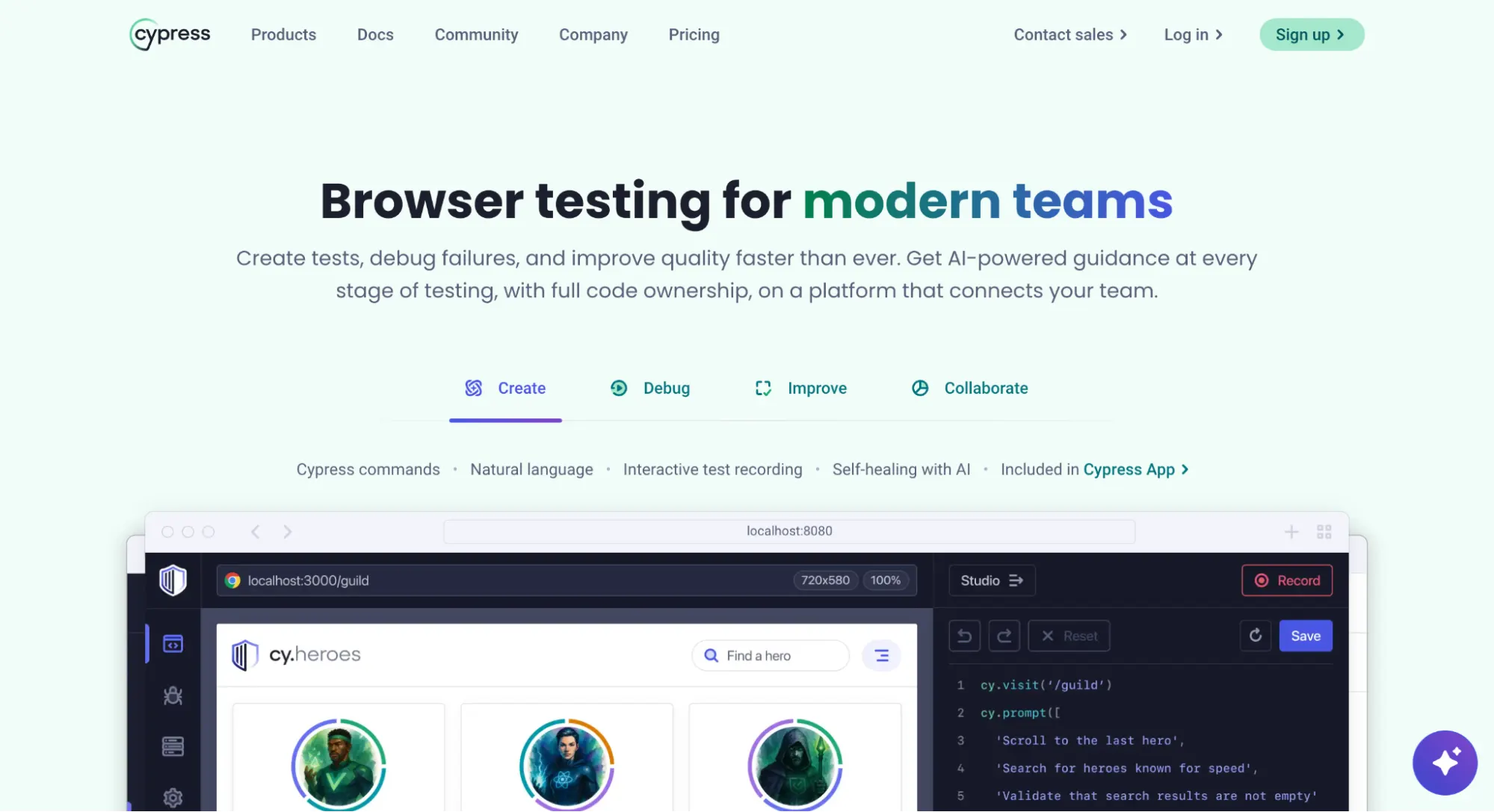
Cypress builds a developer-centric front-end testing platform with two main components: the open-source Cypress App for writing and running tests directly in the browser, and Cypress Cloud for managing and debugging tests at scale. The platform leans into developer experience with natural language test generation, AI self-healing, flake detection, and visual review tools that make it easy to track quality changes over releases. With over 3,700 customers across 78 countries and more than 5 billion tests recorded, the scale of adoption speaks for itself. Enterprise names like Adobe and DHL are in that customer base, which shows legitimacy beyond the startup crowd.
Why Is Cypress a Contender for Top Testing Tools?
Cypress solves the specific problem of front-end test instability by building flake resistance and self-healing directly into the platform’s architecture. For teams running frequent deployments, the combination of fast in-browser debugging and cloud-scale test management means quality feedback loops stay tight without slowing release velocity.
From the User Reviews:
The open-source community around Cypress is genuinely active, which typically means faster fixes and richer ecosystem support than closed platforms can offer. The $54.8M in funding and $17.8M in 2024 revenue suggest the business is growing steadily, and that kind of momentum usually translates to continued product investment.
-
Testrigor – Best for Enterprise Test Automation and Manual QA Team Support
What Is Testrigor’s Business Model?
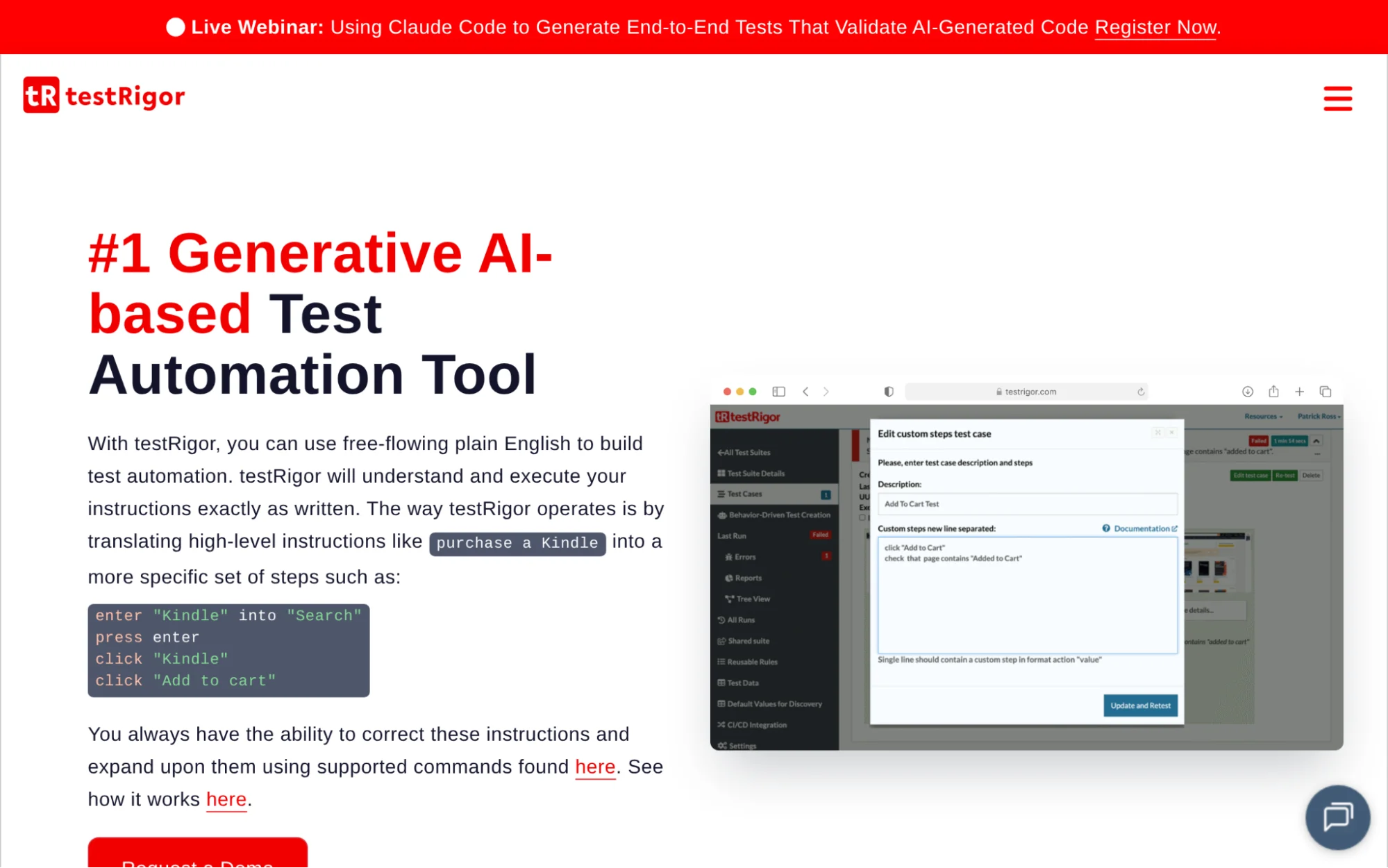
testRigor is a generative AI-based codeless testing platform that lets QA teams write tests in plain English and have them executed automatically across web, mobile, desktop, and API environments. The platform goes further than most by supporting email testing, SMS, phone calls, two-factor authentication flows, and even mainframe testing, so edge cases that usually require specialized scripts are handled without code. They claim 15X faster test creation compared to Selenium and 200X less maintenance time, which are bold numbers. That said, their appearance on the 2025 Inc. 5000 list with 521.83% three-year growth and Gartner’s 2023 “Cool Vendor” designation suggests the results are backing up the claims.
Why Is Testrigor a Contender for Top Testing Tools?
testRigor removes the biggest barrier for manual testers who want to contribute to automation: the need to write code. By letting QA professionals describe tests in plain English, the platform dramatically expands who can build and run automated test suites without requiring a Selenium specialist on the team.
From the User Reviews:
Customers like Netflix, Splunk, and Cornerstone aren’t names that adopt tools without serious evaluation, so their presence in the client list carries weight. The pattern that comes up repeatedly in reviews is around speed of getting started and the relief of not wrestling with Selenium maintenance, which lines up with what the product actually promises.
Also Read
How AI Time Tracking Is Transforming Workforce Productivity?
How These Were Chosen and Verified
The process for putting this list together started with casting a wide net.
Data Sourcing and Preparation
A broad longlist was built by scanning software directories, QA-focused review platforms, and category pages that aggregate testing tools by use case. Product pages, published case studies, and vendor documentation were pulled alongside community discussions to build a picture of how each tool performs outside of marketing materials. The goal at this stage was volume and variety, making sure no strong contender was missed before the filtering began.
Pre-Verification Phase
Once the longlist was assembled, options without documented real-world results were filtered out. This meant looking past self-reported feature lists and focusing on tools with verifiable adoption signals: consistent review patterns across multiple platforms, named customer references, and evidence of use in production QA environments. Tools that appeared only in vendor-controlled channels without third-party corroboration didn’t make it through this stage.
The Verification Phase
Each shortlisted tool was then cross-referenced across sources. Claims made on official product pages were checked against what actual users reported in reviews and case studies. Where discrepancies existed between vendor claims and user-reported outcomes, those gaps were noted and factored into the overall assessment. Particular attention was paid to claims around test maintenance reduction, self-healing accuracy, and speed improvements, since those are the metrics QA teams most frequently misrepresent in marketing materials.
Tracking Authority Markers
Beyond reviews, signals of broader recognition were tracked. This included analyst reports from firms like Gartner, Forrester, and IDC, mentions in trade publications covering software testing and DevOps, and award recognition from credible industry bodies. A tool that shows up consistently across analyst evaluations and independent award programs carries a different level of credibility than one with only vendor-produced content behind it.
Top Testing Tools Proof Points
The final check focused on whether each tool could demonstrate topic-specific depth. This meant looking for dedicated pages covering their AI testing approach, verified reviews that mentioned improvements in defect detection rate, test execution speed, or coverage expansion, and case studies with quantified results tied to QA outcomes. Tools that met all of these criteria across multiple verification layers made the final list. The ones here are the ones that passed every stage of that process.
How to Pick Your Best Match
Choosing between these platforms comes down to where your QA team is today and where you need it to be in six months. Think about your team’s technical depth, the sophistication of your application stack, and whether you’re prioritizing speed of test creation, depth of coverage, or reducing maintenance burden. The right fit depends on how those priorities rank for you.
- Industry/Domain Experience: Look for a platform with documented results in your specific application type, whether that’s web, mobile, API, or desktop. Generic testing tools work, but tools trained on your domain’s patterns catch bugs faster.
- Features and Service Options: Check whether the platform covers your full testing scope. Some tools are front-end specialists, while others cover API, mobile, and edge-case scenarios like two-factor authentication or email flow testing.
- Pricing Structure: Testing platforms range from open-source with paid cloud tiers to full enterprise contracts (not cheap, but worth it if the return on investment on reduced manual hours holds). Map the pricing model to your team size and test volume before committing.
- Results Measurement: Prioritize platforms that give you clear visibility into defect detection rate, false positive rates, and test execution time. If you can’t measure improvement, you can’t justify the spend to your team.
- Industry Knowledge and Compliance: For teams in regulated industries like medtech or fintech, confirm that the platform supports the testing documentation and audit trails required under standards like FDA validation or PCI-DSS. That requirement narrows the field quickly.
Closing Thoughts
The testing space has moved fast, and the gap between the best platforms and the rest is growing wider. The tools on this list stand out because they solve real problems: flaky tests, high maintenance overhead, and slow test creation cycles. Functionize leads for enterprise-scale autonomous testing, while tools like testRigor and Checksum serve teams with different constraints. As AI models get sharper and CI/CD pipelines get faster, the pressure to pick the right testing foundation only increases.