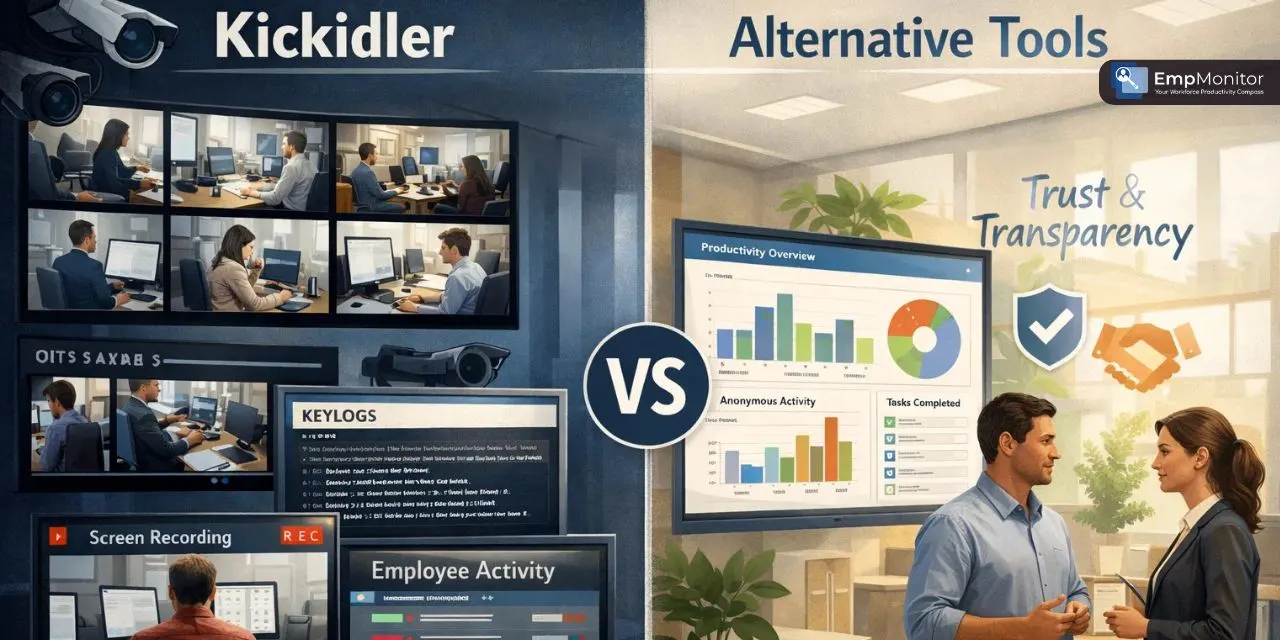
When businesses start evaluating Kickidler competitors, the conversation almost always begins the same way: someone on the team raises a concern about privacy. Kickidler is a recognized employee monitoring platform, but many HR managers and business owners find its surveillance features a step too far. Live video feeds, keystroke logging, and detailed behavioral analytics can feel more like a corporate spy operation than a practical management strategy.
For companies that want real workforce visibility without destroying employee trust, finding better Kickidler competitors becomes a genuine priority. These tools not only provide insight into productivity but also ensure you can Monitor Your Employees Legally And Effectively. This helps businesses maintain accountability while respecting privacy rights. In this blog, we walk through three alternatives that strike the right balance between accountability and well-being, tools that give you the data you actually need, without the invasive overhead that drives great employees away.
Listen To The Podcast Now!
The Kickidler Problem: Why Teams Are Searching for Something Better:
If you have ever read a Kickidler review online, a pattern becomes immediately clear. Users appreciate the platform’s extensive features but consistently flag how those same features can feel overwhelming and suffocating in practice. The Kickidler download and installation process is admittedly smooth, but what unfolds after deployment is where the friction begins.
Continuous live-screen monitoring, video recording of employee sessions, and hyper-detailed behavior reports tend to generate real anxiety among team members who feel that every click they make is being scrutinized. Some users have even gone as far as searching for a Kickidler crack simply to trial the software without a financial commitment, which speaks to both pricing friction and a reluctance to invest before seeing genuine value.
Regardless of the motivation, the message from the market is consistent: organizations want workforce insights without sacrificing employee dignity or trust. That fundamental desire is what’s driving the growing demand for Kickidler competitors that prioritize balance, transparency, and genuine productivity insights over round-the-clock surveillance.
What Should You Look for in Kickidler Competitors?
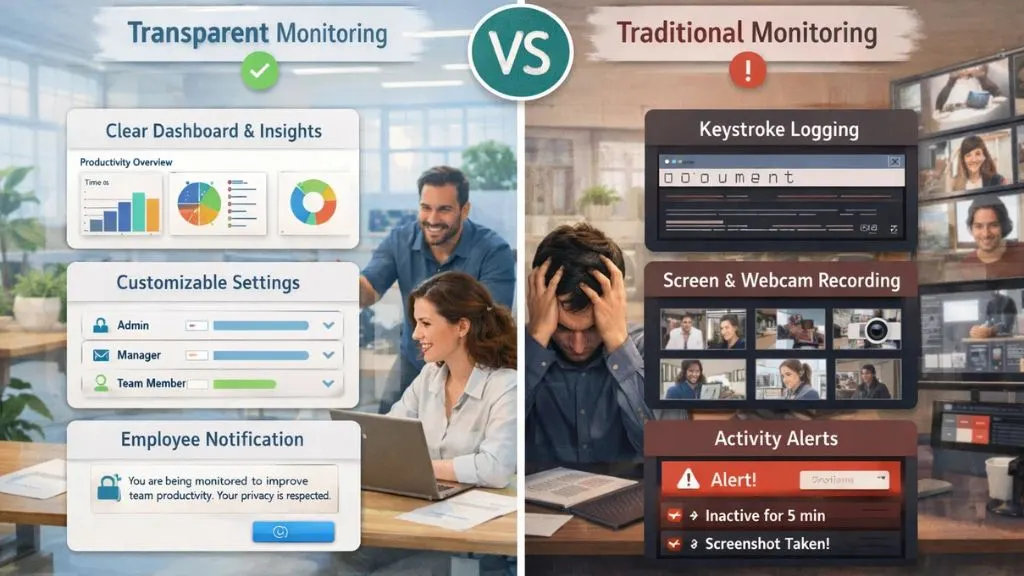
Before jumping into a new platform, it’s worth defining what “balanced monitoring” actually looks like in practice. The strongest Kickidler competitors share a handful of characteristics that meaningfully separate them from pure surveillance solutions.
Transparency comes first. A well-designed monitoring tool should let employees know they are being tracked, reducing anxiety and fostering mutual accountability. Customizability matters just as much; not every team needs the same level of oversight, and your platform should let you dial monitoring depth up or down by role, department, or project type.
Actionable reporting is equally critical. Raw logs and activity feeds are meaningless without context. You want dashboards that reveal trends, productivity patterns, and time distribution, not just surveillance recordings.
And finally, fair pricing with clean onboarding separates genuinely useful tools from complicated ones. The best alternatives offer all of these qualities without steep learning curves or invasive default settings that alienate employees from day one.
The Hidden Cost of Over-Monitoring:
One of the most underreported consequences of invasive monitoring is what it does to team culture over time. Research consistently shows that employees who feel excessively watched report lower job satisfaction, reduced intrinsic motivation, and higher rates of voluntary turnover, all of which cost organizations far more than any short-term productivity gains the software delivers.
Over-monitoring also introduces real legal risks, particularly in regions governed by strict data privacy regulations like GDPR in Europe or various U.S. state-level privacy laws. A tool that captures more employee data than necessary can expose businesses to regulatory scrutiny and financial penalties that no productivity dashboard can offset.
Smart Kickidler competitors are designed with these realities in mind, offering configurable monitoring that collects only what is necessary, protects employee data responsibly, and keeps organizations on the right side of privacy law without giving up useful workforce oversight.
Understanding these costs is an important part of making the right choice when you explore the Kickidler competitors’ market and decide which approach fits your organization’s values and obligations.
#1 EmpMonitor, Comprehensive Monitoring Without the Pressure:
EmpMonitor stands out as one of the most well-rounded Kickidler competitors available today, trusted by over 15,000 companies across 100+ countries and actively monitoring more than 500,000 employees worldwide.
What makes it genuinely different is how it delivers deep monitoring capabilities within a clean, non-intrusive user experience. Rather than making employees feel watched at every moment, EmpMonitor gives managers the clarity they need, backed by intelligent dashboards, automated reporting, and productivity scoring that supports smarter people decisions.
Key Features of EmpMonitor:
- Real-time activity tracking with live dashboards showing active vs. idle time
- URL and app usage monitoring to identify productive and unproductive behavior patterns
- Automated attendance and time tracking with shift management and scheduling
- Productivity scoring based on categorized application and website usage
- Screenshot capture at fully customizable intervals for visual activity proof
- Insider threat prevention and data loss protection tools
- HRMS integration for streamlined, all-in-one workforce management
- Face recognition attendance for in-office and hybrid team setups
- Available on Windows, Mac, and Linux, including Ubuntu 16, 18, and 20
EmpMonitor delivers enterprise-grade workforce monitoring at a price that scales for businesses of any size.
#2 Teramind, Behavior Analytics Built for Risk-Aware Teams:
Teramind is one of the most respected Kickidler competitors for organizations where security and compliance are the primary drivers of monitoring investment. Unlike Kickidler’s always-on recording philosophy, Teramind centers on a rule-based approach; you define what policy violations matter, and the system flags you only when those rules are breached.
Employees are not under a live microscope throughout the day. Instead, managers receive intelligent alerts when genuinely anomalous behavior occurs, such as bulk file transfers, access to restricted websites during business hours, or unusual login patterns that suggest a compromised account.
This approach respects employee autonomy while maintaining a strong security posture. Teramind’s User Behavior Analytics engine is particularly powerful for detecting insider threats before they become costly incidents. Pre-built compliance templates for GDPR, HIPAA, and PCI-DSS further reduce the overhead for regulated industries.
The trade-off is cost and configuration complexity. Teramind sits at the premium end of the pricing spectrum and can be set up without dedicated IT support. For mid-to-large enterprises with serious security mandates, however, it remains one of the most capable Kickidler competitors in this space.
#3 Insightful, The Transparency-First Workforce Analytics Platform:
Formerly known as Workpuls, Insightful has reimagined itself as a productivity-focused workforce analytics tool, and it has carved out a solid reputation among Kickidler competitors by leading with employee transparency in a way that most monitoring platforms simply do not prioritize.
Insightful tracks time, applications, and websites while simultaneously giving employees access to their own data dashboards. This level of openness changes the entire dynamic of monitoring. When employees can see exactly what their managers see, the monitoring tool shifts from feeling like a threat to feeling like a shared performance tool. That perception shift matters enormously for team morale and retention.
The platform also includes project-level time tracking, connecting hours worked to actual deliverables rather than just activity logs. It integrates neatly with productivity ecosystems like Jira, Asana, and Trello, a genuine advantage for tech and creative teams.
Its interface is clean and intuitive, and pricing is competitive. For remote-first companies or growing teams that want productivity intelligence delivered with respect and openness, Insightful ranks among the more thoughtfully designed Kickidler competitors for people-centered organizations.
Comparing These Three Kickidler Competitors Side by Side:
Choosing between these platforms depends on your organization’s size, culture, and core monitoring goals.
EmpMonitor is the most versatile and cost-effective of the three Kickidler competitors reviewed here. It covers a wide range of industries, from IT and healthcare to call centers, banking, and education, with one of the broadest feature sets at the most accessible price point. For businesses that want comprehensive workforce monitoring delivered without invasive defaults, it is the strongest all-around option.
Teramind is purpose-built for security-focused organizations. Its rule-based behavior analytics and compliance reporting tools offer a level of data protection that productivity-first platforms cannot replicate. It is a premium product for premium security requirements.
Insightful sits between the two, delivering strong productivity analytics with a transparency-first approach designed to preserve employee trust. It suits remote teams and tech companies where culture and morale are as important as output metrics.
Together, they represent a far more thoughtful and human-centered category of Kickidler competitors built for modern workplaces where trust matters as much as metrics.
Also Read:
Which Industries Benefit Most from Balanced Monitoring Tools?
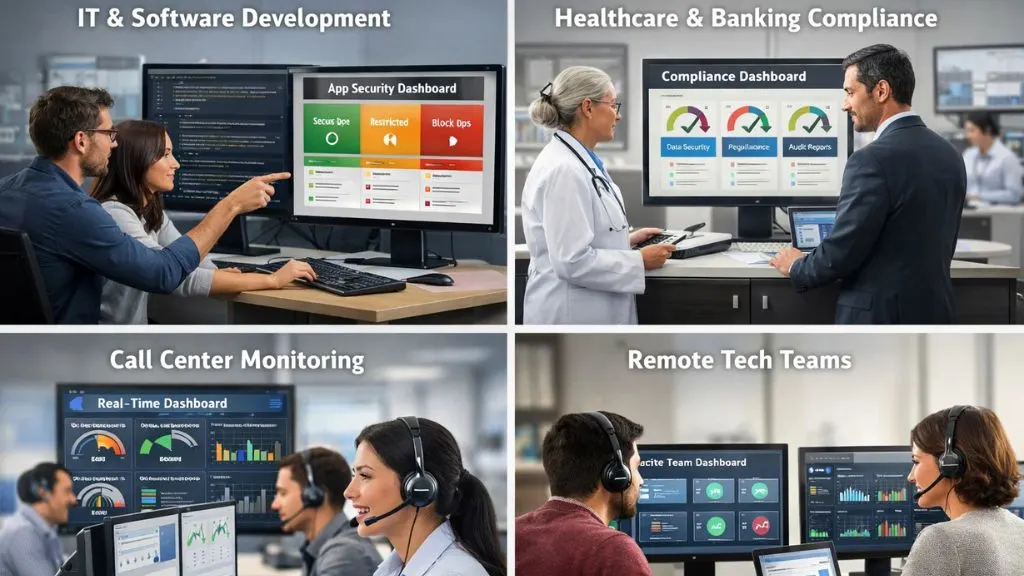
One important thing that separates the best Kickidler competitors from generic surveillance platforms is how well they adapt to different industry needs. Not all monitoring requirements are the same, and the right tool should flex to match your specific context.
- In IT and software companies, the priority is typically measuring deep-work time, tracking development tools usage, and preventing unauthorized data access. EmpMonitor’s app categorization and insider threat features cover these needs well without constantly recording screens.
- In healthcare and banking, compliance and data security take precedence over raw productivity metrics. Teramind’s rule-based behavior analytics and ready-made compliance templates fit these regulated environments precisely.
- In call centers and customer support, understanding agent activity patterns, idle time, and application usage translates directly to service quality. EmpMonitor’s real-time dashboards make this kind of oversight practical and immediate.
- For remote-first tech teams, employee autonomy is culturally non-negotiable. Insightful’s transparent dashboards, where employees can view their own data, address this need directly. Understanding your industry’s specific requirements is what ultimately determines which of these Kickidler competitors delivers the most relevant and practical value for your team.
How to Make the Switch Smoothly?
Transitioning away from Kickidler to any of these Kickidler competitors needs careful planning. The biggest mistake organizations make is enabling all monitoring features on day one without communicating the change to their teams, a recipe for the exact trust breakdown they were trying to avoid.
Start by clearly defining what you actually want to measure. Is your priority attendance tracking, application productivity, project time allocation, or security event detection? Each of these alternatives allows you to customize monitoring depth, so use that flexibility intentionally from the very beginning rather than defaulting to maximum surveillance.
Communicate transparently with your team. Explain what data is being collected, why it matters, and how it will inform management decisions rather than punish individuals. Then pilot the tool with a single department before rolling it out company-wide. Most Kickidler competitors in this category offer trial periods. EmpMonitor, for example, provides a free trial that lets you explore every feature without any financial commitment. A thoughtful rollout earns employee confidence from day one and sets a tone for monitoring that is firm, fair, and genuinely useful.
Conclusion:
Monitoring your workforce does not have to mean sacrificing trust or team culture. The right tool gives managers the clarity they need while giving employees the dignity and respect they deserve. The Kickidler competitors covered in this blog are each built around different priorities, proving that meaningful workforce oversight and a healthy workplace culture can genuinely coexist.
Whether your focus is productivity analytics, behavior-based security, or a transparency-first approach to team management, there is a balanced solution designed for your exact needs. The smartest move is to evaluate your core requirements, pilot a tool with one team, and let the data guide your final decision.
FAQ’s:
Q1. Why are businesses looking for Kickidler competitors?
Ans: Kickidler’s always-on screen recording and keystroke logging feel too invasive for many teams. Businesses want tools that deliver workforce insights without undermining employee trust.
Q2. Do these tools work for remote and hybrid teams?
Ans: Yes. All three platforms support distributed workforces with cloud-based dashboards and cross-platform compatibility.
Q3. Will employees know they are being monitored?
Ans: All the tools covered here support transparent setups where employees are notified, which is both the ethical and legally safer approach in most regions.
Q4. Is it legal to monitor employees without telling them?
Ans: In many regions, particularly under GDPR, covert monitoring is heavily restricted or illegal. Always consult your legal team before deployment.
Q5. How do I choose the right monitoring tool?
Ans: Define your core goal first: productivity, security, or attendance, then match the tool to your team size, budget, and transparency standards. Use free trials before committing.