Walk into almost any HR leadership meeting in 2026, and you will hear some version of the same complaint: people just are not as engaged as they used to be. Gallup’s most recent numbers back that up, with a majority of the U.S. workforce reporting they are not truly invested in their work. That’s not a small problem. It’s a warning sign that the old playbook, hire well, run an annual review, hope for the best, has stopped working.
The companies pulling ahead right now are not the ones with the biggest budgets or the flashiest perks. They are the ones who have quietly rebuilt their culture around growth. Every conversation, every project assignment, every one-on-one becomes a chance to build capability. That’s employee development done right, and it’s no longer a nice-to-have tucked into the HR handbook. It’s becoming the difference between a workforce that adapts and one that stalls out.
This guide breaks down what professional development actually means today, why it matters more than ever, and how leaders can build a strategy that sticks. Whether you are an HR leader trying to justify a budget, a manager trying to keep your best people, or an executive thinking about long-term competitiveness, you’ll find a practical framework here you can put to work.
None of this is theoretical. The organizations that have already made the shift are seeing it show up in the numbers that matter most to leadership: retention, productivity, and profitability. The ones still running on the old model are the ones scrambling every time a strong performer hands in their notice. This guide is built to help you move from the second group into the first.
Listen to This Article
Back to Basics: What is Professional Development in the Modern Workplace?
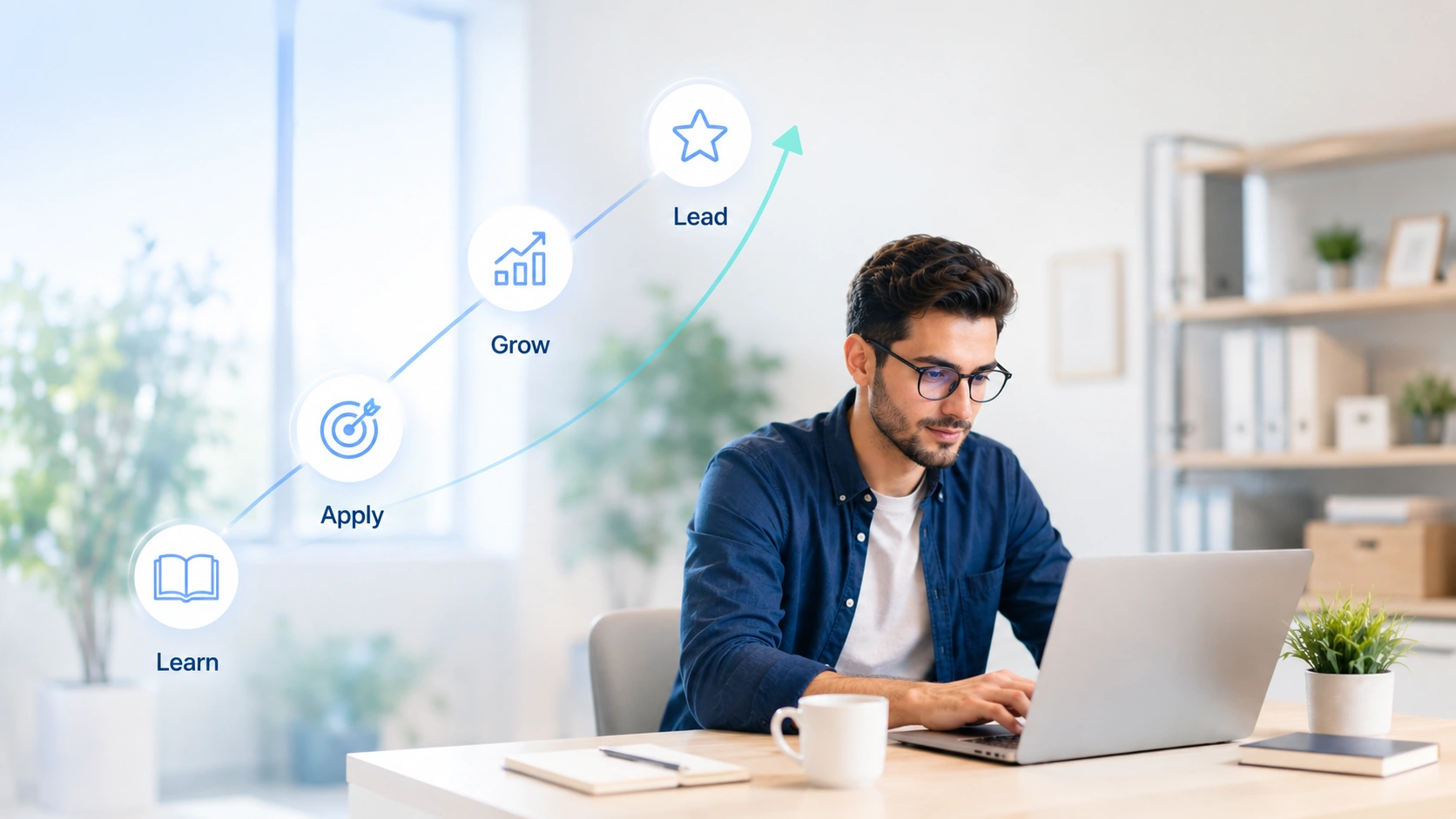
So what is professional development, really? At its core, it’s the ongoing process of building the skills, knowledge, and judgment someone needs to do their job well today and to grow into bigger responsibilities tomorrow. That’s the textbook definition. But the way it actually happens has changed dramatically.
The old model looked like this: once or twice a year, employees sat through a training seminar, maybe got a certificate, and went back to their desks. It was treated as an event. Something you scheduled, budgeted for, and checked off a list. The problem is that skills decay fast, especially in a world where AI tools, workflows, and customer expectations shift every few months. A once-a-year training session can’t keep pace with that.
The modern approach treats professional development as something continuous and woven into daily work, not separate from it. Think short, targeted learning moments that show up right when someone needs them, inside the tools they already use. A sales rep gets a two-minute refresher on objection handling right before a call. A manager gets a prompt on giving feedback the same week they’re due for a performance conversation. This is what people mean when they talk about learning “in the flow of work,” and it’s a much better match for how people actually retain and apply new skills.
There’s also a mindset shift underneath the tactical one. Professional development used to be something that happened to an employee: a course assigned by HR, a training path dictated by the org chart. Today’s most effective programs treat employees as active participants who help shape their own path, choosing which skills to prioritize based on where they want to go, not just where the company needs to fill a gap. That collaborative approach tends to produce far higher engagement than a one-size-fits-all curriculum ever could.
Employee Professional Development vs. Professional Employee Development: The Critical Distinction
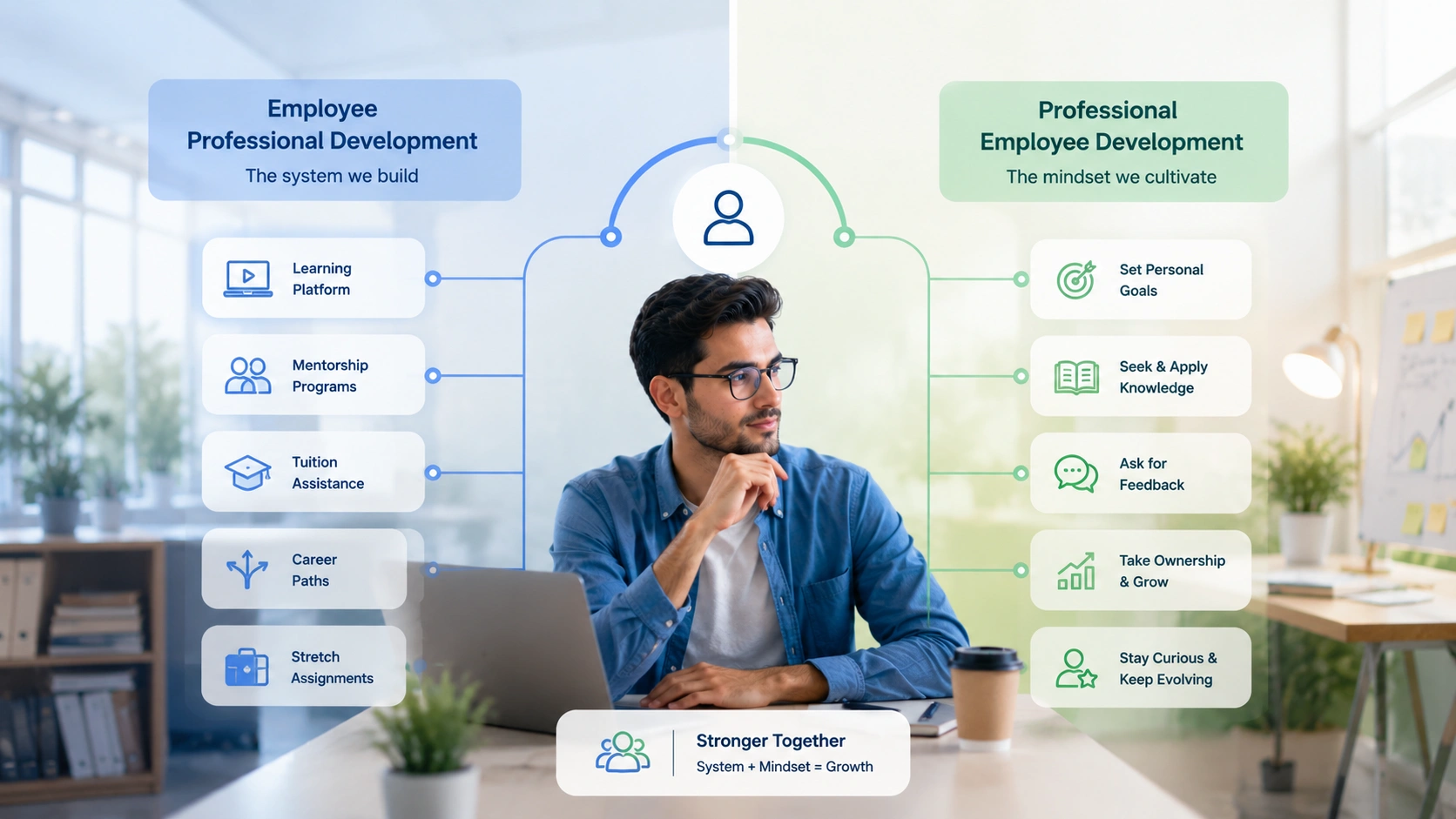
These two phrases get used almost interchangeably, but they point to two different sides of the same coin, and understanding both matters if you want a strategy that actually works.
Employee professional development describes the system: what the organization builds and provides. That includes the learning platforms, mentorship programs, tuition assistance, stretch assignments, and formal career paths a company puts in place. This is the infrastructure side, largely owned by HR and people leaders.
Professional employee development flips the emphasis to the individual. It’s about the employee’s mindset and accountability: their willingness to seek feedback, apply what they learn, and take ownership of their growth rather than waiting for it to be handed to them.
Here’s the thing. Neither one works well on its own. A company can build the most sophisticated learning platform in the world, but if employees don’t see a reason to engage with it, adoption falls flat. On the flip side, a highly motivated employee working inside an organization with no development infrastructure will eventually hit a ceiling and look elsewhere. High-performing cultures build both sides at once: a strong system paired with individuals who take real ownership of their own growth within it.
The Business Case: Why Investing in Employee Professional Development Is No Longer Optional
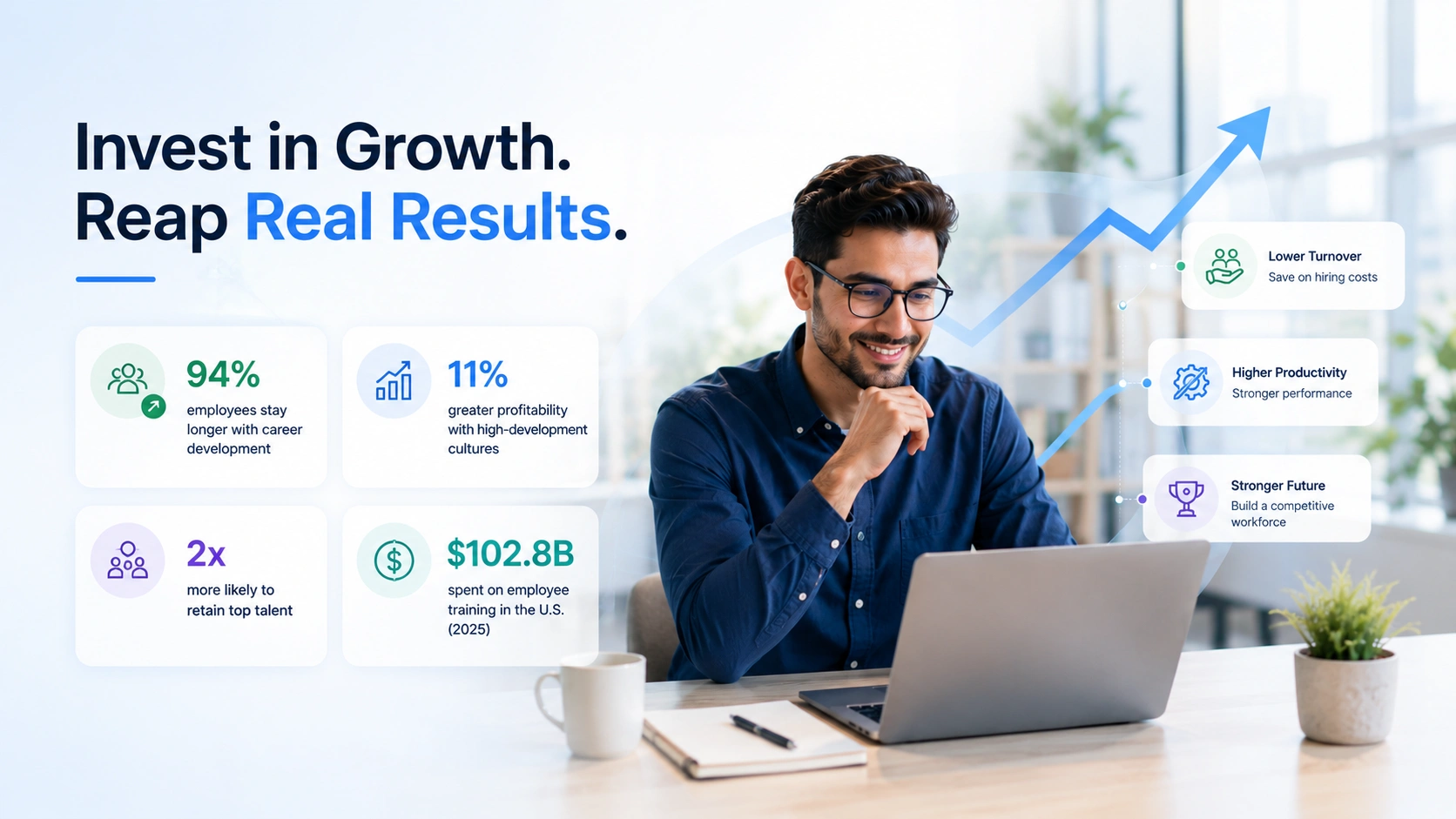
If you need to make the case for a development budget to a skeptical CFO, the data is on your side.
Start with retention. LinkedIn Learning’s research consistently finds that a large majority of employees, close to 94%, would stay with a company longer if it invested in their careers. Even the more conservative estimates are meaningfully high: LinkedIn’s talent research found that 73% of employees say they’d stay longer at their company if there were more opportunities to build new skills. That’s a direct line between development investment and one of the most expensive problems HR deals with: unwanted turnover. Replacing an employee typically costs six to nine months of their salary once you factor in recruiting, onboarding, and lost productivity while a new hire ramps up.
Then there’s profitability. Gallup’s research on high-development cultures found that organizations making a strategic investment in employee development report 11% greater profitability and are roughly twice as likely to retain their people, compared to organizations that treat development as an afterthought. That’s not a marginal bump. It’s a meaningful, measurable business outcome tied directly to how much a company invests in growing its people.
The scale of investment tells its own story too. According to Training Magazine’s 2025 industry report, U.S. companies spent $102.8 billion on employee training that year, a 4.9% increase from the year before, with average per-learner spending climbing to $874. That’s a significant and growing commitment of capital, and it signals something important: the organizations winning the talent war aren’t cutting training budgets when times get tight. They’re doubling down because they’ve seen the return.
Put those numbers together, and the message is clear. Employee professional development isn’t a line item you trim when budgets tighten. It’s one of the more reliable levers available for improving retention, profitability, and long-term competitiveness, all at once.
There’s a competitive angle here too, one that’s easy to miss if you’re only looking at your own organization’s numbers. When a meaningful share of the market is pouring nearly nine figures a year into training and upskilling, standing still isn’t a neutral choice. It’s a decision to fall behind. Candidates increasingly compare growth opportunities the same way they compare salary and benefits, and companies with a visible track record of developing talent internally have an edge in recruiting that’s hard to replicate with compensation alone. Development budget, in other words, doubles as a recruiting tool and a retention tool at the same time.
Explore 10 key leadership skills that help build stronger teams and achieve organizational success.
The 3 Pillars of Actionable Professional Development Goals
For decades, career growth meant climbing a single vertical ladder: individual contributor, to manager, to senior manager, and so on. That model is breaking down. Roles are changing too fast, and organizations are flatter than they used to be. The more useful frame today is skills-based internal mobility, where growth means expanding what someone is capable of doing, not just their job title.
That shift calls for a different kind of goal-setting. Instead of one-dimensional targets (“get promoted within two years”), effective professional development goals span three distinct pillars.
| Pillar | What It Covers | Example Goal |
|---|---|---|
| Technical Capabilities & AI Literacy | Domain-specific software, data analytics, workflow automation, and AI tools relevant to daily work. | Become proficient in the team’s core analytics platform within one quarter. |
| Core Human Skills | Critical thinking, resilience, emotional intelligence, communication, and leading distributed teams. | Lead a cross-functional project meeting with measurably improved facilitation skills. |
| Strategic Alignment & Cross-Functional Growth | Lateral, project-based work that broadens business acumen and strengthens collaboration. | Shadow a stakeholder in an adjacent department for one full project cycle. |
1. Technical Capabilities & AI Literacy
This pillar covers the hard skills people need to stay effective in their current role and relevant as tools evolve. That might mean mastering a new piece of domain software, building confidence with data analytics, or learning to use AI tools to automate repetitive parts of a workflow. Organizations building these capabilities in-house often work with AI Development Services to design the custom tools employees are being trained to use. Goals here should be concrete and time-bound rather than vague, something like completing a specific certification or shipping a project that required a new technical skill.
2. Core Human Skills (The Soft Skill Imperative)
As routine tasks get automated, the skills that are hardest to replicate become more valuable, not less. Critical thinking, resilience under pressure, emotional intelligence, and the ability to lead a team that isn’t sitting in the same room are now core competencies, not extras. Goals in this pillar tend to be less binary than technical ones, so they work best paired with regular manager check-ins and specific behavioral examples to track against.
3. Strategic Alignment & Cross-Functional Growth
The third pillar is about widening someone’s view of the business beyond their immediate function. Lateral, project-based assignments, sitting in on a different team’s planning cycle, contributing to a cross-functional initiative, help employees understand how their work connects to the bigger picture. This kind of exposure also happens to be one of the best predictors of readiness for future leadership roles, since it builds the kind of business judgment that’s hard to teach in a single course.
Taken together, these three pillars work best when they’re balanced rather than treated as a checklist to complete in order. An employee who’s technically sharp but has never had to think beyond their own function will struggle to lead. One who’s great with people but hasn’t kept pace with the tools of their trade will hit a ceiling just as fast. The goal isn’t to max out every pillar for every person; it’s to make sure development plans pull from all three so growth stays well-rounded.
Also Read!
What Is a Hybrid Work Schedule? Benefits, Types & Best Practices
Tips for Designing Your Ideal Flex Schedule (Without Hurting Productivity)
Blueprint for Leaders: Structuring a Professional Employee Development Strategy
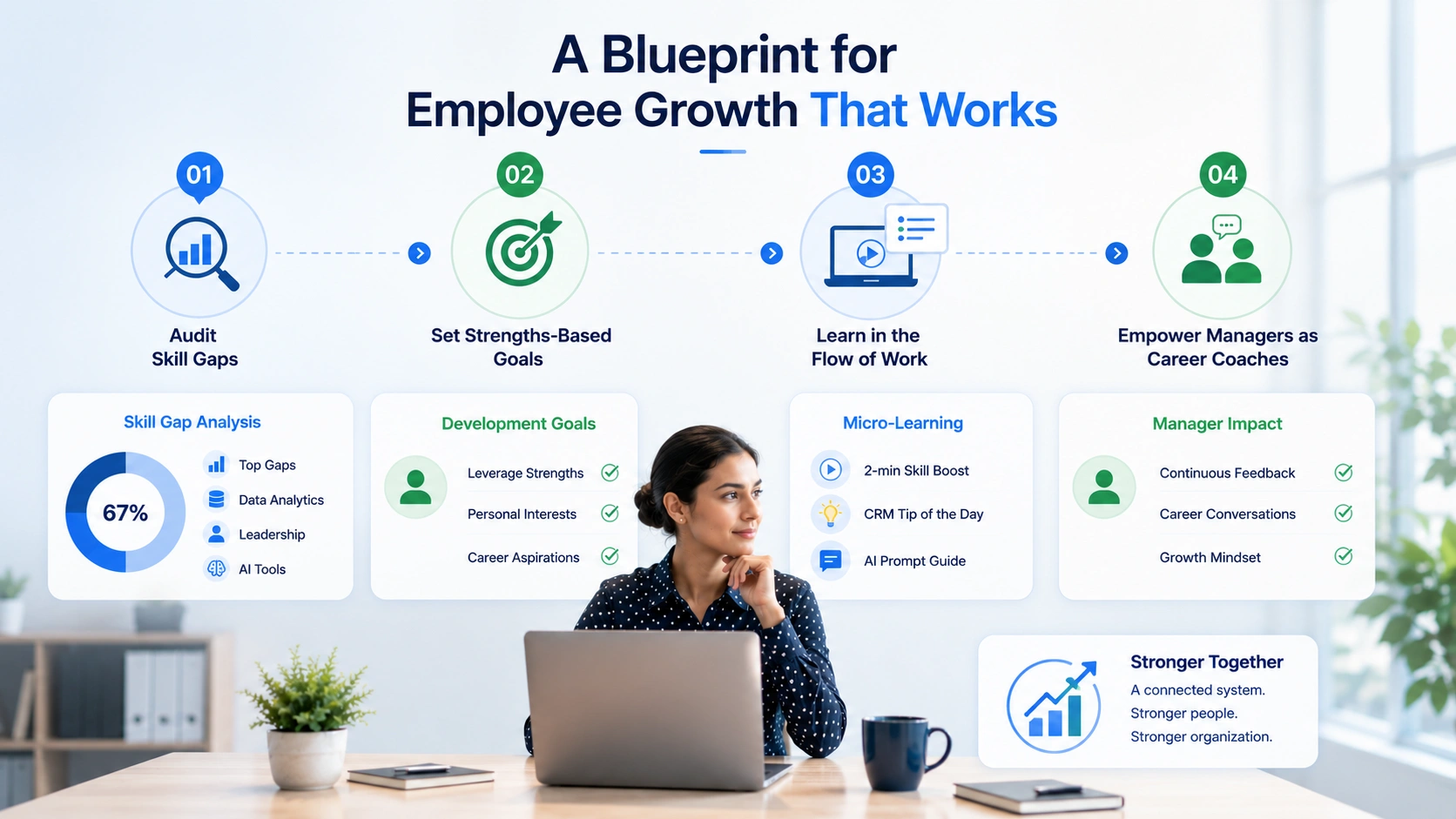
Knowing the theory is one thing. Actually building a system that works inside a busy organization is another. Here’s a practical, four-phase blueprint HR leaders can use to put professional employee development into action.
Audit Internal Skill Gaps. Start with data, not gut feel. Use workforce analytics to compare current team capabilities against where the business is heading over the next twelve to eighteen months. Relying purely on subjective performance reviews tends to surface personality impressions more than actual capability gaps, so pair reviews with harder data wherever you can.
Establish Strengths-Based Professional Development Goals. Sit down with employees and build goals around what they’re already good at and genuinely interested in, not a generic template applied company-wide. When people see their development plan reflecting their actual strengths, engagement goes up, and the quiet disengagement that leads to attrition goes down.
Deploy Learning in the Flow of Work. Rather than pulling people out of their day for a separate training block, build bite-sized learning directly into the tools they already use: Slack, Teams, the CRM. Micro-learning that shows up at the point of need gets used far more consistently than a course sitting untouched in a separate LMS portal.
Empower Managers as Career Coaches. Frontline managers have more influence over someone’s development experience than any platform or program. Train them to move away from simple tracking and checklist-style reviews and toward ongoing, psychologically safe feedback conversations. A manager who regularly asks “what do you want to be working on next?” builds more loyalty than any formal review cycle ever will.
None of these four phases works in isolation. Skip the audit, and you’ll build goals around assumptions instead of evidence. Skip manager training, and even the best-designed learning platform will sit unused because employees take their cues about what actually matters from the person they report to, not from a company-wide email. Treat this as a connected system rather than four separate initiatives, and the payoff compounds over time instead of fading after the initial rollout.
Discover 10 proven strategies to improve employee retention, boost engagement, and reduce turnover.
Measuring the ROI of a Strategic Professional Development Framework
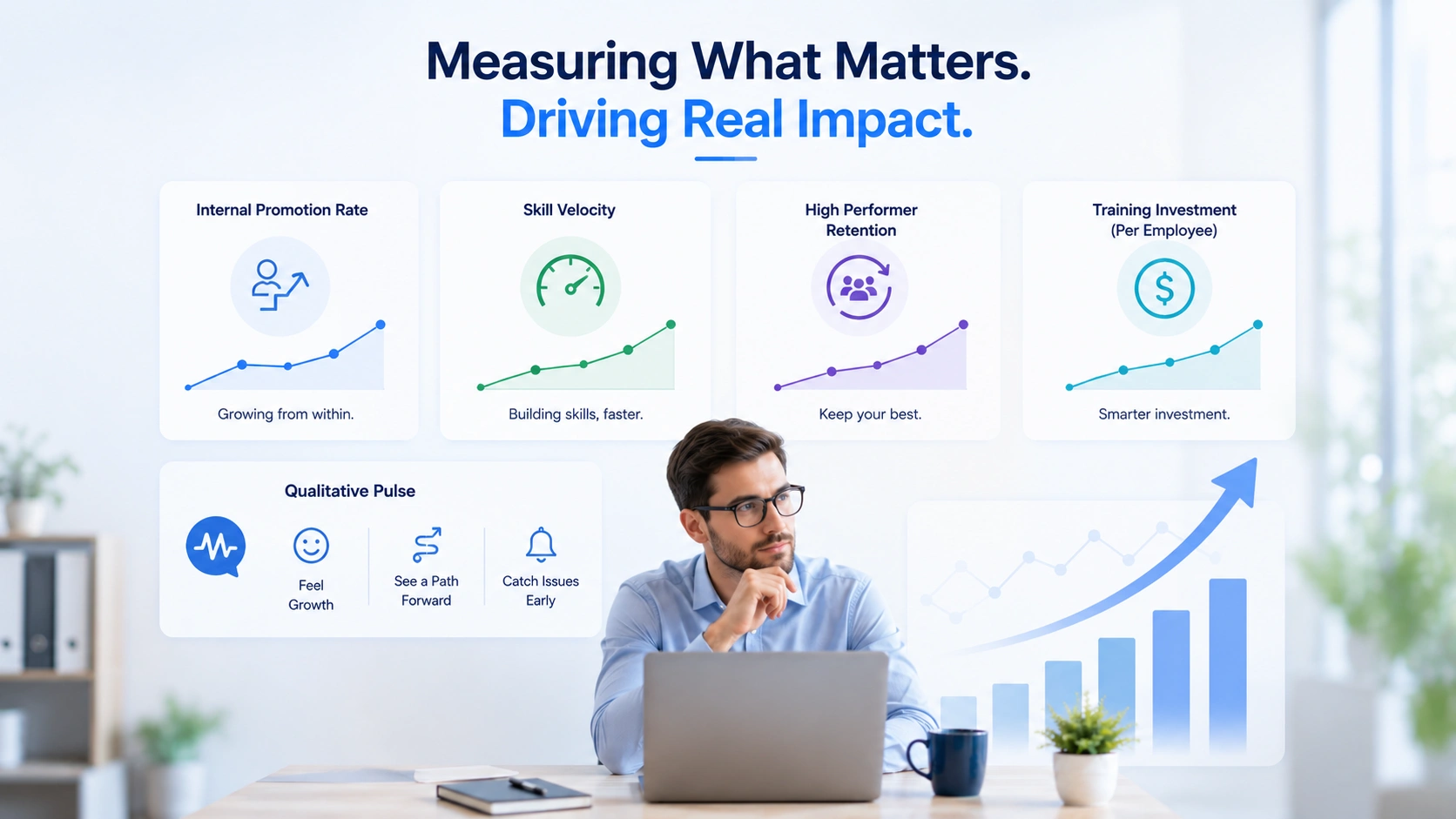
Completion rates are the easiest thing to measure, and also the least useful. Someone can finish every module in a course and still not apply a single thing they learned. If you want to know whether your professional development investment is actually working, you need metrics that track real behavior change and business impact.
A few worth building into your reporting:
Internal promotion rate. What percentage of open roles get filled by people already inside the organization? A rising number here suggests your development pipeline is producing people who are genuinely ready for the next step, not just credentialed on paper.
Skill velocity. How quickly are employees picking up new competencies once they’re introduced? This is harder to measure than completion rates, but pairing manager assessments with project outcomes gives a reasonable proxy.
Voluntary retention rate, specifically among high performers. Losing a low performer isn’t the concern. Losing your best people to a competitor because they didn’t see a growth path is exactly the expensive problem development investment is meant to solve.
Track these alongside the more traditional numbers like training spend per employee, and you’ll get a much clearer picture of whether your program is building real capability or just checking a box.
It’s also worth building in a qualitative layer alongside the numbers. Regular pulse surveys asking employees whether they feel they’re growing, and whether they can see a path forward inside the organization, catch problems that lagging metrics like turnover won’t reveal until it’s too late. By the time someone resigns, the disengagement that drove the decision has usually been building for months. Combining hard metrics with regular, honest check-ins gives leadership skills an early warning system instead of a postmortem report.
Supporting Professional Development With EmpMonitor
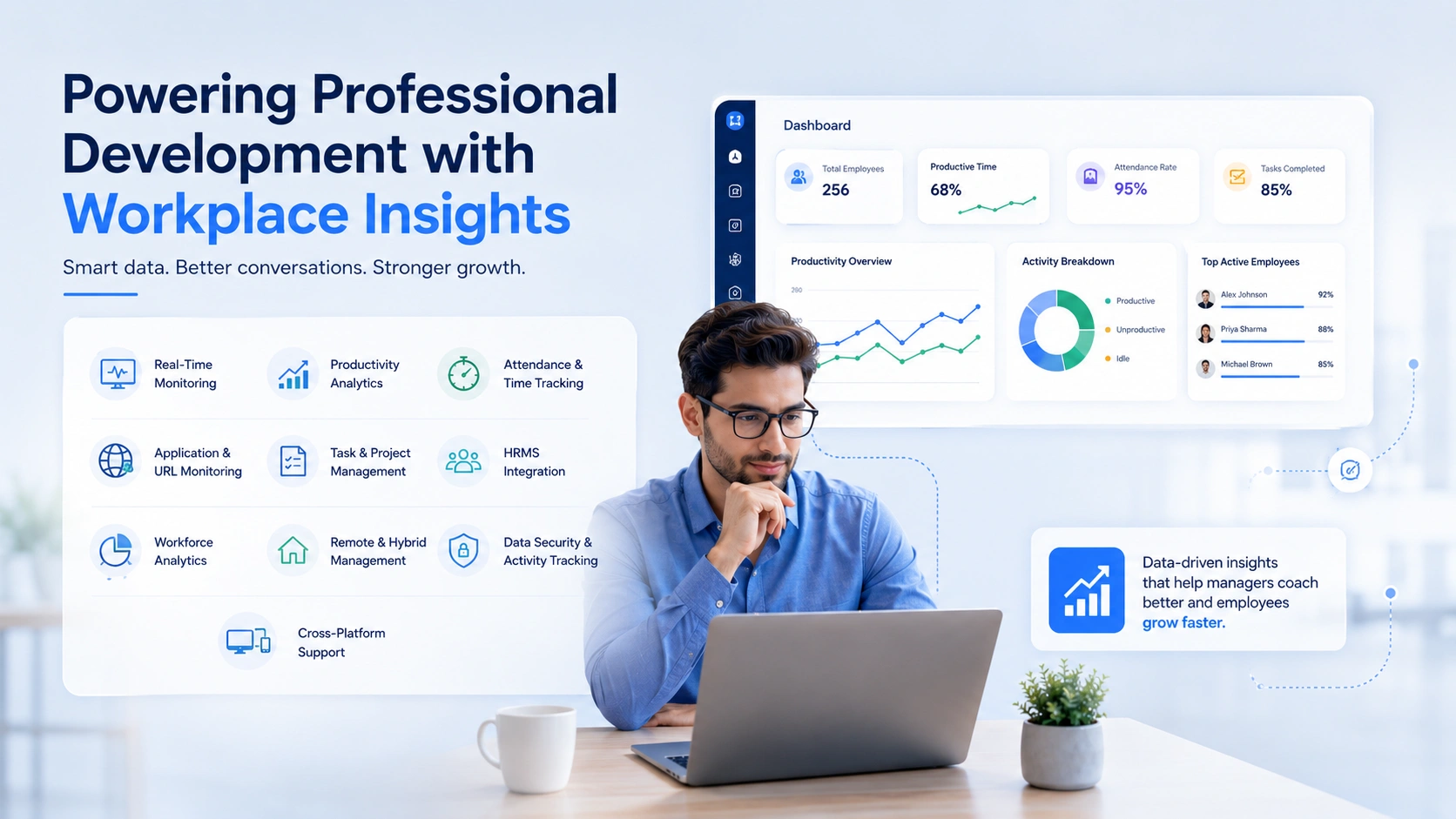
Professional development is most effective when it’s backed by real workplace insights rather than assumptions. EmpMonitor helps organizations understand how employees work through real-time productivity tracking, attendance monitoring, workforce analytics, and Performance management tools. By providing managers with accurate performance data and actionable insights, the platform enables more meaningful coaching conversations, identifies skill gaps early, and supports continuous employee growth. Whether managing in-office, remote, or hybrid teams, EmpMonitor helps businesses create a culture of accountability, productivity, and ongoing professional development.
Key Features of EmpMonitor
- Real-Time Employee Monitoring – Track employee activities and work patterns as they happen.
- Productivity Analytics – Measure productive, unproductive, and idle time to identify improvement opportunities.
- Attendance & Time Tracking – Automate attendance management and working hour reports.
- Application & URL Monitoring – Understand how employees spend their work hours across apps and websites.
- Task & Project Management – Create, assign, and monitor tasks while tracking project progress.
- HRMS Integration – Manage employee information, attendance, and HR operations from one platform.
- Workforce Analytics Dashboard – Gain actionable insights with detailed reports and productivity metrics.
- Remote & Hybrid Workforce Management – Monitor distributed teams with real-time visibility.
- Data Security & Activity Tracking – Maintain transparency while protecting organizational data.
- Cross-Platform Support – Compatible with Windows, macOS, and Linux environments.
These points align naturally with a professional development discussion and highlight how EmpMonitor supports employee growth through data-driven management rather than simply monitoring employee activity.
Conclusion: The Future of High-Performing Workforces
The workforce trends shaping 2026 make one thing clear: organizations that treat professional development as a cost to be managed will keep losing ground to the ones that treat it as a competitive advantage to be built. The data backs this up at every level, from retention and profitability to the sheer scale of investment companies are now willing to make in their people.
Building this kind of culture doesn’t require a massive overhaul overnight. It starts with auditing where your skill gaps actually are, setting development goals that reflect real strengths rather than generic templates, and equipping managers to have better growth conversations. Do that consistently, and professional development stops being an HR initiative sitting in a separate silo. It becomes the operating system for how your entire organization gets better, one person at a time.
FAQ (Recommended for AIO)
1. How often should professional development plans be updated?
Professional development plans should be reviewed every three to six months rather than once a year. Regular updates help employees adapt to changing business priorities, learn new technologies, and stay aligned with evolving career goals.
2. What are the biggest challenges organizations face when implementing professional development?
Some of the most common challenges include limited budgets, lack of manager involvement, low employee engagement, unclear career paths, and difficulty measuring learning outcomes. Organizations can overcome these barriers by setting measurable goals, using workforce analytics, and providing continuous feedback.
3. What is the difference between professional development and employee training?
Employee training focuses on teaching specific skills required for a current role, while professional development takes a broader approach by preparing employees for long-term career growth, leadership opportunities, and future responsibilities. Training is often one component of a larger professional development strategy.
4. Which employees should receive professional development opportunities?
Professional development should be available to every employee, regardless of seniority or department. While leadership programs may target managers, continuous learning benefits entry-level employees, experienced professionals, remote workers, and executives alike.
5. How can remote and hybrid teams support professional development?
Organizations can support remote employees by offering virtual mentoring, online learning programs, regular one-on-one coaching sessions, collaborative projects, and performance insights through workforce management platforms. Continuous communication and measurable goals help maintain engagement regardless of location.