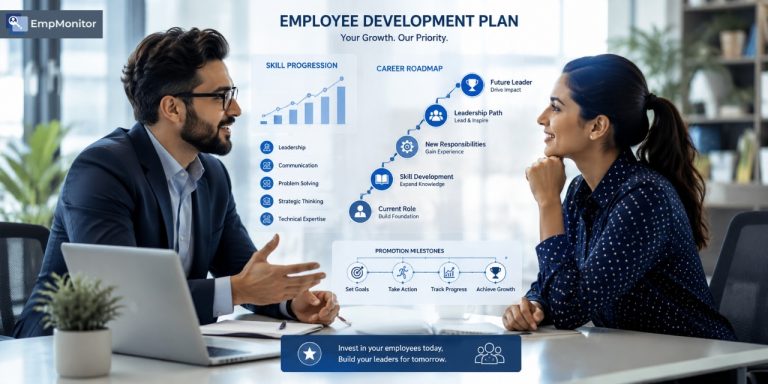
An employee development plan can be the difference between keeping a talented employee and losing them to another opportunity. Yet many organizations still treat employee growth as an occasional conversation instead of an ongoing priority.
Employees want opportunities to learn, grow, and advance in their careers. Managers want engaged teams, stronger performance, and future leaders. A well-designed development plan helps achieve both.
The problem is that many companies either overcomplicate the process or fail to follow through after creating the plan. As a result, development efforts often lose momentum.
This guide explains what an employee development plan is, why it matters, the different types you can use, and how to create one that drives real results. You’ll also find practical examples, common mistakes to avoid, and tips for tracking progress effectively.
Listen To The Podcast!
The Problem Most Companies Don’t Talk About
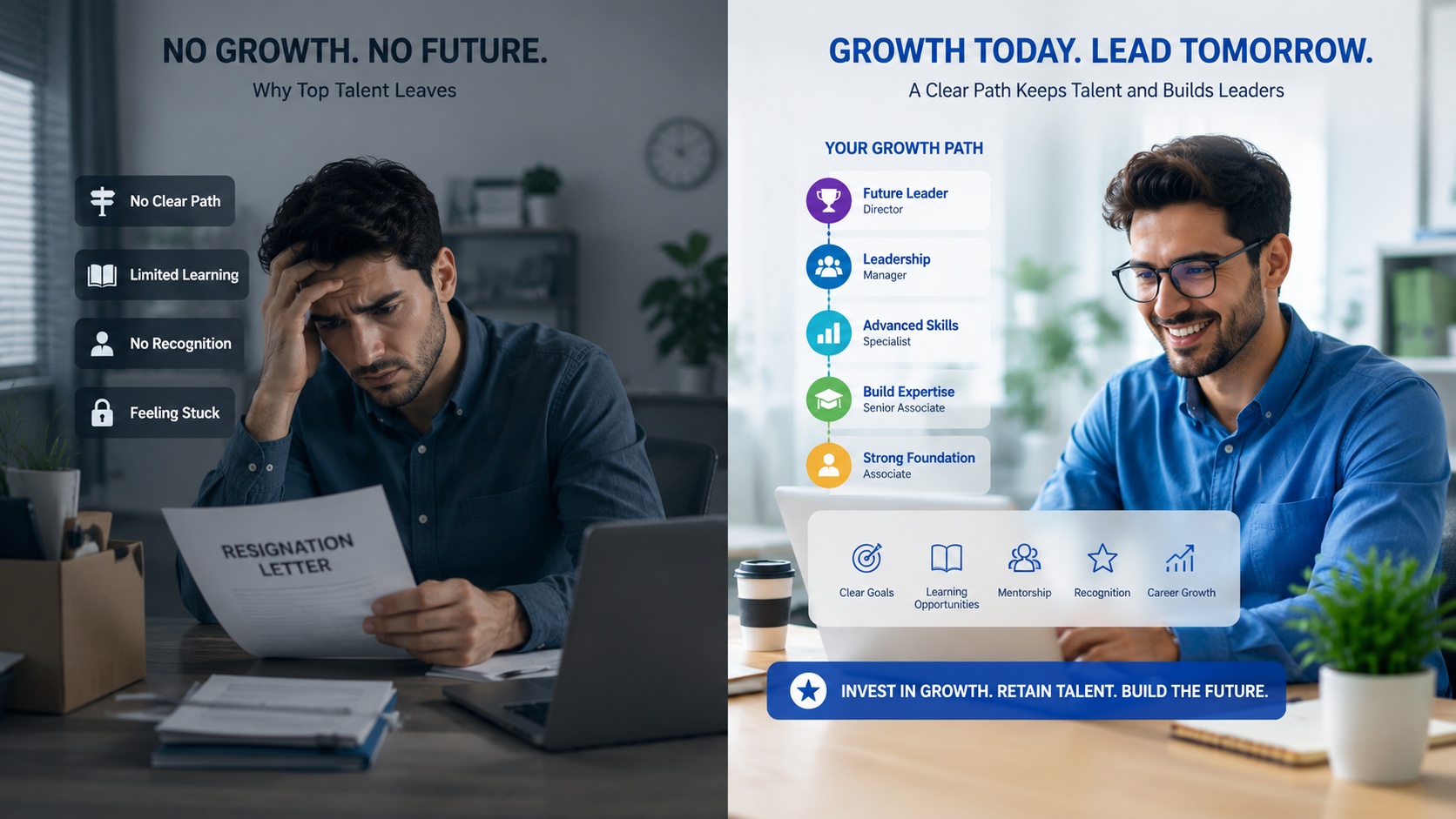
An employee development plan often enters the conversation too late.
A talented employee joins the company, performs well, exceeds expectations, and quietly waits for signs of growth. Months pass. Their manager praises their work during reviews but never discusses future opportunities. Eventually, that employee accepts an offer elsewhere.
The departure usually comes as a surprise. Yet the warning signs were there all along.
Research from Gallup consistently shows that employees who feel disconnected from growth opportunities are far more likely to disengage and leave. Replacing skilled employees is expensive, but the larger cost is losing institutional knowledge, team stability, and future leaders.
Many organizations believe annual performance reviews solve this problem. They do not.
Reviews focus on evaluating past performance. Growth requires looking forward. Employees want to know where they can go, what skills they should build, and how the organization will support that journey.
That gap between evaluation and development creates frustration on both sides. Managers wonder why retention suffers. Employees wonder whether their future matters.
An employee development plan is designed to close that gap.
So, What Is an Employee Development Plan? (Quick Answer)
An employee development plan is a structured, personalized roadmap that outlines an employee’s growth goals, skill-building priorities, learning activities, timelines, and success measures. It helps employees progress in their careers while supporting organizational objectives.
Many people ask, what is a development plan for an employee because it is often confused with corrective performance programs. The distinction matters.
A development plan focuses on growth and future opportunities. A Performance Improvement Plan (PIP) addresses performance concerns and specific deficiencies.
A typical plan includes:
- Career or growth objectives
- Skills and competencies to develop
- Learning activities and milestones
- Progress reviews and success metrics
When done properly, both the employee and employer benefit from the process.
Why Development Plans Actually Matter (Beyond the HR Checklist)
Too many organizations treat development planning as an administrative exercise.
Employees notice the difference.
When people see a clear path forward through a structured employee development plan, they tend to stay engaged longer. Growth creates momentum. It gives daily work a larger purpose beyond completing tasks and meeting deadlines.
A structured development plan also helps managers. Employees with defined goals often require less direction because expectations are clearer. Progress becomes easier to discuss, measure, and support.
The business impact can be significant.
Higher retention reduces hiring costs. Stronger skills improve productivity. Internal promotions become more common because employees are already preparing for future responsibilities.
The workplace is shifting toward skills-based hiring and advancement. Companies that actively invest in development often gain an advantage when competing for talent.
Growth is no longer a nice bonus. Increasingly, it is an expectation.
The 4 Types of Employee Development Plans (And When to Use Each)
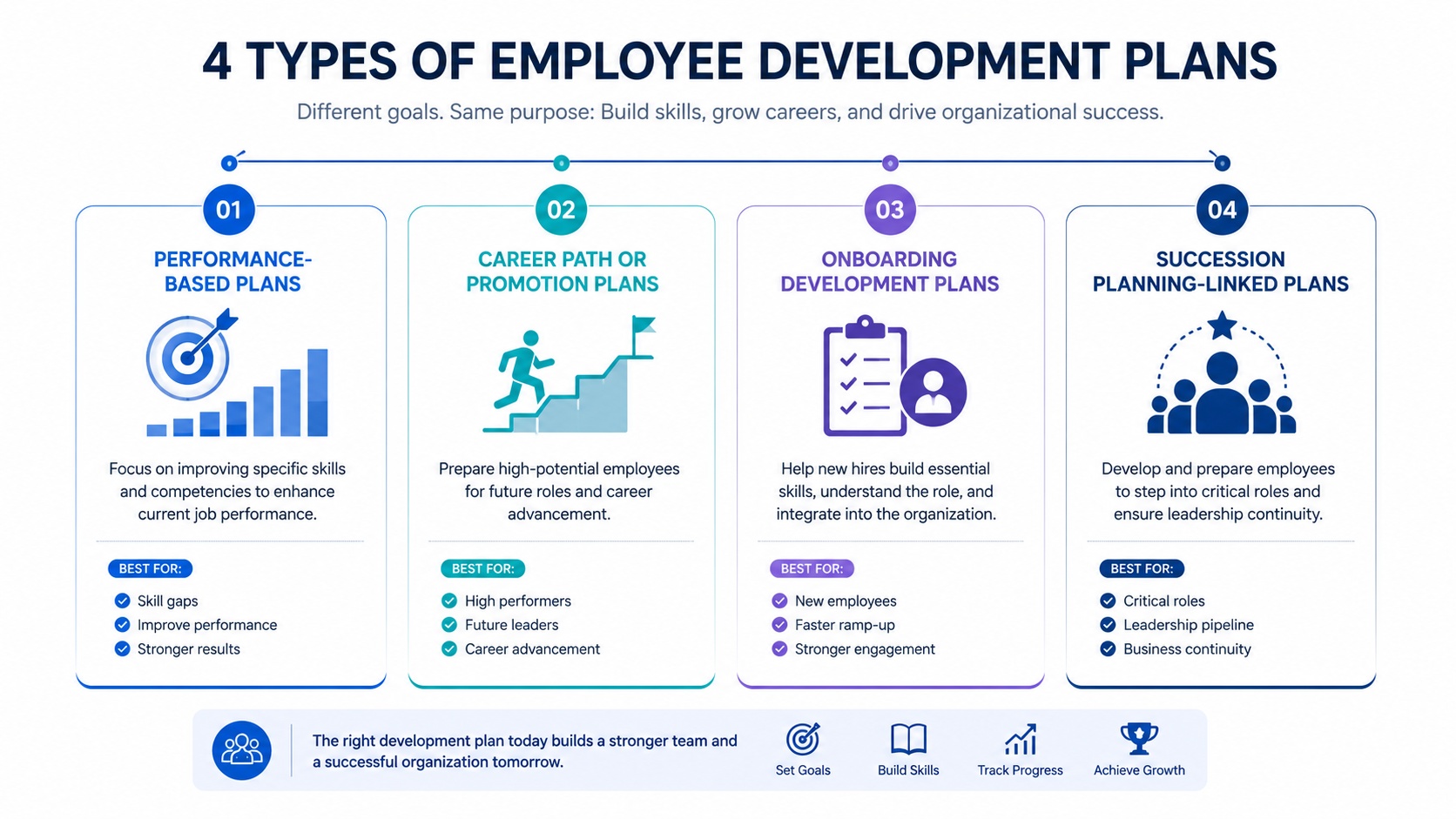
Not every development plan serves the same purpose.
1. Performance-Based Plans
These plans help employees strengthen specific skills or competencies.
Perhaps a project manager needs stronger stakeholder communication. Maybe a salesperson wants to improve negotiation skills.
The goal is improvement, not punishment.
2. Career Path or Promotion Plans
High-performing employees often need guidance on reaching the next level.
A development plan in this category may include leadership training, mentoring relationships, cross-functional projects, or increased responsibilities.
3. Onboarding Development Plans
New hires benefit from structured development during their first few months.
These plans combine role-specific learning with long-term growth discussions. Employees gain clarity about expectations while building confidence.
4. Succession Planning-Linked Plans
Organizations preparing future leaders often create a specialized growth plan for critical roles.
Exposure to strategic projects, executive mentorship, and leadership experiences typically play a central role.
What Does an Employee Development Plan Actually Look Like? (Real Examples)
Many articles discuss theory. Practical examples are far more useful.
Below are realistic employee development plan examples that show how development goals connect to business outcomes.
Example 1: Customer Support Representative to Team Lead
Goal: Move into a team leadership position within six months.
Skills to Develop:
- Coaching techniques
- Conflict resolution
- Performance feedback
Actions:
-
- Shadow current team leads twice monthly
- Complete leadership training
- Lead weekly team meetings
Success Metric:
- Positive leadership feedback from manager and peers
Example 2: Mid-Level Developer Upskilling in Cloud Architecture
Goal: Become capable of leading cloud migration projects.
Skills to Develop:
- Cloud infrastructure design
- Security best practices
- Cost optimization
Actions:
- Complete cloud certification
- Participate in migration initiatives
- Work with senior architects
Success Metric:
- Successfully contribute to a production migration project
Example 3: New Hire 90-Day Development Plan
Goal: Reach full productivity within three months.
Skills to Develop:
- Internal systems knowledge
- Product expertise
- Team collaboration
Actions:
- Weekly onboarding milestones
- Peer mentoring sessions
- Structured product training
Success Metric:
- Independent completion of core responsibilities
Notice how every development roadmap links personal growth to organizational value.
How to Create an Employee Development Plan in 6 Steps
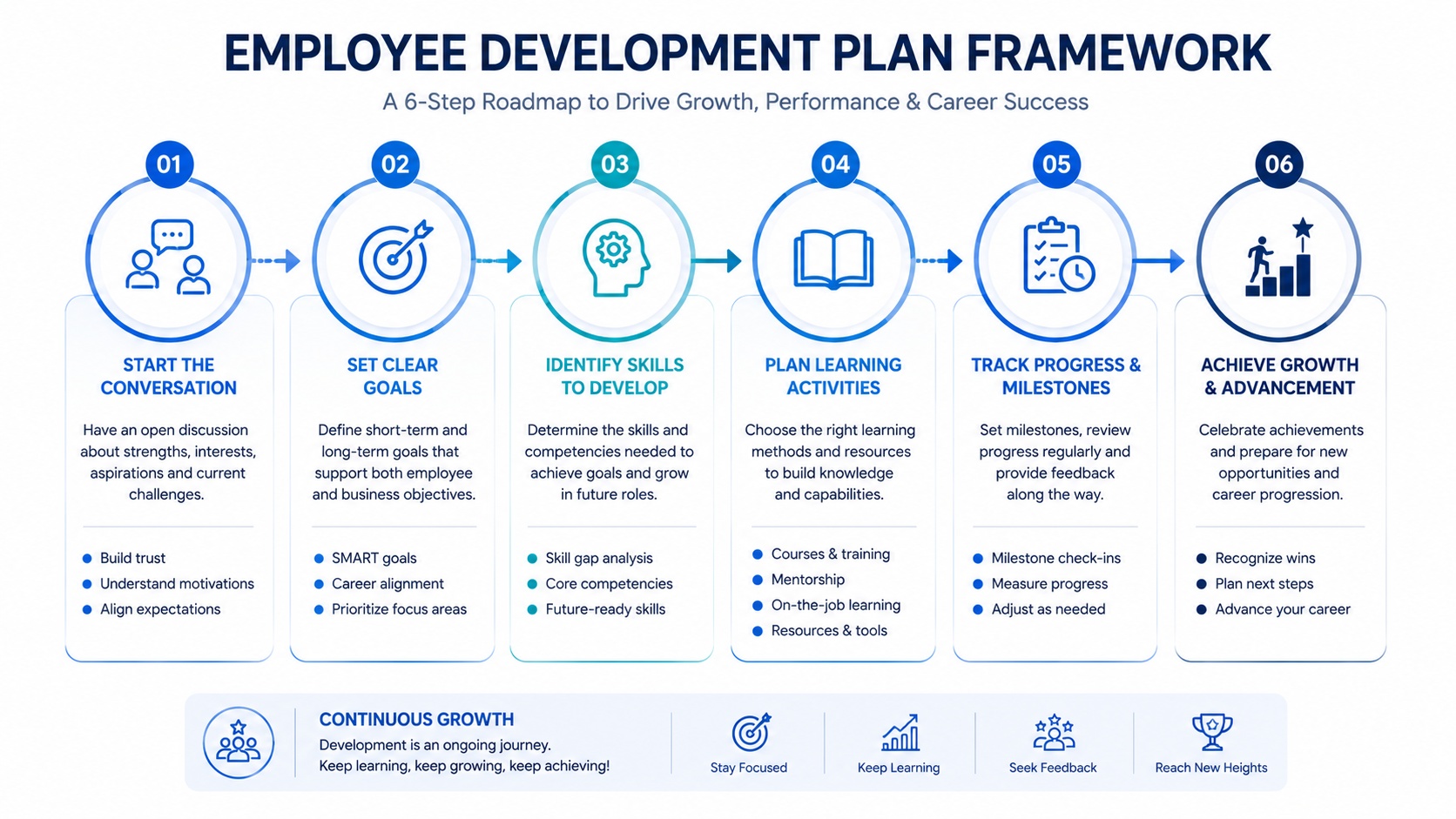
A strong plan starts with conversation, not paperwork.
Step 1: Start With a Real Conversation
The best development conversation begins with curiosity.
Ask questions such as:
- What skills would you like to strengthen?
- Where do you see yourself in two years?
- Which parts of your role energize you most?
- What challenges are holding you back?
Listen carefully before proposing solutions.
Step 2: Align Personal Goals With Business Needs
Development succeeds when employee interests and organizational priorities overlap.
Someone interested in leadership may benefit from managing projects. A future technical specialist may focus on advanced certifications.
That shared ground becomes the foundation of the plan.
Step 3: Set SMART Development Goals
A vague goal like “improve leadership” rarely works.
Instead, define measurable outcomes.
For example: lead three cross-functional projects within six months and receive positive feedback from stakeholders.
Specific goals make the plan easier to execute.
Step 4: Choose the Right Learning Methods
Different goals require different approaches.
Options include:
- Formal courses
- Mentorship
- Job shadowing
- Stretch assignments
- Self-directed learning
A strong professional development plan combines several methods rather than relying on training alone.
Step 5: Build Milestones and Check-Ins
Progress should not wait until annual reviews.
Monthly conversations often work well because they maintain momentum while leaving room for meaningful progress.
Small milestones also create opportunities to recognize achievements.
Step 6: Document It, But Keep It Alive
Documentation matters, but action matters more.
The development plan should evolve as goals change, new opportunities emerge, and priorities shift.
The document is only valuable if people actively use it.
Read More!
9 Characteristics of High Performing employees (Tips To Cultivate Them)
Common Mistakes That Make Development Plans Fail
Even well-intentioned plans can lose momentum.
One common mistake is creating an entire employee development plan without employee input. Ownership disappears when people feel decisions were made for them.
Another problem involves unrealistic goals. Ambition is helpful, but growth requires practical steps and achievable milestones.
Follow-through is equally important.
Many managers hold one planning meeting and never revisit the conversation. Months later, nobody remembers the original goals.
The one-size-fits-all approach creates additional challenges. Employees have different strengths, aspirations, and learning styles. Copying the same template for everyone rarely works.
Confusion between development plans and corrective performance processes can also undermine trust.
Finally, milestones deserve recognition. Progress fuels motivation.
How EmpMonitor Helps You Build and Track Development Plans That Actually Work
Creating a development plan is only the beginning. The real challenge is tracking progress and keeping goals visible amid daily responsibilities.
EmpMonitor helps managers monitor performance, identify growth opportunities, and support employee development with data-driven insights.
Key features include:
- Productivity Monitoring: Track productivity trends and work patterns over time.
- Activity Tracking: Understand how employees spend their work hours and whether development activities are receiving attention.
- Performance Reports: Use detailed reports to measure progress and support objective coaching discussions.
- Manager Dashboards: View individual and team performance from a centralized dashboard.
- Workforce Analytics: Identify skill gaps, productivity trends, and areas that may need additional support.
EmpMonitor complements the human side of development by providing the visibility and insights needed to keep growth plans on track.
The Deeper Reason Development Plans Work (And Why Most Skip It)
Growth is not only about skills.
People want to feel valued.
When organizations invest in employee growth, they communicate something powerful: your future matters here.
Psychologists often describe this dynamic as a form of reciprocal commitment. Employees who feel supported frequently become more engaged, motivated, and invested in organizational success.
The shift is subtle but meaningful.
Forward-thinking companies are moving beyond performance management alone. They are focusing on potential, capability, and long-term contribution.
Viewed through that lens, an employee development plan becomes a strategic advantage rather than an administrative task.
Start Small, But Start Now
The best development plan is not the most sophisticated one.
It is the one that gets used.
Many managers spend weeks searching for the perfect template while delaying the conversation that matters most. Employees rarely need perfection. They need clarity, support, and a realistic path forward.
Think back to the employee who quietly left because nobody invested in their growth.
Now imagine a different outcome.
A manager starts a genuine conversation. Goals are documented. Progress is reviewed. Skills improve. Opportunities appear.
That future often begins with a single discussion and a simple growth plan.
FAQ – Employee Development Plans Answered
What is the difference between an employee development plan and a performance improvement plan?
A development plan focuses on growth, learning, and future opportunities. A Performance Improvement Plan addresses performance deficiencies that require correction. One is growth-oriented, while the other is corrective.
How long should an employee development plan be?
Most plans range from one to three pages. Clarity matters more than length. The document should be detailed enough to guide action without becoming difficult to maintain.
Who is responsible for creating a development plan?
The strongest plans are collaborative. Managers provide guidance and resources, while employees contribute to their goals, interests, and ownership of their development journey.
How often should a development plan be reviewed?
Monthly or quarterly reviews are common. Frequent conversations help maintain momentum and allow adjustments when priorities change.
What should be included in a professional development plan?
A professional development plan typically includes goals, target skills, learning activities, timelines, milestones, and success metrics that define progress.