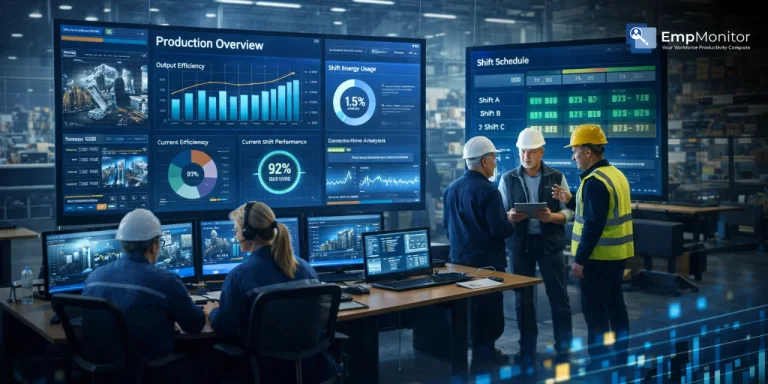
How one of the leading industrial equipment manufacturers in South Asia used EmpMonitor to fix broken shift accountability, eliminate ghost hours, and build a culture of work accountability across a 24/7 support operation.
Industry: Manufacturing / Industrial Equipment
Company Size: 240 employees (90 in support operations)
Work Model: Hybrid – On-site shifts + Remote support staff
Challenge: Shift accountability gaps, unverified work hours, poor cross-shift handoffs
Solution: EmpMonitor – Workforce Productivity & Employee Monitoring Suite
Results: 48% improvement in shift accountability | 31% reduction in support escalations | $120K saved annually
The Background: Running a Factory That Never Sleeps
One of the leading industrial equipment manufacturers in South Asia runs a support operation that mirrors its factory floor. It never stops. With machinery deployed across hundreds of client sites, their technical support team operates in rotating 8-hour shifts, 24 hours a day, 7 days a week. When a client’s production line goes down at 2 a.m., someone needs to be there digitally to answer.
For years, this model worked well enough. But as the company scaled and the support team grew to 90 personnel spread across three shifts, cracks in their work accountability framework began widening into something far more damaging.
Shift handoffs were inconsistent. Managers had no reliable way to verify who was actually working during overnight and weekend shifts. Accountability was assumed rather than enforced and assumptions, as they discovered, are an expensive foundation to build a support operation on.
“In manufacturing, downtime is money,” says the company’s Director of Operations. “Every minute a client’s machine is down because our support team dropped the ball is a minute that costs us a relationship. We needed accountability baked into the system, not hoped for.”
The Problem: Three Accountability Failures Hiding in Plain Sight
- Ghost Hours and Unverifiable Shift Attendance
Work accountability in shift-based environments lives or dies on one question: was the right person actually present and working during their assigned shift? For this manufacturer, the honest answer was that nobody really knew.
Shift attendance was tracked through a combination of manual sign-in sheets and self-reported digital logs. Both were easy to manipulate and hard to audit. Payroll consistently showed 100% shift coverage. Escalation logs told a different story. Response times during overnight shifts were significantly slower than day shifts, suggesting that “present” and “working” were not always the same thing.
- Shift Handoffs Were Breaking the Chain of Accountability
One of the most critical moments in any shift-based operation is the handoff, the point where one team passes active issues, pending tickets, and ongoing client situations to the next. In theory, this manufacturer had a handoff protocol. In practice, it was being followed inconsistently at best.
Open tickets were being dropped between shifts. Clients were calling back to report the same issue twice because the incoming shift had no record of the previous interaction. The accountability gap wasn’t just internal. Clients were feeling it directly.
- Managers Had No Real-Time Visibility Into Shift Performance
The operations manager responsible for overnight and weekend shifts had exactly one tool for monitoring shift accountability: a phone call. If something felt off, they called. If nobody raised a flag, they assumed things were fine.
This reactive approach meant problems only surfaced after they had already caused damage. A support engineer spending half their shift on non-work activity wasn’t discovered until a client complained. By then, the relationship was already strained.
“We weren’t managing shifts. We were hoping they managed themselves.”
The Turning Point: Why This Manufacturer Chose EmpMonitor
After a particularly damaging quarter, three major client escalations, two of which traced directly back to overnight shift failures, leadership initiated a formal review of their work accountability infrastructure.
They evaluated four workforce monitoring platforms over a month. EmpMonitor emerged as the clear choice for three reasons specific to their shift-based environment.
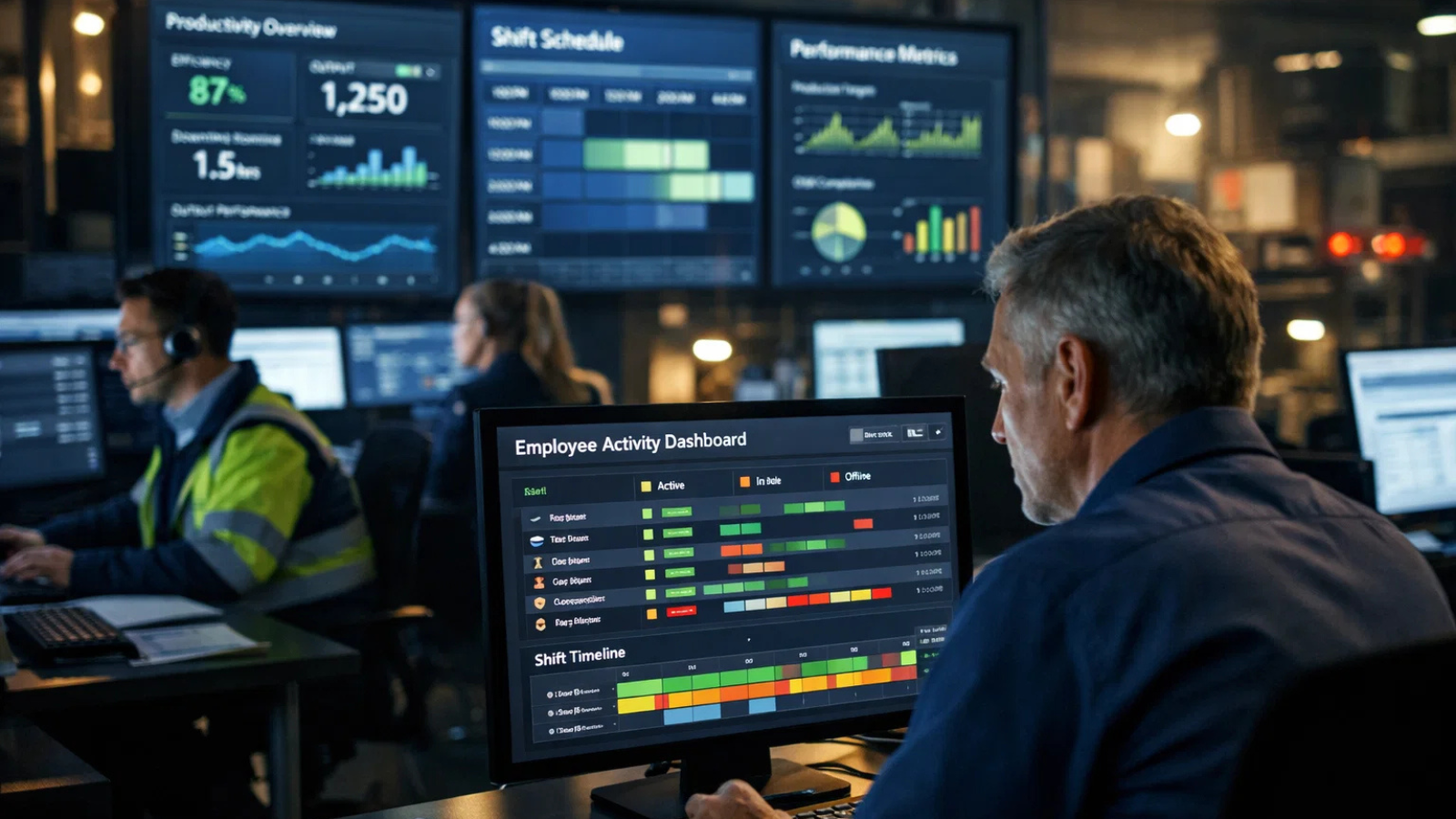
First, the real-time dashboard gave shift managers live visibility into every support engineer’s activity status, active, idle, or offline, without requiring a phone call or a message. For overnight managers monitoring remotely, this was transformative.
Second, EmpMonitor’s attendance automation could be configured around shift schedules, automatically flagging late logins, early logoffs, and extended idle periods during active shift windows. This turned shift accountability from a manual audit process into an automated, always-on system.
Third, the idle time tracking feature directly addressed the ghost hours problem. It couldn’t be fooled by a logged-in session with no activity and that distinction was exactly what this manufacturer needed.
Onboarding began in Q2 2024 across the entire 90-person support team.
The Implementation: Building Accountability Into Every Shift
Week 1 to 2: Transparent Rollout
Leadership was deliberate about framing the rollout correctly. An all-hands briefing for the support team made three things clear: what EmpMonitor tracked, what it did not track, and how the data would be used. The message was simple. This was about ensuring fair accountability across all shifts, not about catching individuals. Night shift and weekend staff, who had long felt overlooked compared to day shift teams, responded particularly positively. For them, the tool was a way to finally get credit for the work they were genuinely doing.
Week 3 to 4: Establishing Shift Baselines
The first month of data painted a detailed picture of shift performance across all three rotations. Day shift averaged 6.4 hours of active work per 8-hour shift. Evening shift averaged 5.8 hours. Night shift averaged just 4.3 hours, confirming the leadership’s suspicion that overnight work accountability was significantly lower than reported.
URL and application tracking revealed that non-work browsing spiked sharply between 1 a.m. and 4 a.m. on night shifts, a pattern invisible to any previous monitoring system but immediately clear on EmpMonitor’s dashboard.
Month 2: Redesigning Shift Accountability Systems
With hard data in hand, operations leadership made targeted changes. Night shift schedules were restructured to pair senior engineers with junior staff, improving peer accountability. Shift handoff checklists were made mandatory and their completion verified through EmpMonitor’s activity logs. If a handoff wasn’t completed, the system flagged it before the incoming shift took over.
Automated alerts were configured to notify on-call managers when any support engineer’s idle time exceeded 25 minutes during an active shift window. This created a real-time accountability loop that didn’t require managers to be physically present or constantly checking in.
Month 3: Reinforcing and Recognising
The company introduced a monthly shift accountability report generated directly from EmpMonitor data. Top-performing shift teams were recognised publicly in the company’s internal newsletter. Consistent underperformers received structured coaching conversations backed by specific data, not assumptions or anecdotes.
The cultural shift was as significant as the operational one. Accountability stopped being a word leadership used in meetings and became something the team could see, measure, and take pride in.
The Results: Accountability by the Numbers
| Metric | Before EmpMonitor | After 90 Days |
| Night Shift Active Hours | 4.3 hrs/shift | 6.1 hrs/shift |
| Shift Handoff Completion | ~60% | 96% |
| Client Escalations | Baseline | -31% |
| Payroll Accuracy | ~72% | 97% |
| Annual Savings | — | $120,000 |
Shift Accountability Improved Dramatically
Night shift active hours climbed from 4.3 to 6.1 hours, a 42% improvement in genuine on-shift productivity. Across all three shifts combined, overall work accountability scores improved by 48% within 90 days. The gap between day shift and night shift performance, which had been a persistent operational headache, narrowed to under 12%.
Handoffs Became Reliable
Shift handoff completion rates jumped from approximately 60% to 96%. Open ticket drop rates between shifts fell sharply. Clients calling back to report the same issue twice, a pattern that had become embarrassingly common, virtually disappeared. Client satisfaction scores for support interactions improved in the subsequent quarterly review for the first time in over a year.
Escalations Dropped Significantly
Major support escalations fell by 31% in the 90 days following full EmpMonitor deployment. Leadership attributed this directly to improved shift accountability. When support engineers knew their activity was visible and their handoffs were being tracked, the standard of care for each ticket improved measurably.
The Financial Case
Payroll accuracy improved from 72% to 97%, recovering significant overpayment that had been quietly leaking from the system for years. Combined with reduced client churn risk and lower escalation management costs, the annualised financial impact was calculated at $120,000, roughly 40x the cost of the EmpMonitor subscription.
“We didn’t just fix our night shift. We fixed our entire accountability culture. EmpMonitor made that possible.”
The Takeaway: Accountability Can’t Be an Assumption
For shift-based operations in manufacturing and industrial support, work accountability is not a soft cultural value. It is an operational requirement. When a client’s production line is down and your support engineer is supposed to be on shift, accountability is the difference between a resolved issue and a lost contract.
This manufacturer’s experience demonstrates what becomes possible when accountability stops being assumed and starts being measured. The changes EmpMonitor enabled weren’t punitive. They were structural. Better visibility led to better systems. Better systems led to better performance. And better performance led to better client outcomes.
In shift-based environments especially, the question is never whether accountability matters. It always does. The question is whether you have the tools to see it, measure it, and build on it.
EmpMonitor Features That Drove Shift Accountability
- Real-Time Dashboard – live shift visibility for remote managers without disruptive check-ins
- Attendance Automation – shift-specific tracking with automated alerts for late logins and early logoffs
- Idle Time Tracking – exposed ghost hours and inactive periods during live shift windows
- URL & App Tracking – revealed non-work activity patterns concentrated in overnight hours
- Automated Alerts – notified on-call managers of extended idle periods in real time
- Individual & Shift Reports – powered data-backed performance reviews and shift accountability scores
- Productivity Scoring – created a measurable, fair standard of work accountability across all three shifts
Ready to bring real work accountability to your shift operations? Visit empmonitor.com to start your free trial or book a personalized demo.
FAQs: Shift Accountability and EmpMonitor
Q1. How does EmpMonitor specifically improve shift accountability in round-the-clock operations?
It gives managers real-time visibility into every shift, who’s active, who’s idle, and who logged off early, without requiring constant manual check-ins. Automated alerts flag accountability gaps the moment they happen, not after the damage is done.
Q2. Can EmpMonitor detect ghost hours – employees logged in but not actually working?
Yes. Idle time tracking measures genuine active work time separately from logged-in time. A session left open with no activity is flagged automatically, making it impossible to claim work accountability that isn’t there.
Q3. Does EmpMonitor work across different shifts and time zones simultaneously?
Absolutely. The real-time dashboard displays all active employees regardless of their shift window or location. Shift-specific reports can be generated independently, giving managers a clear view of each rotation’s performance.
Q4. How does it help with shift handoff accountability specifically?
Activity logs and task completion data provide a verifiable record of what was done during each shift. When handoff checklists are tied to EmpMonitor’s activity data, completion becomes trackable and gaps surface before the incoming shift inherits a problem.
Q5. What kind of results can a manufacturing support team realistically expect?
Based on real-world implementation, teams typically see measurable improvements in active shift hours within the first 30 days. Handoff completion rates, escalation volumes, and payroll accuracy all improve significantly within 60 to 90 days of consistent use.