Twelve billion working days vanish each year due to anxiety and depression at work, costing US$1 trillion in lost output (Source: World Health Organization). The sisyphus meaning myth teaches that work can feel endless and absurd, yet you can still live and work with purpose. Here’s the answer up front: Sisyphus shows that struggle itself can become meaningful when you choose your stance toward it, even when outcomes reset to zero.
In 2026, that lesson lands close to home. However, the myth is not only about pain. It is also about craft, focus, and a clear-eyed choice. Moreover, it hints that how you frame the task may matter more than the task itself. Therefore, if your day feels like rolling a stone that slides back, this guide will help you read the story, correct common myths about the myth, and turn that image into a tool.

Who Was Sisyphus and What Does the Myth Mean?
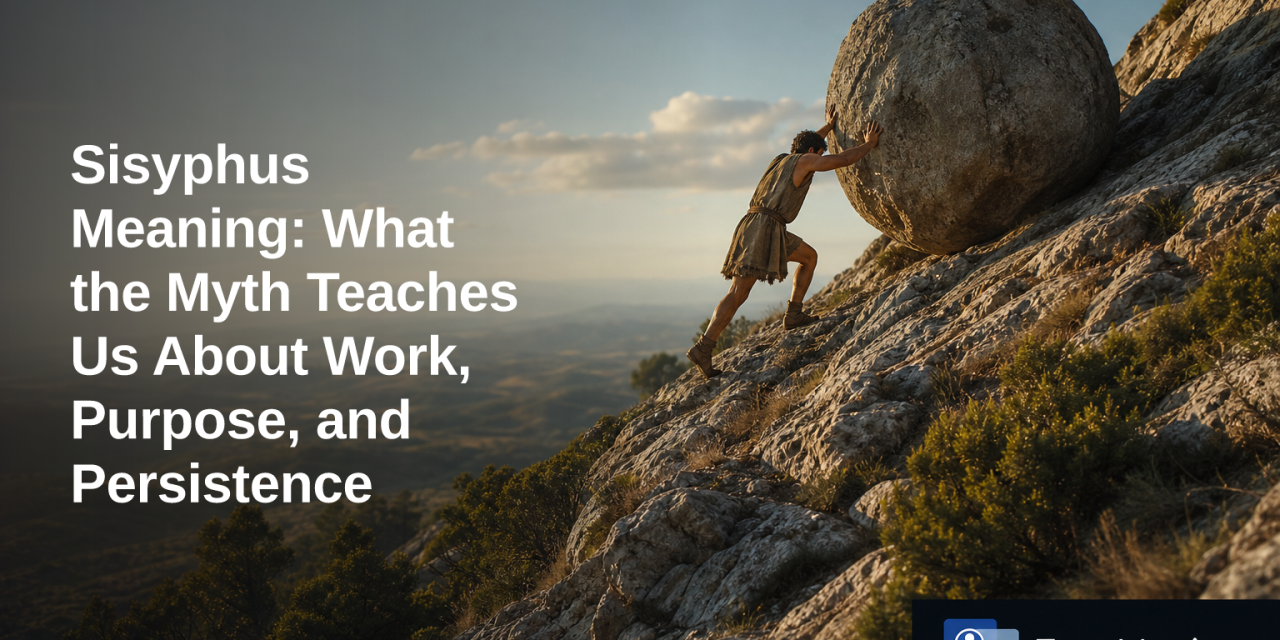
Sisyphus, in Greek myth, was the shrewd king of Corinth. According to Wikipedia’s Sisyphus entry, he crossed the gods by breaking oaths, exposing Zeus’s secrets, and cheating death more than once. As a result, Zeus sentenced him to an exacting task: push a huge stone up a steep hill, only for it to roll down each time he neared the top.
At first read, the punishment sounds simple: labor without end. However, the details add bite. Specifically, the gods chose a task with no finish line, no harvest, and no audience. Moreover, the hill does not change, the rock does not shrink, and the goal always slips out of reach. Therefore, the core meaning centers on futile, repetitive labor, the sort of grind that drains spirit because it erases progress.
Yet the story also points to Sisyphus’s nature. He once bound Thanatos (Death), halting mortality until Ares intervened. He also tricked Persephone into letting him return to life. In fact, he was not a passive figure swept along by fate. He was clever, proud, and defiant, and that color changes how you read the scene on the slope.
- The punishment: roll a boulder uphill forever, losing the gain at the brink.
- The cause: hubris, deceit, and defiance toward the gods’ order.
- The image: repetitive effort stripped of visible progress.
- The hint: an active mind trapped in a closed loop.
Therefore, the sisyphus meaning myth teaches at its core is this: repeat work without end can feel like nothing, yet the person inside the loop still chooses how to face it.
The Hill, the Rock, and the Reset
The hill stands for hard constraints you can’t move. The rock is the task load. The reset is the part of work that undoes itself. However, the stance belongs to you.
How to Understand Sisyphus: From Ancient Myth to Modern Philosophy
You can read the story through four useful lenses. First, the Greek world saw it as divine justice that fits the crime. Second, Albert Camus recast it as a guide to living in an absurd world. Third, existentialists read it as a case study in choice and meaning. Fourth, modern readers use it as a metaphor for burnout and dull loops at work.
From the Greek lens, the gods tailor punishments to mirror faults. Because Sisyphus sought to outsmart fate, his work now mocks that impulse. As a result, every gain reverses. However, the story does not argue that all work is pointless. Instead, it warns that pride without bounds meets a counterforce.
From Camus’s 1942 essay “The Myth of Sisyphus” (see Wikipedia’s overview), the world itself lacks fixed meaning. Therefore, meaning is not found; it is made. Camus ends with the line, “One must imagine Sisyphus happy.” In other words, the act of pushing, done with lucid defiance, becomes its own claim to dignity. Moreover, he locates the key moment in Sisyphus’s walk back down the slope, the instant of awareness before he starts again.
From the existentialist lens (Sartre, de Beauvoir, and others), you are condemned to be free. You cannot escape choosing. Specifically, even refusal is a choice. Therefore, the myth shows that you assign value, project by project, day by day. As a result, you can frame tasks as practice, service, or craft, not only as chores.
Finally, in modern language, we call “Sisyphean” work the kind that resets: inboxes that refill, tickets that return, code that breaks after each patch. However, the metaphor deepens when you add Camus. The loop need not crush you if you learn to own the cycle, name the value, and redesign the task.
- Greek justice: punishment fits the fault.
- Camus’s absurd: choose joy in lucid revolt.
- Existential choice: you make the meaning.
- Modern work: redesign loops to reduce waste.
As a concise bridge: the sisyphus meaning myth teaches that the world may not hand you meaning, so you build it through the way you act inside your loops.
The Pause Before the Push
Camus spotlights the descent. However, that pause exists in your day too: between sprints, before a call, or after a deploy. Therefore, use it to choose your stance.
Also Read!
The Complete Guide to Flex Time: How It Works, Types, and How to Implement It
Common Misconceptions About the Sisyphus Story
A plain reading says “endless punishment.” That’s true but incomplete. In fact, the 20th‑century update flips the focus from the gods to the worker. Camus does not deny the pain. However, he claims Sisyphus can win the inner game by choosing how to face the task. Therefore, the myth is not only about doom; it is also about inner triumph.
Another oversight is to treat Sisyphus as a dull laborer. He wasn’t. Specifically, he was cunning and willful.
That matters because it suggests he keeps his mind even when his hands repeat. Moreover, a bright mind in a loop can still think, learn micro‑skills, and refine form. As a result, repetition can become practice rather than mere grind.
People also mix up futility with meaninglessness. A task can be futile in outcome terms and still matter in virtue terms. For example, a parent tidies a room that will be messy by night. The act can still show care, set norms, and shape a child’s sense of place. Therefore, impact resets do not erase value.
- Misconception: “It’s only about punishment.
- Clarification: Camus reframes it as a chance for inner victory.
- Misconception: “Sisyphus is passive.
- Clarification: He’s crafty; the stance is active, not slack.
- Misconception: “Futile means meaningless.
- Clarification: Meaning can live in craft, care, and choice.
- Misconception: “The message is nihilism.
- Clarification: The essay argues for making meaning despite the void.
As a result, the sisyphus meaning myth teaches not despair but agency. However, agency is not denial. It is a clear look at the hill, then a chosen push.
Two Truths at Once
The work can be both hard and humanizing. Therefore, your job is to remove needless loops and redeem the rest.
Recognizing Sisyphean Patterns in Modern Work and Life
Look for loops with three marks: the outcome resets, feedback is delayed, and effort is hidden. For example, that could be triaging the same low‑value tickets, re‑entering data across tools, or chasing approvals that stall each week. Moreover, your body will tell you: tight shoulders, dread before you start, and a sense of sliding back.
Practically, you can spot these patterns by reviewing where time piles up. Specifically, look for tasks with many restarts, unclear owners, or long idle gaps. However, data beats hunches. Tools like EmpMonitor can help by surfacing actual time sinks. It offers Productivity Measurement, Idle time tracking, and Automated time tracking, so you can see which tasks drain hours without clear returns.
In addition, it is used by 15,000+ companies across 100+ countries and tracks over 500,000 employees, and it’s GDPR compliant with SSL, Firewall, and IP allowlisting. As one reviewer put it, “EmpMonitor does one thing really well: it saves us time!”. Education Career Counsellor. Therefore, this type of data gives you a map to fix or reframe your loops before they burn you out.
“Simplified the management of the entire workforce by 80% in terms of workforce, time, and effort.” — Ashwin Kumar, Chief Project Coordinator
Beyond software, simple habits help. For example, keep a short daily journal: three lines on what you did, what rolled back, and what you learned. Moreover, run a weekly task audit to tag work as “practice,” “service,” or “waste.” As a result, you can cut waste, redesign service, and enjoy practice. Finally, build a small philosophy list. Camus’s essay, a chapter of Viktor Frankl, and a page of Marcus Aurelius, to train your stance.
- Track: use automated logs to see loops as they are.
- Journal: note resets and micro‑wins each day.
- Audit: cut or fix steps that restart work.
- Read: keep ideas near to guide your frame.
Therefore, the sisyphus meaning myth teaches you to combine data with mindset. You need both the map and the meaning.
Make the Invisible Visible
What you can see, you can change. However, what you can’t see will repeat.
What to Do Next: Finding Meaning in Repetitive Work
Start where you stand. First, run a quick audit of the past seven days. List top tasks and star the ones that reset.
Second, apply Camus’s reframing: name why each starred task still matters, skill, service, or signal. Third, eliminate or automate true waste. Fourth, pick one loop to redesign this week, then ship a small change.
For reading, choose one clear source and finish it. Read The Myth of Sisyphus (1942) and write three lines on what “the descent” means for your workday. Moreover, try a “one rock” morning: do one deep task before you open chat or email. As a result, the day starts with a chosen push, not a slide.
 , Small Change; minimalist design)
Therefore, the sisyphus meaning myth teaches a two‑part move: cut needless loops and claim the rest with craft.
- Step 1: Audit one week for reset‑heavy tasks.
- Step 2: Reframe each task’s value in one line.
- Step 3: Remove or automate waste this week.
- Step 4: Read Camus and mark your “descent” moments.
A Small Win Beats a Grand Plan
Pick one loop. Fix one step. However, be strict about finishing.

Key Takeaways
- The sisyphus meaning myth teaches that repetitive labor can feel futile, yet meaning comes from the stance you choose.
- Camus’s “One must imagine Sisyphus happy” points to inner victory: lucid effort despite the reset.
- Not all loops are equal: cut waste, redesign service work, and treat the rest as practice.
- Data plus reflection works: time tracking, a brief journal, and a weekly audit reveal real time sinks.
- In 2026, you can pair practical tools with a clear frame to make hard work humane.
What to Do This Week
Block 45 minutes. Map your top five loops, mark one as “fix now,” and ship one change that reduces resets by Friday. Then, during your “descent” moments, the walk back between cycles, name one reason your push still matters. In addition, bookmark a short reading for next week. As a result, your hill stays the same, but you won’t.
**Get started instantly today →
Moreover, remember this in 2026 and beyond: the hill is steep, the rock is heavy, and your choice still matters.