
A real-world case study showing how a growing distributed team improved productivity, accountability, and workflow clarity.
Company Background
A mid-sized digital marketing agency with a fully distributed team of around 60 employees was experiencing rapid growth. The team operated across multiple time zones, delivering services such as:
- Search engine optimization (SEO)
- Paid advertising campaign management
- Content marketing
- Social media management
The agency worked with dozens of global clients and handled multiple campaigns simultaneously. Remote work had always been part of the company culture, allowing the organization to hire talented professionals from different regions.
For a long time, the system worked smoothly. A smaller team relied on trust-based workflows, communication tools, and shared documents to manage projects.
However, as the organization expanded quickly, the leadership team began noticing operational gaps that were difficult to manage remotely.
What worked for a 20-person team was no longer efficient for a team of more than 60 people.
The Problem: Lack of Visibility in a Growing Remote Team

As the team grew, managers started facing several challenges related to productivity tracking, task ownership, and project coordination.
Without proper systems in place, small inefficiencies gradually turned into bigger operational issues.
Below were the key problems the organization faced.
No Real-Time Visibility
Managers had limited insight into how employees spent their work hours.
Most progress updates came through chat messages or weekly meetings. This meant leadership often discovered delays only after deadlines had already been affected.
Without clear visibility into employee activity, it was difficult to understand whether productivity issues were caused by workload, communication gaps, or distractions.
Missed Deadlines and Overlapping Work
Projects involved multiple team members across departments.
Because there was no centralized task management system, responsibilities were sometimes unclear. Employees occasionally worked on the same task without realizing it, while other tasks remained unfinished.
This lack of coordination led to delays and wasted work hours.
Attendance Confusion
Remote employees logged their work hours using different methods.
Some maintained spreadsheets while others sent updates through messaging apps. HR teams spent considerable time verifying attendance records and resolving disputes related to working hours.
This process became increasingly inefficient as the company grew.
Time Leakage and Productivity Gaps
An internal review revealed that a noticeable portion of the workday was being lost to non-work activities.
Employees occasionally spent time browsing unrelated websites or taking extended breaks, often without realizing how much productive time was being lost.
Because there was no system tracking daily activity patterns, these productivity gaps remained largely unnoticed.
Security and Data Monitoring Concerns
The company regularly handled sensitive client information including campaign strategies, advertising budgets, and analytics dashboards.
Without proper monitoring tools, managers had very limited oversight into how company systems were being accessed or used.
Leadership realized that stronger visibility and accountability were necessary to maintain both productivity and security.
Why EmpMonitor Was the Right Solution
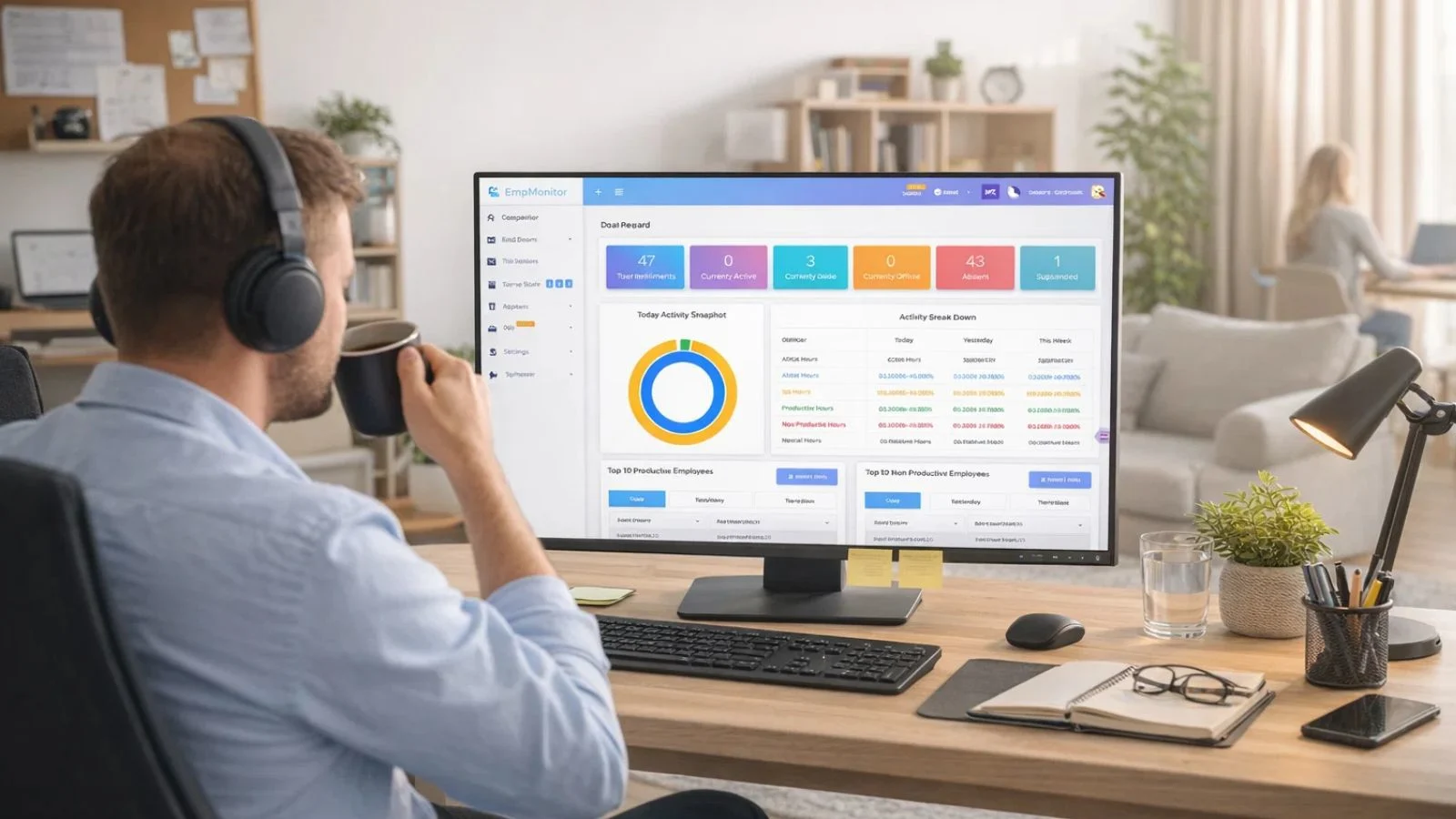
After evaluating several workforce management tools, the company decided to implement EmpMonitor.
The platform offered a combination of productivity monitoring, time tracking, attendance management, and project oversight within a single system.
Several factors made EmpMonitor the right fit.
Designed for Remote Teams
EmpMonitor works effectively for distributed teams that operate across multiple locations and time zones.
Managers could monitor productivity without needing employees to be physically present in the office.
Cloud-Based Accessibility
Because the platform operates through the cloud, managers could access activity dashboards and reports from anywhere.
This made it easier to supervise remote teams while maintaining flexibility.
All-in-One Workforce Management Platform
Instead of relying on separate tools for time tracking, attendance, and task management, EmpMonitor combined everything into a single platform.
This reduced complexity and simplified daily workflows.
The Solution: How EmpMonitor Improved Workflow
Once EmpMonitor was implemented, the company began using its features to solve several operational challenges.
Project Management
Problem: Tasks lacked clear ownership and deadlines.
Solution: Managers used the project management feature to assign tasks to specific team members and set clear deadlines.
Impact:
- Improved accountability across teams
- Reduced confusion around responsibilities
- Projects became easier to track and manage
Work Time Tracking
Problem: Managers lacked insight into how work hours were actually spent.
Solution: EmpMonitor recorded active and idle time throughout the workday.
Impact:
- Managers gained accurate productivity insights
- Employees became more aware of their time management
- Work patterns and productivity trends became easier to identify
Attendance Tracking
Problem: Attendance reporting was inconsistent and difficult to verify.
Solution: The system automatically tracked employee check-ins and check-outs.
Impact:
- Reliable attendance records
- Reduced administrative workload for HR
- Elimination of attendance disputes
Screen Monitoring
Problem: Managers had no visibility into workflow interruptions or distractions.
Solution: Screenshot monitoring allowed managers to observe work progress during office hours.
Impact:
- Reduced non-work screen activity
- Improved focus during working hours
- Better understanding of workflow challenges
Keystroke Monitoring
Problem: Sensitive data required stronger monitoring and oversight.
Solution: Keystroke activity logs helped administrators detect unusual activity patterns.
Impact:
- Early detection of risky behavior
- Stronger protection of client information
- Increased confidence in internal data security
Before vs After Implementing EmpMonitor
The impact of EmpMonitor became noticeable within the first few months.
Before EmpMonitor
Limited visibility into daily work
Managers depended on manual updates and frequent meetings to track project progress.
Frequent project delays
Tasks sometimes overlapped or were unintentionally ignored.
Inconsistent attendance records
Employees used different methods to report their working hours.
Productivity gaps
A portion of the workday was lost to distractions and untracked activities.
Managers spent excessive time on follow-ups
Team leaders often chased updates instead of focusing on strategic tasks.
After Implementing EmpMonitor
Real-time productivity insights
Managers could instantly see activity levels and work patterns.
Clear task ownership
Projects were structured with defined responsibilities and deadlines.
Automated attendance tracking
Employee work hours were recorded automatically and accurately.
Improved focus and accountability
Employees became more mindful of how they used their time.
Managers regained valuable time
Leadership could focus on planning, team development, and client relationships.
Also Read
Remote Team Productivity Challenges — and How EmpMonitor Solved Them
Results and Measurable Improvements
Within six months of implementing EmpMonitor, the organization experienced noticeable operational improvements.
Key results included:
- 38 percent improvement in on-time project delivery
- 55 percent reduction in weekly overtime hours
- 40 percent improvement in attendance consistency
- 40 percent reduction in time spent by managers on manual follow-ups
- 27 percent improvement in overall productivity scores
Better coordination and improved workflows also contributed to higher client satisfaction.
Team Feedback
One senior operations manager described the transformation in simple terms.
“Our team was always skilled and hardworking. The challenge was that we didn’t have full visibility of our distributed team to know how work was actually happening across different locations. EmpMonitor gave us that clarity. Once we had real data, it became much easier to manage projects and support our team.”