
Why Some Companies Fill Roles Faster Than Others
Most hiring delays aren’t caused by a lack of qualified candidates. They’re caused by broken processes. When teams wait for roles to open before sourcing talent, or run candidates through five approval rounds, the best people accept other offers long before a decision gets made.
The average time-to-hire across industries hovers between 30 and 45 days. For specialized or senior roles, that number climbs higher. Meanwhile, top candidates typically stay on the market for 10 days or less. That gap is where companies lose.
Reactive recruiting – posting a job, waiting, then screening – was never efficient. It just worked when the competition was lower. Strong recruiting strategies today look fundamentally different. They’re built around pipelines, not postings.
Read Aloud!
Recruiting Strategies That Consistently Reduce Time-to-Hire
Build a Talent Pipeline Before Roles Open
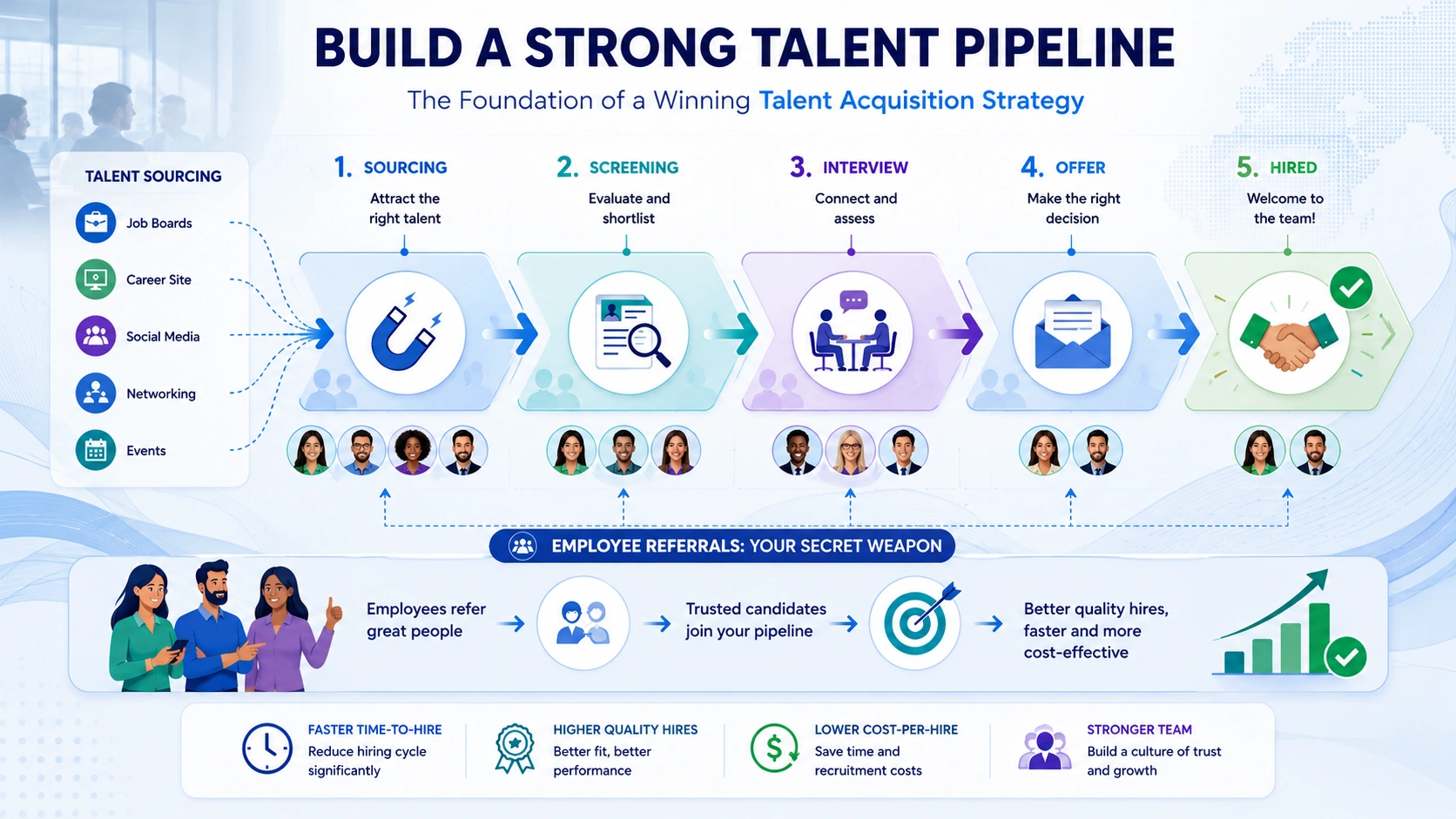
The companies that hire fastest rarely start from zero. They maintain active talent communities – groups of pre-screened candidates who’ve expressed interest in the organization. Smart recruiting strategies always account for pipeline health, not just active openings.
A solid hiring pipeline means that when a role opens, you already have three or four viable candidates to contact. This is the foundation of any talent acquisition strategy worth building. Maintaining a candidate database, sending occasional updates to past applicants, and nurturing passive connections can cut initial sourcing time by half.
Turn Employee Referrals Into a Hiring Engine
Referrals consistently outperform every other sourcing channel on speed and quality. Employees know the culture, understand the role requirements, and only refer people they’d personally vouch for. That informal pre-screening eliminates a significant portion of early-stage effort.
Build a referral program with clear incentives tied to successful hires, not just applications submitted. Companies with active referral programs report up to 55% faster hiring for referred candidates compared to job board applicants. Among all recruiting strategies, referrals deliver the most immediate results.
Use Skills-Based Hiring Instead of Credential-Based Hiring
A surprising number of job postings still require degrees, certifications, or years of experience that have no real bearing on job performance. These arbitrary filters shrink the candidate pool unnecessarily and slow down evaluation.
Skills-based hiring focuses on what a person can actually do. Structured work samples, short assessments, or practical tasks replace credential checkboxes. This speeds up screening and often surfaces candidates who would have been screened out under traditional methods.
Improve Job Descriptions to Attract Better Applicants
Most job descriptions are written for internal clarity, not candidate attraction. They list duties instead of outcomes, bury compensation, and use internal jargon that external candidates don’t recognize.
A stronger job description answers three questions quickly: what will this person actually do, what does success look like in the first 90 days, and what’s the compensation range. Clearer expectations lead to better-fit applications and fewer screening calls that go nowhere.
For example, an administrative assistant job description should clearly outline the role’s responsibilities, required skills, and expectations so candidates can quickly determine whether the position is a good fit.
Create Recruiting Sourcing Strategies for Passive Candidates
Active applicants make up a fraction of the available talent market. The majority of qualified candidates aren’t browsing job boards – they’re employed, not actively looking, but open to the right conversation.
Effective recruiting strategies for passive candidates rely on LinkedIn outreach, industry communities, niche forums, and professional networks. Personalized outreach that references specific work or experience dramatically improves response rates. Generic messages get ignored. Targeted, research-backed messages get replies.
Automate Repetitive Recruiting Tasks
Resume screening, interview scheduling, and candidate status updates consume enormous amounts of recruiter time. Automating these tasks doesn’t eliminate the human element – it redirects recruiter attention toward higher-value work like building relationships and evaluating candidates.
The same applies to candidates, automation can also streamline their job search. Using an AI interview assistant can help them practise role-specific and behavioural interview questions, receive instant feedback, refine their responses, and build confidence before meeting hiring managers.
ATS platforms, scheduling tools, and AI-assisted screening can compress a multi-day coordination process into hours. For teams handling volume hiring, automation can reduce time-to-hire by 30% or more. This is one of the fastest-scaling recruiting strategies available to modern hiring teams.
Strengthen Your Employer Brand
Candidates research companies before applying. If your career page is outdated, your Glassdoor reviews are poor, or your social presence is nonexistent, qualified candidates self-select out before you ever see them.
Employee stories, authentic content about culture, and transparent communication about what it’s like to work at your company all build the trust needed to convert passive interest into active applications.
Improve Candidate Experience at Every Stage
Slow response times, unclear next steps, and disorganized interviews signal to candidates that the company itself may be disorganized. Communication speed between stages matters more than most hiring managers realize.
Candidates who receive timely updates and clear timelines are more likely to stay engaged throughout the process. A poor experience, even for candidates who don’t get the role, affects referrals and reputation.
Read More!
05 Tips To Create Effective Company Goals That Inspire Employee Engagement
A Simple Framework for Choosing the Right Recruiting Strategy
Different hiring goals call for different approaches. Using the wrong recruiting strategies wastes time and resources.
If you need immediate hires: Lean on employee referrals, internal mobility, and fast-track interview formats. Eliminate unnecessary screening steps. Get from first contact to offer in under two weeks, where possible.
If you need specialized talent: Direct sourcing, talent mapping, and industry community engagement work best. Passive candidate outreach through highly personalized messaging typically outperforms job postings for niche roles.
For highly specialized or leadership positions, companies often turn to a dedicated executive search to identify and vet individuals who possess unique skill sets and experience. These firms have extensive networks and proprietary databases, allowing them to pinpoint candidates who may not be actively seeking new opportunities. They also handle the intricate process of initial screening, cultural fit assessment and confidential negotiations, freeing up internal resources. This approach ensures that even the most obscure or senior roles can be filled with precision, reducing the risk of a mis-hire in critical areas.
If you’re hiring at scale: Structured workflows, recruitment marketing, and automation become essential. Without systematic processes, volume hiring creates chaos that slows everyone down.
Real-World Applications of These Recruiting Strategies
Startups typically lack dedicated recruiting teams. The most effective approach combines referrals heavily, keeps interview stages lean (two to three at most), and leans into founder storytelling to build an employer brand quickly.
Mid-sized businesses often hit a growth phase where previous informal methods stop working. Introducing structured sourcing, a basic ATS, and a referral program creates enough process to scale without overcomplicating.
Enterprise teams need automation, structured workflows, and coordination between business units. Alignment between hiring managers and recruiters on role requirements is often the single biggest speed variable. At this scale, recruiting strategies must be documented and measurable to work consistently.
Remote and hybrid organizations face unique sourcing challenges since geography is no longer a filter. Expanding sourcing reach while maintaining a strong virtual candidate experience determines who accepts offers and who declines.
The Biggest Recruiting Mistakes That Slow Hiring Down
Waiting until a role opens to start recruiting guarantees a slow start. By the time sourcing begins, the position has already been vacant for days or weeks.
Using too many approval layers creates internal delays that candidates never see but always feel. Streamlining decision authority speeds up offers significantly.
Ignoring passive candidates limits the talent pool to whoever is actively searching at that moment. That’s a small fraction of qualified people.
Writing generic job descriptions attracts volume without attracting fit. More applications don’t mean better applications.
Measuring activity instead of results is common in recruiting operations. Calls made, resumes reviewed, and postings published don’t predict hiring outcomes. Time-to-fill, offer acceptance rate, and 90-day retention do.
Delaying candidate communication after interviews signals disinterest. Candidates move on quickly when they don’t hear back.
How EmpMonitor Supports Faster Recruiting and Hiring
Effective recruiting decisions start with understanding the workforce you already have. When hiring teams can see productivity trends, workload distribution, and emerging skill gaps, they can prioritize roles more accurately and recruit with greater confidence.
EmpMonitor provides workforce insights that help organizations align hiring efforts with real business needs. Instead of relying on assumptions, teams can use data to identify gaps, forecast workforce requirements, and support smarter recruitment planning.
Key EmpMonitor Features That Support Better Hiring Decisions
- Real-time productivity tracking to identify workload imbalances and understaffed teams.
- Workforce analytics and detailed reports that reveal performance trends across individuals and departments.
- Time tracking and attendance monitoring to understand resource utilization and staffing needs.
- Employee activity monitoring for visibility into daily workflows and operational bottlenecks.
- Project management capabilities that support workload planning and resource allocation.
- Multi-level reporting access that enables HR leaders and managers to make more informed staffing decisions.
The Future of Recruiting Strategies Is Faster, Smarter, and More Predictive
AI-assisted sourcing can now scan candidate databases and surface matches in minutes. Predictive hiring analytics help identify which sourcing channels produce candidates who stay longest. Skills-first recruiting is accelerating as credentials lose their value as proxies for capability.
Internal mobility programs are gaining attention as organizations realize that filling roles from within is almost always faster than external hiring. Companies that invest in mapping internal talent and creating pathways for advancement reduce external recruiting volume significantly.
One overlooked insight: companies that reduce hiring delays often outperform companies that simply increase applicant volume. Speed combined with quality creates a compounding advantage. Every fast, well-matched hire reduces the cost of vacancy and adds productivity sooner.
Final Thoughts: Faster Hiring Starts With Better Recruiting Systems
Hiring speed is an outcome, not a goal. It’s the result of well-designed sourcing, clear job requirements, efficient screening, and consistent communication. No single tactic produces it – a coordinated system does.
The strongest recruiting strategies work together. Talent pipelines feed referral programs. Skills-based hiring speeds up evaluation. Employer branding reduces the sourcing burden. Automation removes delays. Candidate experience keeps qualified people engaged long enough to accept offers.
If hiring feels slow, the answer rarely lies in posting to more job boards. It lies in auditing the current process, identifying where delays cluster, and fixing those bottlenecks systematically. Start there.
Frequently Asked Questions
What are recruiting strategies?
Recruiting strategies are systematic approaches organizations use to attract, source, screen, and hire qualified candidates. They range from building talent pipelines and improving employer brand to using automation and skills-based evaluation.
Which recruiting strategy helps hire the fastest?
Employee referrals consistently produce the fastest hires. Referred candidates skip early sourcing stages, arrive pre-vetted by someone who knows the culture, and typically convert at higher rates.
How does a talent acquisition strategy differ from recruitment?
Recruitment focuses on filling immediate open roles. A talent acquisition strategy takes a longer view – building pipelines, developing employer brand, and planning for future hiring needs before vacancies occur.
What are the best recruiting sourcing strategies for hard-to-fill roles?
For specialized positions, passive candidate outreach through LinkedIn, industry-specific communities, and professional networks works better than job board postings. Direct, personalized messages referencing the candidate’s specific experience significantly improve response rates.
How can small businesses improve recruiting without a large budget?
Referral programs, strong career page content, and streamlined interview processes are all low-cost improvements. Keeping the process fast and communicating well with candidates also reduces drop-off without requiring additional spend.