
Does your career grow from daily maintenance tasks or from productive moments spent on continuous learning? Many people choose to acquire new information in gaps and focus on the daily productivity flow and microlearning. For example, you can use part of each day to acquire a new small skill, read a nonfiction book summary to gain new insights, and think analytically about your work and everyday tasks.
What’s more, employees who engage in structured skill-building during the week maintain a higher focus score than those who do not. We combined these findings with research and data from educational podcasts to identify what actually changes daily learning behavior. Improving your daily productivity may rely on microlearning and on these small, deliberate shifts in how you handle information.
1. ‘Atomic Habits‘ by James Clear: You can attach learning to an existing work action
James Clear defines a habit as a behavior tied to a stable cue. A cue is a repeatable action. When learning is paired with a cue, it requires less mental effort to begin. He explains that you can pair a new habit with a current one, like reading a technical article while you drink your morning coffee. You try to apply such methods and even use the A/B testing approach with hypotheses, apply Google Sheets, Data Analytics, factor analysis, charts, and build a custom formula for improving your learning routines with such daily activities.
Habit formation consistency matters more than duration. It is also about short learning actions repeated daily, which yield higher adherence than longer sessions done irregularly. This method uses existing brain pathways to anchor new behaviors. It prevents you from forgetting your goals when work gets busy. By automating these small actions, you protect your daily productivity from the drain of making too many decisions.
2. ‘Deep Work‘ by Cal Newport: You can protect learning from interruptions
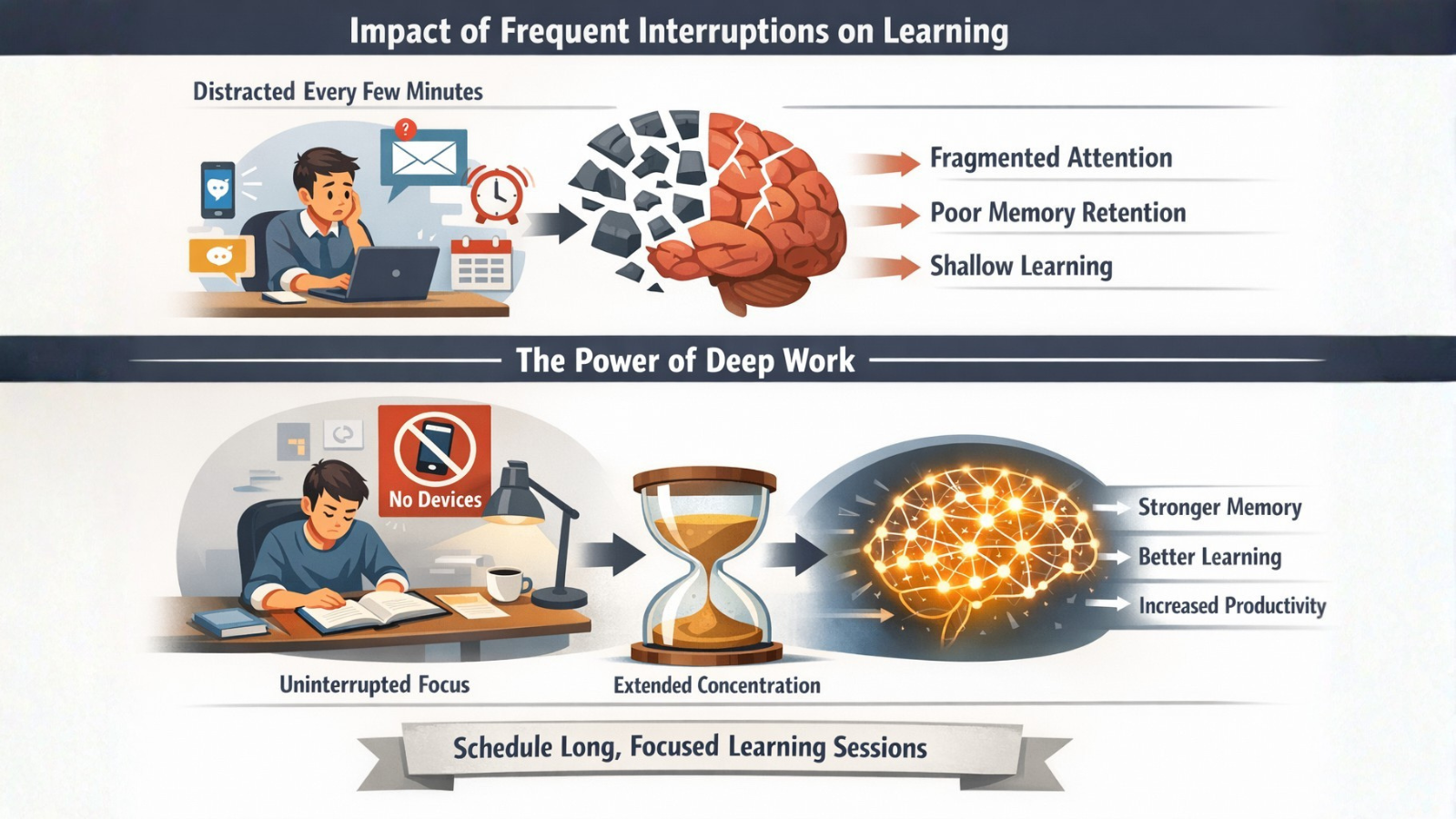
‘Deep Work’ explains how accidental distractions impact our ability to focus and why learning needs to be scheduled with long periods of dedicated concentration (without interruptions).
To protect your cognitive abilities and maintain focus, you can allocate more time to developing new skills and acquiring knowledge without distractions from electronic devices.
Cal Newport describes focused work as time without task switching. Task switching occurs when attention moves between activities, even briefly. You can also find a time slot during the day to devote to focused learning with your phone out of the room. If possible, give yourself adequate time to develop a skill or find hobbies to pick up that require mental effort, such as programming or new language acquisition.
Impact of Frequent Interruptions on Sustained Attention and Learning
When individuals work an average of 8 hours per day, they may be redirected from their primary task approximately once every 2 minutes by notifications from meetings, text messages, or applications. These frequent interruptions fragment attention by forcing repeated task switching.
Cognitive psychology suggests that forming durable memories and learning effectively requires sustained, uninterrupted attention for several minutes at a time. Frequent interruptions disrupt this process by preventing information from being sufficiently encoded into long-term memory. As a result, when learning occurs alongside constant notifications or task switching, much of the acquired information is more likely to be forgotten shortly after the learning experience concludes.
3. ‘The 5 AM Club‘ by Robin Sharma and ‘Learning How to Learn’ by Barbara Oakley: Combining Concepts with Microlearning
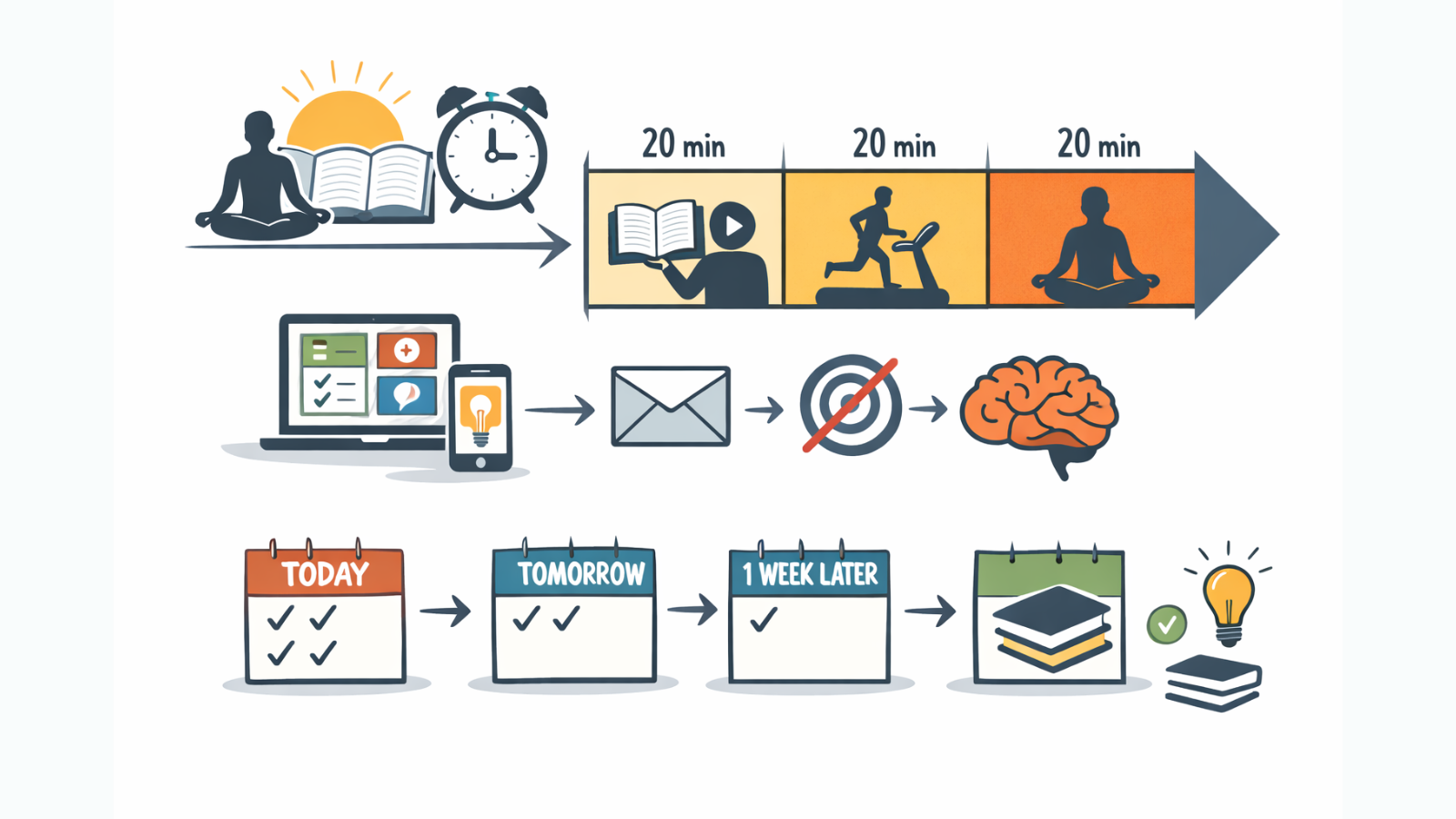
You can improve your daily productivity by focusing on microlearning, which involves learning in small chunks. You can use LMS platforms with segmented microlearning sections or use tools for personal use and scheduling. You can use the 20/20/20 rule to structure the start of your day. In ‘The 5 AM Club’, Robin Sharma explains it as a simple 60-minute block split into three equal parts:
- Spend the first 20 minutes on personal growth: This can include reading a leadership book, reviewing a learning summary, or watching a short tutorial related to your current role.
- Place learning before email or messaging apps: Early learning improves task initiation and reduces procrastination later in the day.
- Keep the session short and specific: Research shows that brief, focused learning sessions improve attention more reliably than longer, irregular study periods.
You can also use “Spaced Repetition” to keep what you learn. Barbara Oakley explains that your brain needs time to strengthen the synaptic connections formed during study. If you learn a new software shortcut, use it three times today, then once tomorrow, and again in a week. This technique transfers information from short-term to long-term memory.
4. ‘The Power of Habit‘ by Charles Duhigg: You can trigger learning automatically
You can change your workday by identifying your Habit Loop. Duhigg notes that every habit has a cue and a reward. If you find yourself scrolling through social media when you’re bored, try replacing that scroll with a 5-minute educational video. You get the same break from work, but you gain a new skill. You can use this framework to turn learning from a chore into an automatic response. When you understand the mechanics of your behavior, you stop fighting against your willpower.
- Identify the Cue: Find the specific trigger that leads to a distraction. For example, you might notice that every time you finish a difficult task, you feel a restless urge to check your phone. Boredom or mental fatigue is the cue.
- Insert a New Routine: You can keep the same cue but swap the action. Instead of opening a social media app, you can choose to open a bookmark for educational podcasts. The action changes, but the timing stays the same.
- Define the Reward: Your brain needs a payoff to lock in the new habit. If the reward for social media is a “mental break,” ensure your learning routine also provides that. A short, interesting video provides a sense of accomplishment, which acts as a stronger dopamine reward than mindless scrolling.
5. ‘Essentialism‘ by Greg McKeown: Narrow learning topics
You can choose to say no to “good” opportunities, so you have time for “great” ones. McKeown argues that most activities are noise and only a few things have value. Apply this to your learning by picking one specific skill to master each month. This focus stops you from feeling overwhelmed by too many options:
- You can look at your list of interests and identify which ones are just wasting your time. For example, trying to learn three different programming languages at once usually results in zero mastery.
- You can choose one “keystone” skill that makes other tasks easier or unnecessary. If you master data analysis, your reporting time drops, which directly increases your daily productivity.
- Essentialism encourages you to leave a 10-minute gap after one learning session to sit and think. This reflection time is where the real learning is consolidated.
6. ‘Mindset‘ by Carol S. Dweck
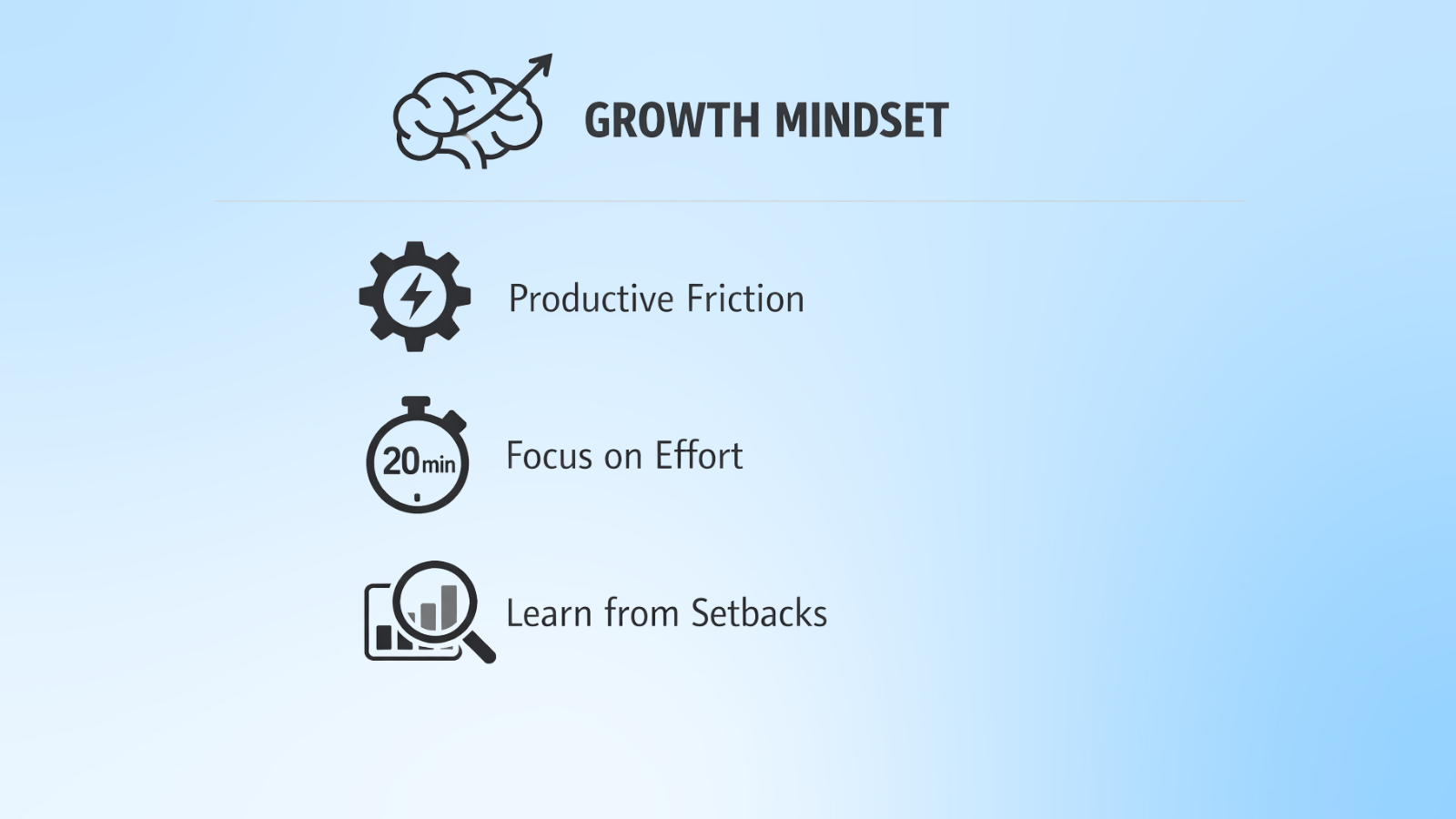
In the context of daily productivity, Carol Dweck’s research focuses on the “Growth Mindset,” which is the belief that your basic qualities and intelligence are things you can cultivate through effort. This contrasts with a “Fixed Mindset,” where you believe your traits are carved in stone. Dweck’s work shows that your internal monologue about your abilities determines how you handle challenges and how much you eventually achieve.
You can use this perspective to view a learning routine as a tool for neuroplasticity, which is the brain’s ability to reorganize itself by forming new neural connections throughout life. When you understand that your brain physically changes when you struggle with a new task, you stop viewing difficulty as a sign of low ability:
- Reframe the struggle: You can treat the frustration of learning a new software or language as “productive friction.” Students who are taught that the brain is like a muscle show higher motivation and better results than those who believe intelligence is static.
- Focus on the process: You can shift your goals from “results” to “effort.” Spend 20 minutes practicing. This change reduces the performance anxiety that often causes people to quit their routines.
- Analyze setbacks: When your daily productivity drops, a Growth Mindset allows you to look at the data without judgment. You can use tools to see where your focus broke and adjust your routine, rather than deciding you are simply “not a productive person.”
Finalizing Your Growth Strategy for Higher Output
Reading for just 10 minutes can reduce stress, which, in turn, lowers cortisol levels and improves mental clarity throughout your workday. Incorporating a learning routine is a practical way to maintain your mental health while improving daily productivity. You can start this process by selecting one nonfiction book and reading it for 20 minutes per day.
By tracking your activity, you can see how these new habits influence your output. Consistent data provides a clear picture of your peak performance times, helping you decide when to schedule your learning.
Acquiring new information keeps your brain flexible and improves your ability to solve complex problems. Moving from a reactive state to a deliberate learning routine ensures that you remain an asset in any industry. So, try focusing on one small change today to build a more sustainable, productive workflow for the future!