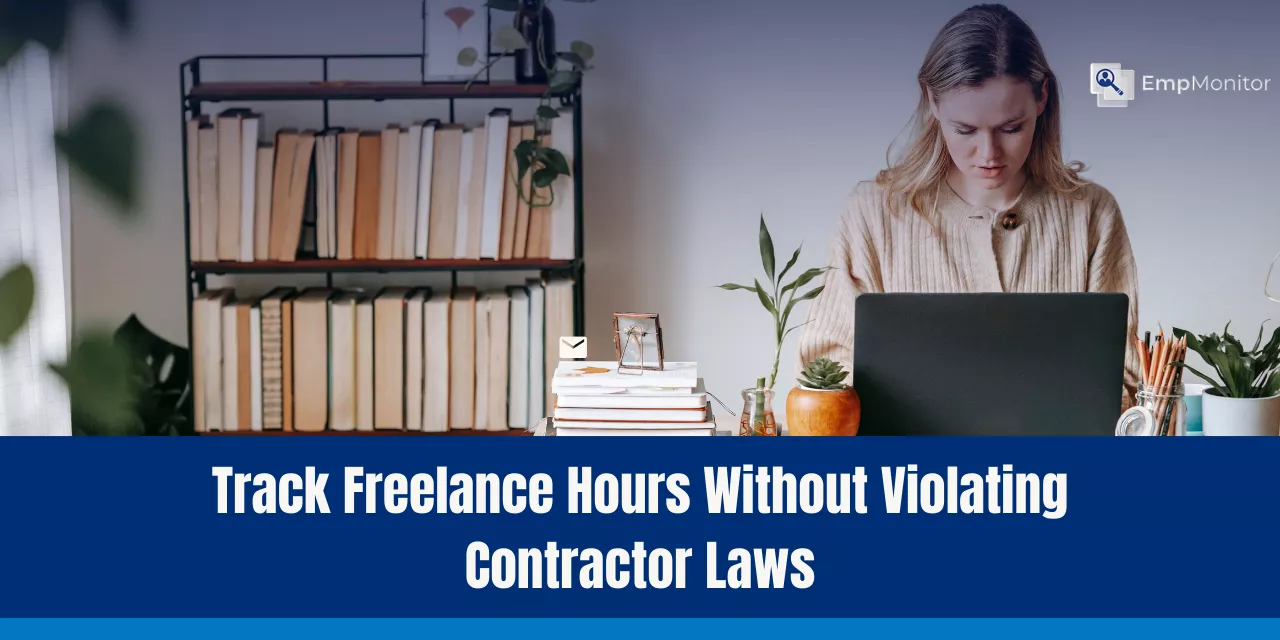
Instead of augmenting your workforce with freelancers as is done in many settings today, many organizations now consider contractors their primary workforce. This includes developers, designers, field consultants, and marketing professionals. While these individuals contribute to critical product delivery and client outcomes, one practical question keeps surfacing: how do you track freelance hours accurately without overstepping boundaries? More importantly, how do you ensure that when you track freelance hours, the process remains transparent, contract-based, and fully compliant with contractor laws?
It is important to understand that tracking freelancer hours is much more than an operational question; it is also a question of legality!
Freelancers are not employees; this distinction must be respected. If you treat a freelancer as an employee, and particularly if you monitor or control how they do their job like an employer would, you will likely experience misclassification action, exposure to compliance fines, and damage to your relationship with the freelancer.
Conversely, if you fail to accurately track freelance hours, you will face a myriad of issues, including billing & payment disputes, payroll leakage, misunderstanding regarding taxation, and cost overruns on projects.
So, your focus should not be on how often you incorporate tracking into your daily workflow; rather your focus should be to incorporate tracking into your workday in a manner that is legally compliant while respecting the independence of the contractor.
Let’s explore how to track freelance hours in a manner that safeguards your organization and preserves the independence of the contractors themselves.
Listen To The Podcast
Why Tracking Freelance Hours Is Legally Sensitive

Unlike employees, freelancers typically control how, when, and where they complete their work. Labor laws in many regions look closely at this autonomy when determining classification. If a company dictates strict schedules, requires constant supervision, or monitors minute-by-minute activity, regulators may interpret that as employee-level control.
That’s where businesses get into trouble.
The issue isn’t whether you can keep track of freelance hours. You absolutely can especially when paying by the hour. The issue is how you do it.
If your tracking methods:
- Restrict flexibility unnecessarily
- Demand constant real-time presence
- Monitor personal devices invasively
- Or blur the line between contractor and employee
…then you may be undermining the legal independence that defines freelance work.
Tracking hours is about documenting billable time not controlling behavior.
The Right Way to Track Freelance Hours
If you’re wondering how to track freelance hours without creating compliance risks, start with these core principles:
1. Focus on Deliverables First, Hours Second
Freelancers are typically engaged for outcomes. If a project can be structured around milestones or deliverables, that’s often safer and simpler than obsessively tracking time.
For hourly contracts, tracking is necessary, but it should support billing accuracy, not performance surveillance.
When you freelance keep track of hours based on project allocation rather than daily activity monitoring, you stay aligned with contractor independence.
2. Let Contractors Log Their Own Time
One of the safest approaches is self-reported time logging. Contractors record the hours spent on approved projects, and managers review or approve those logs.
This maintains:
- Flexibility in work schedules
- Contractor autonomy
- Clear billing documentation
You’re not watching every click. You’re simply verifying the agreed billable time.
3. Avoid Intrusive Monitoring
There’s a big difference between tracking hours and tracking behavior.
High-risk practices include:
- Mandatory webcam surveillance
- Continuous screen recording
- Keystroke tracking on personal devices
- Monitoring activity outside agreed work hours
These methods can blur legal boundaries quickly.
If you need verification for client billing or compliance reasons, use proportionate and transparent systems and only on company-approved devices when possible.
4. Use Transparent Time Tracking Policies
Clarity protects everyone.
Before you implement any system to keep track of freelance hours, document:
- What data is being collected
- Why it is collected
- How it will be used
- Who has access to it
- How long it will be stored
Freelancers should understand the purpose of tracking. If it’s for invoicing accuracy, say that. If it’s for client audit requirements, explain that. Transparency reduces friction and strengthens trust.
Also Read
Time Tracking Software For Freelancers: How To Use It To Boost Career In 2025?
5. Separate Attendance Tracking from Employment Control
Freelancers don’t need “attendance” in the traditional sense. They don’t clock in like employees unless the contract explicitly requires it.
If your tracking system resembles an employee attendance model fixed shifts, break enforcement, location policing regulators may question classification.
Instead, focus on:
- Project-based hour tracking
- Task-level time reporting
- Approved billing cycles
The structure should reflect a contractor relationship, not an employer-employee dynamic.
Common Mistakes Companies Make
Even well-meaning businesses can create risk when they track freelance hours incorrectly. Here are the most common pitfalls:
Treating freelancers like internal staff.
Requiring daily check-ins, mandatory availability windows, or strict schedule adherence may signal employment control.
Over-monitoring under the guise of productivity.
Tracking should justify billing, not evaluate loyalty or presence.
Using employee-only systems for contractors.
Some HR systems are built for payroll employees and may not align with freelance workflows.
Failing to document agreements.
If you expect freelancers to log hours, make sure it’s written clearly in the contract.
The safest approach is always proportionality. Track what’s necessary no more, no less.
Practical Methods To Keep Track of Freelance Hours

Here are compliant ways businesses successfully keep track of freelance hours:
• Project-Based Time Logs
Contractors allocate hours to specific projects or tasks. Managers approve them weekly or biweekly.
• Client-Approved Billing Systems
For agencies or consulting firms, time logs can feed directly into client invoices, creating transparency across all stakeholders.
• Geofenced or Site-Based Check-Ins (For Field Contractors)
If freelancers work at physical locations, geofencing can verify site presence without invasive monitoring. This confirms attendance at approved sites while maintaining autonomy.
• Periodic Work Snapshots (When Contractually Required)
In regulated industries, occasional verification may be necessary. The key is ensuring it’s contractually agreed upon and proportionate.
The goal is documentation not domination.
If your goal is to track freelance hours without crossing legal lines, the right software makes all the difference. The system you use should support documentation, transparency, and structured reporting not constant surveillance.
That’s where EmpMonitor can support compliant contractor management.
How EmpMonitor helps In Tracking Freelance hours

Instead of micromanaging, EmpMonitor helps businesses create structured, report-driven visibility that aligns with contractual agreements. You decide what to track, how to track it, and when it applies keeping the relationship professional and legally sound.
Here’s how EmpMonitor helps you keep track of freelance hours while maintaining autonomy:
- Automated Time Tracking (Contract-Based Configuration)
Freelancers log time against assigned projects or tasks. Tracking can be enabled based strictly on contractual terms, ensuring clarity and consent from the start. - Project & Task-Level Hour Allocation
Track hours per project rather than per minute of activity. This reinforces outcome-focused work instead of minute-by-minute supervision. - Custom Work Reports
Generate detailed weekly or monthly time reports that can be shared with freelancers for review and approval before billing promoting transparency. - Attendance & Location Logs (When Applicable)
For on-site or field-based contractors, optional location verification confirms presence without intrusive oversight. - Productivity Insights (Without Micromanagement)
View summarized work patterns and project engagement instead of invasive live monitoring. The emphasis remains on accountability, not control.
Legal Boundaries to Always Keep in Mind
When deciding how to track freelance hours, always ask:
- Does this system reduce the contractor’s independence?
- Are we controlling how they work instead of what they deliver?
- Would this tracking method apply to employees only?
If the answer raises doubt, simplify your approach.
Also remember: classification laws vary by country and state. What’s acceptable in one jurisdiction may create risk in another. Consulting legal counsel when designing your contractor tracking policy is always wise especially if freelancers represent a large portion of your workforce.
Balancing Accountability and Autonomy
Freelancers want fairness too.
They want:
- Accurate pay
- Clear billing cycles
- Transparent expectations
- Respect for their flexibility
When you freelance, keep track of hours in a structured yet respectful way, it actually strengthens relationships. Contractors appreciate clarity around billing. Clients appreciate documentation. Finance teams appreciate clean records.
Accountability doesn’t have to feel like surveillance.
It becomes problematic only when tracking shifts from verification to control.
Technology Can Help, If Used Correctly
Modern workforce management tools can simplify how to track freelance hours, but the setup matters more than the software itself.
The right system should:
- Allow self-logging of hours
- Support project-level tracking
- Offer optional verification for field work
- Integrate with billing or payroll systems
- Provide clear audit trails
Most importantly, it should allow you to configure rules differently for freelancers versus full-time employees. That separation protects compliance and maintains legal clarity.
Technology should reduce disputes, not create regulatory exposure.
Final Thoughts
Tracking the amount of work you do for freelance clients is essential. When you pay contractors hourly, you must keep records of the hours worked. Likewise, if you bill clients for your services, you will also need to keep records of the services rendered. Additionally, if you have many contractors influenced by different time zones or locations, tracking their hours is paramount for visibility into your project.
How you do it needs to have equal importance as if you do it.
To protect your freelancers while accurately tracking their hours:
- Focus on results
- Permit the contractor to have independence in performing their work
- Use an equitable, easy-to-read time tracking system
- Do not monitor them in an invasive manner
- Keep hours tracked for contractors separate from those tracked for employees
Time tracking is intended to be a way to promote fairness and productivity rather than to have control over those who work for you.
Freelancers are connected to each other and to their clients through mutual trust, and your time tracking system will help build upon that connection.
FAQs
- Can freelancers refuse time tracking software?
Yes. Since freelancers are independent contractors, they can decline time tracking software for freelancers that wasn’t agreed upon in the contract. Time tracking requirements must be clearly defined before work begins to avoid disputes. - Is manual time tracking legally safer than automated tracking?
Not necessarily. What matters is consent and contract clarity, not whether tracking is manual or automated. Any method used to track freelance hours should be proportionate and documented in the agreement. - How detailed should freelance time reports be?
Reports should reflect project progress and billable hours without monitoring unrelated personal activity. The goal is accountability for deliverables, not constant oversight.