
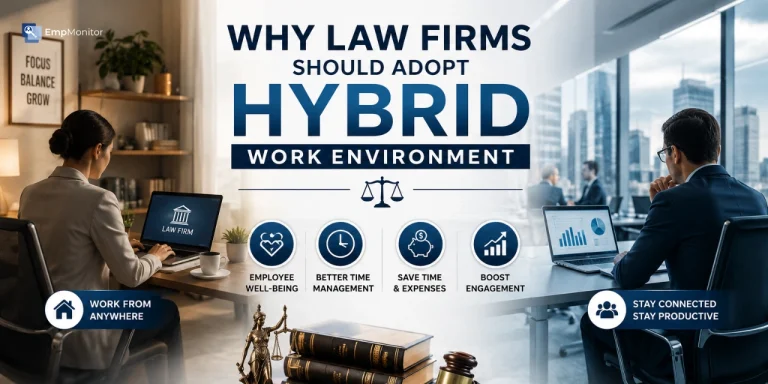
The legal industry is undergoing a significant transformation in how work gets done. Traditional office-based practices are giving way to more flexible work models that combine in-office collaboration with remote productivity.
Today, many law firms are embracing hybrid work environments to meet the evolving expectations of legal professionals while maintaining high standards of client service. This approach allows lawyers and support staff to split their time between the office and remote locations, creating greater flexibility without compromising efficiency.
As competition for top legal talent increases and workplace preferences continue to evolve, hybrid work has become more than a temporary adjustment—it is now a strategic advantage. Firms that successfully implement flexible work arrangements are seeing benefits such as improved employee satisfaction, better work-life balance, reduced operational costs, and enhanced productivity.
In this article, we’ll explore why hybrid work is becoming the preferred model for modern law firms and the key benefits it offers for both employees and organizations.
In a hurry? Listen to the blog instead!
Benefits Of Hybrid Work Environment-

From last year’s experience, law firms have noticed that employees can work agile, even when working from home. All the more with a bit more flexibility in the work pattern, it has become easier for employees to balance their work life more efficiently. Let’s know more about such benefits of remote work in the legal industry.
Employee Well Being-
If you see the current scenario, it is still not possible for law firms to start office work. With social distancing norms, there is a shortage of workspace where employees can work freely without having any safety concerns. Of course, employees’ well-being should be the priority for every organization. The ability to work from home brings them the comfort of working in a secure work environment where they can efficiently balance out their personal and professional interests.
Better Time Management-
Thanks to the flexible work environment in law firms, employees can efficiently manage their work time and complete their tasks ahead of deadlines. We have also noticed that with remote working options, employees can be more productive with their work. It gives them the ability to plan and customize their work hours, depending on their preferred hybrid work schedule. So, they can be more effective in balancing out the time between their personal and professional needs.
Commute Time & Expenses-
Usually, in the law industry, employees may also have to commute to different cities depending on their clients’ requests. Traveling such long distances puts extra physical and mental stress, which can be simply avoidable with the hybrid workforce. Moreover, it also helps them reduce their commute expenses since they can manage to do most of their tasks from home. On the other hand, if you see it from an employer’s perspective, hybrid work culture also reduces the expenditure on industrial infrastructure and maintenance costs.
Boost Employee Engagement-
By letting employees work remotely, such law firms are also showing their intent of trust towards their employees. And because of that, employees are also honest about their work and trying to give out their best for the business.
With all such benefits of the hybrid work environment, law companies are considering it to continue for some more time. In fact some leading experts also believe that this hybrid model of work culture seems to be the future of the law industry.
Read More:
What Is a Hybrid Work Schedule? Benefits, Types & Best Practices
Why Is Hybrid Project Management Trending In The Modern World?
Hybrid Model: Effect Of New Work Pattern-

The hybrid work pattern gives employees a choice where they have the flexibility to work from anywhere they want. It means that even while keeping the office work culture alive, lawyers do not really need to come to the office. As per their preferences, they can also do their work from home. Earlier, even those law firms who were not in favor of remote work are now considering hybrid models in their industry. Going by the facts and figures, before the pandemic, only 37% of law firm’s employees wanted to work remotely. But now, more than 76% of them are in favor of remote work.
If you see the female population, there has been huge satisfaction because of the new remote work pattern, especially because most of the working women have so many responsibilities to manage. They have to do household chores, child care, and many other things in their life. In the survey, compared to male employees, more female employees believe that this hybrid work model has really improved their work experiences.
Hybrid Workforce Responsibilities-
 With all the positives to the hybrid work environment (employee well-being, work-life balance, reduction in commute time and expenses, and better work engagement), there are also some challenges. In a recent event of CLOC, Mr. David Wilkins, Professor at Harvard Law University, said about the danger of employee burnout due to working remotely in isolation. Being a social animal, working alone seems to be a very difficult task, especially for law practitioners. Though technology is helping us to connect with each other, it simply can’t replace the water cooler chats of the workplace.
Therefore, we suggest you use remote monitoring software (like EmpMonitor) that can help you to enhance employee responsibility and transparency in your business. The EmpMonitor software gives you the ability to know whether your employees are engaged in their work activities or doing something else. With better work transparency, it becomes easier for law firms to motivate their employees so they can be even more efficient and effective in their work.
Hybrid Work Environment: The New Future-
By the things that are happening now, we may assume that remote work culture can be the new future of the law industry. But somewhere around the corner, people are also missing their office work life. Not to mention that with a hybrid work model, there is enough flexibility for employees to examine how the new method can be adjusted according to their comfort zone.
Like any other industry, law firms have also taken a huge blow because of the COVID-19 pandemic. However, by still using the technology, they are responding to the situation in a better way.
So what do you think about hybrid work practices in law firms? Please tell us in the comments section given below.
Frequently Asked Questions
1. Are Law Firms That Reject Hybrid Work Falling Behind Their Competitors?
Many modern law firms are adopting hybrid work models to improve flexibility, attract top talent, and boost employee satisfaction. Firms that resist workplace changes may struggle to stay competitive in an evolving legal landscape.
2. Can Hybrid Work Actually Make Lawyers More Productive?
Yes. Hybrid work allows legal professionals to reduce commuting time, work in focused environments, and better manage their schedules, which can contribute to higher productivity and efficiency.
3. What Is the Biggest Mistake Law Firms Make When Implementing Hybrid Work?
One common mistake is failing to establish clear communication, performance expectations, and collaboration processes. A successful hybrid model requires the right policies and technology to keep teams aligned.
4. Why Are More Legal Professionals Choosing Hybrid Work Over Traditional Offices?
Many legal professionals value the flexibility, work-life balance, and autonomy that hybrid work offers. It allows them to remain productive while having greater control over their daily routines.
5. How Can Law Firms Track Productivity Without Micromanaging Employees?
Law firms can use productivity and workforce management tools to gain visibility into work progress, hybrid project management, and team performance while maintaining employee trust and autonomy.