There is a version of this story that ends badly.
A manager at a hybrid company notices his team is underperforming. He starts sending more check-in messages, scheduling extra status calls, and asking employees to report their progress every few hours. The in-office team feels watched. The remote team feels suffocated. Trust erodes. Good people start looking for the exit.
This is not that version.
This is the story of how a hybrid company discovered that the problem was never about effort. It was about visibility. And once the team had the right kind of visibility, everything else started to fall into place.
The Setup: A Company Running Two Speeds
The client ran a mid-sized IT services company with 26 employees split across two working models. One group came into the office daily. The other worked fully remote. Both teams handled similar functions, client support, ticket resolution, and project coordination, and both were measured against the same performance benchmarks.
On the surface, the arrangement seemed fair.
In practice, it was producing very different results.
When the Same Rules Produced Different Outcomes
The in-office team was consistently hitting their targets. Response times were within acceptable ranges. Ticket backlogs stayed manageable. Clients rarely complained.
The remote team was a different story entirely.
Tickets were taking longer to close. Response windows were stretching unpredictably. Some requests sat untouched for extended periods with no clear reason why. When the manager brought it up in team meetings, the remote employees assured him everything was fine and that they were working hard.
He believed them. But the numbers didn’t line up.
The Real Question Nobody Was Asking
The instinct for most managers at this point is to assume the remote employees are slacking. But the client was more measured than that. Before drawing conclusions, he asked a more useful question: is the problem with effort, or with visibility?
He suspected it was the latter. He just needed a way to find out.
What Was Actually Going On Beneath The Surface?
Before making any decisions, the client took a few weeks to study the data he already had. What he found was more nuanced than a simple productivity problem.
Two Teams, Two Realities
Comparing the workload logs of both teams revealed something unexpected. The in-office team was carrying a slightly heavier volume of incoming requests, yet their resolution times were significantly faster. The remote team, despite having a comparable number of employees, was processing fewer tickets per person per day.
Initially, that looked like a motivation problem. But a closer read told a different story.
Uneven Workload Nobody Had Mapped
When the client broke the data down by individual rather than by team, a clearer picture emerged. Some remote employees were genuinely stretched, handling a disproportionate share of complex, time-consuming tickets. Others appeared to have relatively light queues but were still missing resolution targets.
Nobody had mapped this imbalance. Nobody had visibility into it. The manager was making resourcing decisions based on headcount rather than actual workload distribution.
The Accountability Gap
There was also a subtler issue. In the office, accountability was partly structural, colleagues could see each other working, managers could glance across the room, and the social environment created natural pressure to stay on task.
That structure didn’t exist for the remote team. Without it, some employees had quietly settled into a slower rhythm without even fully realizing it. It wasn’t malicious. It was simply what happens when expectations aren’t reinforced by any visible system.
The company needed something that could create that structure without replicating the office in people’s homes.
Also Read:
Guide For Mastering The Hybrid Work Model
Why Adding More Meetings Wasn’t The Answer?
Before landing on EmpMonitor, the client had tried the obvious fixes. He had added a weekly accountability call. He had asked team leads to send daily summaries. He had introduced a manual ticket-logging system where employees were expected to record their activity at the end of each day.
None of it worked particularly well.
The Problem with Manual Accountability
Manual reporting systems create a new job on top of the actual job. Employees spend time writing summaries instead of working. The data is always slightly behind reality. And crucially, it relies entirely on self-reporting, which means it measures what people say they did, not what they actually did.
The daily logs told the manager that his remote team was busy. The ticket data told him something different. He couldn’t reconcile the two, because he had no way to see what was actually happening in between.
What He Actually Needed
He needed a system that could show him how work hours were genuinely being spent, without requiring employees to report on themselves. One that could surface workload imbalances, flag patterns of idle time, and give him the kind of objective data that would make difficult conversations easier, not harder.
That was when he started looking at EmpMonitor.
How EmpMonitor Changed The Picture?
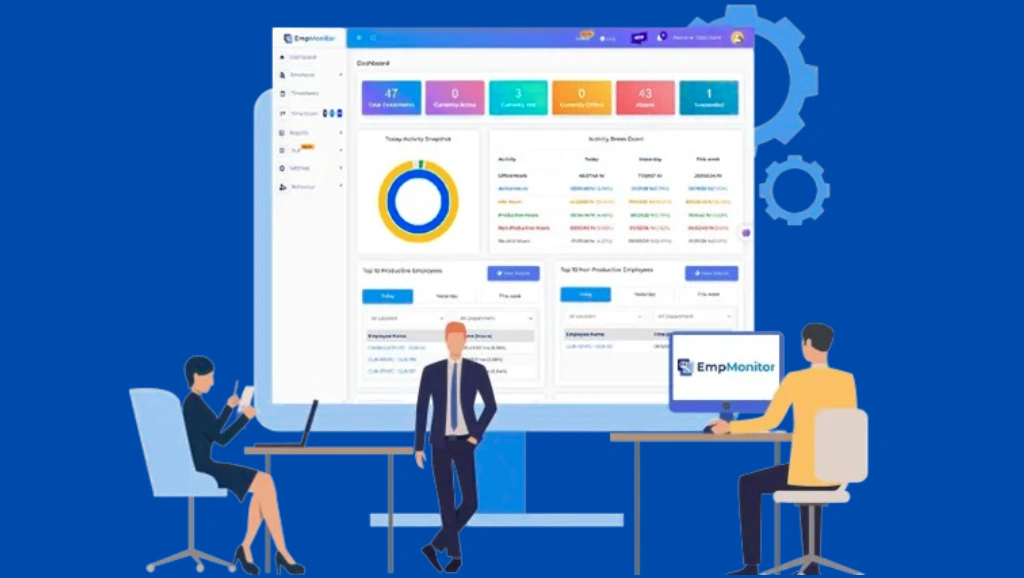
The client introduced EmpMonitor with full transparency. He held a team meeting, explained what was being monitored and why, and framed it clearly as a tool for fairness rather than surveillance. He wanted employees to understand that the goal was to make sure workloads were distributed equitably and that strong performance would be visible and recognized in a hybrid work environment.
The reaction was mixed at first, which he expected. What surprised him was how quickly the tone shifted once employees saw the data themselves.
Features That Made the Difference
- Real-time activity tracking: Gave the manager a live view of active and idle status across all employees from a single dashboard, making it easy to spot gaps as they happened throughout the day.
- App and website usage tracking: Showed exactly how work hours were being distributed across tools, making it immediately clear who was staying on task versus cycling through unrelated applications and websites.
- Automated screenshot monitoring: Provided timestamped snapshots of employee screens at regular intervals, giving the manager objective context for activity patterns without requiring anyone to file a report.
- Attendance and time tracking logs: Automatically captured login times, logout times, and idle periods, creating an honest record of each employee’s working day without relying on manual check-ins.
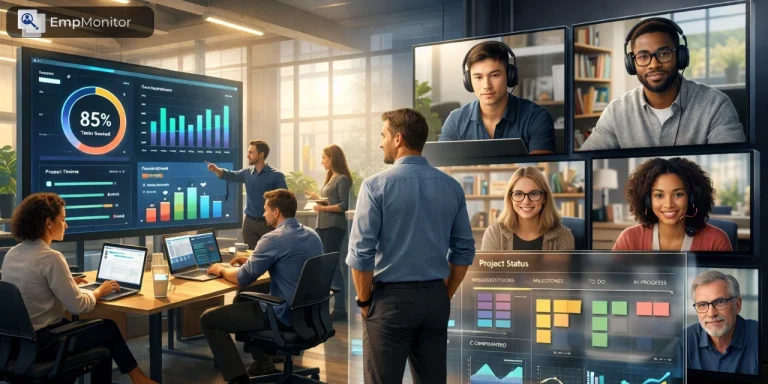
- Insightful productivity reports: Delivered a clear visual breakdown of productive versus unproductive time per team member, making workload imbalances immediately visible and impossible to overlook.
What Happened In The First Two Weeks?
Within three days of introducing EmpMonitor, overall team productivity increased by 22 percent. The change was most pronounced in the remote team. Simply knowing that activity was now visible created a natural shift in how people approached their workday.
By the end of the second week, the initial spike had settled into a steady improvement of around 15 percent, a realistic, sustainable gain rather than a short-lived burst.
More importantly, the data had surfaced something the manager hadn’t expected.
Also Read:
How Hybrid Work Security Is Impacting Modern Workspace?
The Real Insight: It Wasn’t a People Problem
Two weeks into monitoring, the productivity reports told an interesting story. A handful of remote employees were genuinely overwhelmed, carrying a disproportionate share of the complex tickets while their metrics made it look like they were underperforming.
At the same time, a few employees had noticeably light queues but were still missing targets.
Nobody had been managing this. Nobody had even known it existed.
Rebalancing the Workload
Using EmpMonitor’s activity and productivity data, the client mapped the actual workload of every team member for the first time. Two employees from the lighter queue were reassigned to support the higher-volume areas. One remote employee who had been quietly struggling under an unfair ticket load finally got the backup they needed.
The result was not just a productivity number. It was a team that finally felt the distribution was fair.
The Conversations Got Easier
For the two employees whose light queues and low output were now clearly visible in the data, the manager’s conversation was calm and factual. There was no accusation, no guesswork, and no need to rely on subjective impressions. The data showed the situation plainly, and both employees responded constructively once expectations were clearly tied to something they could see.
One of them later said it was the first time a performance conversation had felt fair to them.
The Numbers: Before and After
Before EmpMonitor, the remote team was operating at 54% productivity while the in-office team sat at 71%. Two weeks after implementation, those numbers shifted to 67% and 76% respectively, a sustained improvement of 15% for the remote team and 7% for the in-office team.
But three things changed that no percentage could capture. Ticket resolution times normalized across both teams for the first time.
The performance gap between in-office and remote employees, which the manager had assumed was structural, closed significantly once workloads were balanced. And the manager stopped spending his mornings chasing updates, because the information he needed was already waiting on the dashboard.
Did The Monitoring Create Anxiety — Or Fix It?
The Bottom Line
Hybrid teams don’t fail because remote employees can’t be trusted. They fail because the systems that create natural accountability in an office — visibility, social context, shared presence, simply don’t transfer to a remote setting without intentional design.
The right tool doesn’t replace that context with surveillance. It replaces it with clarity.
When every team member can see that effort is being measured fairly, and every manager can see where the real gaps are, accountability stops being something you enforce and starts being something the team maintains itself.
EmpMonitor gave this company the visibility to stop guessing and start managing. That is a different thing entirely from micromanagement. And the results reflected that difference clearly.
If your hybrid team is producing uneven results and you can’t quite put your finger on why, the answer probably isn’t more meetings.
It might be time to simply see what’s actually happening. EmpMonitor is a good place to start.
FAQs
1. What makes hybrid team management different from managing a fully remote team?
In a hybrid setup, natural office accountability, shared presence, visible activity, peer awareness, applies to only part of the team. This creates an unintentional imbalance where remote employees are held to a less visible standard, often leading to performance gaps that have nothing to do with individual effort.
2. How does EmpMonitor support accountability without creating a micromanagement culture?
EmpMonitor gives managers objective, data-driven visibility into how work hours are being spent, without constant check-ins or manual reporting. It surfaces the information needed automatically, enabling fair, informed conversations instead of guesswork or supervision.
3. Can EmpMonitor help identify workload imbalances across a team?
Yes. EmpMonitor’s productivity reports and real-time activity tracking make it easy to compare workload distribution across individuals. In this case, it revealed that some underperforming employees were actually overloaded, something the manager had no way of seeing before.