

When it comes to keeping your systems running smoothly and your teams productive, understanding active vs passive monitoring is no longer optional; it’s essential. As organizations navigate increasingly complex digital landscapes, the choice between these two monitoring approaches can mean the difference between preventing issues before they escalate and scrambling to fix problems after they’ve already impacted your operations.
Whether you’re monitoring network infrastructure, application performance, or employee productivity, knowing which strategy to deploy and when can significantly improve your operational efficiency and reduce costly downtime.
The monitoring landscape has evolved dramatically. What once seemed like a simple choice has evolved into a nuanced decision that requires careful consideration of your specific needs, resources, and goals. This guide will walk you through everything you need to make the right choice for your organization.
Listen To The Podcast Now!
Understanding the Fundamentals:
What Is Active Monitoring?
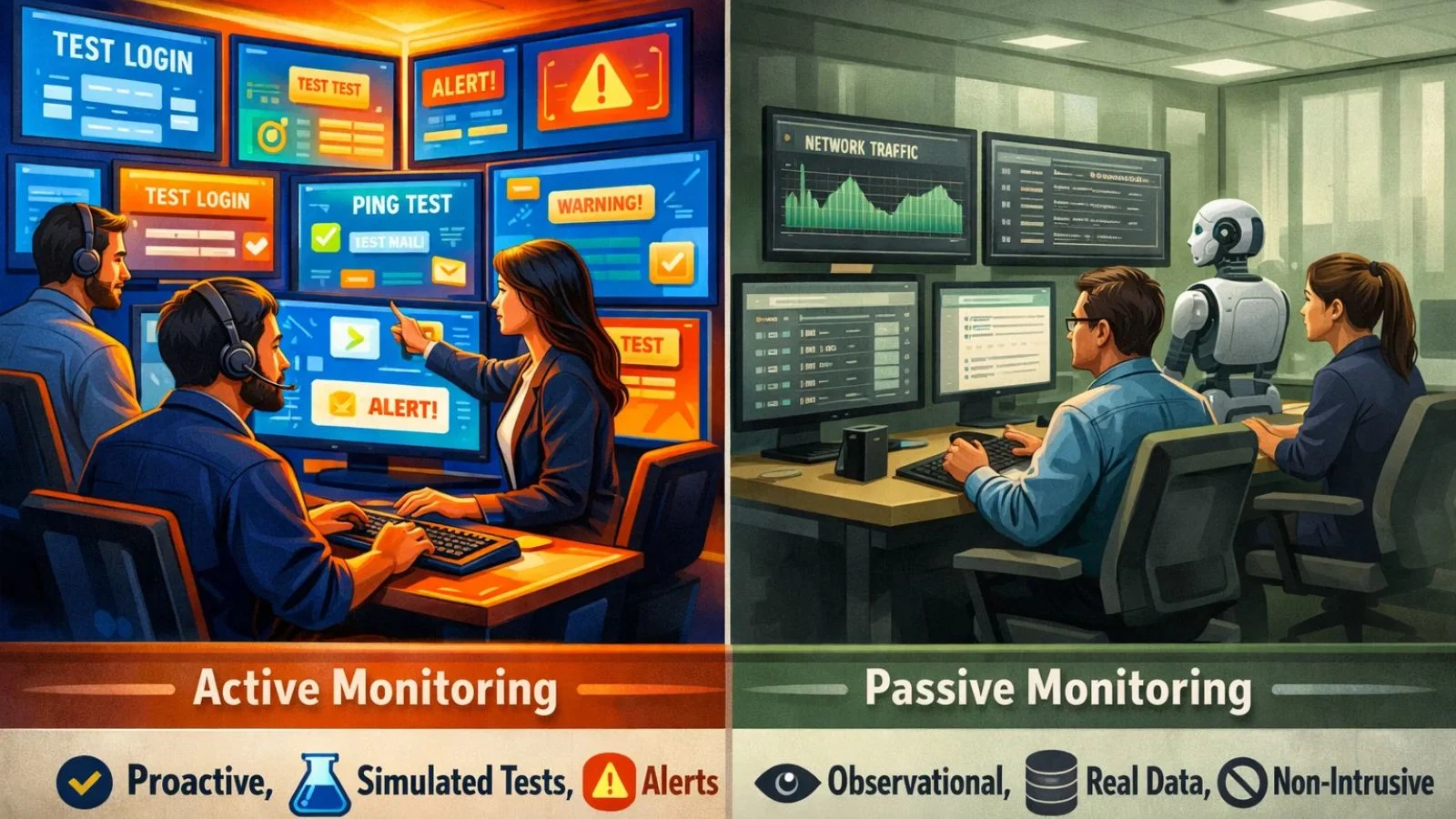
Active monitoring takes a proactive approach to system oversight. The system continuously sends test requests, performs synthetic transactions, and simulates user interactions to verify that services are functioning as expected. This approach doesn’t wait for problems to surface naturally; it actively seeks them out, which is especially crucial when you want to Monitor Employee Behavior to ensure everything is running smoothly.
In practice, active monitoring might involve pinging servers every few minutes, running automated test scripts that simulate user logins, or sending test emails through your mail server to ensure delivery systems are operational. The key characteristic is that the monitoring system initiates the interaction rather than waiting to observe naturally occurring events. By implementing such strategies, organizations can effectively track and address any employee behavior that deviates from the expected patterns or performance.
What Is Passive Monitoring?
Passive monitoring takes an observational stance. Instead of generating its own test traffic, it watches real user interactions and system behaviors as they happen organically. This approach is like having security cameras recording actual events rather than staging scenarios to test response times.
Passive monitoring examples include analyzing actual network traffic patterns, tracking real user sessions on your website, or observing genuine employee workflows without intervention. The monitoring system remains invisible to end users, collecting data from authentic interactions rather than artificial tests.
The Critical Differences Between Active Vs Passive Monitoring:
1. Detection Speed and Timing:
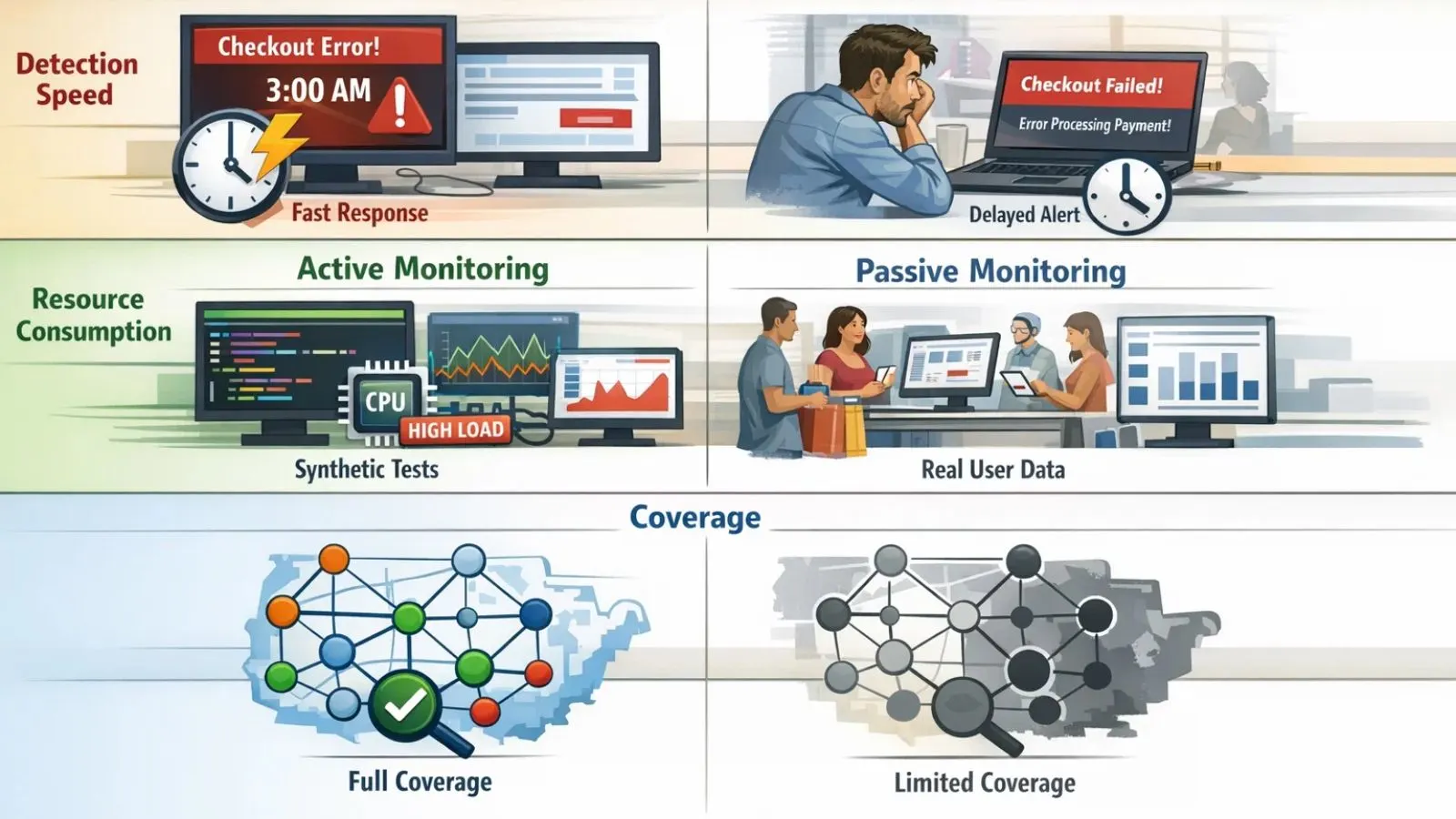
One of the most significant distinctions in active vs passive monitoring lies in how quickly issues are identified. Active monitoring can detect problems before they affect real users because it’s constantly testing functionality.
If your checkout page stops working at 3 AM, active monitoring will alert you immediately, even if no customers are shopping at that hour. Passive monitoring, however, only identifies issues when they actually occur during real usage. This means if that same checkout page fails at 3 AM, you won’t know until the first customer tries to make a purchase.
2. Resource Consumption and Data Quality:
Active monitoring generates additional load on your systems because it’s constantly running tests and checks. While this overhead is usually minimal, it’s something to consider when working with resource-constrained environments.
Each synthetic transaction consumes bandwidth, processing power, and storage. When comparing passive monitoring vs active monitoring in terms of data authenticity, passive monitoring has a distinct advantage.
It captures real user experiences, actual system behaviors, and genuine performance metrics under authentic conditions. Active monitoring provides controlled, consistent data points, excellent for establishing baselines, but synthetic tests may not fully replicate the complexity of real user behavior.
3. Coverage and Completeness
Active monitoring excels at ensuring comprehensive coverage. You can design tests to check every feature, endpoint, and functionality, even those rarely used by actual users. Passive monitoring coverage depends entirely on actual usage patterns, which can leave blind spots in less frequently accessed areas of your systems.
Building Your Decision Framework:
1. Assess Your Monitoring Objectives:
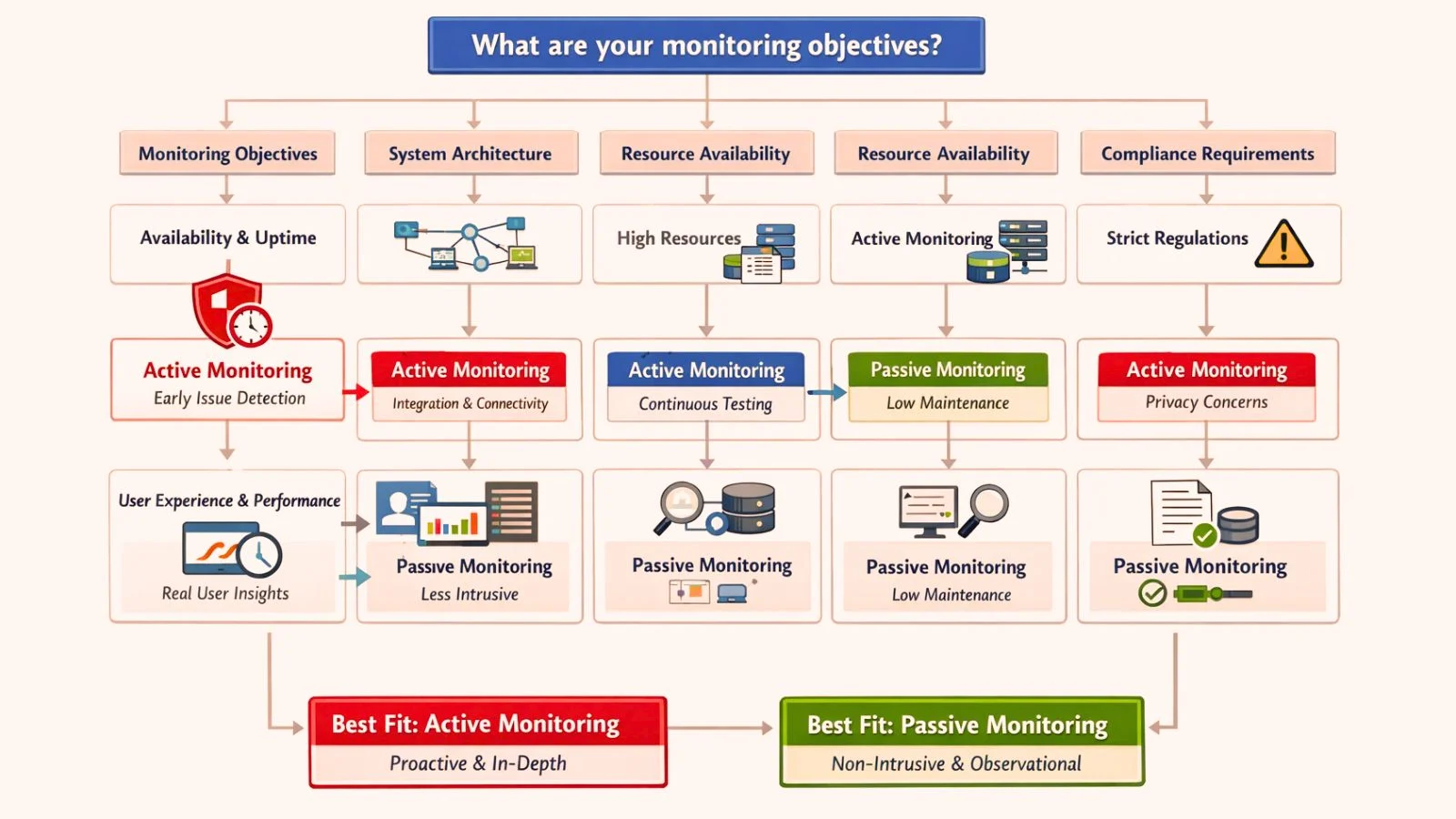
The first step in choosing between active vs passive monitoring is clearly defining what you’re trying to achieve. Are you primarily concerned with preventing downtime? Optimizing user experience? Ensuring compliance? Understanding employee productivity patterns?
For availability and uptime monitoring, active approaches typically provide better early warning systems. If you need to guarantee 99.9% uptime on critical services, active monitoring will catch issues during low-traffic periods that passive monitoring might miss until peak hours.
For performance optimization and user experience insights, passive monitoring often delivers more valuable data since it reflects actual user experiences.
2. Consider Your System Architecture:
The complexity and architecture of your systems play a crucial role in determining the most effective monitoring approach. Distributed systems with multiple microservices often benefit from active monitoring to verify inter-service communication and catch integration issues early. Legacy systems that are fragile or resource-constrained might be better suited to passive monitoring approaches that don’t add additional load.
3. Evaluate Resource Availability:
Implementing active vs passive monitoring requires different resource investments. Active monitoring demands ongoing effort to create, maintain, and update test scenarios as your systems evolve.
Every new feature requires new tests, and outdated tests can create false alarms that erode trust in your monitoring system. Passive monitoring requires sophisticated analysis capabilities to extract meaningful insights from observed data.
4. Factor in Compliance Requirements:
Certain industries and regulations may influence your choice. Active employee monitoring, for instance, might raise privacy concerns in some jurisdictions or organizational cultures. When monitoring workplace productivity, passive employee monitoring approaches that observe aggregated patterns without intrusive testing may be more appropriate and legally compliant.
Similarly, active vs passive office monitoring strategies must consider employee expectations and legal requirements around workplace surveillance. Transparent, passive observation of general patterns often finds better acceptance than active systems that might feel invasive.
Industry-Specific Applications:
1. E-commerce and Web Applications:
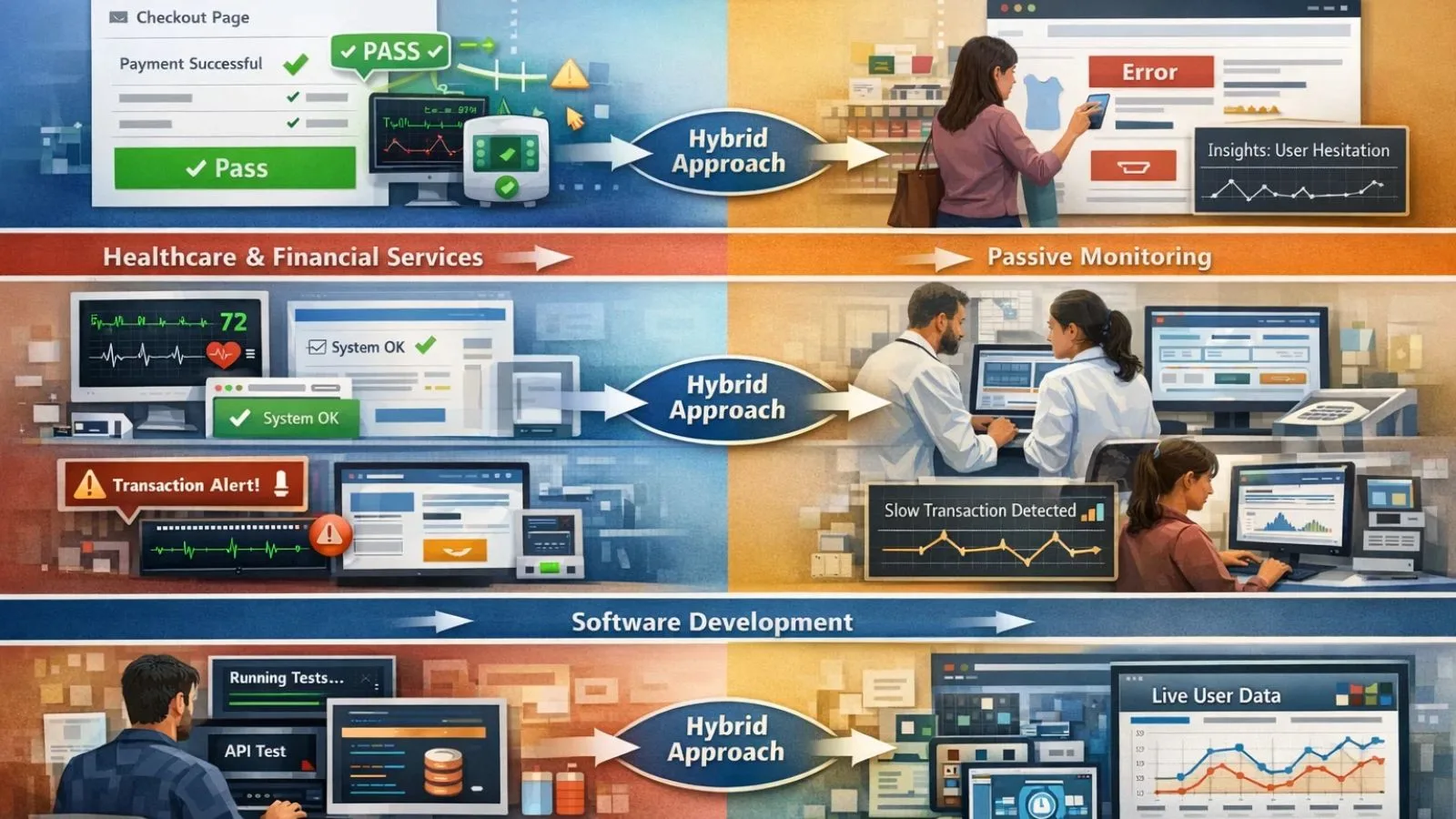
Online retailers typically benefit from a combination approach. Active monitoring ensures that critical paths like checkout processes and payment gateways remain functional around the clock.
Meanwhile, passive monitoring tracks real customer journeys, identifying friction points that only manifest under specific conditions. The debate of active vs passive monitoring in e-commerce often concludes that neither alone is sufficient.
2. Healthcare and Financial Services:
Healthcare organizations prioritize active monitoring for critical systems where downtime could have life-threatening consequences. Electronic health record systems and patient monitoring equipment require constant verification. However, passive monitoring also plays a vital role by tracking actual clinician workflows and revealing system performance issues under real clinical operations.
Banks implement robust active monitoring to ensure transaction processing systems remain available. The question of active vs passive monitoring in financial services isn’t either-or; it’s about strategic deployment of both methodologies to meet both regulatory requirements and customer experience goals.
3. Software Development:
Development teams increasingly rely on both approaches. Active monitoring validates that new deployments haven’t broken existing functionality through automated testing. When weighing active vs passive monitoring for software applications, teams often implement active synthetic monitoring in staging environments, then layer passive monitoring in production to understand actual user impact.
Streamlining Your Monitoring Strategy with Modern Tools:
As organizations recognize that the active vs passive monitoring debate isn’t about choosing one or the other but rather implementing both effectively, the need for comprehensive monitoring solutions has grown. Modern monitoring platforms integrate multiple approaches into unified systems that provide holistic visibility.
When evaluating monitoring tools, look for solutions that offer flexible data collection methods, intelligent alerting that reduces false positives, intuitive dashboards that make sense of complex data streams, and seamless integration with your existing technology stack.
Also Read:
Why To Monitor Employee Behavior & What Are Its Benefits?
How To Announce Employee Monitoring Without Causing a Revolt
EmpMonitor: A Comprehensive Approach to Workplace Monitoring:

Organizations seeking an integrated solution to optimize workforce productivity should consider platforms specifically designed for this purpose. A robust employee monitoring system can bridge the gap between active and passive approaches, offering valuable insights without unnecessary complexity.
Key Features of EmpMonitor:
- Automated Screenshot Capture: Configurable intervals to maintain visibility into work activities, ensuring managers have accurate insights into employee performance.
- Application & Website Usage Tracking: Monitor and analyze how time is allocated across various applications and websites to identify efficiency gaps.
- Customizable Productivity Scoring: Assign scores based on predefined criteria tailored to align with your business goals, giving a measurable view of employee performance.
- Comprehensive Reporting: Detailed reports that transform raw data into actionable insights, helping managers make data-driven decisions.
- Hybrid Monitoring Methodology: Combines periodic automated checks (active element) with continuous observation of natural work patterns (passive element) for a well-rounded monitoring experience.
- Employee Self-Improvement Tools: Workers can access their productivity data, identify personal patterns, and optimize their workflows, fostering personal growth.
- Managerial Oversight & Support: Provides managers with the visibility required to offer appropriate resources, support, and guidance to improve overall team performance.
When implemented with clear communication to employees, these tools offer the right balance of oversight and privacy, promoting a healthy, efficient work environment for both individual and team productivity.
Implementing Your Monitoring Strategy:
1. Start with Critical Systems:
Don’t try to monitor everything at once. Begin by identifying your most critical systems, those whose failure would have the most significant business impact. Implement active vs passive monitoring for these first, learning from the experience before expanding coverage.
For each critical system, determine which aspects require proactive testing and which are better served by passive observation. Payment processing might need active monitoring to ensure it’s always functional, while user browsing behavior might be better understood through passive analysis.
2. Establish Baselines and Configure Alerting:
Before you can effectively detect anomalies, you need to understand normal behavior. Spend time collecting baseline data under both approaches. Active monitoring baselines tell you what “healthy” test results look like. Passive monitoring baselines reveal typical usage patterns and performance characteristics.
The value of any monitoring approach is severely diminished by poor alerting. Too many alerts lead to fatigue and ignored warnings. The goal is actionable alerts that indicate genuine problems requiring human attention. Active monitoring alerts should trigger when tests fail or performance degrades below acceptable thresholds.
3. Create Feedback Loops:
Monitoring is only valuable if it drives improvement. Establish processes that convert monitoring insights into action. Regular reviews of monitoring data should inform system improvements, capacity planning, and resource allocation. The insights gained from active vs passive monitoring should directly influence your technology roadmap and operational priorities.
Common Pitfalls to Avoid:
1. Over-Reliance on a Single Approach:
Perhaps the most common mistake is treating active vs passive monitoring as mutually exclusive options. Most organizations achieve the best results by strategically combining both approaches.
Active monitoring provides the safety net that catches issues before they impact users, while passive monitoring offers the authentic insights that drive meaningful improvements.
2. Monitoring Without Context:
Collecting data without understanding what it means or how it relates to business outcomes is wasteful. Every metric you monitor should connect to something you care about: customer satisfaction, revenue, operational efficiency, or compliance. If you can’t explain why a particular metric matters, you probably shouldn’t be monitoring it.
3. Neglecting Maintenance:
Monitoring systems require ongoing care. Active tests become outdated as systems evolve. Passive monitoring thresholds need adjustment as usage patterns change. Alert fatigue sets in when notifications aren’t tuned. Schedule regular reviews of your monitoring configuration to ensure it remains relevant and valuable.
4. Ignoring the Human Element:
When implementing active employee monitoring or passive employee monitoring approaches, remember that you’re observing people, not just systems. Transparency about what you’re monitoring and why builds trust. Secretive monitoring damages morale and can create legal complications. Involve employees in discussions about monitoring goals and methods.
5. Measuring Success:
Understanding whether your active vs passive monitoring strategy is working requires establishing clear success criteria from the start. What outcomes are you trying to achieve? Reduced downtime? Faster incident response? Improved user satisfaction?
For active monitoring, key metrics might include mean time to detection and false positive rates. For passive monitoring, focus on insight, actionability, and detection accuracy.
The true value of active vs passive monitoring extends beyond technical metrics to business outcomes. Track these business-level impacts to justify your monitoring investments and guide future resource allocation.
Your monitoring needs will evolve as your systems and business grow. Schedule quarterly reviews of your active vs passive monitoring strategy to ensure it remains aligned with current needs. Evaluate which approaches are delivering the most value, identify gaps in coverage, and adjust alerting thresholds based on accumulated data.
Conclusion:
The choice between active vs passive monitoring isn’t binary; it’s strategic. The most successful organizations leverage both approaches, applying each where it delivers the most value. Active monitoring provides proactive protection for critical systems, ensuring issues are caught before they impact users.
Passive monitoring offers authentic insights into real-world performance and behavior, driving continuous improvement. By understanding the strengths and limitations of each approach and implementing a thoughtful strategy, you can build visibility into your systems that truly serve your organizational goals.
FAQ’s:
Q1: Can I use both active and passive monitoring together?
Ans: Absolutely. Most mature monitoring strategies incorporate both approaches, using active monitoring for proactive issue detection and passive monitoring for real-world performance insights.
Q2: Which approach is more cost-effective?
Ans: It depends on your specific needs. Active monitoring may have higher implementation costs due to test creation, while passive monitoring may require more sophisticated analysis tools.
Q3: How do I choose between active vs passive monitoring for employee productivity?
Ans: Consider your goals and culture. Passive employee monitoring is generally less intrusive and focuses on patterns rather than constant testing, making it more suitable for most workplace environments.
Q4: What’s the biggest risk of relying only on passive monitoring?
Ans: You’ll only discover issues when they affect real users, potentially missing problems during low-usage periods that could escalate into major incidents during peak times.