Remote hiring moved from experiment to baseline faster than most leaders expected.
In fact, nearly 52% of the global workforce now works remotely, almost doubling since the pre-pandemic level.
Talent sits everywhere, and the smartest companies already hire across borders, time zones, and cultures.
Sounds like an advantage, right?
But here’s the catch: most teams still hire as if everyone will sit in the same office five days a week.
That mismatch quietly kills performance before day one even begins.
Remote work demands a different lens, far more than polished answers in a Zoom call.
So let’s fix that.
This guide breaks down a simple, battle-tested 5-step framework to help you spot, attract, and hire distributed high-performers.
Let’s get into it.
P.S. Want to understand the systems that actually make remote teams work? Check out our guide on “What Are Remote Work Systems”.
Why Most Remote Hiring Fails?
Most hiring mistakes show up after the contract is signed, making them harder to spot up front.
Remote-enabled roles may attract 50% more qualified applicants, but a larger pool does not automatically mean a stronger signal.
Teams often lean on credentials and smooth interviews, then end up with people who hesitate without clear direction or struggle to prioritize on their own.
Someone can sound sharp in a call and still lose momentum when left to manage tasks independently.
Another weak point hides in communication.
Remote work depends on clarity in writing and the ability to move work forward without constant check-ins.
Yet many hiring processes barely test that.
The pattern feels familiar. Promising hires, uneven execution.
So let’s skip the trial and error and jump into a framework that actually delivers results.
Step 1: Define the Role for Remote Reality (Not Office Thinking)
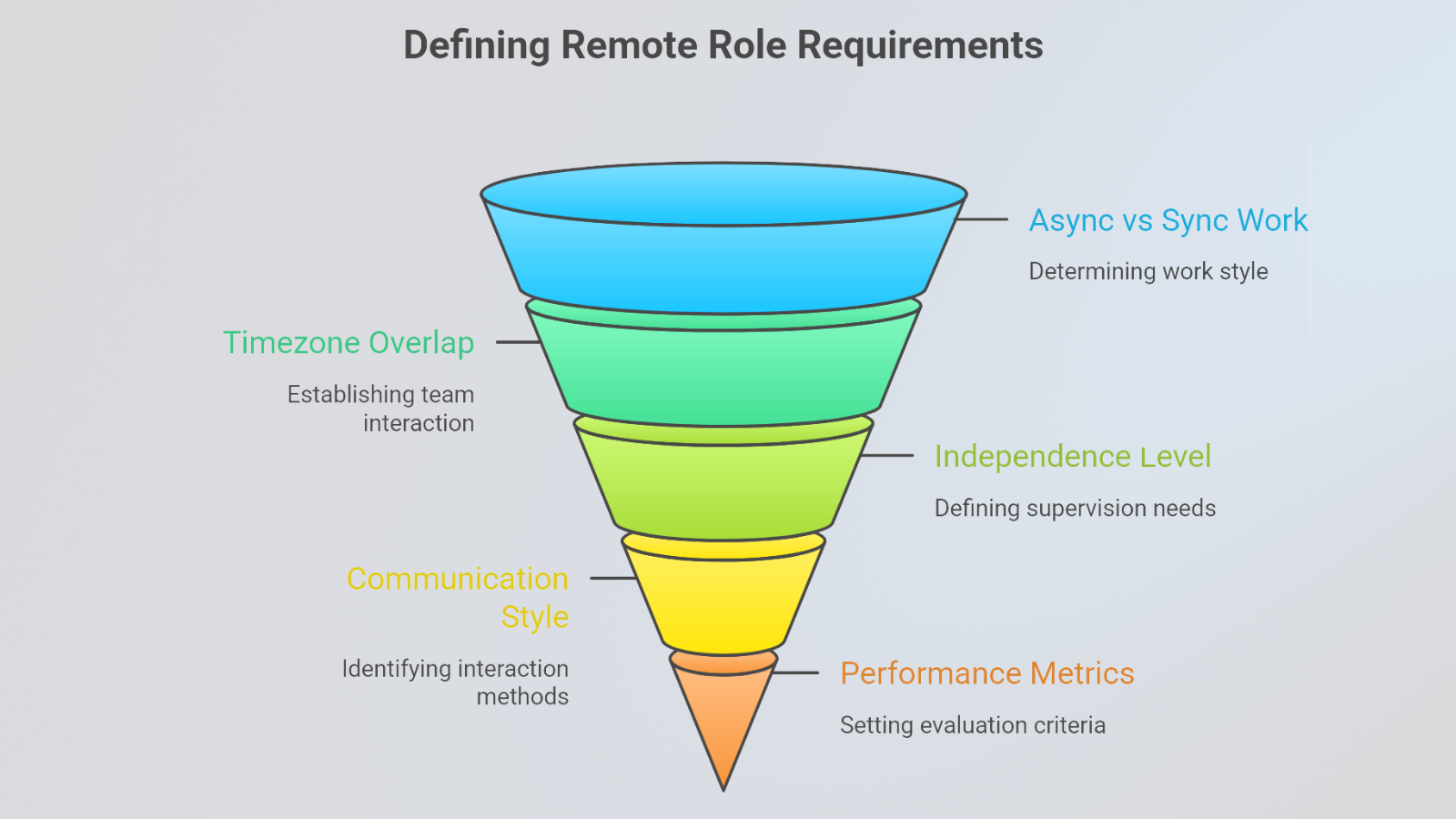
A remote role needs more than a recycled office job description with “remote” added at the top.
While the work may look similar, the behavior required to succeed changes completely.
In an office, weak structure can hide behind quick desk chats and spontaneous follow-ups.
This safety net doesn’t exist in remote environments.
Before posting the role, define what the job truly requires in a distributed setup:
- Async vs sync work: Will this person make progress through written updates, shared docs, and project tools, or will they need frequent live calls?
- Timezone overlap: Do they need four shared hours with the team, or can they work with a lighter overlap?
- Independence level: Will they receive detailed direction, or own outcomes with minimal supervision?
- Communication style: Should they be good writers, meeting facilitators, or both?
- Performance metrics: Measure output, quality, speed, and ownership instead of hours online.
A weak job description says: “Must be a team player with strong communication skills.”
In contrast, a strong one is specific: “You’ll share clear async updates, flag blockers early, and manage weekly deliverables across two time zones.”
Notably, 71% of companies report reduced collaboration as a challenge in remote environments, highlighting the need for clearly defined role structures.
Most companies hire for tasks. Remote teams need to hire for behavior.
Now that the role is clear, the next step is finding the right people to match it.
Step 2: Source Globally, Filter Intelligently
Once the role reflects remote reality, the talent pool opens up in a big way.
It’s no surprise that global hiring gives access to incredible people across continents and markets.
In fact, remote hiring expands talent pools by 340% and shortens time-to-hire by 16%.
At the same time, it brings a new challenge: volume (more applications, more noise, more mismatch).
So, global sourcing works best when paired with sharp filtering.
Instead of posting everywhere, focus on channels where remote professionals already operate.
Platforms like We Work Remotely, Remote OK, and Dynamite Jobs attract candidates who actively choose distributed work. Some teams also use an AI recruiting tool to handle the first cut of high-volume applications before moving shortlisted candidates into the async screen below.
Then filter for signal:
- Remote track record: Look for outcomes delivered across time zones, plus examples of solo ownership.
- Written clarity: Ask one short async prompt, like “Explain a complex project in 150 words”.
- Quick async screen (15–30 min max): Give a small, focused task that tests one core skill, not a full work simulation.
- Self management: Look for how they scope, prioritize, and communicate within that small task.
- Expectation alignment: Include quick questions on overlap hours, tools, and response times.
Read next: 8 Tips On How To Make Remote Collaboration Easier.
An async-first screening process mirrors the real job. It shows how someone thinks, communicates, and executes without constant supervision.
This step is about filtering fast and fairly, reducing noise before deeper evaluation.
But great candidates deserve a process that reveals how they actually work.
And that leads us to the next step:
Step 3: Design a Structured Remote Interview System
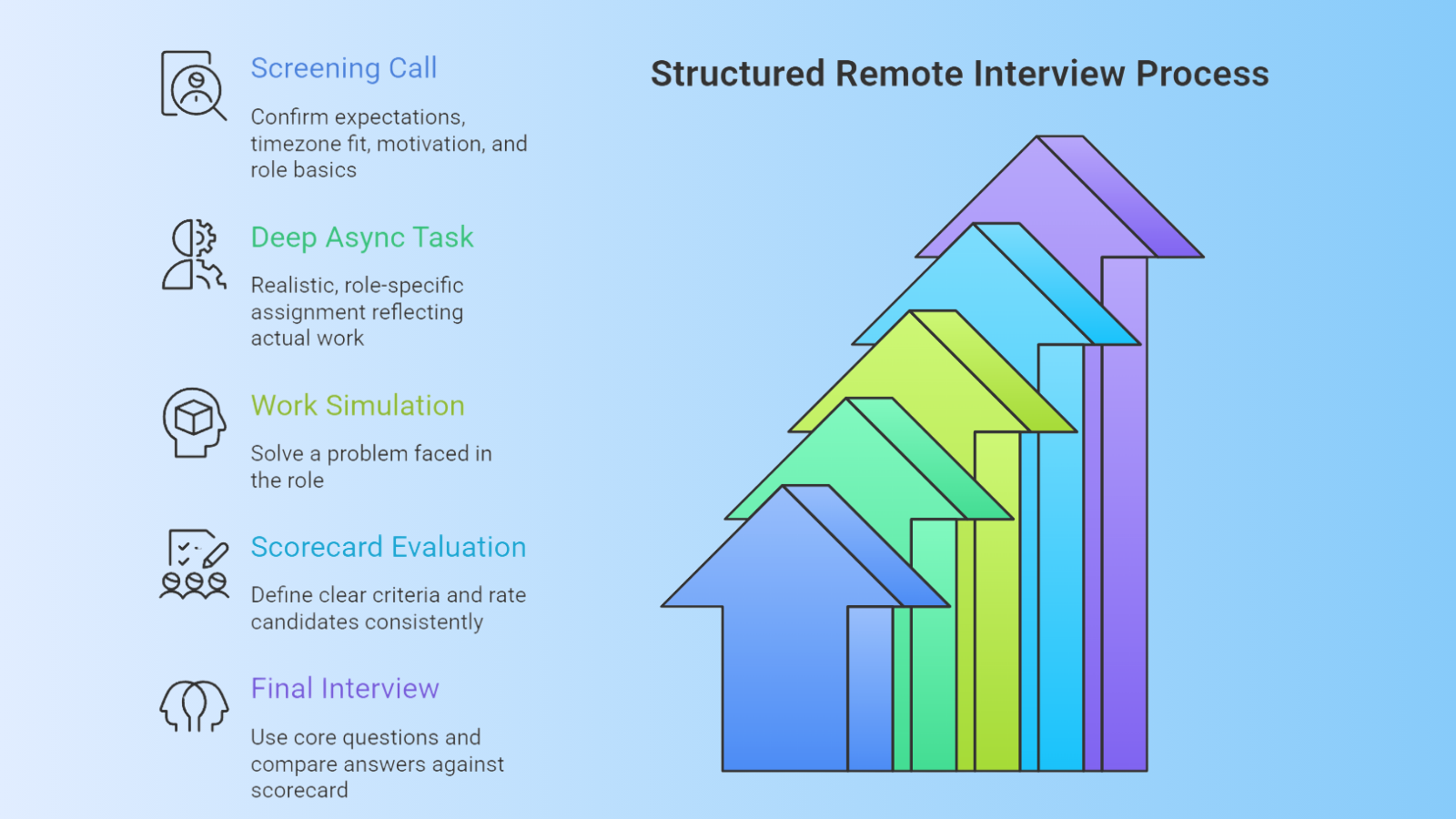
After filtering for real signals, the interview process should keep that same discipline.
A casual “let’s chat and see” approach feels easy, but it creates messy decisions.
In practice, one candidate gets judged on personality, another on experience, and another on who had the best internet connection that day.
That’s how bias sneaks in, and strong operators get missed.
For this reason, remote interviews need structure.
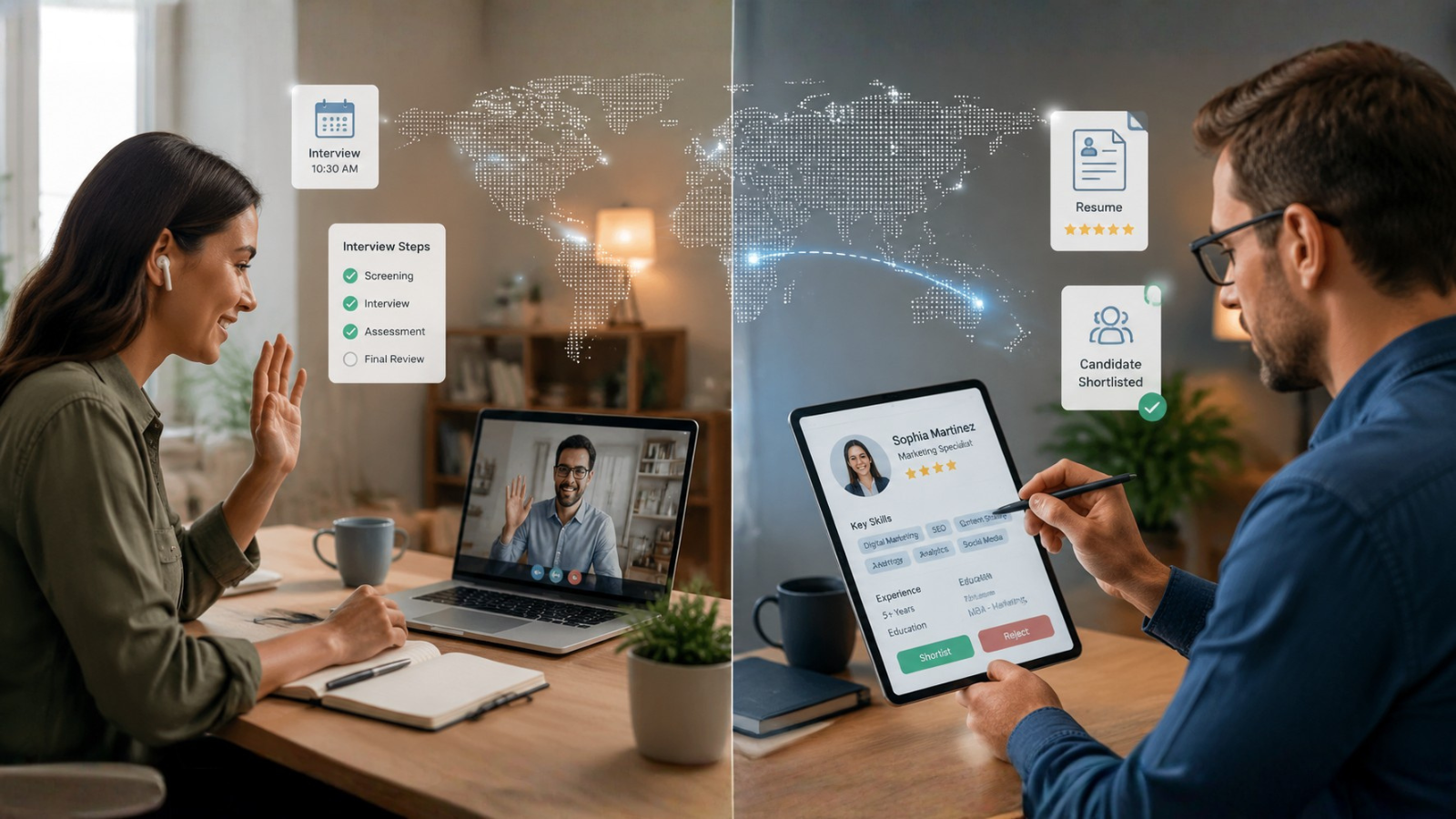
To reflect that, build a simple process that tests how the person would actually perform:
- Screening call: Confirm expectations, timezone fit, motivation, and role basics.
- Deep async task: A realistic, role-specific assignment that reflects actual work (longer and more involved than Step 2).
- Scorecard evaluation: Define clear criteria (e.g., clarity, ownership, problem-solving) and rate every candidate consistently.
- Final interview: Use the same core questions for every finalist and compare answers against that scorecard.
This becomes even more critical for senior roles, where companies often rely on structured processes or COO executive search partners to reduce costly hiring mistakes.
Adding this level of structure directly improves outcomes: structured interviews are roughly 2× more predictive of actual job performance than unstructured ones.
The goal stays simple: Interviews should reflect the job itself, not just talk about it.
Now let’s move from evaluation to real-world validation.
Step 4: Validate Through Real Work (Trial Projects)
At this point, you’ve seen how candidates think, communicate, and approach problems.
Now it’s time to validate something more important: how they perform when given real responsibility.
This is where paid trial projects become essential. And yes, pay is critical.
A serious candidate gives you real time and real effort, so the company should treat that work with respect.
It also creates a realistic dynamic.
When someone receives payment, expectations rise on both sides, which mirrors a true working relationship.
A solid trial project usually includes:
- A clear brief: What needs to be done, why it matters, and what “good” looks like.
- A realistic deadline: For example, 24 to 72 hours, depending on complexity.
- A defined output: A written plan, sample deliverable, audit, strategy doc, code review, customer response, or project breakdown.
- A simple scorecard: Delivery quality, speed, communication, independence, and judgment.
For example, a marketer can outline a campaign for a real ICP; A developer can review a small pull request. A customer support hire can draft replies to three tricky tickets; A project manager can turn a messy brief into a clean execution plan.
Remember: Remote hiring success comes from watching behavior under real conditions.
Resumes can exaggerate, interviews can charm, but work reveals the truth.
This shift is already happening across hiring: 76% of employers now use skills tests to measure and validate candidate ability.
With the right person in place, onboarding becomes the next priority.
Alongside trial projects, companies should also complete a criminal background check to verify a candidate’s professional history and identify any potential risks before extending a final offer. While skills and performance remain the primary hiring criteria, a criminal background check adds an extra layer of due diligence that helps remote teams build trust, especially when employees will have access to sensitive systems, data, or customer information.
Step 5: Build a High-Performance Onboarding System
This is the last step, yet importance stays right at the top.
A great hire can still stall out fast if onboarding feels vague, slow, or chaotic.
In remote teams, early confusion rarely fixes itself through hallway conversations.
It turns into silence, missed expectations, and people quietly checking out.
Start with pre-boarding so day one feels clean and confident:
- Accounts, tools, permissions, and a short “how we work” doc
- Clear expectations on overlap hours, response times, and where updates live
- A named onboarding buddy plus a direct manager cadence
Then give the first week a simple structure.
Think: context, relationships, and quick wins. For remote-first companies, onboarding documentation can also include employment eligibility verification steps. Many distributed organizations incorporate digital identity verification workflows and online notary services to support I-9 compliance and other legally required onboarding documentation without requiring in-person processing.
Finally, run a 30-60-90 plan that makes progress visible:
- 30 days: learn the product, workflows, and ship small tasks with tight feedback.
- 60 days: own a meaningful project, write updates, handle blockers proactively.
- 90 days: operate with steady autonomy and measurable impact.
Remote teams often fail due to weak onboarding systems, so treat onboarding as the performance engine, not an admin checklist.
Because when it’s done right, structured onboarding can improve new hire retention by up to 82%.
From Hiring to System Design
Remote hiring works best when treated as a system, not a one-off decision.
Each step builds on the previous one and removes guesswork from the process:
- Define the role around real remote behavior
- Source globally with clear filters
- Evaluate through structured interviews
- Validate with real, paid work
- Onboard with intention and clarity
When these pieces connect, hiring stops feeling unpredictable.
It turns into a repeatable process that surfaces the right people and helps them perform from the beginning.
Build the system, and the results follow.
FAQ
What makes remote hiring different from traditional hiring?
Remote hiring focuses on behavior, communication, and self-management rather than presence, personality, or office dynamics.
How can I tell if a candidate will perform well remotely?
Look for clear written communication, ownership in past work, and consistent delivery during async tasks or trial projects.
Are paid trial projects really necessary?
Yes. Paid trials show real performance under real conditions and reduce hiring risk significantly.
Where should I find high-quality remote candidates?
Use focused platforms like We Work Remotely, Remote OK, and niche communities where remote professionals already operate.
What is the biggest mistake in remote hiring?
Treating it like office hiring. That usually leads to poor fit, weak execution, and early churn.