
Cloud security in 2026 is no longer about building a stronger perimeter. It’s about understanding who is accessing what, from where, and what they’re doing once inside.
For IT employers and security leaders, the challenge is clear: cloud intrusions surged dramatically in recent years, and the majority of breaches now involve cloud data. Traditional tools can’t keep up with remote work, SaaS sprawl, insider threats, and increasingly strict compliance requirements.
Two technologies often surface in these conversations:
- CASB (Cloud Access Security Broker)
- UAM (User Activity Monitoring)
Some see them as alternatives. In reality, they solve different parts of the same problem.
This guide breaks down where each tool excels, where they fall short, and how IT teams can combine them for a layered, enterprise-grade cloud defense.
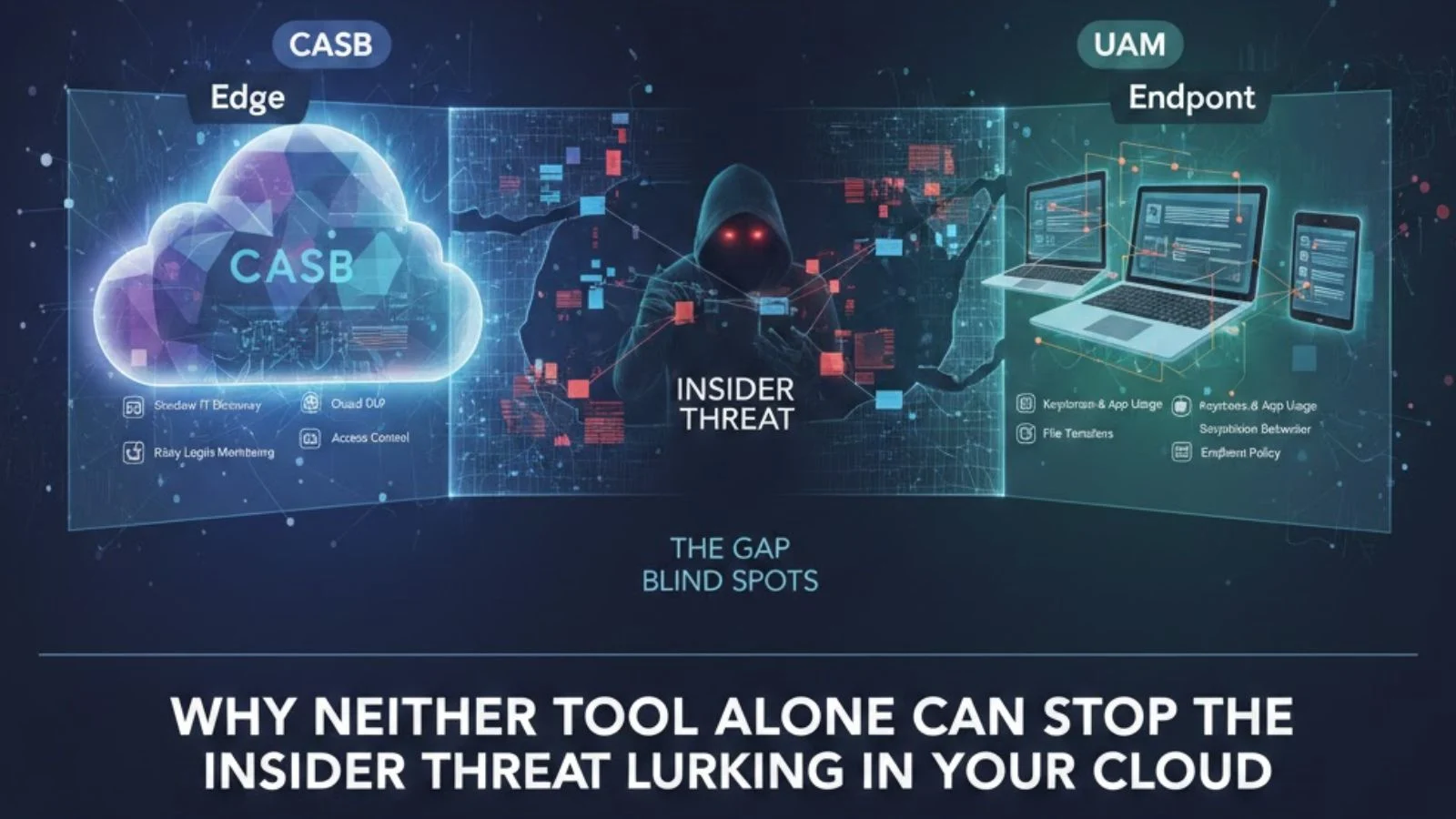
Why Neither Tool Alone Can Stop the Insider Threat Lurking in Your Cloud
Security teams often deploy Cloud Access Security Broker to gain control over SaaS applications and cloud services. It helps:
- Discover shadow IT
- Enforce cloud DLP policies
- Control access to sanctioned apps
- Monitor risky logins
But here’s the gap: CASB primarily focuses on cloud access and data movement — not deep user behavior once authenticated.
On the other hand, UAM tracks:
- Keystrokes and application usage
- File transfers
- Suspicious insider behavior
- Policy violations at the endpoint level
Yet UAM typically lacks full visibility into API-level cloud interactions or SaaS configuration risks.
The result?
- Cloud Access Security Broker sees the cloud edge.
- User Activity Monitoring sees user behavior.
- Neither sees the complete picture alone.
And insider threats, whether malicious or negligent thrive in these blind spots.
How CASB Secures the Cloud Edge While UAM Watches What Happens Inside
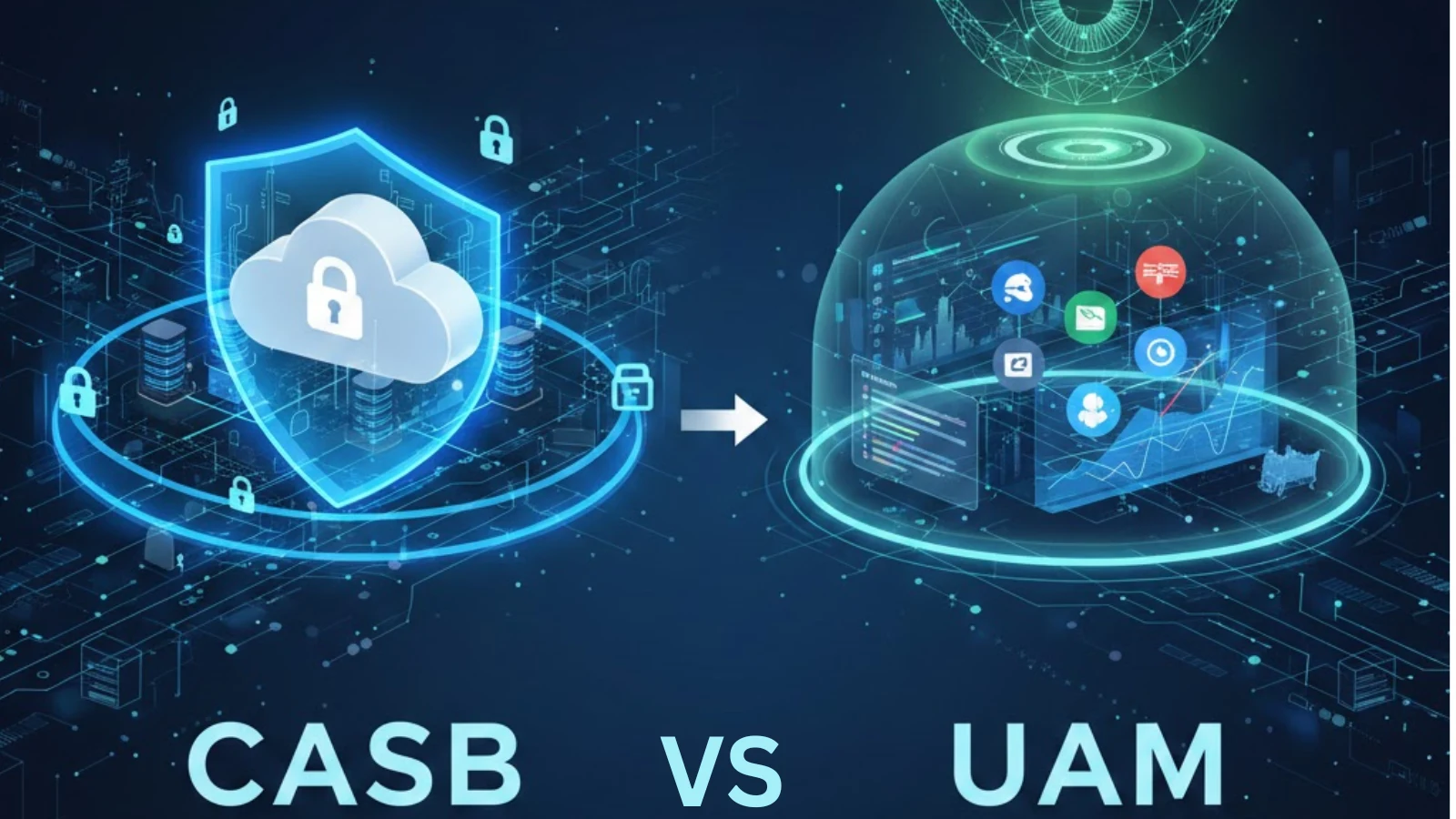
To understand their relationship, think in architectural layers.
CASB: The Cloud Gatekeeper
Cloud Access Security Broker acts as a centralized control layer between users and cloud applications, ensuring that access and data usage follow organizational policies. It enforces role-based access controls, applies encryption or tokenization to sensitive data, and implements Data Loss Prevention (DLP) rules to prevent unauthorized sharing. CASB also helps discover shadow IT by identifying unsanctioned cloud services and provides cloud threat protection against risky behaviors.
Its strengths lie in delivering deep visibility into cloud applications, monitoring activity through APIs, supporting compliance requirements, and enabling conditional access based on user risk, device posture, or location.
UAM: The Behavioral Watchtower
UAM focuses on monitoring what users actually do at the device and session level. It tracks endpoint activities, privileged user actions, suspicious session behavior, and potential data exfiltration patterns in real time. This gives organizations visibility beyond login events and into day-to-day operational behavior.
Its strength lies in detecting insider threats, maintaining detailed audit trails, identifying behavioral anomalies, and supporting forensic investigations when incidents occur.
For IT architects, Cloud Access Security Broker and UAM are not competing tools, they are complementary layers in a defense-in-depth strategy.
Also Read
Shadow IT: How to See What Apps Your Employees Are Really Using
Understanding the Blind Spots Each Tool Leaves — and How to Close Them

Let’s break this down honestly, something vendor brochures rarely highlight.
CASB Blind Spots
Cloud Access Security Broker provides strong control at the cloud layer, but it doesn’t see everything. Its visibility into unmanaged or personal devices is limited, which can be risky in hybrid work environments. It may also struggle to inspect activity inside encrypted sessions without additional configurations.
Not every cloud application integrates cleanly via APIs, which means coverage can be incomplete across an organization’s entire SaaS ecosystem. And while CASB detects policy violations, it may miss subtle insider misuse, such as gradual data hoarding or low-and-slow exfiltration tactics.
UAM Blind Spots
UAM, on the other hand, focuses on endpoint behavior. It monitors what users do locally, but typically lacks deep API-level insight into cloud platforms. It does not provide full SaaS governance controls, shadow IT discovery, or visibility into risky cloud configurations.
In short, it sees behavior, but not always the broader cloud architecture context.
Closing the Gaps
IT leaders can close these gaps by integrating both perspectives:
- Correlating Cloud Access Security Broker logs with UAM behavioral analytics
- Aligning endpoint alerts with cloud access events
- Creating detection rules that combine cloud activity and user behavior
- Feeding both data streams into SIEM or XDR platforms for unified analysis
When combined, isolated alerts become connected signals. And that’s when raw activity logs evolve into actionable, contextual threat intelligence.
A Practical Guide for IT Teams Navigating Shadow IT, DLP, and Zero Trust
Cloud security isn’t theoretical anymore, it’s operational. IT teams need controls that work in real-world environments where employees use dozens of cloud apps daily.
1. Shadow IT Management
Shadow IT remains one of the biggest visibility challenges. Cloud Access Security Broker plays a critical role here by identifying unsanctioned cloud applications being used across the organization. It provides insight into unauthorized cloud usage, assigns risk scores to third-party apps, and tracks data being shared externally.
UAM strengthens this visibility at the user level. While CASB detects risky applications, UAM can identify employees uploading sensitive files to those apps or copying data from internal systems before doing so. Together, they expose both the application risk and the user behavior behind it.
2. Data Loss Prevention (DLP)
Cloud Access Security Broker enforces DLP policies within cloud environments, across SaaS storage platforms, email systems, and collaboration tools. It prevents sensitive data from being shared externally or accessed by unauthorized users.
UAM extends DLP to the endpoint. It monitors USB transfers, screenshot capture attempts, and file compression activities that often precede data exfiltration.
Combined, they protect data across cloud platforms and local devices — securing information both in transit and at rest.
3. Zero Trust Architecture
Zero Trust operates on a simple principle: never trust, always verify. Cloud Access Security Broker supports this by enforcing conditional access, identity-based controls, and risk-aware authentication before granting cloud access.
But Zero Trust doesn’t end at login. UAM validates behavior after access is granted, monitoring privilege misuse, suspicious activity, or potential lateral movement.
Without behavioral monitoring, Zero Trust becomes incomplete. Access control alone cannot stop misuse that happens after authentication.
Also Read
From SaaS Visibility to Endpoint Behavior: Building a Layered Cloud Defense
Enterprise architects in 2026 design security around defense-in-depth principles. No single control is sufficient. Instead, resilience comes from layering visibility, governance, and response across identity, cloud, and endpoint environments.
A modern layered cloud security stack typically includes:
- Identity & Access Management (IAM)
- Cloud Access Security Broker (within Security Service Edge)
- UAM for endpoint visibility
- SIEM/XDR for correlation
- SOAR for automated response
Each layer serves a distinct purpose.
IAM verifies identity and ensures only authenticated users gain access.
CASB governs cloud access, enforcing policies and protecting SaaS environments.
UAM validates behavior at the device level, monitoring how users interact with data after authentication. For security teams looking to unify these signals, deploying a purpose-built xdr platform enables cross-layer correlation: connecting identity, cloud, and endpoint telemetry into a single detection and response workflow.
SIEM or XDR platforms correlate signals across systems to detect patterns.
SOAR automates remediation, reducing manual response time.
When these layers work together, organizations significantly reduce dwell time, the period attackers remain undetected inside systems.
Strengthening the Endpoint Layer with Practical UAM Implementation
In this layered model, endpoint visibility becomes critical. While Cloud Access Security Broker provides strong cloud-side governance, real-world insider risk often emerges at the device level, through file transfers, privilege misuse, or suspicious session activity.
User Activity Monitoring platforms, such as EmpMonitor help operationalize this layer by providing real-time visibility into endpoint behavior. Capabilities like activity tracking, file movement monitoring, privileged user oversight, and detailed audit logs support insider threat detection and compliance reporting.
When integrated into a broader security stack, such tools enhance behavioral validation without replacing existing cloud controls. They act as the connective tissue between identity enforcement and incident response — ensuring that access governance is continuously supported by behavioral insight.
How EmpMonitor Supports Risk Mitigation in a Layered Security Model

Within a defense-in-depth architecture, endpoint visibility plays a direct role in reducing insider and operational risk. By strengthening the behavioral monitoring layer, EmpMonitor helps organizations detect misuse early, improve accountability, and support compliance requirements without disrupting existing cloud controls.
Key capabilities that support risk mitigation include:
- Real-time user activity monitoring to detect unusual or high-risk behavior
- File movement and transfer tracking across local drives, external storage, and network paths
- Privileged user monitoring to oversee sensitive access and administrative actions
- Application and website usage visibility for identifying policy violations
- USB and external device monitoring to reduce data exfiltration risks
- Detailed, timestamped audit logs for compliance and forensic investigations
- Behavioral reporting and analytics to identify anomalies over time
When aligned with CASB, IAM, and SIEM tools, these capabilities help close visibility gaps between cloud access and endpoint activity, strengthening overall threat detection and response readiness.
What CASB Can’t See and UAM Can’t Reach: Mapping the Real Security Gap
Security analysts often struggle with alert fatigue. Why?
Because tools operate in silos.
Consider this scenario:
- An employee downloads sensitive client data from a SaaS CRM.
- Cloud Access Security Broker logs the download.
- The same employee compresses files and uploads them to a personal cloud drive.
- UAM logs the local compression and upload.
Individually, each event may look benign.
Together, they signal high-risk exfiltration.
Without integration, the story remains fragmented.
This is the real security gap: lack of contextual correlation.
Compliance-Driven Cloud Security: Choosing the Right Controls for GDPR, HIPAA & Beyond
In regulated industries, security investments are often driven by compliance requirements. Cloud controls must not only prevent breaches but also provide verifiable audit evidence.
Cloud Access Security Broker supports compliance at the cloud layer by enforcing data residency requirements under GDPR, securing protected health information for HIPAA, monitoring cloud activity for PCI-DSS, and generating detailed audit logs across cloud applications.
UAM complements this by creating behavioral accountability. It provides employee activity audit trails, privileged access reporting, insider risk documentation, and forensic-ready logs for investigations.
Compliance teams prioritize evidence, traceability, real-time visibility, and enforceable policies.
CASB strengthens cloud compliance posture.
UAM reinforces behavioral accountability.
Together, they improve audit readiness and reduce regulatory exposure.
Integrating CASB and UAM into Your SSE Stack for Maximum Threat Coverage
Cloud security architecture has evolved. Cloud Access Security Broker now operates as part of broader Security Service Edge (SSE) frameworks that combine Secure Web Gateway (SWG), Zero Trust Network Access (ZTNA), CASB, and cloud firewall capabilities.
But visibility alone is not enough — integration matters.
Organizations maximize protection by feeding UAM telemetry into SSE analytics, correlating endpoint risk signals with cloud access decisions, and automating responses when behavioral anomalies are detected. AI-driven risk scoring across both cloud and endpoint layers further strengthens detection accuracy.
For security engineers, the goal isn’t adding more tools. It’s orchestrating them into a unified, intelligent defense layer.
When Employees Become the Risk: Aligning User Monitoring with Cloud Access Controls
As hybrid work expands, insider risk has become more complex. Employees access cloud applications from unmanaged devices, use personal networks, and handle sensitive data outside traditional office environments.
The challenge is maintaining visibility without crossing privacy boundaries.
Best practices include transparent monitoring policies, role-based access controls, and risk-based monitoring rather than blanket surveillance. Collaboration between HR and security teams is equally important.
CASB controls what users are allowed to access.
UAM monitors what they actually do after access is granted.
Balancing visibility with privacy is essential for maintaining trust, compliance, and organizational reputation.
Beyond Shadow IT: Why the Next Breach Will Come From a Trusted User
Early cloud security strategies focused heavily on discovering rogue applications. Today, the greater risk comes from legitimate credentials being misused, whether through compromise, privilege abuse, insider exfiltration, or SaaS misconfigurations.
Most major cloud breaches now involve authenticated users. That reality changes the security equation.
Access control alone is insufficient.
Behavioral validation must continue after login.
Monitoring must extend beyond authentication events.
The future of cloud security combines identity verification, access governance, behavioral intelligence, and automated response.
CASB and UAM together form this continuous control model.
Final Thoughts for IT Employers and Security Leaders
For organizations evaluating cloud security strategies in 2026, the takeaway is clear:
- Cloud Access Security Broker strengthens cloud visibility and access governance.
- UAM enhances insider threat detection and endpoint oversight.
- Neither eliminates risk independently.
- Integration creates measurable security value.
The real question is not “CASB or UAM?”
It is:
“How do we architect both into a cohesive, risk-driven security strategy?”
Organizations that successfully align cloud access controls with behavioral monitoring will reduce insider exposure, strengthen compliance posture, shorten breach dwell time, and mature their Zero Trust implementation.
Modern cloud security is no longer about blocking unknown attackers.
It’s about validating trusted users, continuously, intelligently, and contextually.
FAQs
1. Can CASB or UAM replace a traditional firewall?
No. Firewalls protect network traffic at the perimeter, while CASB secures cloud application access and UAM monitors user behavior at the endpoint level. They address different layers of security and are most effective when integrated into a broader security architecture.
2. Is UAM only useful for detecting malicious insiders?
Not at all. UAM is equally valuable for identifying accidental policy violations, risky user behavior, and operational inefficiencies. Many insider incidents are unintentional, and early detection helps prevent compliance breaches and data loss.
3. Do small and mid-sized businesses need both CASB and UAM?
It depends on risk exposure and cloud adoption. Organizations heavily reliant on SaaS platforms and remote work environments benefit significantly from combining cloud access control (CASB) with behavioral visibility (UAM), even at mid-market scale.