
Performance management is the backbone of every successful organization. It shapes how teams grow, how goals are met, and how individuals reach their potential. Yet many companies still treat it as just an annual review, and that’s exactly where things go wrong. True Performance Management goes far beyond paperwork and ratings.
It is an ongoing, structured process that connects each employee’s daily efforts to the bigger business vision. When done right, it builds accountability, boosts morale, and drives consistent results. In this blog, we’ll uncover the real secrets behind a great performance management strategy and how the right tools can make the entire process effortless and impactful.
Listen To The Podcast Now!
What Is Performance Management and Why Does It Matter?
Performance management is a continuous process of setting clear expectations, monitoring progress, providing meaningful feedback, and evaluating results over time. It is not a single event; it is a cycle that runs throughout the entire year and touches every level of the organization. Companies that invest in structured performance management consistently see higher employee engagement, reduced turnover, and stronger overall business outcomes.
The process helps managers identify top performers, support employees who are struggling, and align everyone toward shared organizational goals. Without it, teams tend to operate in silos with no clear direction or accountability. With a solid performance management system in place, businesses create a culture of transparency where every employee understands what is expected of them and how their daily contributions connect to the bigger picture. It becomes the foundation for long-term growth, workplace trust, and sustainable success across every department and team.
Key Elements of an Effective Performance Management Process:
A strong performance management process is built on a few non-negotiable pillars. Each of these elements works together to create a fair, motivating, and results-driven work environment where both employees and managers can thrive:
- Goal Setting: Clear, measurable goals aligned with company objectives give employees a definite roadmap to follow. Using structured frameworks like OKRs or SMART goals makes performance management more focused, transparent, and genuinely actionable for everyone involved.
- Continuous Feedback: Waiting for year-end reviews is an outdated approach that no longer serves modern teams. Regular one-on-one check-ins and real-time feedback allow employees to course-correct early before small issues evolve into serious performance problems.
- Performance Tracking: Monitoring employee progress through real data removes subjectivity and guesswork from the equation entirely. Managers can make more informed, confident decisions based on actual output, attendance trends, and task completion rates.
- Recognition and Development: Acknowledging achievements and consistently offering growth opportunities keep employees motivated and engaged. Effective performance management should celebrate wins and milestones, not just document shortcomings or failures.
- Fair Evaluations: Consistent, bias-free appraisals build employee trust and organizational credibility. When people feel the process is genuinely fair, they are far more likely to stay engaged, perform better, and remain loyal to the organization over the long term.
Common Performance Management Mistakes to Avoid:
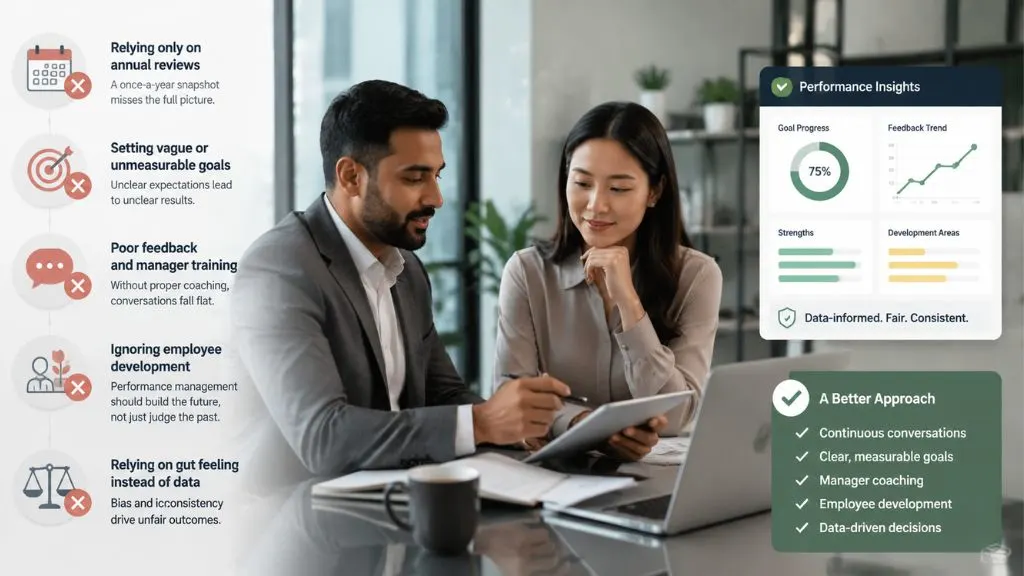
Even well-intentioned performance Supervision efforts can fall flat if they rely on outdated or poorly designed approaches. One of the most widespread mistakes is depending solely on annual reviews. This gives managers and employees only a narrow snapshot of performance across an entire year, missing the full picture of progress, challenges, and growth.
Another significant issue is setting vague or unmeasurable goals. When expectations are unclear from the start, employees have no reliable way to know whether they are succeeding, improving, or falling short. Many organizations also neglect to properly train their managers on how to deliver meaningful and constructive feedback. Without proper coaching, performance conversations become uncomfortable, vague, or entirely superficial.
Ignoring employee development is another critical pitfall. Performance Supervision should not only evaluate past performance but also actively uplift employees toward their future potential. Treating it as a one-way judgment process rather than a collaborative growth dialogue is a missed opportunity that organizations simply cannot afford. Finally, relying on gut feeling instead of data leaves performance management wide open to personal bias, favoritism, and inconsistency. Addressing these mistakes head-on is truly where meaningful performance transformation begins.
How to Build a Performance Management System That Works?
Building an effective performance Supervision system starts with absolute clarity. Every employee should understand their role, key responsibilities, and exactly how their performance will be measured right from day one. Begin by defining company-wide goals at the leadership level, then thoughtfully cascade them down to individual team and employee objectives that feel connected and meaningful.
Create a consistent review cadence, monthly or quarterly check-ins consistently outperform annual reviews by keeping the conversation alive and relevant throughout the year. Invest meaningfully in manager training so that feedback conversations feel constructive, encouraging, and growth-focused rather than stressful or punitive.
Make performance Supervision a genuine two-way conversation. Employees should always have the space and psychological safety to share their own perspectives, surface challenges, and articulate their personal growth aspirations. The best systems create dialogue, not monologue.
Choose digital tools and platforms that automate routine tracking tasks, significantly reduce manual paperwork, and surface meaningful workforce insights without requiring hours of manual analysis. The right employee performance Supervision approach turns raw data into clear, purposeful action and drives real, measurable improvement that the entire organization can see and feel.
Also Read:
How Performance Management Software Boosts Productivity?
8 Performance Management System Pitfalls And How To Fix Them
EmpMonitor: The Smarter Way to Manage Performance:
When it comes to finding the best performance Supervision software, EmpMonitor stands out as a complete, data-driven solution trusted by 15,000+ companies across 100+ countries. It seamlessly combines employee monitoring, productivity tracking, attendance management, and workforce analytics into one powerful and intuitive platform, making performance Supervision more objective, consistent, and genuinely effortless for teams of every size.
Key features that make EmpMonitor a performance management powerhouse:
- Real-Time Activity Monitoring: Track exactly what employees are working on throughout the day with live visibility, no guesswork, just clear and actionable data at your fingertips.
- Productivity Calculation: Automatically calculate productive versus idle time across your entire workforce to identify high-performers and spot employees who may need additional coaching or support.
- Attendance & Time Tracking: Monitor clock-ins, clock-outs, shift adherence, and leave patterns with effortless accuracy and zero manual effort.
- Live Screencasting & Recording: A newly launched feature that delivers instant visibility into remote and hybrid team workflows, keeping managers informed without micromanaging.
- URL & App Tracking: Understand precisely which tools, platforms, and websites employees spend their working hours on and make smarter decisions based on that insight.
- Insightful Real-Time Dashboard: Access a comprehensive, easy-to-read dashboard with team-wide and individual performance metrics updated in real time.
- Task & Project Management: Create, assign, and track tasks and projects all within the same unified platform, improving team collaboration and deadline adherence.
- Data Security & Privacy Protection: All workforce performance data is securely stored in a protected database, ensuring complete confidentiality and compliance at all times.
Visit EmpMonitor to explore flexible pricing plans starting at just $3/user/month and claim your free trial today.
Performance Management in the Age of Remote Work:
Remote and hybrid work has fundamentally changed what effective performance management looks like in practice. Managers can no longer rely on physical presence or visible desk activity as a reliable proxy for productivity and output. This significant shift has made data-driven performance Supervision more essential, and more urgent, than it has ever been before.
Organizations now need tools that deliver clear visibility into employee activity without feeling invasive or creating a culture of mistrust. Clear, structured communication becomes even more critical when teams are spread across different time zones and working environments. Virtual check-ins must thoughtfully replace the spontaneous hallway conversations of office life, and written feedback needs to be more deliberate, specific, and empathetic than ever before.
Performance Supervision in a remote context also needs to account for employee well-being and work-life balance. Burnout among remote workers is a very real and measurable performance killer that organizations ignore at their peril.
The right performance management systems bridge the gap between remote autonomy and organizational accountability, giving both managers and employees exactly what they need to perform, connect, and genuinely thrive in a flexible, modern work environment.
The Role of Data in Modern Performance Management:
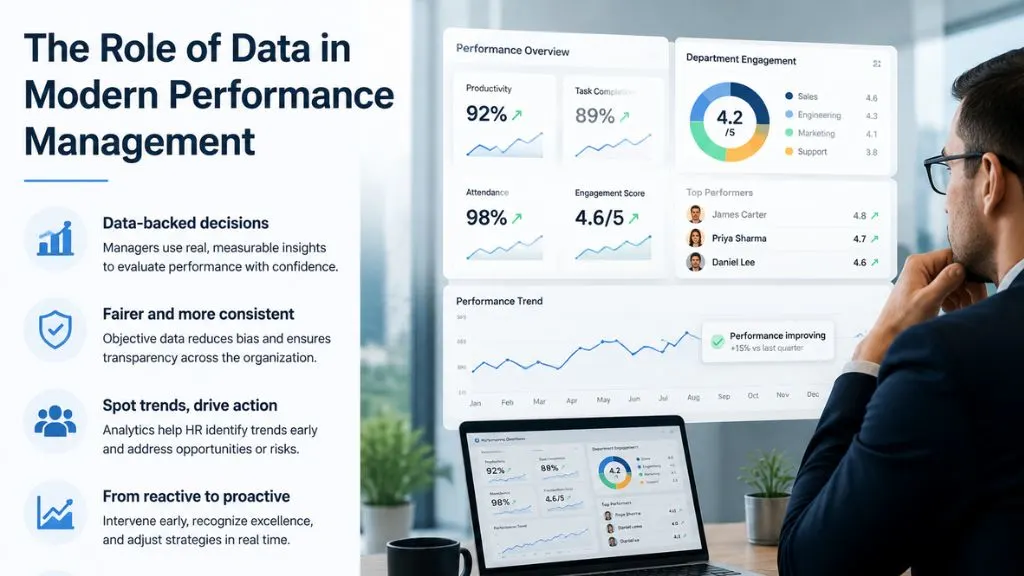
Data is fundamentally transforming the way forward-thinking organizations approach performance management. The era of purely subjective, feeling-based evaluations is rapidly coming to an end. Today, managers can confidently back their performance assessments with concrete, verifiable data productivity metrics, attendance records, task completion rates, application usage patterns, and real-time engagement scores.
This data-driven shift makes performance management significantly more fair, more consistent, and far more credible in the eyes of employees. People feel less vulnerable to personal bias and favoritism when they know their performance is being measured against objective, transparent numbers rather than a manager’s subjective impression.
Analytics also empower HR teams to identify broader workforce trends that might otherwise go unnoticed, such as specific departments showing signs of declining engagement, or teams that are consistently exceeding their performance targets and deserve formal recognition. Data-driven performance management transforms leadership from a reactive position to a proactive one.
Rather than waiting for problems to become critical, managers can intervene early, recognize patterns, and adjust strategies before performance suffers at scale. Whether it’s celebrating a standout performer, addressing a quiet productivity dip, or restructuring a team goal, reliable data turns performance management from an administrative burden into a true strategic growth lever for the entire business.
How Performance Management Drives Employee Retention?
One of the most underappreciated benefits of strong performance management is its direct and powerful impact on employee retention. When employees receive regular, meaningful feedback and feel that their growth is genuinely valued by the organization, they are far less likely to seek opportunities elsewhere. Performance Supervision creates a sense of purpose and direction that goes well beyond the day-to-day job description.
Employees who participate in structured goal-setting conversations feel more ownership over their work and more connected to the company’s mission. When their achievements are consistently recognized through the performance Supervision process, whether through formal evaluations, salary adjustments, or simple manager acknowledgment, loyalty naturally follows.
On the other hand, organizations with weak or neglected performance management tend to experience higher attrition rates, lower morale, and a damaging cycle of losing their best talent to competitors who prioritize employee development. Retention is not just about salaries and perks; it is fundamentally about whether employees feel seen, supported, and challenged to grow. A well-designed performance Supervision culture delivers all three, making it one of the most cost-effective investments any organization can make in its people and its future.
Conclusion:
Great performance management is not a one-time event; it is a living, breathing process that must evolve alongside your team and your business goals. The real secret lies in combining absolute clarity of expectations, continuous and honest feedback, fair and data-backed evaluations, and the right digital tools to hold it all together. When organizations commit to making performance Supervision a genuine strategic priority rather than just a compliance checkbox to tick, they unlock the full, compounded potential of their entire workforce. Whether you are building a startup from scratch or leading a large enterprise team, the right approach to performance management will always be your most sustainable competitive advantage. Start with the basics, stay consistent, let real data guide your decisions, and watch the results follow.
FAQs:
Q1. What is the main goal of performance management?
Ans: To align employee efforts with business objectives and drive consistent growth through structured feedback and evaluation.
Q2. How often should performance reviews be conducted?
Ans: Monthly or quarterly check-ins work best, supported by continuous real-time feedback throughout the year.
Q3. What makes a performance management system effective?
Ans: Clear goals, consistent tracking, fair evaluations, and two-way feedback make any performance management system truly effective.
Q4. How does performance management help remote teams?
Ans: It provides data-driven visibility into productivity and ensures accountability without relying on physical presence.
Q5. Can small businesses benefit from performance management?
Ans: Absolutely. Even small teams gain clarity, motivation, and direction through a simple but consistent performance management process.