
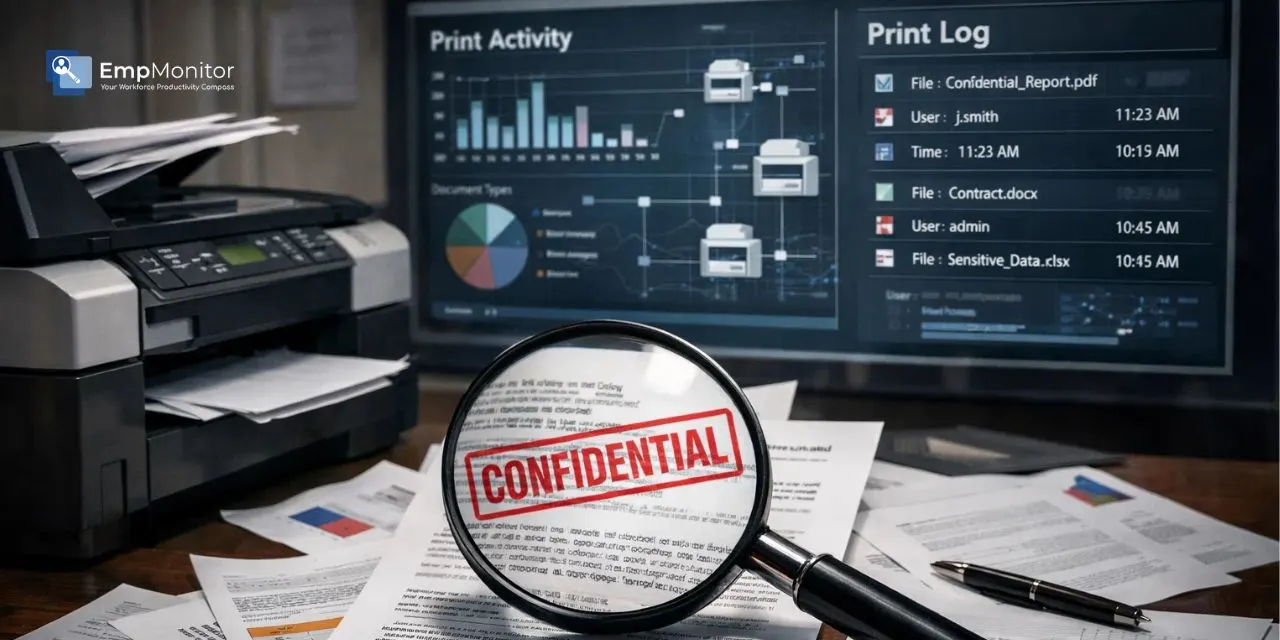
Every organization fears the moment a confidential file lands in the wrong hands, and no one knows how it happened. Employee printed document tracking has become one of the most overlooked yet critical aspects of modern workplace security. Most companies put enormous resources into digital security but leave their print environments completely unmonitored. That is a serious blind spot.
Effective employee printed document tracking closes that gap by giving organizations a clear record of every print job initiated across the workplace. While businesses invest heavily in cybersecurity, physical document leaks continue to cause serious damage. A single printed page containing salary details, client contracts, or trade secrets can cost a company its reputation.
Listen To The Podcast Now!
Why Physical Document Leaks Are Still a Big Problem?
In a world dominated by cloud storage and digital workflows, you might assume paper leaks are a thing of the past. They are not. Employee printed document tracking data consistently shows that printed materials remain a primary channel for internal data theft and accidental exposure.
Many security teams simply do not think to include print environments in their monitoring strategy, which makes it an easy path for insiders looking to extract information undetected. Implementing employee-printed document tracking as part of a broader Employee Monitoring Policy is no longer optional for organizations handling sensitive data.
Employees print sensitive files for meetings, personal reference, or convenience, and those pages often end up left on desks, carried out of the office, or photographed with smartphones. The challenge is that, unlike digital files, printed documents leave no automatic trail unless your organization has a deliberate tracking system in place.
Industries like healthcare, finance, legal, and government face the highest exposure. A misplaced patient record or a printed merger document found in a public trash can can trigger regulatory investigations, lawsuits, and enormous fines. The problem is not just malicious intent; carelessness accounts for a significant share of these incidents, too.
How Physical Document Leaks Actually Happen?
Understanding the root causes of leaks helps organizations build smarter defenses. Employee printed document tracking becomes far more effective when you know where the vulnerabilities lie.
The most common scenarios include employees printing files they are not authorized to access, taking home printed work for convenience, sharing printed reports with unauthorized parties, or simply abandoning documents in shared spaces like printers, conference rooms, or break areas.
Insider threats are particularly dangerous here. A disgruntled employee planning to leave the company may print customer lists or financial records in their final days of employment. Without employee printed document tracking in place, this kind of activity can go completely unnoticed until the damage surfaces weeks or months later.
Contractors and temporary staff also pose a risk. They often have access to sensitive systems but may not be subject to the same level of oversight as permanent employees.
The Role of Print Logs in Identifying the Source:
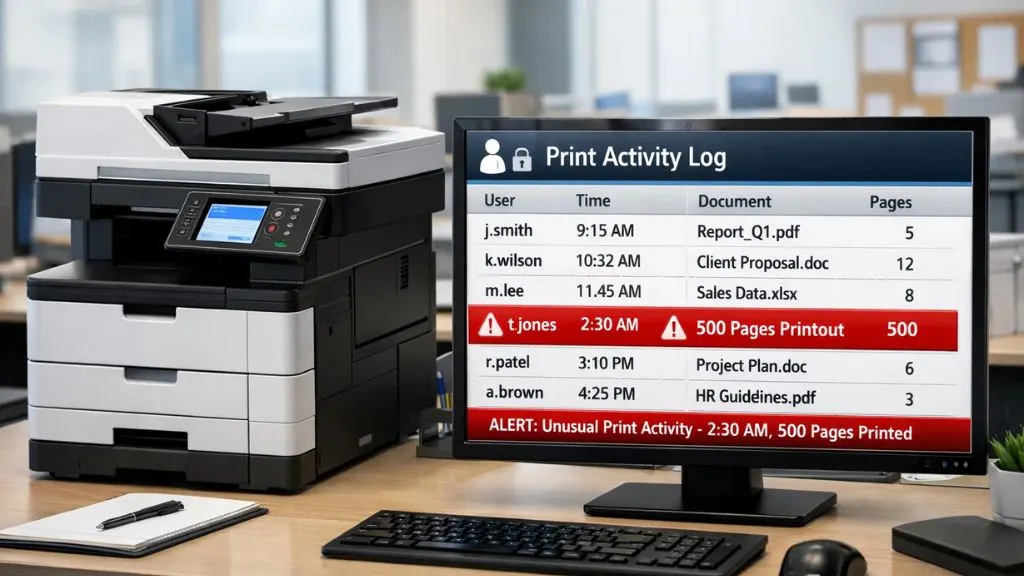
Print logs are the first line of defense in employee printed document tracking. Most modern printers and multifunction devices maintain internal logs that record user identity, document name, number of pages, timestamp, and destination. However, these logs are rarely reviewed proactively; they sit buried in device settings until something goes wrong.
Making print log review a routine process transforms reactive investigation into proactive prevention. When employees know their print activity is being recorded and periodically reviewed, they are far less likely to misuse printing privileges.
IT administrators should configure printers to require user authentication before printing. This removes the risk of documents being printed anonymously. Combined with centralized print management software, organizations can get a real-time view of all print activity across every device in the network.
Employee printed document tracking through print logs also helps identify unusual behavior patterns, such as an employee printing hundreds of pages overnight or printing files outside their normal job function.
Setting Up a Document Classification System:
One reason physical leaks go undetected for so long is that organizations fail to classify their documents before printing them. Without knowing which documents are sensitive, employees have no clear guidance on what requires extra care.
Employee printed document tracking works best when paired with a strong document classification policy. Documents should be labeled by sensitivity level, for example, Public, Internal, Confidential, and Restricted. Printing rules can then be applied based on classification. Restricted documents might require manager approval before printing, or be watermarked automatically with the printer’s username and timestamp.
Watermarking is particularly powerful. Even if a document leaves the building, the watermark ties it back to the specific employee who printed it. This single measure can be enough to deter intentional leaks and simplify investigations when leaks do occur. When integrated with employee-printed document tracking systems, watermarking creates an unbroken chain of evidence from digital file to physical output.
Document tracking systems that integrate with classification tools allow security teams to monitor which classified files are being sent to print queues, flag unusual activity, and generate detailed audit trails for compliance purposes.
Building a Culture of Print Accountability:
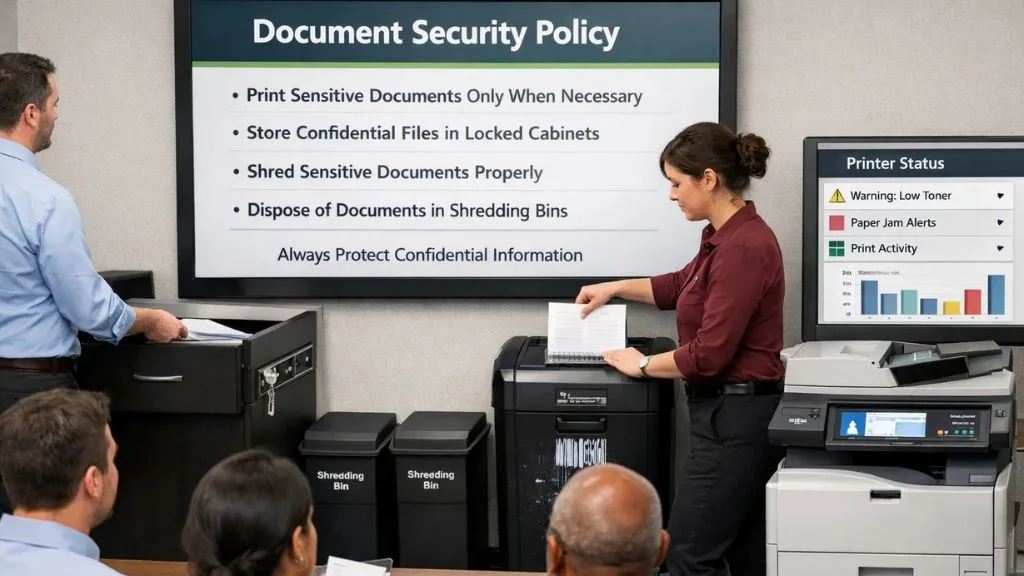
Technology alone cannot stop physical document leaks. Employee printed document tracking needs to be supported by a workplace culture where people understand the value of information security and take personal responsibility for the materials they handle. A monitoring system is only as effective as the human behaviors it is designed to reinforce.
This starts with clear, written policies on what can and cannot be printed, who is responsible for collecting documents from shared printers, and how sensitive printed materials should be stored and disposed of. Shredding bins should be readily available, and employees should understand that tossing a printed salary sheet in a recycling bin is a policy violation.
Regular training helps reinforce these norms. Short, practical sessions on document handling, covering everything from picking up print jobs promptly to locking away sensitive materials, go a long way toward reducing accidental leaks.
Accountability frameworks also matter. When employees know that employee-printed-document tracking is active and that printing unusual volumes or accessing restricted file categories will trigger alerts, behavior naturally becomes more cautious and deliberate.
Using Monitoring Software to Close the Gap:
Even the best policies have gaps. People forget, make mistakes, or sometimes act with bad intent. This is where monitoring software becomes essential for comprehensive employee printed document tracking. Organizations that rely solely on policies without technical controls are essentially operating on the honor system, and that is rarely enough when sensitive data is at stake. Consistent employee printed document tracking through dedicated software creates a verifiable record that supports both security enforcement and regulatory compliance.
Endpoint monitoring tools can track application usage, file access, and device activity, giving security teams visibility into what files employees are opening and sending to printers. Some solutions can detect when a sensitive file is accessed, and a print command is executed within a short time window, flagging this as a potential risk event.
Combining print log data with endpoint monitoring creates a much more complete picture. You can see not just that a document was printed, but which file it was, how the employee accessed it, and what they did before and after printing it. This level of insight is invaluable for both investigation and prevention.
Employee document tracking at this level also supports compliance with regulations like HIPAA, GDPR, and ISO 27001, which require organizations to demonstrate they have controls in place over how sensitive information is accessed and handled.
Also Read:
How EmpMonitor Helps You Track and Prevent Document Leaks?

EmpMonitor is a comprehensive workforce monitoring and productivity management platform trusted by over 15,000 companies across 100+ countries. When it comes to employee tracking, EmpMonitor provides the visibility and control organizations need to stop leaks before they escalate.
Here is how EmpMonitor supports your document security efforts:
- Real-Time Activity Monitoring: Tracks employee activity across applications and devices, helping you spot suspicious behavior around sensitive file access and print activity.
- User Activity Logs: Maintains detailed logs of what files employees interact with, creating a clear audit trail for security investigations.
- Insider Threat Prevention: Identifies unusual access patterns and high-volume file activity that may indicate an employee is gathering information for unauthorized printing or sharing.
- Screenshot Monitoring: Captures periodic or triggered screenshots, providing visual evidence of what was on-screen when a print job was initiated.
- Data Loss Prevention (DLP) Features: Prevents unauthorized transfer of sensitive data via USB devices.
- Productivity & Behavior Analytics: Uses an alert-based mechanism that allows you to create custom rules, triggering notifications based on defined risk levels or detected behavioral anomalies.
EmpMonitor gives security and HR teams the tools to enforce employee printed document tracking policies with real evidence, not just assumptions.
Responding to a Suspected Document Leak:
Despite best efforts, leaks can still happen. When they do, a fast and structured response limits the damage. Employee printed document tracking data becomes your most valuable resource in these moments. Without it, investigations are slow, inconclusive, and often impossible to resolve without resorting to general suspicion. Organizations that have invested in employee printed document tracking are able to pull precise records, timestamps, document names, user accounts, and respond with evidence rather than guesswork.
Start by pulling print logs from the device or devices involved. Cross-reference timestamps with access logs from your monitoring software to identify who accessed the file and when. If your organization uses watermarking, examine the leaked document to trace it back to the print source immediately.
Conduct a discreet internal investigation before escalating. Talk to the employee involved, review their recent activity history, and determine whether the leak was intentional or accidental. Avoid making accusations without evidence, as wrongful accusations carry their own legal risks.
If the leak involves regulated data, such as personal health information or financial records, notify your legal and compliance teams right away. Depending on the regulation, you may have a mandatory reporting window.
Conclusion:
Physical document leaks are a real and ongoing threat that no organization can afford to ignore. Employee printed document tracking, when combined with strong policies, a culture of accountability, and the right monitoring tools, gives businesses a fighting chance at stopping leaks before they cause lasting harm. The cost of implementing a solid tracking program is a fraction of what a single serious data breach can cost in fines, legal fees, and reputation damage.
FAQ’s:
Q1. What is employee printed document tracking?
Ans: It refers to the process of monitoring and recording print activity in the workplace to identify who printed what, when, and in what volume, helping prevent unauthorized document leaks.
Q2. Can print tracking work without special software?
Ans: Basic tracking is possible through native printer logs, but dedicated monitoring software offers far greater detail, automation, and alerting capabilities.
Q3. Is monitoring employee print activity legal?
Ans: In most jurisdictions, yes, provided employees are informed of the monitoring policy. Always consult legal counsel to ensure compliance with local laws.
Q4. How does EmpMonitor help with document security?
Ans: EmpMonitor provides real-time activity monitoring, user behavior analytics, insider threat prevention, and screenshot monitoring, all of which support effective employee printed document tracking.
Q5. What should I do if I suspect an employee leaked a document?
Ans: Pull print and access logs immediately, cross-reference with monitoring data, involve your legal team if regulated data is involved, and document every step of your investigation.