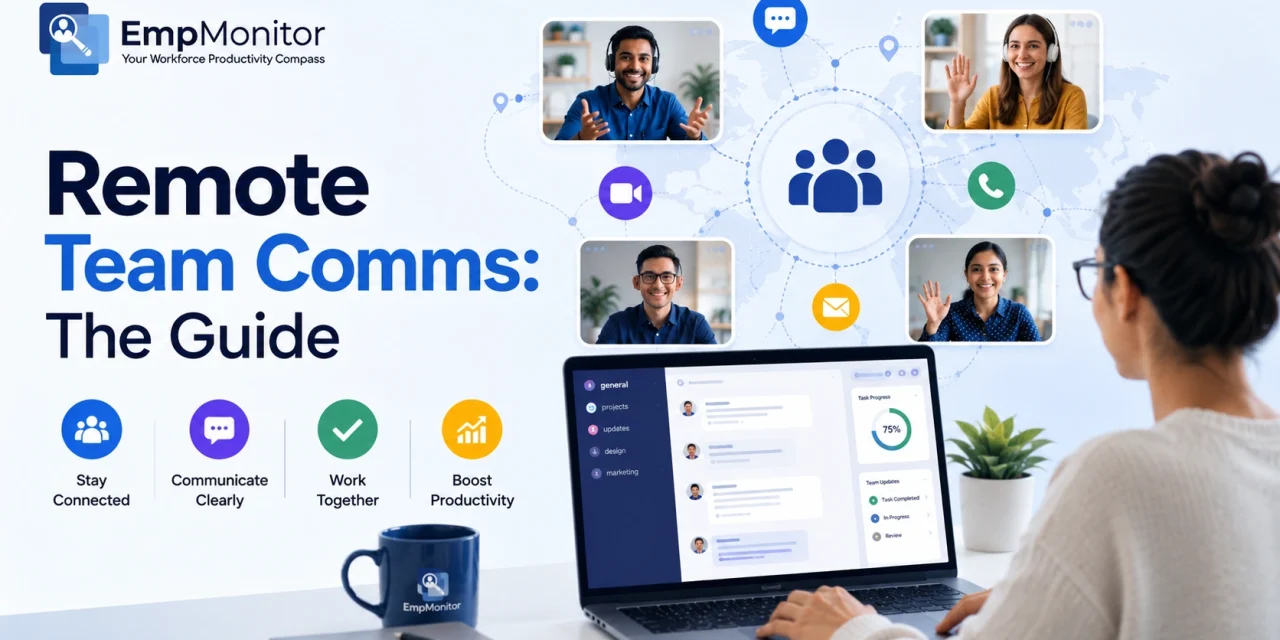
Effective team communication has become one of the biggest challenges for modern businesses. With remote and hybrid work now common across industries, organizations must create clear communication systems that keep employees connected, productive, and aligned.
Even before remote work became mainstream, many organizations had already started building distributed teams. Today, businesses of all sizes rely on remote and hybrid collaboration to improve flexibility, productivity, and global hiring opportunities. If only they had enough resources and time to train every employee for it, the world would have witnessed a shift in the work culture a long, long time ago! It was never a necessity. As distributed teams increasingly rely on digital tools to share ideas and keep projects aligned, an AI presentation maker can help organize updates, training materials, and collaborative plans into clear visual presentations that are easier to communicate across different locations.
The catch?
Most of us still struggle to keep up with effective team communication because we took it for granted when we used to work in the same room pre-lockdown.
And that’s a fact.
Effective team communication takes work. As a leader, you need to make sure that your team has streamlined and transparent communication. Otherwise, they won’t be able to work as a team akin to miscommunication, misunderstandings, internal conflicts, and many more.
Problems with team communication are frustrating. You may assume that your team is working, but you are only spinning your wheels. Your hours of work can go pointless if the right person isn’t available at the right time. It often happens with teams that don’t have an aligned working schedule and lack proper team communication.
Enjoy the Audio Version of This Blog

Recent workplace studies show how important communication has become for modern teams:
• Poor communication continues to be one of the leading causes of workplace delays and productivity issues.
• Remote employees who feel connected to their teams are more engaged and productive.
• Businesses with strong communication cultures experience better employee retention.
• Transparent communication improves collaboration, accountability, and workflow management.
• Hybrid teams rely heavily on clear documentation and async communication to stay aligned.
The statistics are not very surprising. Employee communication is no child’s play. Organizing team meetings and establishing good interpersonal relationships does not imply effective team communication.
Effective team communication means every person in the team knows what to do next. They know where to look up the information they need, and they are aware of the correct way to share the ideas or information.
Alright, that’s a lot of pep talk. Let’s get into how you can actually implement it on your premises now.
Why Talk About Team Communication?
Are Regular Team Meetings Not Enough?
For starters, when team communication breaks down, terrible things happen:
- Meeting deadlines becomes next to impossible.
- Employees lose trust in their leaders.
- You waste hours trying to keep work on track.
- Different teams work in conflicting directions and goals.
- Some employees start duplicating their work while others may start missing them.
- Finished projects do not come off very well in front of the clients.
As annoying as they may sound, these problems are way worse than you can imagine. At worst, they can cost your company thousands of dollars and put innocent jobs at stake.

Make sure that the people share information not only with their team but also with the other parts of the company. Information silos are HUGE suckers. Building healthy and effective team communication gives you plenty of benefits:
- There remain fewer team conflicts.
- You can always estimate accurate project timelines.
- It becomes easier to be creative and discuss ideas more openly.
- You establish employee retention by encouraging honest feedback.
- Teams hit deadlines pretty consistently.
- Finished projects are always the best.
Long story short, you get a hell of a lot done, and your company stays a perfectly sunny place to work.
Sounds dreamy? (I know, right?) Here’s how to do it.
5 Proven Strategies for Effective Team Communication
There are two parts of communication:
→ Expressing your ideas in a way that other people get to understand them;
→ Understanding what other people want to convey to you.
When you lead a team, you have to make sure both of the things are happening regularly. Here are the 05 BEST strategies that make sure your workplace establishes the best team communication:
Suggested Reading
1. Company Culture and Team Assessment
Before you figure out your communication standards, it is helpful to start viewing everything through your company’s lens. Company culture plays a pivotal role in influencing the communication that the manager or the team leader has with their team members.
Company culture is not something that you can label- it’s something that your employees define with their beliefs and behaviors. For instance, if your employee leaves early for the day but works late on the weekends to compensate, it’s a part of your company’s culture!
Your values determine how you work as a team. Companies that believe in work-life balance restrict excessive non-work-related team communication. You can use workforce analytics tools like EmpMonitor to understand productivity patterns, workload distribution, and employee engagement more effectively.
EmpMonitor helps organizations analyze team productivity, work patterns, and operational efficiency through detailed reporting and workforce insights. Get a detailed analysis of your distant team’s whereabouts and draft the perfect communication manifesto that fits into your company’s cultural beliefs.
A Communication Manifesto Answers Questions Like:
- What tools should your organization use to gain and share knowledge?
- When is it acceptable to interrupt an employee’s task to share information or ask questions?
- How quickly should you respond to any queries or questions?
- When to use private or public channels while discussing work?
- Whom to include or exclude from conversations?
2. Identify Your Pain Points
We already discussed your company culture; now, let’s get into why we were discussing it in the first place. Every company faces barriers ahead of it that make it difficult for it to accomplish its tasks.
Here are some of the reasons why team communication is still a HUGE pain for most of us, the first one being pretty obvious:
Remote Work

Whether your organization operates remotely, hybrid, or across multiple locations, maintaining clear communication requires structured workflows and reliable collaboration systems. You cannot rely on meetings, and clearing a single doubt sometimes takes more than an hour. The solution is to change the tools that you use to communicate and to stay in touch 24×7.
Misunderstandings

Occasional misunderstandings are harmless. But if you frequently notice that you say one thing and your team hears another, there exists an underlying issue. It could be a language or cultural barrier. Your body language and tone of voice might send mixed messages, or maybe everyone is highly distracted for some reason! Get to the root of the situation.
Lack of Information

If your colleagues frequently come back asking for more details on projects, it’s a sign that you are not giving them enough information at the start. Even when you buy a bookshelf, it comes with detailed instructions for assembly. Contrary to this, managers often hand off work without sufficient detail in a hurry. Taking a few extra minutes to get back to the basics is no big deal.
Information Bottlenecks

When there is only one person (preferably the boss) with all the information, they need to be available to everyone else at all times. Such a person is known as an information bottleneck. Other people go dysfunctional until they get a response to their questions from them. It usually happens by accident but tends to continue for ages and millennia.
Once you understand the barriers that hinder your team’s communication, it will be more feasible for you to rectify them. Read ahead to know how.
3. Encourage Open and Transparent Communication

To get your team to communicate better, you have to become a better communicator among them first. Team members gradually pick up and learn behavior from their leaders. Altering your own skills is tough- but it is worth giving a shot. Be prepared to polish your communication for a better foreseeable future for your teams.
Make communication a team goal. Treat it as a priority, ask everyone specifically about their ideas, and take them seriously. When you do so, employees get the impression that you care about them and start feeling more open in expressing their thoughts.
Take Feedback Gracefully
Effective team communication demands honesty. And you can never expect honesty if you react poorly to negative feedback and criticism. Ask your staff if they are getting enough resources and time to finish their assigned tasks. Ask them to be honest about the workplace’s shortcomings- so that you can start working on them ASAP.
Make Meetings Effective
Keep things short and crisp- never stretch your meetings for too long- especially with distant teams. Nobody would work for those 25 minutes of video call- make sure that the outcome is worth everyone’s sacrifice. Keep an eye on your team’s work and schedule a meeting during their idle hours when they are doing their least urgent tasks.
4. Invest In Communication Technologies
This point is as obvious as the noonday sun.
Communication tools are inevitable in maintaining a healthy distant workforce. You cannot rely entirely on video calls, team meetings, and face-to-face communication. You have to invest a few dollars in the required tools as well.
However, getting a new piece of software won’t magically solve your organization’s team communication issues. You still have to keep a constant check on the pain points and look for effective methods to mend them.
Nevertheless, here’s what you need to cover the basics:
Modern teams also rely on async communication tools like Loom, Notion, and ClickUp to reduce unnecessary meetings and improve collaboration across different time zones.
Chatting Software
Resort to using a single platform for communicating via texts. Make sure that all the employees of your organization create an account on it. Restrict them from using it as their personal accounts and only allow exchanging official documents with these accounts. Make sure you keep a close eye on the official profiles. Platforms like Slack, Microsoft Teams, and Google Chat are widely used for secure workplace communication and team collaboration
Create separate groups, official channels, etc., for clearing doubts, sharing information, assigning tasks, and categorizing the given projects. Also, ask your employees to send regular work updates in task windows or specific groups.
Project Management Software
Project management software will assist you in answering all of your work-related questions. You can always answer questions that come to your head, like:
- How long will the project take to finish?
- What is my next task?
- Which employee is sitting idle?
- Which employee is the most productive?
- Which project is running late?
- Which team member needs my help?
- How do I balance my team’s workflow?
Once you know the answer to all the questions, it becomes a lot easier for you to build a better and more transparent environment for your colleagues.
A transparent and honest environment brings more employee satisfaction and better feedback. As a result, they feel more connected to their organization, and team communication occurs more authoritatively.
Other Handy Tools
You may need a few tools that solve some specific challenges for your teams.
Google Workspace allows teams to collaborate on documents, spreadsheets, presentations, and shared files in real time. Docs and Sheets allow multiple people to edit a doc at the same time. Enterprise administrators can view Google Workspace pricing and choose a subscription plan that suits their team size and company budget. If you have files to share and organize, cloud storage through Box, Dropbox, or even Google Drive is a smart choice. They are secure and provide you with bulk storage. For team meetings and video conferencing, video conferencing platforms like Zoom, Google Meet, and Microsoft Teams support virtual meetings, webinars, and hybrid collaboration.
Recommended Articles
Quiet Quitting Is Growing – Here’s What It Really Means and What to Do About It
5. Promote Friendship and Bonding In Your Team
Removing communication barriers becomes possible with a team that stays close and connected regularly. It becomes easier for people to be honest and open when they trust their teammates.
They learn from each other and collaborate more effectively, so they know who to ask for help. Connect on topics outside of work and give them the freedom to chat. For instance, set up a group yoga class if you find out that your team enjoys yoga.
Start small. Accelerate to something big. Games are a viable mental break, but you have to participate, too. When your employees find you goofy, they feel more connected to your real self. If you don’t participate, you send a subtle message that you don’t approve.
Bonus: Introduce Reflective Listening
A bonus hug and a bonus candy for every reader who was patient enough to stick with me till here! Here’s a reward for you. You can encourage your employees to follow reflective listening.
Reflective listening is a communication strategy in which a listener grasps and understands your said idea gradually. Here’s how they do it:
- Listen to the speaker carefully.
- Think about what the speaker said to you in-depth.
- Repeat back what they said in your own words.
- Ask doubts and have a discussion. Clarify as needed with the same process.
When you teach your employees to use this process, they start analyzing and interpreting your ideas in their own ways. Meaning, they would zone out less in meetings and pay more attention during doubt-clearing sessions. Also, this way, you get more unalloyed inputs and get to look at an idea from multiple points of view.
The Final Steps
Are you ready to start working on your team communication?
Managing remote and hybrid teams requires strong leadership, clear workflows, and consistent communication practices, and we are no less proud of ourselves for doing it right. Get started with your communication manifesto TODAY. Start working on your teams and make the best out of them. Choose a communication issue that you want to tackle next.
Effective communication is now a core part of successful remote and hybrid workplaces. Organizations that invest in transparent communication systems, collaboration tools, and employee engagement strategies build stronger and more productive teams.
As workplaces continue evolving in 2026, companies that prioritize communication will adapt faster, retain better talent, and improve overall business performance.
Use EmpMonitor to analyze your staff’s activities and observe them closely to create your own team communication standards.
FAQs About Remote Team Communication
What is effective team communication?
Effective team communication ensures employees clearly understand goals, responsibilities, deadlines, and workflows while collaborating efficiently.
Why is communication important in remote teams?
Strong communication helps remote teams avoid misunderstandings, improve collaboration, and maintain productivity.
What are the best communication tools for remote teams?
Popular tools include Slack, Microsoft Teams, Zoom, Notion, ClickUp, and Google Workspace.
What is async communication?
Async communication allows employees to communicate without requiring immediate responses, improving flexibility and productivity.
How can managers improve remote communication?
Managers can improve communication by encouraging transparency, documenting workflows, reducing unnecessary meetings, and using collaborative tools.