Burnout rarely announces itself. It doesn’t arrive with a resignation letter or a dramatic breakdown in a team meeting. Most of the time, it builds slowly — one missed deadline, one skipped lunch, one “I’m fine” that wasn’t quite true — until a capable, motivated employee quietly crosses a line they can’t walk back from.
The numbers behind this are hard to ignore. According to Gallup, 76% of employees experience burnout at work at least some of the time. Nearly a quarter report feeling burned out very often or always. And here’s the part that should concern every manager and HR leader: most of those employees won’t tell you they’re struggling. They’ll just gradually stop performing, stop engaging, and eventually stop showing up — physically or mentally.
For businesses, the downstream cost is significant. Burned-out employees are 63% more likely to take unplanned sick days. The resulting productivity losses cost the US workforce alone approximately $47.6 billion annually. Beyond the numbers, burnout quietly erodes team culture, raises turnover risk, and puts your highest performers — the ones who push hardest — at the greatest danger.
The good news is that burnout is preventable, and the signs of employee burnout are visible long before the situation becomes a crisis — if you know what you’re looking for and have the right tools to act on what you see. This guide walks through what those signs look like in practice, why they’re so easy to miss, and how a platform like EmpMonitor can give managers the visibility they need to step in early.
What Employee Burnout Actually Looks Like at Work?

The clinical definition of burnout — emotional, physical, and mental exhaustion caused by prolonged, unmanaged stress — is accurate but abstract. In practice, burnout looks a lot more specific, and a lot more human.
It might look like a software engineer who stops asking questions in sprint planning. A customer service rep whose response times have quietly doubled. A high-performing team lead who’s started missing small details they never would have missed six months ago. None of these look like a crisis in isolation. That’s exactly why burnout is so easy to miss.
According to the World Health Organization, burnout is characterized by three core dimensions: energy depletion or exhaustion, increased mental distance from one’s job, and reduced professional effectiveness. In a workplace context, those three dimensions produce a recognizable, if gradual, set of behavioral and performance changes.
Signs of Employee Burnout: What Managers Should Watch For
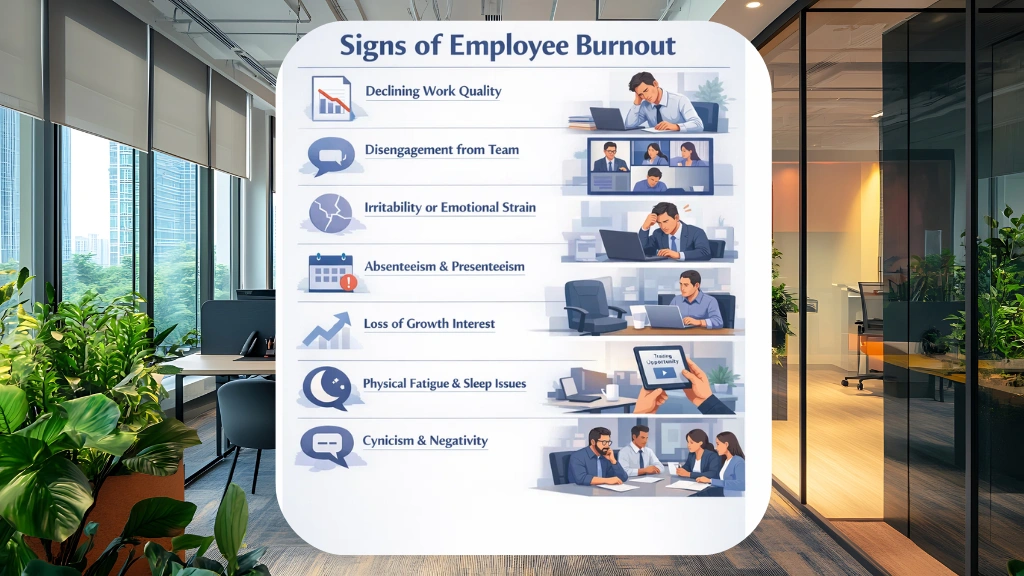
Recognizing employee burnout signs early is the difference between catching a problem while it’s still manageable and dealing with the fallout of losing a key team member. Here are the most consistent and telling indicators.
1. A Noticeable Drop in Output Quality or Speed
One of the earliest and most reliable signs your employee is heading for burnout is a shift in their work quality. This isn’t about occasional off days — everyone has those. It’s about a sustained pattern: deadlines being pushed, submissions requiring more revisions than usual, or work that lacks the care and attention the person normally brings.
Employees experiencing burnout often describe their thinking as foggy. Decisions that once felt straightforward feel heavy. Priorities that were previously obvious become hard to sort. This cognitive slowdown shows up in the work before it shows up in any conversation, which is why tracking output patterns over time is so valuable.
2. Disengagement from Team Interactions
Burned-out employees tend to retreat. They stop contributing ideas in meetings they once led. They respond to Slack messages with two words where they’d previously written two paragraphs. They skip optional team calls and grow quiet in channels that used to see them regularly.
Donald Cardarelli, a professor of management at Syracuse University, notes that sudden silence among previously vocal, feedback-seeking high performers is a particularly strong signal. The employees most engaged with their work are often the most visibly affected when burnout starts to set in — because the contrast is so sharp.
This disengagement isn’t laziness. It’s withdrawal — and it tends to accelerate if left unaddressed.
3. Increased Irritability or Emotional Reactivity
Burnout depletes the emotional reserves that help people navigate stress, disagreement, and frustration with composure. As those reserves run low, small friction points start producing outsized reactions. A routine piece of feedback lands badly. A scheduling change creates disproportionate frustration. A colleague’s mistake becomes a flashpoint.
This irritability can damage working relationships quickly, making it harder for the burned-out employee to get the support they actually need — and creating a secondary layer of stress on top of the original one.
4. Absenteeism and Presenteeism
Increased unplanned absences are a well-documented employee burnout sign. Burned-out employees are significantly more likely to call in sick, often because the stress has begun to manifest as physical symptoms — headaches, disrupted sleep, lowered immune function, digestive issues — that make functioning difficult.
But absenteeism’s quieter counterpart, presenteeism, is equally damaging and harder to track. This is when an employee shows up but is mentally elsewhere — going through the motions, producing minimal work, and consuming time without generating meaningful output. Without data on actual productivity levels, presenteeism is nearly invisible to managers.
5. Loss of Interest in Growth or Development
Motivated employees ask questions. They seek feedback. They volunteer for new projects, express interest in learning opportunities, and talk about where they want to go in their careers. When those behaviors stop — when an employee who once chased development suddenly seems indifferent to it — it often signals something deeper than a change in priorities.
Burnout is frequently linked to a loss of purpose. When work starts feeling meaningless rather than purposeful, the interest in growing within it naturally fades. This is one of the more subtle signs of burnout, but it’s a reliable one.
6. Physical Symptoms and Sleep Disruption
Burnout isn’t just a mental state — it has real physical consequences. Prolonged stress suppresses the immune system, disrupts sleep cycles, causes muscle tension, and contributes to conditions like chronic headaches and digestive problems. Employees who frequently mention fatigue, poor sleep, or physical discomfort are flagging something that deserves attention, not just a sympathetic nod.
Changes in sleeping patterns are particularly telling. Employees may report difficulty falling asleep despite exhaustion, waking frequently during the night, or oversleeping without feeling rested. Any of these can create a feedback loop where poor sleep worsens cognitive function, which worsens work performance, which increases stress.
7. Cynicism and Negativity Toward the Organization
When employees begin expressing consistent skepticism about the company’s direction, leadership decisions, or their own role’s value, it’s worth investigating the root cause. Occasional frustration is normal. But sustained cynicism — a creeping belief that nothing will improve, that their contributions don’t matter, or that the organization doesn’t care about them — is a significant employee burnout sign.
This negativity can spread. A burned-out team member in a low-trust, high-stress state can gradually shift the emotional tone of an entire team, making it harder for others to stay motivated and engaged.
Also Read:
Employee Burnout Causes, Symptoms, & How To Prevent It In 2025
7 Minute Employee Burnout Signs You Might Be Overlooking
Why Signs of Burnout Are So Easy to Miss — and Why That’s a Problem

The reason burnout so often goes undetected isn’t managerial negligence. It’s that the signs are gradual, often ambiguous, and frequently masked by employees who don’t want to be seen as struggling.
In many workplace cultures, there’s a lingering stigma around admitting mental health difficulties. Employees may soften their language, saying they’re “a bit overwhelmed” or “just tired” rather than naming what’s actually happening. A manager who takes those phrases at face value — without following up on what specifically is creating that overwhelm — will miss the window to intervene.
The early signs of employee burnout also mimic other things: a temporary workload spike, a bad week, a personal stressor outside of work. Without trend data over time, it’s genuinely difficult to tell the difference between someone having a rough patch and someone whose reserves are running critically low.
This is where objective data becomes essential. Gut instinct and good intentions matter, but they’re not enough on their own. Managers who lead distributed or large teams especially need systems that surface behavioral patterns before they become crises.
How EmpMonitor Helps Managers Spot and Address Employee Burnout Signs?
EmpMonitor is a workforce management and employee monitoring platform built for the realities of modern work — distributed teams, hybrid setups, and the challenge of maintaining visibility without resorting to micromanagement. Its core strength, in the context of burnout, is this: it gives managers access to objective behavioral data that reveals patterns human observation alone would miss.
The goal isn’t surveillance. It’s awareness — the kind that lets managers support their teams meaningfully rather than reactively.
Productivity Monitoring That Reveals Real Trends
EmpMonitor tracks how employees spend their working hours — which applications they’re using, how long they’re spending on specific tasks, and what their productivity scores look like over time. When a previously high-performing employee’s output starts dipping consistently across a two- or three-week window, that trend appears clearly in the data.
This matters because it removes the ambiguity. Instead of wondering whether someone is having a rough week or genuinely struggling, managers have a factual baseline to work from — which makes conversations easier, more specific, and far more supportive.
Time Tracking and Attendance Patterns
EmpMonitor automatically logs when employees start and stop working, tracks hours across shifts, and flags attendance anomalies. A pattern of late starts, early endings, or an uptick in sick day requests over several weeks can be an early indicator that something’s wrong. Catching that pattern at week three is very different from catching it at week ten.
For remote employees, especially, this kind of visibility is critical. Without physical presence, managers have very few passive signals to work with. EmpMonitor fills that gap without requiring constant manual check-ins.
Live Dashboard for Real-Time Team Visibility
EmpMonitor’s live dashboard gives managers a real-time snapshot of who’s working, what they’re working on, and how their productivity compares to their own recent averages. This isn’t about monitoring in an intrusive sense — it’s about having enough context to notice when something seems off, without having to schedule a meeting to find out.
A manager who can see at a glance that a key team member has been minimally active for three consecutive days has the information they need to reach out proactively — before the employee reaches a breaking point.
Screenshot Capture for Contextual Insight
For teams working on complex or high-stakes projects, EmpMonitor’s automated screenshot feature provides a visual record of work activity during designated hours. This can help managers understand not just how much time is being spent but also on what, which can surface signs of distraction or difficulty that productivity scores alone might not fully explain.
Access to screenshot data is restricted to authorized managers and HR personnel, with full audit trails maintained for compliance and privacy accountability.
Geolocation and Field Team Monitoring
For organizations with field-based employees, burnout can be especially hard to detect because there’s even less direct contact. EmpMonitor’s geolocation tracking gives managers visibility into where field employees are checking in from, how their movement patterns are changing over time, and whether their activity levels are consistent with their responsibilities.
HRMS Integration for a Complete People Picture
EmpMonitor integrates with HRMS platforms to connect workforce monitoring data with employee records, leave history, payroll information, and performance reviews. This integration means HR teams don’t have to piece together a burnout picture from disconnected sources — they can see a unified, comprehensive view of each employee’s health and history.
For HR leaders trying to identify systemic burnout risks — specific departments, roles, or managers with consistently high stress indicators — this connected data view is invaluable.
Using Monitoring Data to Support Employees — Not Scrutinize Them
Any discussion of workforce monitoring tools needs to address the ethical dimension honestly. Data about employee activity is only useful if it’s used in the service of the employee’s wellbeing, not as ammunition for performance management conversations.
EmpMonitor is designed with this in mind. Its monitoring functions are active only during designated work hours. Sensitive data — screenshots, keystroke logs, app usage records — is accessible only to authorized personnel and maintained with clear data governance protocols. The system supports compliance with data protection standards and gives employees transparency into what is being tracked.
The critical factor, though, is how managers choose to use what they see. Spotting a burnout pattern in the data should prompt a supportive conversation, not a disciplinary one. The data gives managers the knowledge to act early. What they do with that knowledge determines whether it actually helps.
When employees know that monitoring is used to support them — to catch problems before they escalate, to adjust workloads fairly, to recognize when someone needs relief — the tool becomes part of a culture of care rather than a culture of control.
What to Do When You Spot the Signs Your Employee Is Heading for Burnout
Identifying the signs of burnout is only the first step. What comes next matters just as much.
The most important thing a manager can do is open a conversation — not a performance review, not a productivity audit, but a genuine, low-pressure check-in where the employee feels safe being honest. Ask open questions: What’s been feeling heavy lately? Is your workload manageable right now? Is there anything I can do to make things easier?
From there, practical interventions often include workload adjustment, schedule flexibility, or connecting the employee with mental health resources and counseling services. Some employees need a few lighter weeks. Others need a longer break. Some benefit most from clearer boundaries or a mentor to talk things through with. There’s no universal solution — which is why the conversation matters so much.
Organizationally, preventing burnout requires more than reactive support. It requires building a culture where work-life boundaries are respected, recognition is consistent, and employees feel safe raising concerns before they become crises. When leadership models healthy behavior — taking time off, setting limits, being open about their own challenges — it sets a tone that makes it easier for everyone else to do the same.
Conclusion
Burnout rarely disappears on its own. Left unaddressed, it deepens — reducing productivity, damaging relationships, driving absenteeism, and ultimately pushing your best people out the door. The employees most likely to burn out are often the most committed ones, because they’re the ones who push through warning signs the longest before finally hitting a wall.
Spotting the signs of employee burnout early gives managers and HR teams the window to make a real difference. That requires two things working together: the human skills to notice behavioral changes and have honest conversations, and the data infrastructure to surface patterns that observation alone would miss.
EmpMonitor brings that data infrastructure within reach — giving managers the visibility they need to lead attentively, make informed decisions, and step in before burnout becomes a crisis. Not to monitor employees more closely, but to understand their teams more fully.
Because the organizations that take employee wellbeing seriously don’t just retain better talent — they build the kind of workplace where people actually want to do their best work.
FAQs
1. What are the early signs of employee burnout?
Early signs include a noticeable drop in work quality or speed, disengagement from team interactions, increased irritability, absenteeism or presenteeism, loss of interest in growth, physical symptoms like fatigue or sleep disruption, and cynicism toward the organization. Monitoring trends over time helps identify burnout before it escalates.
2. How can managers detect burnout in remote employees?
Managers can detect burnout in remote teams by observing patterns in productivity, attendance, and communication. Tools like EmpMonitor provide objective insights such as app usage, task completion rates, and attendance anomalies — giving managers data to spot early warning signs even without physical presence.
3. How does EmpMonitor help prevent employee burnout?
EmpMonitor provides managers with real-time dashboards, productivity scores, automated screenshots, and attendance tracking. This data allows managers to intervene early with support, workload adjustments, or wellness initiatives — helping prevent burnout before it becomes severe.