
Creative agencies thrive on flexibility and accountability. It attracts top talent, fuels original thinking, and keeps the work fresh. But flexibility without accountability can slowly create operational problems. Deadlines begin to slip, workloads become uneven, and billing accuracy suffers. That was exactly the challenge a growing creative agency faced.
As the agency expanded its client roster and began working with more remote creatives, its informal systems started breaking down. Hours were not clearly tracked, workloads were difficult to balance, and revenue gaps appeared in client billing.
This case study explores how EmpMonitor helped the agency create a balance between creative freedom and operational visibility, allowing leadership to manage teams more effectively while maintaining the culture that made the company successful.
The Background: A Studio Built on Creative Freedom:
The agency is a mid-sized creative studio specializing in brand identity, digital campaigns, and content production. Its team consists of around 35 in-house employees and more than 20 remote freelancers working across multiple client projects.
From the beginning, the company believed great creative work requires flexibility. Instead of strict schedules, the team worked with:
- Flexible work hours
- Outcome-focused project check-ins
- Minimal management layers
For several years, this structure worked well. Designers, strategists, and copywriters produced high-quality campaigns for clients across retail, technology, and healthcare sectors.
However, as the agency grew and began handling larger client retainers, leadership realized that flexibility needed to be supported with better visibility.
Managers struggled to answer basic operational questions such as:
- Who is working on which project?
- How much time is actually spent on each task?
- Are workloads evenly distributed?
Without clear data, decision-making became increasingly difficult.
It’s becoming harder to ignore.
The Problem: When Flexibility Starts to Cost You:
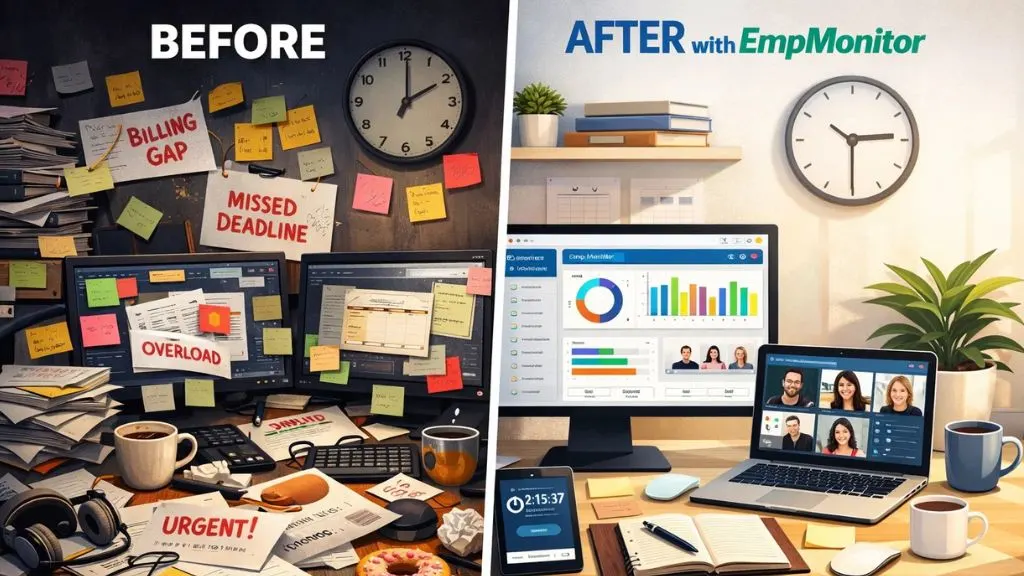
The agency relied heavily on self-reported timesheets and manual project estimates. While this system worked in the early stages, it began causing problems as the team expanded.
Three major challenges repeatedly surfaced.
Billing Gaps:
Client invoices were often based on estimated hours rather than verified work time. This sometimes led to billing disputes and made revenue forecasting less reliable.
Missed Deadlines:
Without visibility into active workloads, project managers occasionally assigned tasks to already overloaded team members. As a result, deadlines were missed or pushed back.
Workload Imbalance:
Some employees were handling multiple projects simultaneously, while others had available capacity. Since managers lacked accurate productivity data, these imbalances were difficult to identify.
Leadership wanted to solve these problems without introducing micromanagement or damaging the agency’s creative culture.
They needed a solution that could provide operational clarity while still allowing the team to work independently.
The Discovery: Why They Chose EmpMonitor?
After evaluating several workforce management platforms, the operations team selected EmpMonitor.
The decision was based on one key factor: real-time workforce visibility without intrusive monitoring practices.
EmpMonitor provided features that aligned with the agency’s workflow:
- Real-time dashboard showing active, idle, and offline employees
- Automated time and attendance tracking to replace manual timesheets
- URL and application monitoring to understand how work hours were spent
- Productivity reports for both individuals and teams
Another important advantage was cross-platform compatibility, allowing the software to run on both Windows and Mac devices used by the creative team.
The pricing model also allowed the agency to scale easily as it continued to add freelancers and remote contributors.
The Implementation: Getting Creatives On Board:
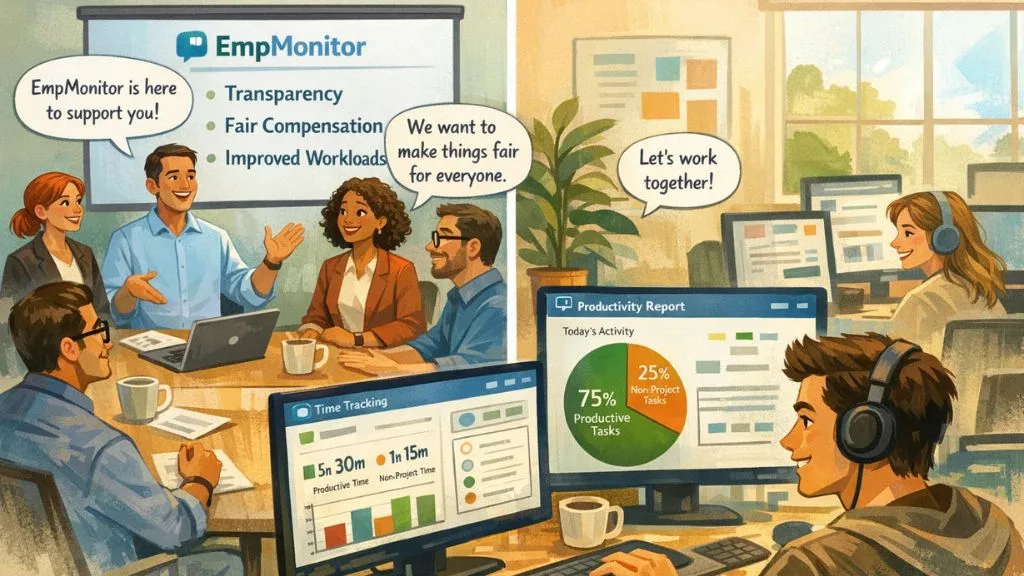
Rolling out productivity tracking software inside a creative environment required careful communication.
Leadership approached the process in phases.
Phase 1: Transparent Communication:
Before installing the software, management held a company-wide meeting explaining the purpose of the new system.
The focus was not surveillance but operational improvement:
- Fairer workload distribution
- Accurate billing for client projects
- Better visibility for managers
Because the reasoning was clearly explained, the team showed minimal resistance.
Phase 2: Establishing Baseline Data
Once EmpMonitor was deployed, the agency began collecting baseline productivity data.
Early insights revealed:
- Average productive work time was around 5.1 hours per day within an eight-hour schedule.
- Significant time was lost to frequent tool switching and non-project browsing during peak hours.
Instead of blaming employees, leadership used this data to identify workflow inefficiencies.
Phase 3: Turning Insights Into Action
Within the first two months, managers began using productivity reports during weekly planning sessions.
This helped them:
- Balance workloads across the team
- Assign tasks based on available capacity
- Identify workflow bottlenecks
In one example, a designer consistently showed low afternoon activity. The data revealed the issue was not disengagement but delays in client feedback loops. After adjusting approval timelines, the designer’s productivity improved quickly.
EmpMonitor also replaced manual timesheets with automated attendance tracking. This allowed the accounts team to generate invoices based on actual logged project hours, eliminating most billing corrections.
The Results: Flexibility and Accountability, Finally Working Together:
Within 90 days of full deployment, the results were measurable across every department.
|
Metric |
Result |
|
Productivity Increase |
32% |
|
Billing Accuracy |
91% |
|
Fewer Missed Deadlines |
45% |
|
Hours Saved Monthly by HR |
18 hrs |
Productivity climbed because teams had clarity, not pressure. Designers knew what was expected, could track their own output in real time, and felt motivated to perform consistently. The sense of fairness increased, high performers were recognized, and lower-engagement team members received structured coaching rather than vague feedback.
Billing accuracy jumped to 91%, saving the agency from ongoing revenue leakage. With EmpMonitor’s time tracking tied directly to project codes, client reports became transparent and audit-ready. One major retainer client actually increased their monthly spend after seeing the agency’s detailed productivity data during a quarterly review.
HR reclaimed nearly 18 hours per month that had previously been lost to manual timesheet reconciliation. Those hours were reinvested into onboarding new freelancers and designing a structured skills development program. Across every metric, flexibility and accountability had stopped working against each other and started driving results together.
EmpMonitor Features That Made the Difference:
1. Real-Time Dashboard: Live view of active, idle, and offline team members across both office and remote setups
2. Automated Attendance Tracking: Replaced unreliable manual timesheets with verified clock-in and clock-out records.
3. Productivity Scoring: Automated calculation of productive versus idle time for every employee
4. URL & App Tracking: Helped managers understand which tools and sites were consuming the most working hours
5. Individual & Team Reports: Enabled data-driven performance reviews and workload planning.
6. Insider Threat Prevention: Added a layer of data security as the agency handled confidential brand assets for enterprise clients.
The Takeaway: Structure Is Not the Enemy of Creativity:
Creative teams often worry that monitoring tools will restrict innovation or signal distrust.
However, this case shows the opposite.
When implemented transparently and used responsibly, EmpMonitor helped the agency build an operational structure that supported flexibility instead of limiting it.
With better visibility and accurate data, leadership can now:
- Manage projects more efficiently
- Maintain fair workloads across the team
- Provide transparent client reporting
Most importantly, the agency preserved the creative culture that originally made it successful while gaining the operational clarity needed to scale.
FAQ’s:
Q1. Can EmpMonitor work for creative teams with flexible schedules?
Ans: Yes. EmpMonitor tracks actual active hours regardless of when employees start or end their day, making it ideal for flexible work environments where standard 9-to-5 schedules do not apply.
Q2. Will employees feel monitored rather than trusted?
Ans: Transparent communication during rollout is key. Most teams respond positively when they understand the tool supports fair workloads and accurate billing, not individual penalties.
Q3. How does EmpMonitor handle remote freelancers?
Ans: EmpMonitor supports cross-platform devices, allowing agencies to monitor both in-house staff and remote contributors within the same unified dashboard.