
Flexible work schedule management has become one of the most valuable workplace skills for managers and HR teams. Employees want greater control over when they work, while organizations still need accountability, collaboration, and consistent results.
That balance is not always easy to achieve. Give people complete freedom without structure, and confusion follows. Create too many rules, and flexibility loses its value. The organizations that succeed understand that flexible work schedule management is not about tracking every minute. It is about building systems that support both autonomy and performance.
Read Aloud!
What Is a Flexible Work Schedule, Really?
A flexible work schedule allows employees to adjust their start and end times or work outside traditional 9-to-5 hours while still meeting required hours or performance expectations.
Unlike remote work, which focuses on where work happens, flexible scheduling focuses on when work happens. Someone can work flexible hours from an office, home, or a combination of both.
Many employees ask, “how does flex time work for employees?” In most cases, organizations establish core hours when everyone should be available. Outside those hours, employees have flexibility to arrange their schedules around personal needs, productivity preferences, or family responsibilities.
Effective flexible work schedule management ensures that flexibility benefits employees without disrupting business operations.
The 5 Most Common Flexible Schedule Models (And When to Use Each)
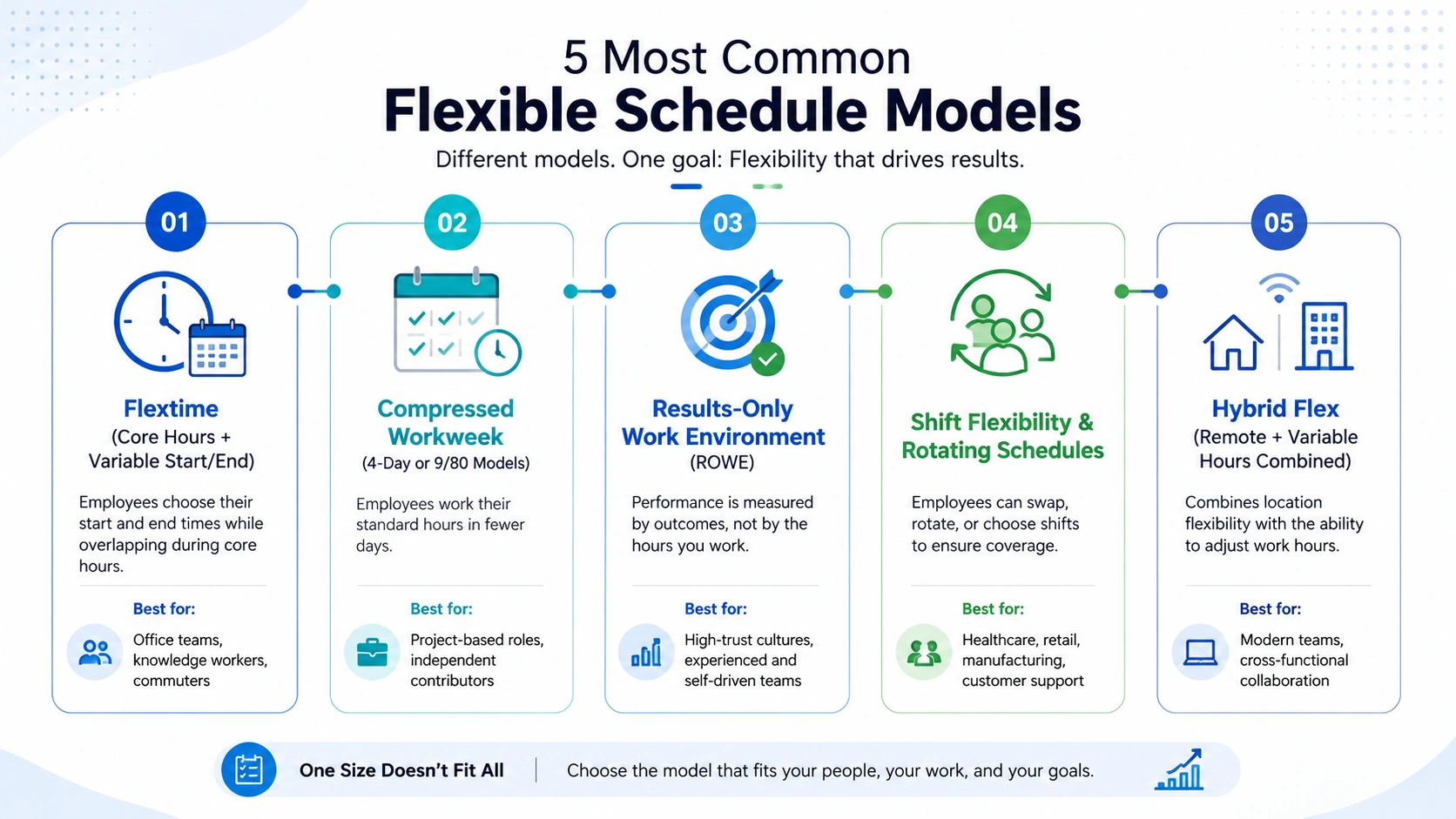
Flextime (Core Hours + Variable Start/End)
This is the most common model. Employees choose when to start and finish their workday while remaining available during designated core hours.
It works particularly well for office teams, knowledge workers, and organizations with employees across different commuting schedules. Successful flexible work schedule management in this model depends on clear communication and shared availability windows.
Compressed Workweek (4-Day or 9/80 Models)
Employees work their standard weekly hours in fewer days. A common example is four 10-hour workdays instead of five 8-hour days.
Many employees appreciate the additional day off, but managers must ensure workloads remain realistic. This model often suits project-based roles and independent contributors.
Results-Only Work Environment (ROWE)
In a ROWE structure, performance matters more than schedules. Employees are evaluated based on outcomes rather than hours worked.
This approach requires strong trust and measurable goals. Flexible work schedule management becomes heavily focused on deliverables instead of attendance.
Shift Flexibility and Rotating Schedules
Industries such as healthcare, retail, and customer support often require continuous coverage.
Employees may swap shifts, rotate schedules, or select preferred work periods. Strong employee schedule tracking becomes essential to avoid staffing gaps and scheduling conflicts.
Hybrid Flex (Remote + Variable Hours Combined)
This model combines location flexibility with schedule flexibility.
It can deliver exceptional employee satisfaction, but it also introduces coordination challenges. Teams often rely on flexible work schedule software to keep schedules visible and maintain alignment across departments.
Why Managing Flex Schedules Is Harder Than It Looks
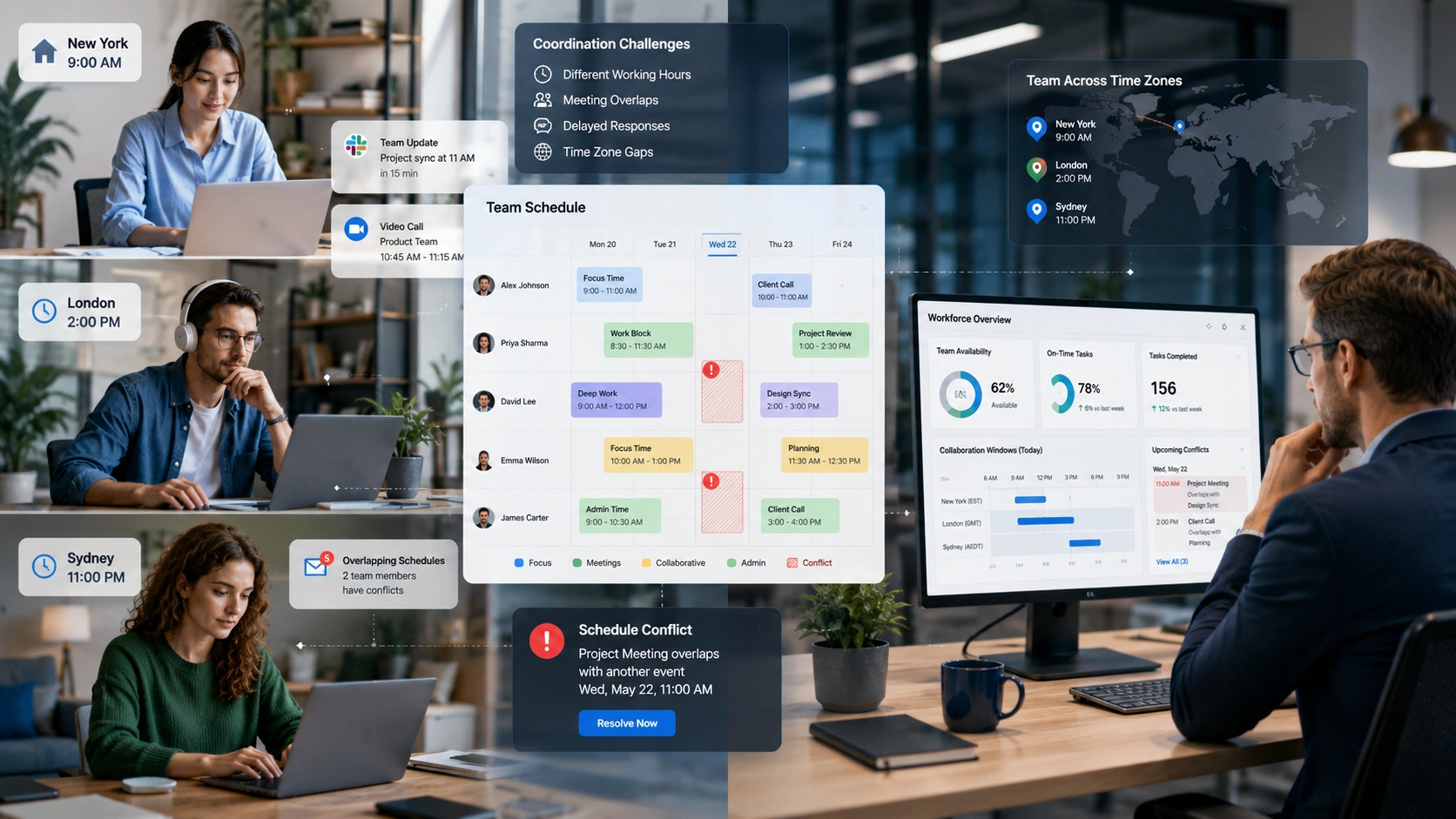
Many leaders support flexibility in theory. The challenge begins when they try to manage it at scale.
The first issue is visibility. Managers can no longer rely on seeing employees at their desks to understand progress. Without proper systems, it becomes difficult to know whether projects are moving forward.
Coordination creates another challenge. Team members working different hours may miss meetings, delay decisions, or struggle to collaborate efficiently.
Perceptions of fairness can also create tension. Employees working fixed schedules may feel flexibility is being distributed unevenly.
Research from organizations such as Gallup and SHRM consistently shows that flexibility can improve engagement and retention. Yet those benefits only appear when flexible work schedule management includes clear expectations and accountability structures.
How to Actually Manage Flexible Work Schedules (A Practical Framework)
Step 1: Define What “Flexible” Means for Your Team
Many organizations make flexibility too vague.
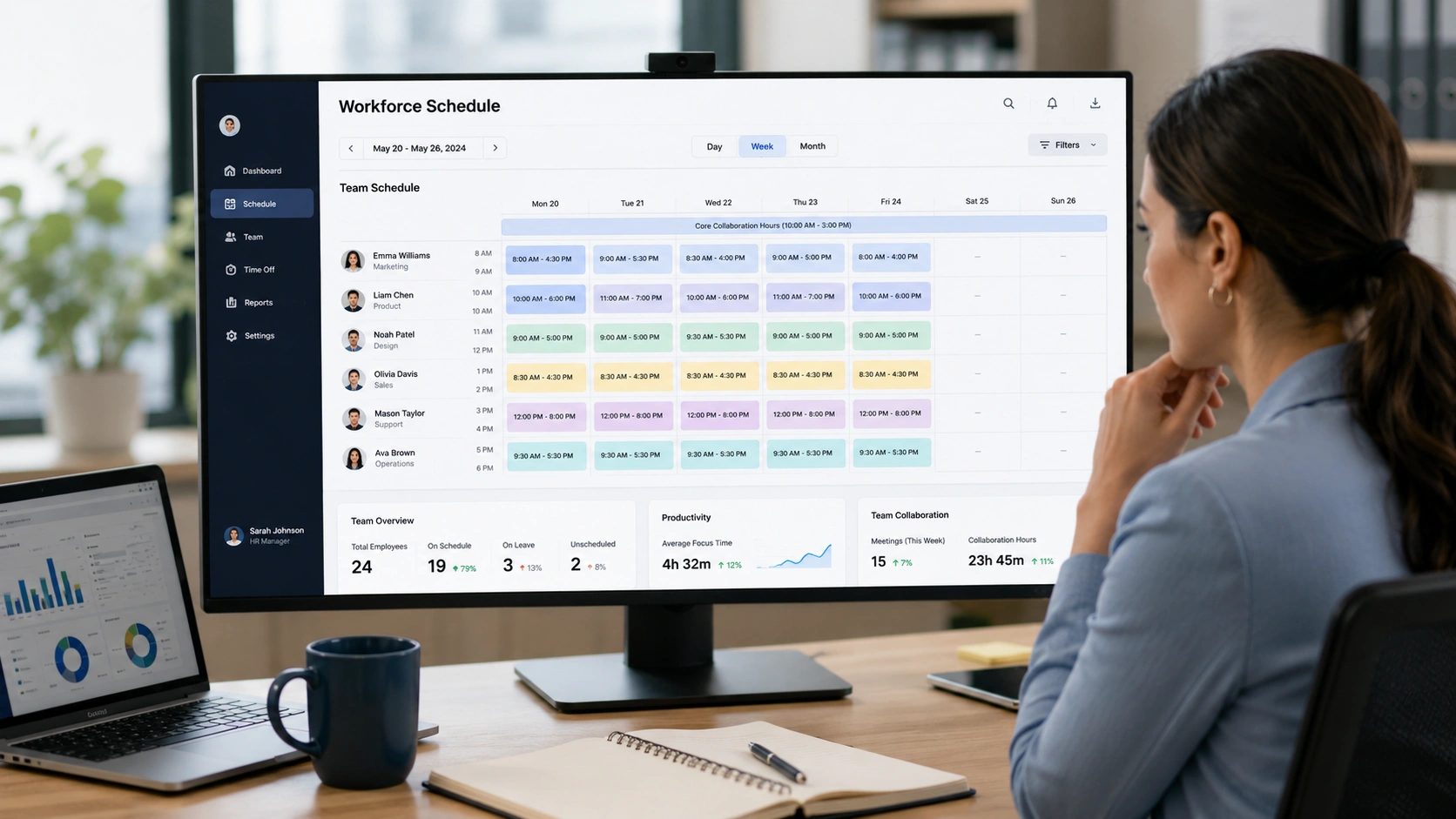
Start by identifying core collaboration hours. Determine when employees must be available and which activities require real-time participation.
Strong flexible work schedule management begins with clear boundaries rather than unlimited freedom.
Step 2: Build a Scheduling Policy, Not Just Guidelines
A policy creates consistency across teams.
Include approval processes, eligibility requirements, communication expectations, scheduling procedures, and performance standards. Document how schedule changes are requested and approved. You can use tools like Tiger Form to create employee schedule request forms to streamline submissions and improve transparency.
This reduces confusion and helps managers apply flexibility fairly.
Step 3: Set Output Expectations, Not Just Hour Expectations
Employees should understand exactly what success looks like.
Instead of focusing exclusively on hours worked, establish measurable outcomes. Weekly goals, project milestones, and performance metrics provide far better visibility than simple attendance records.
This shift is often the biggest improvement organizations make in their flexible work schedule management strategy.
Step 4: Choose the Right Tools for Visibility Without Surveillance
Technology should support transparency, not create anxiety.
When evaluating flex time tracking software, look for features that provide schedule visibility, attendance records, productivity insights, and reporting capabilities without encouraging excessive monitoring. These tools can also help teams maintain financial records, including details related to a prepaid amortization schedule, when integrated with broader business management systems.
Managers exploring how to track employees on flexible hours should focus on outcomes, trends, and workload balance rather than minute-by-minute oversight.
Step 5: Review and Adjust Regularly
Workforces change. Business needs change.
Schedule quarterly reviews to gather employee feedback, identify bottlenecks, and refine scheduling policies. Flexible work schedule management works best when treated as an evolving process rather than a one-time initiative.
The Mistakes That Quietly Kill Flexible Schedule Programs
Not every role can operate with the same level of flexibility.
One common mistake is applying identical scheduling rules to positions with very different responsibilities. Customer-facing roles often require more structure than independent project work.
Another issue is measuring hours while ignoring results. Employees quickly notice when productivity matters less than visibility.
Teams also struggle when there are no shared overlap hours. Flexibility improves individual productivity, but collaboration still requires connection points.
Inconsistent management creates additional problems. If one employee receives flexibility while another does not, resentment can develop quickly.
Finally, many organizations assume employees naturally know how to manage flexible schedules. Time management, communication, and prioritization skills often require guidance and training.
How EmpMonitor Helps You Manage Flexible Teams Without the Guesswork
One of the biggest concerns surrounding flexible work schedule management is maintaining visibility without creating a culture of distrust.
EmpMonitor helps bridge that gap by providing managers with meaningful workforce insights while allowing employees to retain schedule flexibility.
Key capabilities include:
- Automated time tracking across different work schedules
- Productivity insights that reveal patterns without constant supervision
- Attendance and shift management for flexible and fixed employees
- Reporting dashboards for operational visibility
- Idle time detection and work-hour records for compliance support
- Integration capabilities for remote and hybrid work environments
Organizations using flexible work schedule software often discover that better visibility leads to greater trust, not less.
The goal is not surveillance. It is clarity. Managers gain confidence in the system, and employees gain confidence that performance is evaluated fairly.
Also Read!
How A Hybrid Company Improved Accountability Without Micromanagement
The Psychology Behind Why Flexible Schedules Succeed or Fail
The strongest flexible programs are built on more than policies and technology.
According to Self-Determination Theory, autonomy is a major driver of motivation. Employees generally perform better when they have meaningful control over how they work.
Trust acts as the foundation of successful flexible work schedule management. When employees feel trusted, engagement often rises. When managers feel informed, anxiety tends to decrease.
Interestingly, flexibility can also create stress. Some employees thrive with complete freedom, while others struggle without structure. Too many choices can make prioritization harder.
High-performing flexible teams usually rely on shared rituals. Regular check-ins, planning sessions, and communication routines create stability without excessive rules.
Generational preferences add another layer. Many Gen Z employees prioritize flexibility as an expectation, while Millennials often focus on flexibility as a tool for balancing personal and professional responsibilities.
Frequently Asked Questions About Flexible Work Schedule Management
How does flex time work for employees on hourly contracts?
Hourly employees typically record the actual hours they work while remaining within approved scheduling guidelines. Employers still need accurate records for payroll and compliance purposes.
What’s the difference between flex time and a compressed workweek?
Flex time allows employees to vary daily schedules. A compressed workweek reduces the number of workdays while maintaining the same total hours.
How do you track employees on flexible hours fairly?
Use consistent reporting standards, measurable goals, and transparent attendance systems. Fair tracking focuses on expectations that apply equally across similar roles.
Can flexible schedules hurt team collaboration?
They can if overlap hours are not established. Most successful teams maintain shared availability periods for meetings, decisions, and collaborative work.
What should a flexible work schedule policy include?
A policy should define eligibility, scheduling expectations, communication requirements, approval procedures, performance standards, and review processes.
How do managers measure productivity with flexible employees?
Productivity should be evaluated through outcomes, project completion, quality standards, customer satisfaction, and agreed performance metrics.
How to Manage Flexible Work Schedules?
Manage flexible work schedules by setting clear expectations, defining core working hours, tracking results instead of time alone, and using scheduling tools to maintain visibility. Regular communication and consistent policies help teams stay productive while giving employees the flexibility they need.
What tools are best for managing flexible employee schedules?
Organizations often combine scheduling platforms, project management systems, collaboration tools, and employee schedule tracking solutions to maintain visibility and coordination.