
Every manager has been there. You walk into Monday morning, check the attendance log, and suddenly, half your team is out. One person is sick, another has a family emergency, and a third simply didn’t show up. By noon, the rest of the team is stretched thin, morale is dipping, and productivity has taken a hit that won’t be easy to recover from.
Employee absenteeism is one of those problems that quietly drains organizations from the inside. It rarely makes headlines, but its impact on culture, output, and profit is very real. The good news? Most absenteeism is preventable, not through stricter rules or disciplinary action, but through smarter leadership and a workplace people actually want to show up to.
This guide walks you through 10 proven strategies to reduce employee absenteeism in a way that’s sustainable, human-centered, and built to last.
Tap to listen
What Is Employee Absenteeism? (Absenteeism Definition Explained)
At its core, employee performance is the habitual pattern of being absent from work without a valid reason, or being absent far more frequently than normal. It goes beyond the occasional sick day or approved vacation. Absenteeism, in HR terms, refers to unplanned, recurring, or excessive absence that disrupts operations and signals a deeper issue within the workplace.
Types of absenteeism can be broadly divided into two categories:
- Planned absences, pre-approved leave, scheduled medical appointments, maternity or paternity leave. These are expected and manageable.
- Unplanned absences, last-minute call-outs, no-shows, and mental health days taken without notice. These are the ones that create chaos and cost money.
It’s also worth distinguishing absenteeism from presenteeism, a related but different problem where employees show up physically but are mentally checked out. Both are costly, but absenteeism tends to be more visible and measurable.
Understanding what absenteeism actually is, and what it isn’t, matters because the solutions are very different depending on the root cause. Treating a symptom without understanding the disease rarely works.
What Is Considered Excessive Absenteeism in the Workplace?
There’s no universal rule that says “X days absent per year is excessive.” It depends on your industry, company size, and the nature of the roles involved. That said, most HR professionals use a benchmark of around 2–3% as an acceptable absenteeism rate. Once you start creeping toward 5% or higher, it’s a signal worth taking seriously.
Excessive absenteeism generally means an employee is absent significantly more often than their peers, or more than what the business can reasonably accommodate without operational disruption. This could look like:
- Calling in sick every Monday or Friday (a classic pattern)
- Frequently leaving early or arriving late without prior notice
- Taking leave in bursts, just under the threshold that would trigger a formal review
- Being absent on days with high workloads, deadlines, or important meetings
When these patterns emerge, HR should step in, not with a disciplinary reflex, but with a curious and open mindset. More often than not, something is going on beneath the surface.
Industry insight: According to Gallup research, actively disengaged employees miss nearly 37% more work days per year than their engaged counterparts. Absenteeism and engagement are deeply connected.
Why Employee Absenteeism Is a Serious Business Problem
You might be tempted to shrug off a few missed days here and there. But the compounding effect of absenteeism on a business is significant and often underestimated.
The productivity hit is the most obvious consequence. When someone doesn’t show up, someone else has to absorb their work, which leads to overload, burnout, and resentment among the team members who do show up consistently.
The financial cost is substantial, too. The Centers for Disease Control and Prevention (CDC) has estimated that lost productivity from absenteeism costs U.S. employers approximately $225 billion annually. That’s not a rounding error.
Team morale suffers quietly but deeply. When one person keeps disappearing without clear consequences, it breeds resentment and erodes trust. High performers, the people you most want to keep, often start asking themselves why they should give their best when others aren’t even showing up.
And then there’s the long-term risk: unaddressed absenteeism is often a leading indicator of broader workforce problems, toxic culture, poor workforce management, or systemic burnout. If you ignore the warning signs long enough, the problem doesn’t just cost you productivity. It costs you your best people.
Recommended Articles
Measuring Productivity That Matters: An EmpMonitor Client Success Story
How to Create an Effective Goal Tracker (That You’ll Actually Stick To)
Top Causes of Employee Absenteeism You Must Address First
Before you can fix a problem, you have to understand what’s driving it. In most workplaces, absenteeism doesn’t happen in a vacuum. Here are the most common root causes:
Poor workplace culture. Employees who feel undervalued, disrespected, or invisible are far more likely to disengage, and eventually, to simply stop showing up. Culture is the single biggest invisible driver of attendance.
Lack of engagement. When work feels meaningless or disconnected from any larger purpose, it’s easy to rationalize skipping it. Engaged employees miss fewer days, not because of loyalty, but because they genuinely care about what they’re building.
Burnout and mental health. This has accelerated dramatically post-pandemic. Chronic stress, anxiety, and burnout are now among the leading causes of workplace absence globally. And unlike a broken leg, burnout doesn’t always come with an obvious diagnosis.
Weak or toxic management. People don’t leave companies, they leave managers. The same applies to attendance. A manager who micromanages, dismisses concerns, or plays favorites creates an environment where absence becomes a coping mechanism.
Lack of flexibility. Rigid schedules that don’t accommodate life’s realities, doctor’s appointments, school pickups, and personal commitments force employees to use sick days for things that could otherwise be handled without taking a full day off.
The key takeaway: most absenteeism is not about laziness. It’s a symptom of something that needs fixing in your workplace. When you address the root causes, attendance improves naturally.
How to Reduce Employee Absenteeism (Strategic Approach)
Here’s where a lot of companies go wrong: they see high absenteeism and immediately reach for the policy manual. New rules, stricter call-out procedures, point systems, and disciplinary warnings. And for a brief moment, the numbers might improve, because people are scared.
But fear is not a sustainable attendance strategy. The moment fear fades or finds a new outlet (quiet quitting, anyone?), the problem comes back worse than before.
The organizations that genuinely solve absenteeism do it by combining three things: solid data to understand what’s actually happening, a culture that makes people want to be present, and policies that are fair and consistently applied. That combination, data plus culture plus policy, is what the following 10 strategies are built around.
10 Proven Strategies To Reduce Employee Absenteeism
1. Create a Clear Employee Attendance Policy

You can’t manage what you haven’t defined. A well-written attendance policy does more than list the rules; it communicates expectations, defines what counts as an unacceptable absence, and outlines the process when those expectations aren’t met.
The best attendance policies are clear without being punitive. They explain how leave should be reported, what documentation (if any) is required, and how the company will respond to patterns of excessive absence. They also make room for human nuance, acknowledging that life happens and that chronic illness or mental health struggles may require different handling than repeated no-shows.
When employees know exactly where the line is and trust that it’s applied fairly, they’re more likely to respect it. Ambiguity breeds inconsistency, and inconsistency breeds resentment.
2. Offer Flexible Work Options to Reduce Employee Absenteeism

This is one of the highest-impact levers available to modern employers, and it’s still underused.
When people have flexibility, to work from home when they’re under the weather but not incapacitated, to shift their hours to accommodate a school run or a medical appointment, to compress their week when they need a long weekend, they don’t need to take full unplanned days off as often.
Remote and hybrid work models have demonstrated this clearly. Employees who have some control over when and where they work report lower stress levels, fewer sick days, and higher job satisfaction. Offering flexibility isn’t just a perk; it’s a direct investment in attendance and productivity.
3. Improve Workplace Culture to Prevent Excessive Absenteeism

Culture is the invisible architecture of your workplace. You can’t see it directly, but you feel it the moment you walk in the door. And it has an outsized impact on attendance.
A culture built on trust, psychological safety, and genuine respect for employees creates a place people want to be. When someone misses work in a healthy culture, it’s usually because they genuinely can’t come in, not because they can’t stand the thought of being there.
Building that culture requires consistent effort from leadership: transparent communication, following through on commitments, celebrating wins, addressing conflict quickly, and making sure every employee, regardless of level, feels like they matter. It’s not a program. It’s a daily practice.
4. Support Employee Mental Health and Well-being

Mental health is no longer a fringe concern; it’s a mainstream workforce issue, and the numbers bear this out. Stress, anxiety, and depression are now among the top causes of short-term work absences worldwide.
Employers who take mental health seriously, through Employee Assistance Programs (EAPs), access to counseling, mental health days, and open conversations about burnout, see measurable reductions in absenteeism. Not because they’re being generous, but because they’re addressing the actual cause of the problem.
Small signals matter too. Managers who check in genuinely, teams that talk openly about stress, and leadership that models healthy boundaries all create an environment where people feel safe enough to ask for help before they hit the wall. Prevention is almost always cheaper than intervention.
5. Train Managers to Handle Absenteeism Effectively
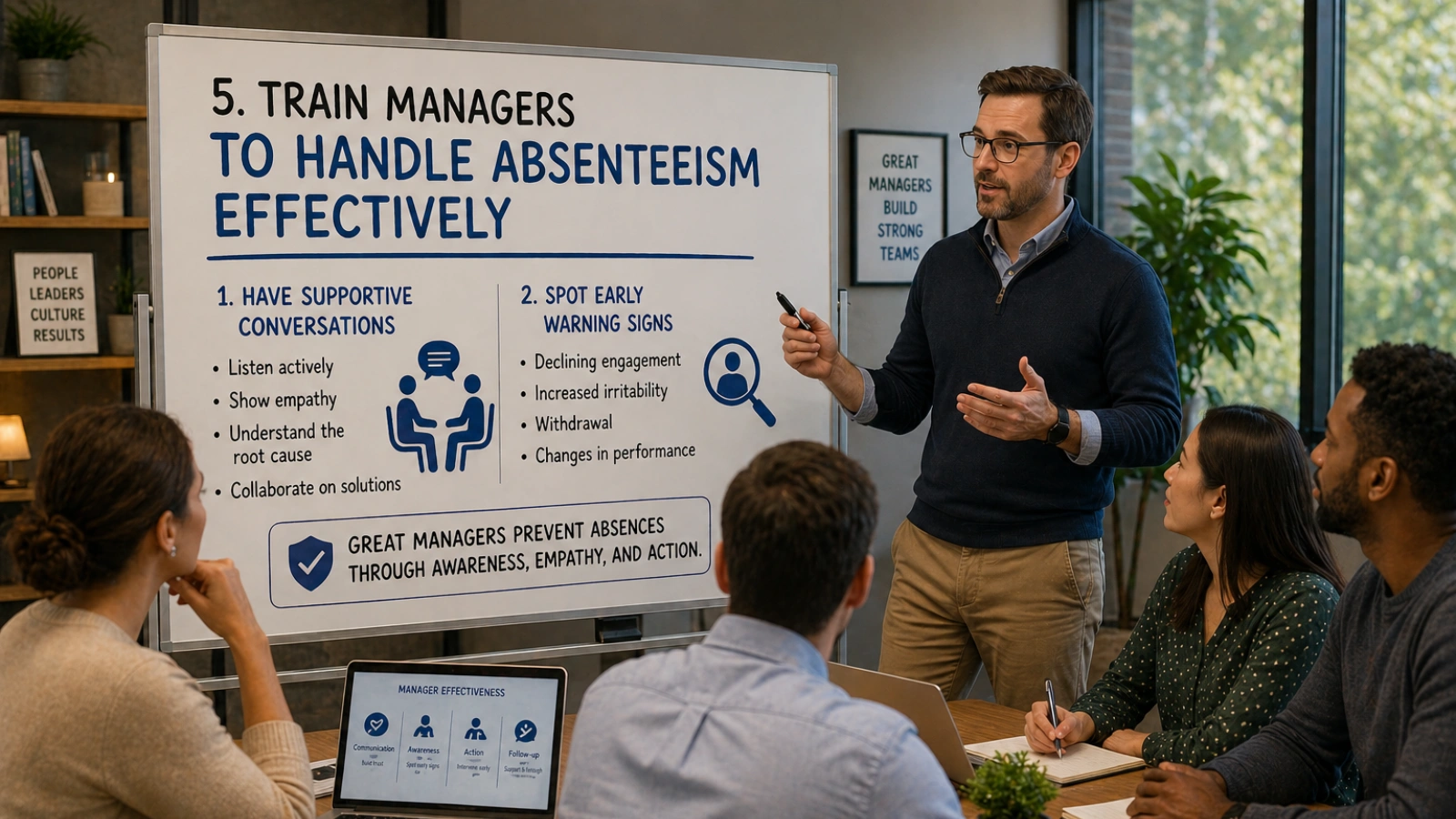
Your managers are the front line of your absenteeism problem, and your best tool for solving it. Research consistently shows that the manager relationship is the most significant predictor of employee engagement, and by extension, attendance.
Managers need training in two distinct areas. First, how to have supportive, non-judgmental conversations with employees who are showing patterns of absence. These conversations, done well, can surface underlying issues and unlock solutions before the situation escalates. Done poorly, they can make the problem worse.
Second, managers need to understand how to spot early warning signs, declining engagement, increased irritability, withdrawal from team interactions, and respond proactively. Absenteeism rarely appears out of nowhere. There are almost always signals that a skilled manager can catch and address.
6. Use Data and Analytics to Track Employee Absenteeism

Gut feeling is not a workforce strategy. If you’re trying to reduce absenteeism without looking at your data, you’re essentially guessing, and expensive guesses tend to produce expensive mistakes.
Modern HRIS platforms make it relatively straightforward to track absence patterns: by department, by manager, by day of the week, by time of year. When you visualize this data, patterns emerge that aren’t obvious at the individual level. Maybe one team consistently has higher Friday absences. Maybe there’s a spike every quarter-end when workloads peak. Maybe certain managers have significantly higher absence rates in their teams than others.
That data is gold. It tells you exactly where to focus your attention and resources, and it gives you a baseline to measure improvement against.
7. Recognize and Reward Good Attendance

Recognition is one of the most underutilized tools in the HR toolkit. People respond to appreciation, genuinely, not performatively. And recognizing good attendance (as part of a broader recognition of reliability and commitment) reinforces the behavior you want to see more of.
This doesn’t have to mean expensive attendance bonuses or elaborate reward programs. It can be as simple as a manager acknowledging, in a team meeting, the person who has been consistently reliable through a difficult stretch. Or a quarterly note from leadership to employees who have exemplified dependability.
What you recognize, you get more of. It’s one of the simplest truths in people management, and one of the most consistently forgotten.
8. Encourage Employee Engagement and Motivation

Engaged employees are present employees. Not because they’re afraid of consequences, but because they’re invested in the work and the team. They show up because they want to.
Building that engagement requires understanding what motivates your people individually. Some are driven by growth and learning opportunities. Others are motivated by autonomy, by impact, by team belonging, or by compensation. A good manager knows their team well enough to understand what matters to each person, and structures their approach accordingly.
Regular one-on-ones, meaningful feedback, opportunities to take on new challenges, and genuine investment in career development all contribute to an environment where people feel valued and motivated. That feeling is the antidote to disengagement, and disengagement is one of the biggest drivers of absenteeism.
9. Address Workplace Issues Quickly

Unresolved conflict is a slow poison in any team. When interpersonal issues, unfair treatment, or toxic behaviors are allowed to fester, people find ways to avoid the environment that’s making them uncomfortable, and one of the easiest ways to do that is to simply not show up.
Leaders and managers need to be willing to have uncomfortable conversations early, before small grievances become deep resentments. This means taking complaints seriously, investigating fairly, and resolving issues visibly enough that employees trust the process.
Open communication channels, anonymous feedback tools, regular pulse surveys, and an open-door policy that actually functions as one help surface issues before they become attendance crises. People who feel heard are far less likely to vote with their feet.
10. Implement Return-to-Work Interviews
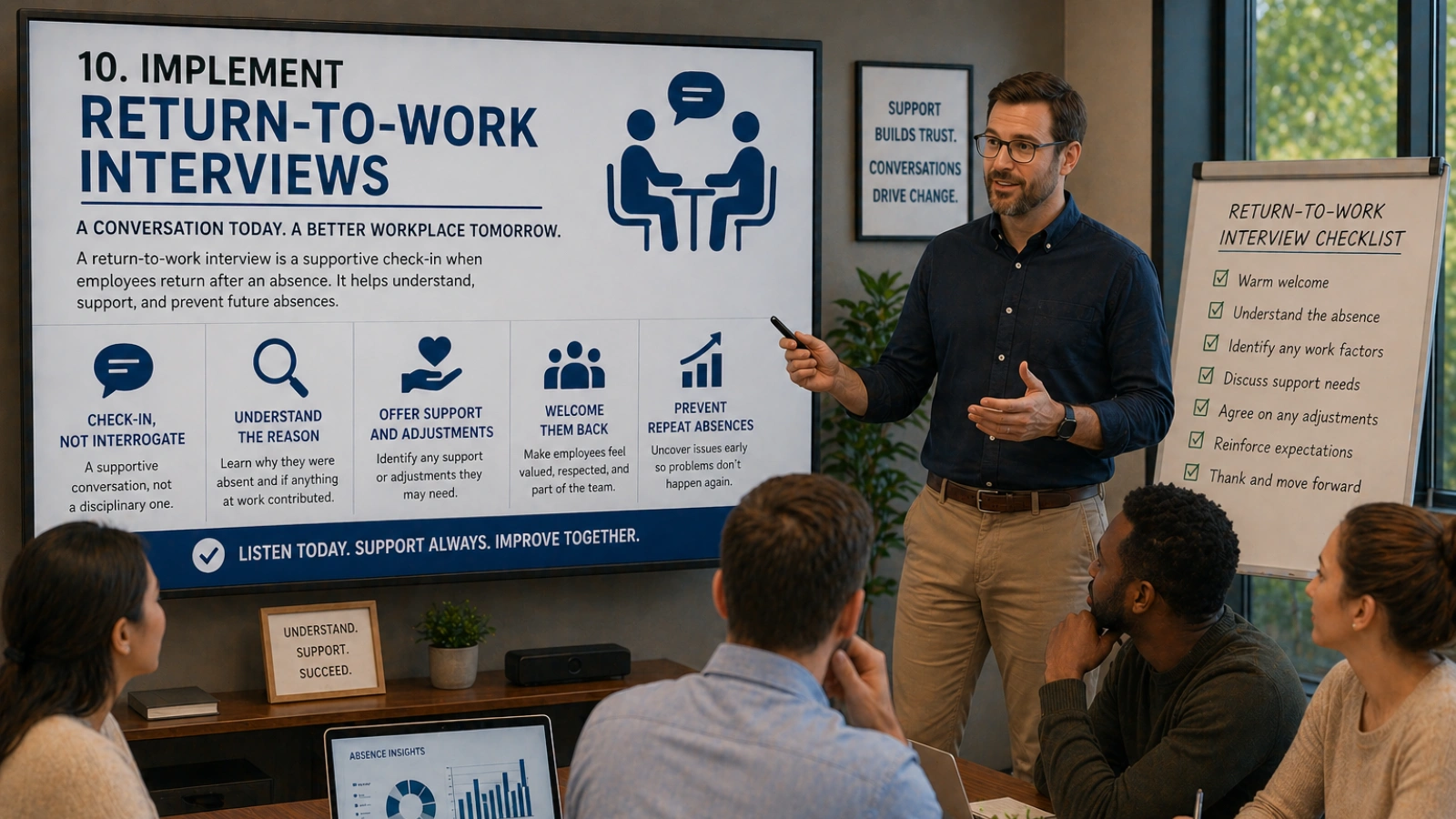
This is one of the most consistently effective tools for reducing repeat absenteeism, and it’s criminally underused.
A return-to-work interview is a brief, structured conversation between a manager and an employee when they come back after a period of absence. It’s not an interrogation, it’s a check-in. The goal is to understand why the employee was absent, whether anything in the workplace contributed to it, whether they need any support or adjustments going forward, and to make sure they feel welcomed back rather than treated with suspicion.
These conversations do two things simultaneously. They send a clear signal that attendance is noticed and valued. And they uncover information that would otherwise stay hidden, the manager who’s been making someone’s life difficult, the role that’s become overwhelming, the health condition that needs accommodation. That information allows you to act before the same problem repeats.
How to Measure and Monitor Employee Absenteeism Rates
You can’t improve what you don’t measure. Fortunately, absenteeism is one of the more straightforward workforce metrics to calculate.
The standard absenteeism formula is: (Number of unplanned absences ÷ Total available workdays) × 100
For example, if an employee missed 8 days out of 240 available working days, their individual absenteeism rate is 3.3%. Aggregate this across your team or organization to identify patterns.
Track this monthly, not just annually, so you can spot seasonal trends or emerging problems early. Benchmark against your industry average to understand whether your numbers are typical or concerning. And always segment by department, team, and manager, the aggregate often hides the most important signal.
Use Employee Monitoring Tools to Reduce Absenteeism
One of the most effective ways to reduce employee absenteeism is by using smart monitoring and productivity tools like EmpMonitor. These tools give you real-time visibility into employee activity, helping you identify attendance patterns, productivity gaps, and potential issues before they become serious problems.
Instead of relying on guesswork, businesses can use data-driven insights to make better decisions, improve accountability, and create a more productive work environment.
Key Features of EmpMonitor
Here are some of the most useful features that help reduce absenteeism and improve workforce productivity:
1. Time Tracking & Attendance Monitoring
Track employee work hours, login/logout times, and attendance records accurately. This helps identify patterns of excessive absenteeism and late arrivals.
2. Real-Time Activity Monitoring
Get insights into employee activities, including app usage, website visits, and active/idle time. Managers can quickly spot disengagement or inefficiencies.
3. Automated Screenshots & Screen Recording
Capture screen activity at intervals to understand work behavior and ensure accountability without constant supervision.
4. Productivity Reports & Analytics
Generate detailed reports showing productive vs idle time, helping HR teams make data-driven decisions.
5. Live Screen Monitoring
View employee screens in real time to ensure work is on track and provide instant support when needed.
6. Project & Task Management
Assign tasks, track progress, and manage workloads efficiently to avoid burnout—a major cause of absenteeism.
7. Insider Threat & Data Security
Monitor suspicious activities and protect company data from misuse or internal threats.
8. Alerts & Notifications
Get instant alerts for inactivity, unusual behavior, or policy violations, allowing quick action.
Use Smart Monitoring Tools to Reduce Absenteeism
Managing absenteeism becomes much easier when you have the right data. Tools like EmpMonitor help businesses track employee activity, attendance, and productivity in real time, so you can identify issues early and take action before they grow.
Instead of relying on guesswork, these tools provide clear insights into work patterns, helping managers make smarter decisions, improve accountability, and build a more productive workplace.
Key Features of EmpMonitor
Time Tracking & Attendance Monitoring: Accurately track work hours, login/logout times, and attendance trends.
Real-Time Activity Monitoring: Monitor app usage, website activity, and idle time to understand engagement levels.
Automated Screenshots & Screen Recording: Capture work activity to ensure transparency and accountability.
Productivity Reports & Analytics: Get detailed insights into productive vs idle time for better decision-making.
Live Screen Monitoring: View employee screens in real time and provide instant support when needed.
Project & Task Management: Assign tasks, track progress, and balance workloads to prevent burnout.
Data Security & Insider Threat Detection: Protect sensitive company data by identifying unusual or risky behavior.
Alerts & Notifications: Receive instant alerts for inactivity or policy violations.
Final Thoughts: Reducing Employee Absenteeism Requires Strategy, Not Just Rules
If there’s one thing this guide should leave you with, it’s this: employee absenteeism is rarely just an attendance problem. It’s a people problem, and it requires a people-first solution.
The organizations that successfully reduce absenteeism over the long term are the ones that invest in their culture, their managers, their employees’ well-being, and their data. They don’t rely on fear or rigid policies. They build workplaces where showing up is something people want to do.
That’s not a soft goal. It’s a measurable, strategic, and highly achievable one. Start with one or two of the strategies above, track your results, and build from there. The investment pays off in ways that show up not just in attendance records, but in engagement scores, retention rates, and ultimately, your bottom line.
FAQs About Employee Absenteeism
What is employee absenteeism?
Employee absenteeism refers to the pattern of an employee being frequently or excessively absent from work without a valid reason or prior notice. It goes beyond occasional sick days and typically signals a recurring issue that needs to be understood and addressed.
What is excessive absenteeism?
Excessive absenteeism occurs when an employee’s absence rate is significantly higher than the company average or industry benchmark. While there’s no universal threshold, most HR teams treat an absenteeism rate above 3–5% as a red flag worth investigating.
How to reduce employee absenteeism effectively?
The most effective approach combines a clear attendance policy, flexible work options, strong workplace culture, mental health support, and data-driven monitoring. Quick fixes rarely work; sustainable reduction comes from addressing root causes rather than symptoms.
What are the main causes of absenteeism?
The most common causes include poor workplace culture, low employee engagement, burnout and mental health issues, weak management, and rigid working conditions that leave employees no option but to take full days off for minor personal needs.
How can HR manage absenteeism better?
HR can make a significant difference by creating clear and fair policies, training managers to have supportive conversations, using absence data to identify patterns early, implementing return-to-work interviews, and building a culture where employees feel valued and heard.