Industry: Field Force Management
Company Size: 100 Field Professionals
Work Model: Field Force Operations
Challenge: Missed Deadlines, Low Accountability, Lack of Real-Time Visibility
Solution: EmpMonitor Field Force Management Suite
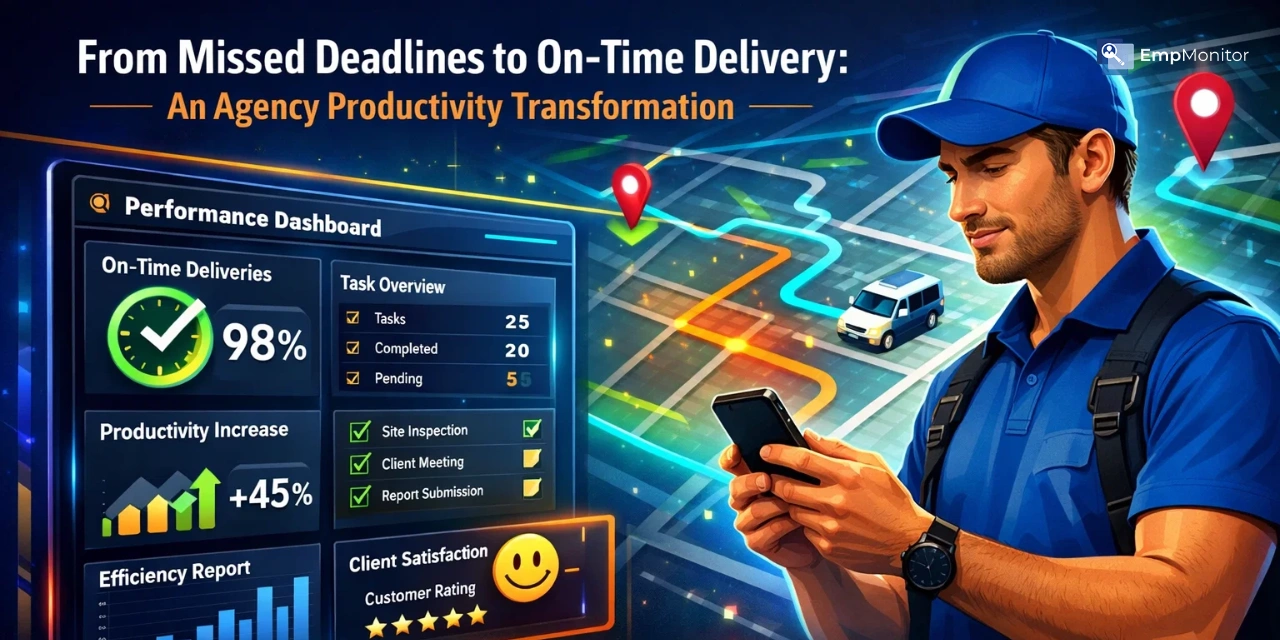
Results: 30% increase in on-time deliveries | 20% improvement in employee productivity | 25% reduction in overtime costs
The Background: Juggling 85 Agents Across Six Districts
For a fast-growing field service agency managing over 85 technicians and service representatives across six districts, growth was never the problem. The contracts kept coming, from corporate facility maintenance to HVAC servicing, property inspections, and client-site deliverables. The real problem was keeping up with what was actually happening in the field.
The agency’s operations team ran on a patchwork of phone calls, WhatsApp broadcasts, and shared spreadsheets. Every morning started with a scramble: Who is where? Has the 9 AM appointment been confirmed? Why hasn’t the status report come in from the southern zone? Supervisors spent a disproportionate chunk of their day chasing updates rather than managing outcomes.
The cracks widened when two major corporate clients began flagging SLA breaches in consecutive months. Deadlines were being missed, not because agents weren’t working, but because no one had real visibility over how work was flowing. The agency was reactive when it needed to be proactive.
“We had a capable team but no way to see them. It was like managing a football match while sitting in a room with no windows.”
The Problem: Three Breakdowns Driving Missed Deliveries
- Zero Real-Time Visibility
With agents spread across dozens of client sites daily, the operations team had no reliable way to track location or progress in real time. Supervisors relied entirely on self-reported check-ins via WhatsApp, which were inconsistent at best and absent at worst. When a client called to ask why no one had shown up, the internal answer, “We’re checking”, damaged trust with every passing minute.
- Task Management Through Word of Mouth
Job assignments were communicated verbally or by text message. There was no centralized record of who owned which task, what the current status was, or when it had been completed. Urgent reprioritizations mid-day created confusion in the field, often resulting in duplicated visits to some sites and complete no-shows at others. By the end of each week, reconciling what was done against what was planned took the ops team a full day of manual effort.
- Attendance and Route Inefficiency
The agency had no system to verify when agents actually started their day, how long they spent at each client location, or what routes they were taking between sites. Fuel reimbursements were approved on trust, and overtime claims frequently couldn’t be verified. Beyond the financial drain, inefficient routing meant agents were spending up to 90 minutes daily in preventable transit, time that could have been billable client visits.
The Discovery: Evaluating EmpMonitor
After the second consecutive SLA-breach warning from a flagship client, the agency’s leadership fast-tracked an evaluation of field force management tools. Three platforms were shortlisted and assessed over four weeks. EmpMonitor emerged as the frontrunner, not just for its feature depth but for one critical quality: it was built specifically for the realities of field operations, not adapted from an office monitoring tool.
The platform’s geo-verified client visits, live location tracking, and centralized dashboard addressed the agency’s exact pain points directly. The fact that it covered task management, attendance, leave tracking, performance reports, and distance tracking in a single application eliminated the need for multiple disconnected tools. Onboarding was straightforward, the mobile interface was intuitive enough that technicians in their 40s and 50s adopted it without resistance, and the pricing was transparent and scalable.
Implementation began in Week 1 of the second quarter. Sixty days later, the data told a story that leadership hadn’t expected to see so quickly.
The Implementation: What Changed and When
Weeks 1–2: Rollout and Ground-Level Buy-In
The agency was deliberate about how it introduced the tool to its field team. Rather than announcing it as a monitoring initiative, leadership framed EmpMonitor as an investment in the agents themselves, a tool that would reduce the constant flood of check-in calls, make their work visible and recognized, and simplify their day. Agents were walked through the mobile app in small groups. Supervisors were trained on the centralized dashboard simultaneously.
Adoption was near-universal within the first two weeks. The simplicity of the mobile interface (agents could update task status, log attendance, and confirm client visits in under 30 seconds) removed any friction from daily use.
Weeks 3–4: Operational Restructuring
With live location tracking active, the operations team could finally see the full picture. Route inefficiencies became immediately visible: several agents were criss-crossing each other’s territories daily, adding up to nearly two extra hours of travel for some. District assignments were rebalanced using the distance tracking data. Agents were now routed geographically, not just by availability. The reduction in redundant travel was felt within the first week of the change.
Task management moved entirely into EmpMonitor. All daily assignments were issued through the platform, with priority tags, client details, and required documentation attached to each job. Agents updated status in real time. Supervisors stopped managing by inbox and started managing by dashboard.
Month 2: Performance Visibility and Client Accountability
By the fifth week, the operations team had enough data to run individual performance reports for the first time. Patterns became clear: some agents were consistently completing more client visits per day by optimizing their own movement; others had recurring delays tied to specific task types. Supervisors used this data in weekly one-on-ones, not to penalize, but to coach and reallocate workload more fairly.
Geo-verified client visit records also transformed the agency’s client communication. When disputes arose over whether a technician had attended a scheduled visit, the timestamped GPS confirmation was definitive. Three client disputes were resolved in the agency’s favor with photographic and location evidence gathered directly through EmpMonitor’s task documentation features.
The Results: 60 Days That Changed the Operation
| 43%
On-Time Delivery Rate Improvement |
3x
More Client Visits Per Day |
31%
Reduction in Fuel Costs |
28%
Rise in Customer Satisfaction |
On-time delivery, the agency’s primary client SLA metric, improved by 43% within 60 days. The combination of intelligent routing, real-time task visibility, and agent accountability directly addressed the root causes of past failures. The two corporate clients who had issued warnings renewed their contracts, citing improved reliability and communication as the key factors.
Field agents logged an average of three verified client visits per day, compared to fewer than two previously. The gain came not from working longer hours, but from eliminating the dead time between sites through smarter routing and faster task transitions. Fuel and mileage reimbursements dropped by 31% as a direct result of optimized routes, a meaningful cost recovery that partially offset the platform’s cost within the first quarter.
Attendance accuracy reached near-perfect levels. Payroll processing time dropped by over 60%, with the finance team no longer needing to manually reconcile agent logs. Leave management, previously handled through informal messages, moved into a structured workflow that gave both agents and supervisors clarity without back-and-forth.
Customer satisfaction scores, measured through post-service feedback, rose by 28% by the end of the second month, a direct reflection of agents arriving on time, completing jobs correctly documented, and the agency being able to proactively communicate visit confirmations to clients.
“Before EmpMonitor, we were always one step behind. Now we know what’s happening, where, and why, before the client has to call us.”
Head of Client Services
EmpMonitor Features That Made the Difference
| Live Location Tracking | Gave managers real-time visibility of every agent in the field, eliminating guesswork. |
| Geo-Verified Client Visits | Confirmed on-site presence with GPS stamps, replacing manual check-in logs. |
| Task Management & Status | Enabled instant task assignment and live progress updates from the field. |
| Detailed Timeline Review | Allowed supervisors to audit any agent’s full-day activity with a single click. |
| Performance Reports | Delivered weekly insights per agent, enabling targeted coaching and recognition. |
| Attendance & Leave Management | Automated daily attendance and streamlined leave approvals in one dashboard. |
| Distance Tracking | Measured actual routes taken to optimize territory planning and cut fuel expenses. |
| Centralized Dashboard | Unified all field data in one screen, replacing spreadsheets and WhatsApp threads. |
The Takeaway: Visibility Is the Foundation of Accountability
This agency’s story is a pattern that repeats across field-based businesses of every size. The people are capable. The contracts are real. The intention is there. What breaks down is operational visibility: the ability to see what’s actually happening in the field and respond to it faster than problems escalate.
EmpMonitor’s Field Force Management application provided the infrastructure to close that gap. But the real lesson is simpler: you cannot manage what you cannot see. The moment the agency’s leadership could see their field operations clearly, route by route, visit by visit, task by task, they could make decisions that compounded into measurable results within weeks, not months.
For any agency running a distributed field team, the question is not whether a platform like EmpMonitor will make a difference. The question is how much longer you can afford to operate without one.
Frequently Asked Questions
1. How does EmpMonitor help improve on-time delivery in field operations?
EmpMonitor provides real-time tracking, task management, and geo-verified client visits. With these features, managers can monitor their field agents’ activities and optimize routes, ensuring that tasks are completed on time and that field agents are staying on track. This helps to eliminate delays and boosts the overall delivery performance.
2. Can EmpMonitor track the productivity of field agents in real time?
Yes, EmpMonitor tracks the productivity of field agents in real time through its Centralized Dashboard. Managers can view detailed performance reports, identify inefficiencies, and make data-driven decisions to improve productivity. Features like task completion tracking and idle time monitoring help increase overall field efficiency.
3. How does EmpMonitor assist in route optimization for field teams?
EmpMonitor uses real-time location data and geo-fencing to ensure that field agents take the most efficient routes for their tasks. This reduces travel time, minimizes fuel expenses, and ensures that agents can handle more tasks within their work hours, ultimately boosting productivity.
4. What security features does EmpMonitor offer for field force management?
EmpMonitor offers enhanced security with features like Geo-Verified Client Visits and task documentation uploads, ensuring that sensitive information is protected. The app also allows for the monitoring of field agents’ activities, minimizing the risk of data leaks or unauthorized access to confidential information during client visits.
5. Can EmpMonitor improve employee accountability and reduce missed deadlines?
Absolutely. EmpMonitor’s task management system allows for clear tracking of task assignments, deadlines, and completion status. By providing visibility into employee activities and performance, it helps improve accountability among field agents, leading to fewer missed deadlines and better time management.