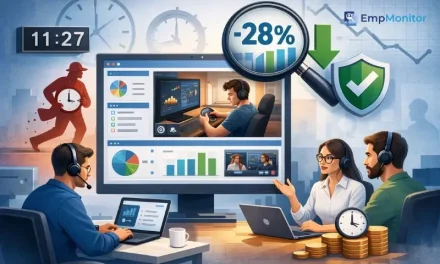

There is a problem that grows quietly.
It does not announce itself in a single missed deadline. It builds slowly, across weeks and projects, until a pattern becomes impossible to ignore. Clients start asking for updates more frequently. Internal reviews reveal client delivery timelines slipping by days, then weeks.
The team insists they are working hard. The manager has no reason to disbelieve them, and no clear way to find out where the time is actually going.
This is the story of how one company stopped guessing and started delivering.
A Business Built On Deadlines It Could No Longer Keep

The client managed a project-based services team of 20 employees responsible for delivering time-sensitive work to external clients. Meeting deadlines was not just a performance metric; it was the foundation of every client relationship they had.
For a long time, delivery was reliable. Then, gradually, it wasn’t.
When “We’re On It” Stopped Being Enough
Project timelines began stretching beyond estimates with no clear explanation. Deliverables that should have taken five days were taking eight. Client escalations became more frequent. Internal retrospectives produced the same conclusion every time: the team was busy, everyone was working, but somehow the output wasn’t matching the hours being logged.
The manager had no visibility into where the disconnect was happening. He only saw the results: deadlines missed, clients frustrated, and a team that couldn’t explain the gap either.
The Question That Changed Everything
Rather than assuming the worst about his team, the manager asked a more precise question. Not “why isn’t my team working hard enough?” but “where exactly is the time going, and why isn’t it translating into output?”
That question led him to EmpMonitor.
Why The Old Approach Was Getting Wrong?
Before implementing any new tool, the manager had tried to solve the problem through the process. More structured daily standups. Stricter task assignment in the project management system. Manual end-of-day progress reports from each team member.
The results were underwhelming.
Reporting on Work Is Not the Same as Doing It
Every manual reporting system placed an additional burden on the team without adding any real visibility for the manager. Employees spent time writing updates.
The updates described what had been done, not why client delivery timelines were still slipping. And because the reports were self-submitted, they naturally reflected effort rather than output.
The standups confirmed that people were busy. They did not explain why client deliverables were still arriving late.
What Was Actually Needed?
The manager needed objective data, not summaries of what employees thought they had accomplished, but a clear picture of how working hours were actually being distributed across tasks, tools, and time. He needed to see patterns across the team, not just individual snapshots.
And he needed that information without adding another layer of manual process on top of an already stretched client delivery workflow.
How Empmonitor Brought Clarity To The Chaos?

The rollout was handled transparently. The manager brought the team together, explained the purpose of the tool clearly, and framed it as a way to identify where support was needed and ensure that effort was being recognized fairly.
There was no hidden agenda. The goal was better client delivery, for clients, for the business, and for the team itself.
Within days, the data started telling a story that no status update had ever captured.
Features That Drove the Difference
- Real-time activity tracking: Gave the manager a live view of active and idle status across all 20 employees from a single dashboard, making it immediately visible where working hours were being lost throughout the day.
- App and website usage tracking: Revealed exactly how time was being distributed across tools. It became clear that a significant portion of working hours was being spent outside the core project tools, on unrelated applications and websites, during hours that had been logged as productive.
- Automated screenshot monitoring: Provided timestamped, interval-based snapshots of employee screens, giving the manager objective context for daily activity patterns without requiring anyone to self-report.
- Attendance and time tracking logs: Automatically recorded login times, logout times, and idle periods, replacing assumptions about working hours with accurate, verifiable data.
- Insightful productivity reports: Delivered visual breakdowns of productive versus unproductive time per team member, making it straightforward to identify where time was being lost and which individuals needed support or redirection.
- Project management integration: EmpMonitor’s task and project tracking capability allowed the manager to connect time data directly to project progress, giving him a clearer picture of resource allocation and where bottlenecks were forming before they became missed client delivery deadlines.
Together, these features did not just monitor the team; they gave the manager the clarity to lead it properly for the first time.
What The Data Revealed?
Two weeks into using EmpMonitor, the picture became clear.
Time Was Leaking in Plain Sight
Across the team, productivity reports showed that a meaningful portion of logged work hours were not being spent on client-facing deliverables. The pattern was consistent enough to explain the timeline gaps that had been frustrating the manager for months. I
It wasn’t one or two individuals; it was a team-wide drift that had gone unmeasured and therefore unaddressed.
Some Employees Were Carrying More Than Others
Digging deeper into individual activity data, the manager discovered a significant workload imbalance. A few team members were consistently overloaded with complex, time-intensive tasks. Others had lighter queues but similar deadline pressures, creating a situation where the team as a whole appeared stretched while individual capacity was being unevenly utilized.
This had never been visible before. Every planning conversation had been based on headcount rather than actual task distribution.
Bottlenecks Were Forming Early and Going Unnoticed
With project tracking data now available, the manager could see where delays were originating, not at the final delivery stage, but much earlier in the workflow. Tasks were sitting idle at handoff points between team members, losing hours that accumulated into days by the time a deliverable reached the client.
Also Read:
How To Improve Workflow With Project Time Tracking?
Task And Project Management: Insider Tips For Success
What Changed After EmpMonitor?
The manager made three specific changes based on what EmpMonitor’s data showed.
Workloads were redistributed. Overloaded team members received support. Employees with available capacity were reassigned to higher-priority deliverables. For the first time, resourcing decisions were based on actual task data rather than assumptions, and client delivery timelines finally had a realistic foundation to stand on.
Bottleneck points in the workflow were identified and addressed. Handoff delays that had been invisible before were now flagged early by EmpMonitor, allowing the manager to intervene before they impacted client delivery deadlines.
Unproductive time patterns were addressed directly. With objective data from EmpMonitor in hand, conversations with individual team members were calm and factual. There was no guesswork, no accusation, just a clear picture of where time was going and a shared agreement on what needed to change.
The Results
Within 30 days of full implementation, the average project delivery time decreased noticeably. Client escalations dropped. The team reported that the workload finally felt more evenly distributed. And the manager’s mornings, previously spent chasing updates, were now spent reviewing a dashboard that already had the answers.
Where Effort Ends And Delivery Begins
Missed client deadlines are rarely the result of a team not caring. More often, they are the result of a team operating without the visibility needed to manage their own time effectively and a manager without the data needed to support them properly.
EmpMonitor did not fix this company’s delivery problem by catching people out. It fixed it by making the problem visible for the first time. Once the data was there, the right decisions followed naturally.
If client delivery is a pressure point in your business and your team’s effort isn’t translating into results, the gap probably isn’t motivation. It’s visibility.
EmpMonitor is a practical place to start closing that gap.
FAQs
1. How does EmpMonitor help improve client delivery timelines specifically?
EmpMonitor gives managers real-time visibility into how working hours are being spent across the team. By identifying where time is being lost, where workloads are uneven, and where workflow bottlenecks are forming, it enables faster, more informed decisions that directly impact delivery speed.
2. Can EmpMonitor identify bottlenecks in a project workflow?
Yes. EmpMonitor’s project management and activity tracking features allow managers to see where tasks are stalling, which team members are overloaded, and where handoff delays are forming, often before they escalate into missed deadlines.
3. Will introducing monitoring affect how the team feels about their work?
When introduced transparently and framed around fairness and support rather than surveillance, monitoring typically has a positive effect. Team members whose effort is now objectively visible often feel more recognized, and those who were drifting have a clear basis for understanding what needs to change.
4. How quickly can a company start seeing results after implementing EmpMonitor?
Many teams begin noticing patterns in work habits within the first few days of using EmpMonitor. Once managers review the initial productivity reports and activity data, they can quickly identify workload imbalances, time leaks, or workflow bottlenecks. With small adjustments based on this data, improvements in project delivery timelines can often appear within the first few weeks.