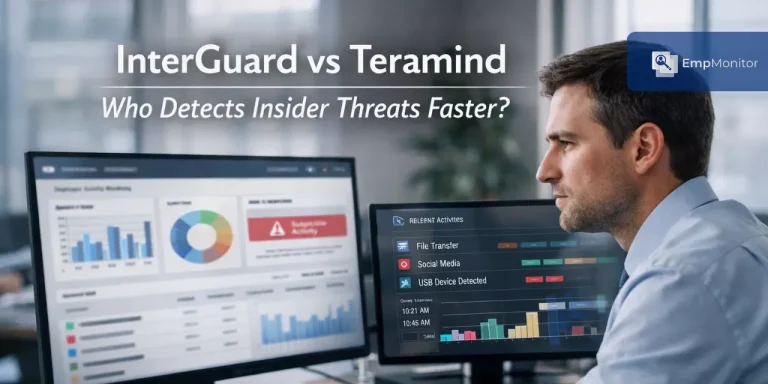
Insider threats don’t usually start with obvious warning signs. They begin quietly an unusual login time, a sudden spike in file downloads, or subtle shifts in employee behavior. By the time these patterns become visible, the damage may already be underway. That’s why businesses are no longer just asking if they can monitor activity they’re asking how quickly they can detect risks and respond. In this blog, we’ll compare InterGuard vs. Teramind through that exact lens:
Which one detects insider threats faster in real-world conditions?
But before jumping into that comparison, it’s important to establish a practical baseline for what fast detection actually looks like when teams are managing real employees, not just systems.
Listen To The Podcast
InterGuard vs. Teramind: What Fast Insider Threat Detection Really Looks Like
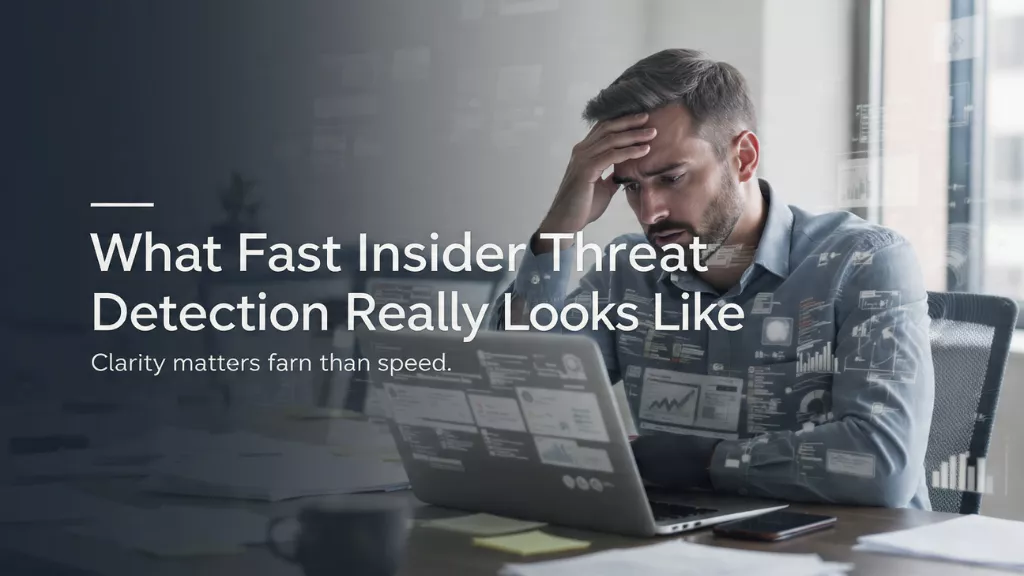
Speed in insider threat detection isn’t just about real-time alerts.
It’s about:
- Seeing employee activity as it happens
- Understanding behavior, not just actions
- Identifying risks before they escalate
- Acting without digging through layers of data
In many cases, delays don’t happen because tools are slow they happen because the data is scattered, unclear, or difficult to interpret.
This is where having a strong operational foundation makes a difference.
InterGuard vs. Teramind: Building That Foundation with EmpMonitor

Before comparing InterGuard vs.Teramind, it helps to look at a platform that focuses on clarity and immediate visibility, because that’s where faster detection often begins.
EmpMonitor approaches insider threat detection from a practical angle:
give managers direct, real-time insight into employee activity without overcomplicating the process.
Real-Time Monitoring That Actually Feels Real-Time
EmpMonitor provides instant visibility into:
- Live app and web usage
- Active vs idle time
- Ongoing employee activity across systems
Everything is available in one place, which reduces the time spent switching between tools or interpreting fragmented data.
Screen Recordings for Context, Not Guesswork
Instead of relying only on logs, EmpMonitor allows you to:
- Access recorded screen sessions
- Review what actually happened during specific timeframes
- Validate whether activity was productive or suspicious
This removes ambiguity. You’re not guessing you’re seeing.
Live Screen Monitoring for Immediate Action
EmpMonitor takes it a step further with live screen access.
Managers can:
- View employee screens in real time
- Spot unusual behavior instantly
- Intervene before issues escalate
This kind of visibility significantly reduces response time because there’s no delay between detection and verification.
Screencast for Direct Intervention
When something feels off, EmpMonitor allows secure remote access to employee systems.
This helps teams:
- Troubleshoot issues instantly
- Guide employees in real time
- Address risks without escalation
Instead of reacting later, teams can step in at the moment something happens.
Time Tracking That Reveals Hidden Patterns
Time tracking isn’t just about productivity it’s also a signal.
EmpMonitor tracks:
- Working hours
- Idle time gaps
- Sudden changes in work patterns
These subtle shifts often indicate early signs of insider risks, such as disengagement or misuse of time.
Also Read
Monitask vs. EmpMonitor: Which Freelance Tracker Wins?
Time Doctor Vs Hubstaff: The Real Cost Of “Per User” Pricing
Automated Screenshots for Continuous Visibility
With customizable screenshot intervals, managers get:
- A visual trail of employee activity
- Regular snapshots of workflows
- A quick way to audit behavior without constant monitoring
This creates a balance between oversight and efficiency.
Chat Monitoring for Behavioral Signals
Insider threats don’t always involve files they often involve communication.
EmpMonitor helps track:
- Time spent on chat and social platforms
- Usage patterns during work hours
This can highlight distractions, policy violations, or unusual communication behavior.
Insightful Reports That Make Data Actionable
All this data is only useful if it’s easy to understand.
EmpMonitor provides:
- Visual reports
- Automated timesheets
- Clear engagement metrics
Instead of digging through raw logs, managers can quickly identify patterns and take action.
InterGuard vs. Teramind: Why This Foundation Matters Before Comparing Tools
When insider threat detection is built on:
- Real-time visibility
- Clear behavioral insights
- Easy-to-understand data
Detection naturally becomes faster not because of complex algorithms, but because there’s less friction in understanding what’s happening.
With that baseline in mind, let’s now compare InterGuard and Teramind.
InterGuard: Fast for Defined Risks
InterGuard focuses heavily on data protection and rule-based monitoring.
How It Detects Threats
InterGuard works by:
- Monitoring emails, files, and web activity
- Applying predefined rules and policies
- Triggering alerts when violations occur
- Blocking certain actions when needed
Where It Detects Threats Quickly
InterGuard is fast when:
- A user violates a defined policy
- Sensitive data is accessed or transferred
- A restricted action is attempted
Because these scenarios are rule-based, detection is immediate.
Where It Can Lag
However, the system depends on:
- Predefined conditions
- Known risk patterns
If a threat doesn’t clearly break a rule, like subtle behavioral changes, it may not be flagged early.
So while InterGuard is efficient for known threats, it may take longer to detect unusual or evolving risks.
Teramind: Faster with Behavioral Detection
When comparing InterGuard vs. Teramind, Teramind takes a different approach by focusing on behavioral analytics and real-time monitoring.
How It Detects Threats
Teramind includes:
- User behavior analytics (UEBA)
- Real-time activity tracking
- Risk scoring based on patterns
- Session recording and playback
Instead of waiting for rule violations, it identifies anomalies in behavior.
Why It Often Detects Threats Earlier
Teramind can detect risks faster because:
- It flags unusual behavior, even without rule violations
- It monitors patterns across multiple data points
- It provides real-time alerts for suspicious activity
For example, if an employee suddenly starts accessing large amounts of data outside normal hours, it can raise a flag immediately.
The Trade-Off
That level of detection comes with challenges:
- More alerts, including false positives
- A steeper learning curve
- More effort required to interpret data
So while detection may be faster, decision-making can sometimes slow down due to complexity.
InterGuard vs. Teramind: Who’s Actually Faster?
When comparing InterGuard vs. Teramind, the answer depends on the type of threat.
If the threat is:
- Clearly defined (policy violation) → InterGuard responds quickly
- Subtle or behavior-based → Teramind detects it earlier
But in real-world scenarios, threats are rarely obvious.
They evolve. They hide in patterns.
That’s why behavioral detection often feels faster in practice.
InterGuard vs. Teramind: Where EmpMonitor Quietly Gains an Edge
After looking at InterGuard vs. Teramind, both tools, something becomes clear.
Speed isn’t just about:
- Rules (InterGuard)
- Or analytics (Teramind)
It’s about how quickly teams can see, understand, and act.
This is where EmpMonitor stands out.
It doesn’t rely heavily on:
- Complex configurations
- Deep analytical setups
Instead, it focuses on:
- Immediate visibility
- Clear activity tracking
- Simple, actionable insights
Because of this, teams often:
- Spend less time configuring
- Spend less time interpreting alerts
- Respond faster in real situations
InterGuard vs. Teramind: Final Verdict
If we narrow it down:
- InterGuard is fast for structured, rule-based threats
- Teramind is faster for behavioral and unknown risks
But when you factor in usability and response time:
- EmpMonitor offers a more balanced and practical approach
It may not position itself as the most advanced system, but it reduces the gap between detection and action.
And in insider threat management, that gap is where most risks either grow or get stopped in time.
InterGuard vs. Teramind: FAQs
Does insider threat detection always require advanced AI tools?
Not necessarily. While AI and behavioral analytics can improve detection, many insider threats can be identified through consistent monitoring, activity tracking, and clear visibility into employee actions. Tools that present data in an easy-to-understand way can often help teams respond faster than overly complex systems.
How important is real-time visibility compared to automated alerts?
Real-time visibility is just as important as alerts. Alerts tell you something happened, but live monitoring shows you what is happening right now. Having both ensures you can verify issues instantly instead of relying only on notifications.
Can small businesses benefit from insider threat monitoring tools?
Yes, insider threats are not limited to large enterprises. In fact, smaller teams often face higher risks due to limited oversight. Tools with simple setup and clear insights can help small businesses monitor activity without needing dedicated security teams.
What is the biggest challenge in detecting insider threats early?
The biggest challenge is identifying subtle behavioral changes. Most insider threats don’t break rules immediately they evolve over time. Without visibility into patterns like unusual work hours, app usage, or sudden productivity drops, early detection becomes difficult.