When it comes to workplace security and insider threat prevention, the debate around StaffCop vs Teramind is one that IT managers and business owners consistently revisit. Both platforms have earned solid reputations in the employee monitoring space, but which one truly dominates in security features? Choosing the right tool matters more than ever, especially as remote and hybrid work continue to expand organizational risk surfaces.
From real-time activity tracking and behavioral analytics to policy enforcement and audit trails, security demands have grown increasingly complex. In this blog, we break down the critical differences, feature by feature, to help you make a confident, well-informed decision. Whether you’re a small business owner or an enterprise security lead, this guide has you covered.
Listen To The Podcast Now!
StaffCop at a Glance:
StaffCop is an employee monitoring solution developed by Atom Security. It is built with a strong emphasis on insider threat prevention, comprehensive activity logging, and data protection. Organizations frequently bring up StaffCop vs Teramind when evaluating platforms that support on-premises deployment, a crucial factor for industries handling classified or highly sensitive data, including government agencies, banking, and healthcare.
For those Moving Away from Teramind, StaffCop offers a solid alternative with its focus on security and control over monitoring data. StaffCop supports monitoring across Windows, Linux, and macOS environments. It captures keystrokes, screenshots, file transfers, USB activity, and clipboard data.
The tool is known for its detailed audit trails and robust reporting capabilities. One of its most valued features is local deployment, giving organizations complete control over their monitoring data without routing it through third-party cloud servers. While its interface may feel dated compared to more modern tools, the depth of its security functionality is difficult to overlook for compliance-driven businesses.
Teramind at a Glance:
Teramind is a US-based employee monitoring and insider threat prevention platform positioned firmly as an enterprise-grade solution. In any StaffCop vs Teramind evaluation, Teramind immediately stands out for its polished, modern interface, behavior-based analytics, and cloud-first architecture, though on-premises deployment is also supported.
Teramind monitors employee emails, websites, applications, social media activity, and instant messages. Its real-time alerting system can detect behavioral anomalies and automatically trigger responses such as blocking a user session or sending an alert to the security team.
One of Teramind’s signature capabilities is its behavior rules engine, which lets IT administrators create custom logic based on specific triggers and thresholds. With support for over twelve different communication channels, Teramind casts a significantly wider monitoring net than most competing tools, making it a go-to option for enterprises that need broad, intelligent visibility.
User Activity Monitoring: StaffCop vs Teramind:
User activity monitoring forms the backbone of any serious security platform. In the StaffCop vs Teramind comparison, both tools excel here, but with distinctly different approaches.
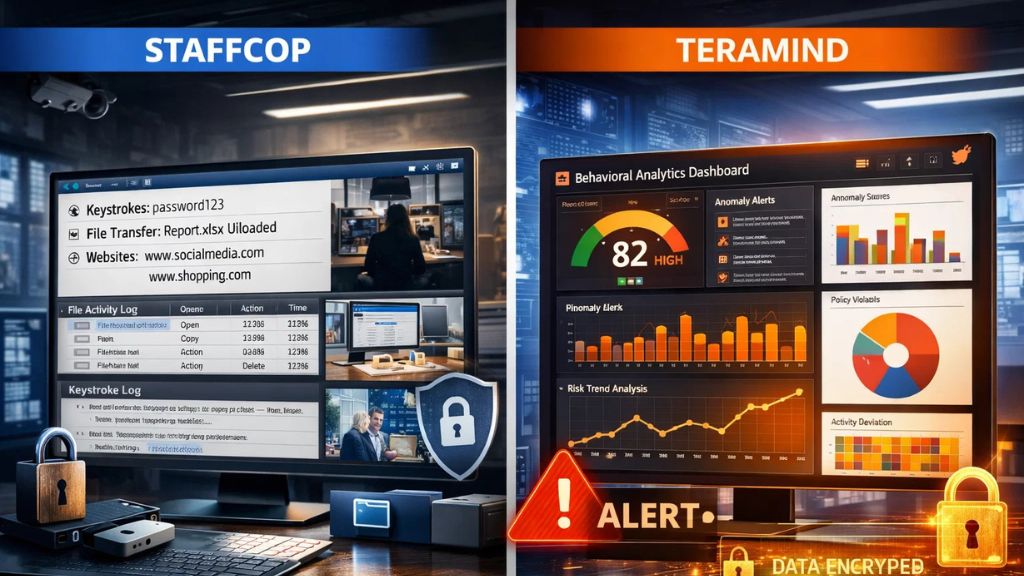
StaffCop logs every user action: keystrokes, clipboard activity, file operations, application usage, and website visits. It provides administrators with granular, timestamped visibility into what every employee does on their device. What sets StaffCop apart is its ability to capture data even in offline mode, syncing logs once the device reconnects to the network, a valuable feature for field teams or remote workers in low-connectivity environments.
Teramind takes a behavior-driven approach. Rather than simply logging raw data, it creates behavioral baselines for each user and flags deviations from those established patterns. This helps security teams identify genuine risk signals without getting buried in raw logs. In the StaffCop vs Teramind face-off on user activity monitoring, Teramind wins on intelligence, while StaffCop wins on the sheer depth of raw data capture.
Data Loss Prevention: StaffCop vs Teramind:
Data loss prevention is a non-negotiable concern for any business handling sensitive information. When comparing StaffCop vs Teramind in this area, a clear capability gap emerges. Teramind DLP capabilities are among the most advanced available in the employee monitoring market. The platform allows businesses to build content-aware rules that monitor and block sensitive data from being transferred via email, USB drives, cloud uploads, or messaging apps. This makes Teramind one of the most comprehensive data loss prevention software options for enterprises that require deep content inspection and real-time policy enforcement.
StaffCop also addresses data loss prevention solutions by monitoring file transfers, USB device usage, and clipboard activity. It can generate alerts when specific file types are copied or moved to external storage. However, StaffCop does not yet offer content-aware scanning to the depth that Teramind delivers through its dedicated data loss prevention engine.
For organizations that require enterprise-level DLP with fine-grained content rules, Teramind clearly holds the advantage. StaffCop remains a reliable option for businesses seeking straightforward, rule-based protection without the added complexity.
Insider Threat Detection: StaffCop vs Teramind:
Insider threats remain among the most dangerous and underestimated security risks in modern organizations. The StaffCop vs Teramind comparison on insider threat detection reveals two capable, yet fundamentally different approaches.
StaffCop relies on rule-based monitoring and thorough log analysis. Administrators can configure specific triggers, such as excessive file downloads, after-hours logins, or unusual USB activity, and receive instant alerts when those thresholds are crossed. The system then records all associated activity around the event, making forensic investigation straightforward and defensible in compliance contexts.
Teramind employs a behavioral analytics engine that continuously learns what “normal” looks like for each user. When behavior deviates, for example, an employee suddenly accessing a database they have never touched, the system flags it automatically, even without a pre-set rule in place. This predictive approach means security teams can act before a breach escalates.
In the StaffCop vs Teramind insider threat matchup, Teramind’s proactive, predictive model gives it an edge for larger organizations. StaffCop remains a dependable choice for teams that prefer manual, customizable rule-setting and direct administrative control.
Stealth Mode & Deployment Options: StaffCop vs Teramind:
StaffCop vs Teramind
Deployment flexibility and monitoring discretion are factors that often get overlooked early in tool evaluations. The StaffCop vs Teramind comparison in this area reflects some meaningful differences in philosophy and architecture.
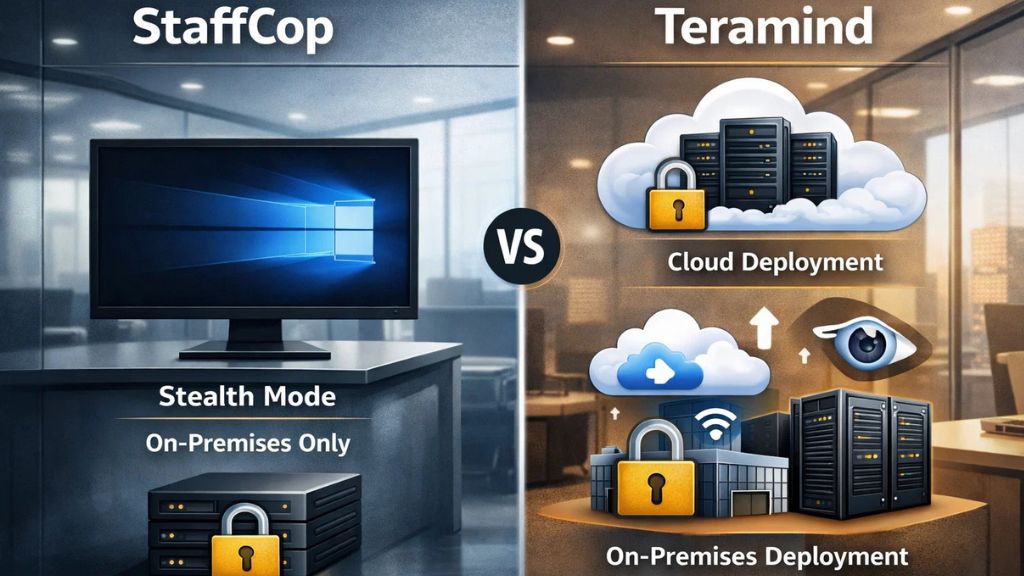
StaffCop operates in stealth mode by default, running invisibly in the background without any visible indicator to the monitored user. This makes it especially useful in high-security environments where discreet surveillance is required. It also offers full on-premises deployment, meaning all monitoring data stays within the organization’s own infrastructure, a significant compliance advantage for regulated industries. Teramind also supports a transparent and a stealth monitoring mode, giving organizations flexibility based on their internal policy.
While Teramind’s primary strength lies in its cloud-based deployment, it does offer an on-premises option for enterprises with strict data residency requirements. In the StaffCop vs Teramind deployment debate, StaffCop has a slight edge for privacy-first, on-premises organizations, while Teramind appeals to those who want cloud agility with optional local deployment.
Reporting & Analytics: StaffCop vs Teramind:
Strong security tools do more than collect data; they transform it into actionable insights. The StaffCop vs Teramind comparison on reporting and analytics reveals two contrasting design philosophies.
StaffCop produces detailed, granular reports on user activities, including application usage, website visits, file operations, and keystrokes. These reports are thorough and highly customizable, making them particularly valuable during forensic investigations or regulatory compliance audits. However, the reporting interface can feel complex and may require a learning curve for non-technical users.
Teramind’s reporting suite is far more visual and intuitive. Clean dashboards give security managers an at-a-glance view of risk scores, productivity trends, and policy violations without having to dig through raw data tables.
Automated report scheduling further reduces the burden on HR and compliance teams. In the StaffCop vs Teramind analytics comparison, Teramind leads on usability and visualization, while StaffCop retains the advantage in raw investigative depth and detail.
Compliance & Audit Readiness: StaffCop vs Teramind:
Compliance readiness is increasingly a make-or-break factor when choosing monitoring software. In the StaffCop vs Teramind comparison on this front, both tools offer meaningful compliance support, but again, with different strengths.
StaffCop provides comprehensive audit logs that are difficult to tamper with, making them highly useful for legal proceedings, internal investigations, and regulatory submissions. It supports compliance with industry standards by maintaining complete records of all user activity over configurable time periods.
Teramind is built with enterprise compliance firmly in mind. It offers pre-built compliance report templates aligned with frameworks such as HIPAA, PCI-DSS, and ISO 27001, reducing the manual effort required to demonstrate compliance. Automated policy enforcement also helps organizations catch violations before they become audit red flags. For organizations in heavily regulated industries, Teramind’s compliance toolkit is more immediately ready to use, giving it a clear edge in this StaffCop vs Teramind round.
Pricing & Scalability: StaffCop vs Teramind:
Budget is always a significant factor when evaluating enterprise-grade monitoring tools. In the StaffCop vs Teramind pricing conversation, the two platforms differ notably in their approach to cost and growth.
StaffCop offers flexible licensing options, including perpetual licenses, which can make it more cost-effective for organizations looking to avoid ongoing subscription fees. Its on-premises model also reduces long-term cloud infrastructure costs, which resonates with IT teams managing tight budgets.
Teramind follows a tiered subscription model, Starter, UAM, DLP, and Enterprise, each offering progressively more advanced capabilities. While pricing is higher than StaffCop, the feature depth justifies the investment for many enterprise security teams, particularly those that need advanced behavioral analytics and content-aware DLP.
When evaluating StaffCop vs Teramind for scalability, Teramind scales more gracefully using cloud infrastructure with multi-region support. StaffCop can scale, but it requires more hands-on IT management for larger deployments. Mid-size businesses on tighter budgets may find StaffCop more accessible, while growing enterprises will likely find Teramind’s subscription model better suited to their long-term needs.
Also Read:
ActivTrak vs Teramind: Which is Safer for Enterprise Security?
EmpMonitor: A Smarter Alternative Worth Considering:
While the StaffCop vs Teramind debate remains relevant, a growing number of businesses are discovering that EmpMonitor delivers a well-rounded alternative that balances security, productivity tracking, and affordability in one platform. Trusted by 15,000+ companies across 100+ countries, with 500K+ employees tracked globally, EmpMonitor has built a compelling reputation as an all-in-one workforce management solution.
Here is what makes EmpMonitor stand out:
- Real-Time Activity Monitoring, Live screen tracking, and application usage monitoring as it happens
- Insider Threat Prevention, Detect unauthorized data access and suspicious behavior instantly
- User Activity Monitoring, Track URLs, app usage, and keystrokes for full visibility
- Attendance & Time Tracking, Automate attendance management with precise, reliable time logs
- Productivity Analytics Measure active vs idle time with detailed, actionable employee reports
- Screenshot & Screen Recording, Capture and review employee screen activity on demand
Conclusion:
The StaffCop vs Teramind comparison ultimately comes down to your organization’s priorities. Teramind leads on behavioral analytics, content-aware DLP, and compliance readiness, making it ideal for larger enterprises. StaffCop excels in on-premises control, forensic-level logging, and cost-efficiency, a strong fit for security-focused teams that prefer hands-on administration. Both platforms bring genuine value to the table. Evaluate your organization’s size, data sensitivity, budget, and deployment preference before making your final call. The right choice is the one that aligns with your unique security strategy.
FAQ’s:
Q1. Is Teramind better than StaffCop for large enterprises?
Ans: Teramind is generally preferred at enterprise scale thanks to its cloud architecture, behavioral analytics, and pre-built compliance report templates. StaffCop is better suited for organizations that require strict on-premises data control and hands-on administrative oversight.
Q2. Does StaffCop support data loss prevention?
Ans: Yes, StaffCop monitors file transfers, USB activity, and clipboard usage to help prevent data leaks. However, it does not offer the content-aware policy engine that Teramind’s dedicated DLP module delivers, making Teramind the stronger choice for advanced DLP needs.
Q3. Which tool is better for insider threat detection, StaffCop or Teramind?
Ans: Teramind uses behavioral baselines and predictive analytics to detect insider threats proactively. StaffCop relies on rule-based triggers and detailed audit logs. Teramind is better for automated, real-time threat detection, while StaffCop suits teams that prefer manual, configurable rule-setting.
Q4. Can both StaffCop and Teramind be deployed on-premises?
Ans: Yes, both tools support on-premises deployment. StaffCop is primarily built around on-premises architecture, giving it an edge for organizations with strict data residency requirements. Teramind offers on-premises as an option alongside its primary cloud-based deployment.
Q5. Which platform is more cost-effective, StaffCop or Teramind?
Ans: StaffCop tends to be more budget-friendly, especially with its perpetual licensing model that avoids ongoing subscription fees. Teramind’s tiered subscription pricing is higher but reflects a broader and more advanced feature set suited to enterprise-level security requirements.