You’ve read the articles, downloaded the apps, and scribbled to-do lists—yet your workday still feels chaotic. The problem isn’t your effort; it’s your habits. In this article, we’ll explore science-backed strategies that help you form and maintain strong, effective routines without overhauling your entire day.
Forming productive work habits isn’t about imposing a robotic routine upon yourself. Instead, these habits are small, intentional shifts that compound over time to create lasting improvements in how you manage your tasks. Whether you’re battling procrastination, drowning in emails, or simply seeking a more focused workday, the following guide shares 20 strategies that are proven to work.
Let’s cut through the noise and dive straight into actionable advice.
In a hurry? Listen to the blog instead!
What Are Productive Work Habits?
Before we jump into the list, let’s define it clearly: productive work habits are behaviors that help you stay focused, organized, and efficient—without burning out. These productive behaviors shape your entire workday and have a significant impact on your overall performance.
It’s not about hustling nonstop. It’s about getting the right things done, at the right time, with the right energy.
Looking for good work habits examples? A classic example is planning your day before emails take over. Other examples include saying “no” to meetings that could’ve been a message, setting clear priorities, and using time blocks to focus on deep work.
These habits help you:
- Reduce friction in your day
- Free up mental space for work that matters
- Deliver higher-quality output, consistently
- Prevent burnout before it starts
The best part? You don’t need to overhaul your life overnight. Start small. Pick one or two habits from this list and build from there.
20 Productive Work Habits (That Actually Work)
1. Prioritize Ruthlessly: Start With Your “Must-Do” Tasks

A clear set of priorities is the cornerstone of any effective routine. Begin your day by identifying your top 1–3 Most Important Tasks (MITs)—those non-negotiable items that drive significant results. Listing these first means you’re using your highest energy and focus at the start of the day, setting a positive tone.
When you make decisions in the morning, you’re harnessing a time when mental clarity is at its peak. Research shows that tackling MITs early in the day can reduce decision fatigue by up to 28%, allowing you to maintain momentum throughout your work hours.
To embed productive work habits into your routine, consider writing your MITs on paper rather than relying solely on digital lists. There’s something powerful about physically checking off tasks that provides a sense of accomplishment and reinforces positive behaviors.
Try this: Before you check Slack, email, or messages, take a moment to write down your top 3 non-negotiables for the day. This simple habit helps you take control of your time instead of reacting to everything as it comes.
2. Set SMART Goals and Track Progress
It’s easy to fill your day with tasks and feel productive. But without clear goals, you might end up working hard without really moving forward. That’s where SMART goals come in.
SMART stands for Specific, Measurable, Achievable, Relevant, and Time-bound. It’s a simple way to set goals that give you real direction.
- Specific: What exactly do you want to achieve?
- Measurable: How will you know when it’s done?
- Achievable: Is this realistic with your current resources?
- Relevant: Does it align with your bigger priorities?
- Time-bound: When do you want to finish it?
Instead of writing “improve my communication,” try: “Attend one feedback workshop this month and apply one new technique in our next team meeting.” The clearer your goal, the easier it is to take action—and the easier it is to celebrate when you hit it.
Tracking your progress—whether through a spreadsheet, an app, or a notebook—helps you see how far you’ve come. Even small wins build the confidence to keep going.
3. Master Deep Work Sessions (No, You Can’t Multitask)
In our always-on world, multitasking gets a lot of praise, but studies show it can reduce your productivity by up to 40%. What feels like multitasking is usually just context switching—rapidly jumping between tasks. And every time you rip your focus away for a distraction, it takes over 23 minutes to fully refocus on the original task.
That mental reset takes time and energy. It may only be a few seconds each time, but it adds up fast. The result? Slower progress, more mistakes, and increased stress.
Instead, try carving out time for deep work—periods when you devote all your attention to one high-priority task. Set aside uninterrupted 90-minute chunks to get into the zone. During these sessions, turn off notifications, close extra browser tabs, and resist the urge to check your emails.
Pro tip: Try the “tab diet.” Keep only the essential tabs open for the task you’re working on. Having too many open makes it tempting to switch focus, even when you don’t need to.
If you need extra help staying on track, consider using productivity apps that monitor your focus time and alert you when distractions creep in, so you can tweak your approach as needed.
4. Identify and Protect Your Golden Hours
Whether you realize it or not, you likely already have times of day when you naturally feel energized and focused—and times when you feel like you’re running on empty. You can thank your body’s ultradian rhythms for that. These are natural cycles that occur throughout a 24-hour period, driving predictable dips and peaks in your energy.
The key is to pinpoint when you’re hyper-attentive and protect those windows for your most demanding, creative work—then save admin tasks, routine emails, and meetings for your lower-energy slots.
How to get started:
- Keep a simple log for one to two weeks—note how you feel (focused, sluggish, sharp, distracted) at different times throughout the day.
- After a week, look for patterns. When do you consistently hit your peak? When does your brain check out?
- Act on those insights: move recurring meetings away from your peak hours, block your calendar during your sharpest times, and batch low-effort tasks for afternoons or whenever you typically drag.
Matching your tasks to your natural rhythms is one of the simplest yet most effective productive work habits you can develop. By aligning your work with your energy levels, research suggests you could see up to a 50% improvement in efficiency.
5. Use the 80/20 Rule to Work on What Matters
Have you ever noticed that a small part of your work seems to drive the biggest results? That’s the Pareto Principle (80/20 rule) in action—the idea that 80% of your outcomes typically come from just 20% of your efforts.
In practical terms: a small number of tasks or actions usually lead to the biggest impact. The key is figuring out which tasks those are—and then focusing your time and energy there.
What works: Start by asking yourself: Which tasks actually move things forward? These are your high-leverage activities—things that contribute directly to your goals, like deep work, strategic planning, or key client communication—not the little stuff that just fills your day.
Take a look at your to-do list. Chances are, only a few items truly move the needle. Highlight those first, and let the rest wait—or delegate them if possible.
Example: If you’re in marketing and you find that one channel brings in 80% of your leads, that’s where your best hours should go. Not spread equally across ten different tactics.
When you focus on the right things, you make faster progress with less stress. The 80/20 mindset gives you permission to let go of tasks that don’t truly serve your bigger goals.
6. Create A Distraction List (Not A To-Do List)
Ever found yourself off on a tangent after a single distracting thought? Instead of letting these mental interruptions derail your focus, maintain a “distraction list.” Opt for a WordPad online to jot down intrusive thoughts—like “Call the vet” or “Check that article later”—so you can address them at a more appropriate time.
This simple technique is a cornerstone of productive work habits because it clears your mental clutter, allowing you to return to your main task with renewed focus. Once your primary work session is over, revisit your distraction list to tackle those tasks one by one.
For added effectiveness, consider reviewing your distraction list weekly. Over time, you might notice recurring themes that can be addressed by restructuring your work or delegating certain responsibilities.
7. Sort Tasks With The Eisenhower Matrix
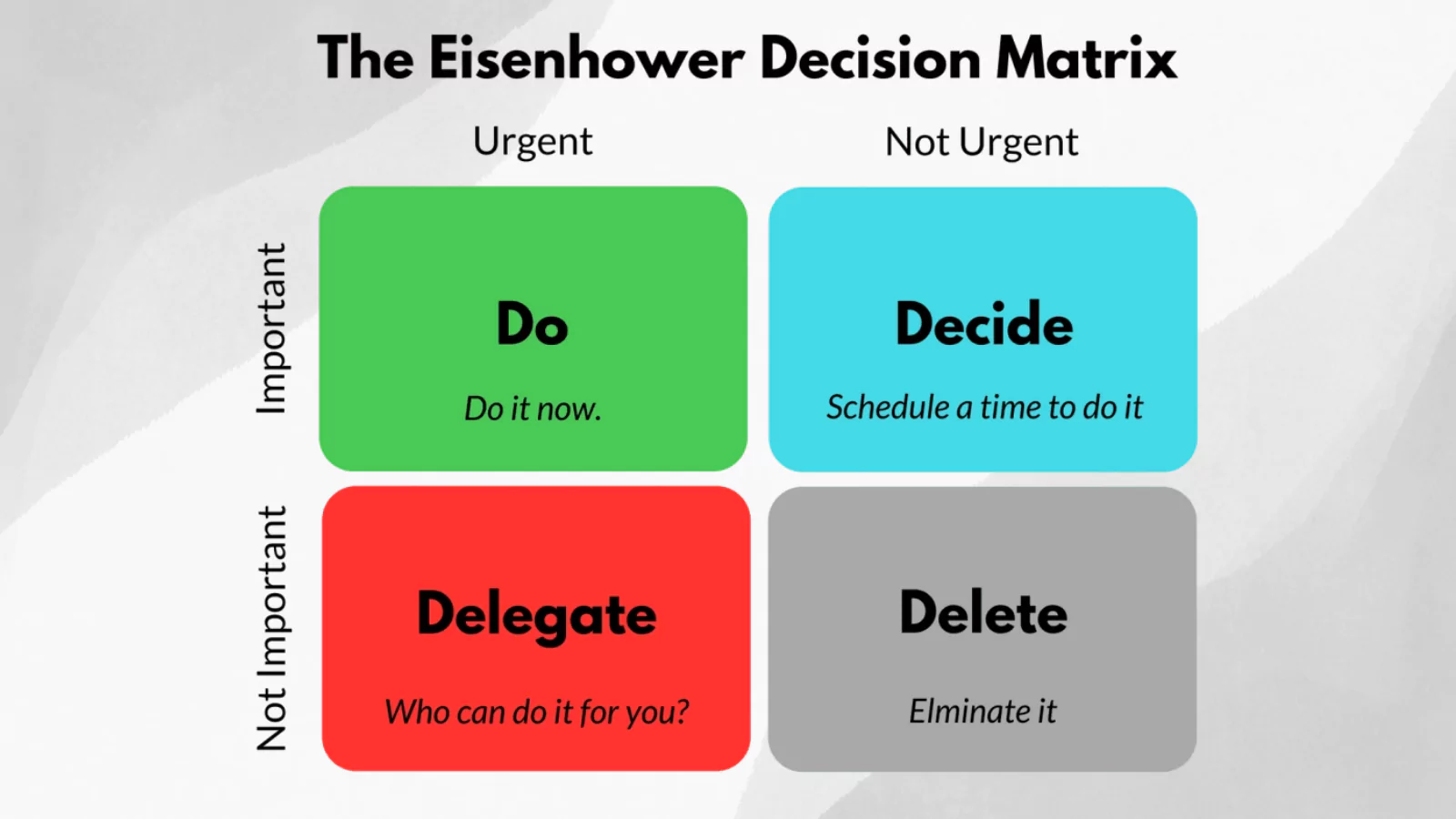 Not all tasks hold equal value. The Eisenhower Matrix is a practical framework that divides your to-dos into four quadrants:
- Urgent + Important: Do these tasks immediately.
- Important, Not Urgent: Schedule these tasks.
- Urgent, Not Important: Delegate these tasks to others.
- Not Urgent + Not Important: Eliminate these tasks from your agenda.
This framework is a favorite among CEOs like Tim Cook because it provides clarity and prevents burnout by ensuring you’re not overwhelmed by low-priority tasks. Integrating such a system into your daily routines strengthens your productive work habits by continually reinforcing a mindset that prioritizes impact over activity.
When you consistently apply this technique, you learn to evaluate your workload critically and focus on tasks that truly drive results.
8. Automate Repetitive Tasks (Save 5+ Hours/Week)
Repetition is the enemy of creativity and efficiency. Instead of manually handling every recurring task, look for ways to automate. Whether it’s filtering emails, setting invoice reminders, or scheduling social media posts, let technology handle the mundane so you can focus on work that matters.
Automation is a vital component of productive work habits because it frees up valuable time you can invest in higher-level thinking and strategy. Tools like EmpMonitor are excellent for identifying repetitive tasks and suggesting automation solutions that could save you up to five hours a week.
9. Stay Organized Digitally and Physically
“A clear space equals a clear mind”—and when it comes to getting things done, this couldn’t be more true. Clutter, whether on your desk or your desktop, adds tiny bits of friction to your day that compound over time.
Physical space: Keep only daily essentials on your desk. At the end of each day, spend just two minutes tidying up—stack papers, plug in devices, clear the trash. It doesn’t have to be perfect; just manageable.
Digital space: Organize files and folders in a way that makes sense to you. Name things clearly, delete what you no longer need, and use project management tools like Notion, Asana, or Trello to keep track of tasks without the chaos of scattered notes.
End-of-day shutdown routine (5–10 minutes):
- Review what you finished today
- Write down your top 3 tasks for tomorrow
- Close browser tabs and tools you no longer need
- Quick tidy of your physical space
This routine makes a huge difference in how you start the next morning—prepared rather than overwhelmed.
Recent research found that the average employee spends over 3.5 hours every single day searching for information they need to do their jobs. Setting up easy access to the information you rely on frequently, whether through a well-organized Notion page, labeled email folders, or a password manager is a productivity investment that pays back every single day.
10. Trim Email Overload With The “5-Sentence Rule”
Emails can be a silent productivity killer, often dragging conversations into lengthy, back-and-forth exchanges. To combat this, adopt the “5-sentence rule” for email communication.
Keep your emails concise, clear, and to the point. Focus on delivering necessary information, adding clear action items, and linking to detailed resources when necessary.
This practice is one of the productive work habits that has been shown to reduce email back-and-forth by up to 62%, according to data from Boomerang. Shorter emails mean less time deciphering lengthy messages and more time getting actual work done.
11. Use Templates to Stop Reinventing the Wheel
Starting something from scratch—whether it’s a slide deck, a survey, a brief, or a recurring report—takes far more time than it should. It also leaves room for inconsistency, especially if someone else needs to take over the task later.
That’s the value of templates. They give you a customizable structure and starting point so you’re not investing hours into early-stage groundwork every single time.
What to template:
- Documents and reports you create regularly
- Emails you send time and again (set these up as canned responses in Gmail or Outlook)
- Meeting agendas, project briefs, and onboarding checklists
- Any recurring survey, form, or workflow
Start by identifying the things you build most often, create a clean template for each, and store them somewhere accessible to your whole team. Even small templates can save dozens of hours across a year.
12. Schedule “Micro-Breaks” Every 55 Minutes
Long stretches of continuous work can lead to diminishing returns. Instead, break your day into cycles of 55 minutes of work followed by a 5-minute break. These micro-breaks are crucial for recharging your mind, preventing burnout, and boosting overall creativity.
Regular breaks protect your well-being and reinforce productive work habits by allowing your brain to rest and reset. Studies indicate that these short pauses can increase creative output by as much as 33%.
Use these breaks to stretch, hydrate, or gaze out the window. Even a few minutes away from your desk can provide the mental clarity needed to tackle complex tasks when you return.
If you prefer a more structured reset, a quick micro-game can work exceptionally well because it interrupts mental rumination without dragging you into a long distraction. Online solitaire is ideal for this since it’s familiar, calming, and pattern-based, so your brain “switches lanes” and comes back refreshed. You can play a fast round of Wordle for the same refocus effect.
13. Take Care of Your Body (And Not Just Your Brain)
Physical wellness tips might not be what you expect in a productivity article—but how you feel physically has a huge impact on your energy, focus, and output. This isn’t novel information, but it’s consistently underrated.
Simple changes that make a real difference:
- Stay hydrated: Keep a large water bottle on your desk so you don’t have to think about it.
- Get up and move: Even standing up and stretching every hour resets your body and your focus.
- Invest in your setup: An ergonomic chair, a monitor stand, or a wrist rest can reduce fatigue and discomfort that quietly drains your energy over hours.
- Prioritize sleep: Everything else on this list works better when you’re well-rested.
Don’t overwhelm yourself by overhauling your whole routine. Even one or two small physical adjustments during your workday can produce a noticeable shift in your energy and output.
14. Say “No” To Low-Impact Meetings

Meetings can be a significant drain on productivity, especially when they lack clear objectives. Learn to say “no” to invites that don’t have a well-defined agenda. Instead, suggest resolving the matter via email or a brief async update if necessary.
Studies from Harvard indicate that managers can waste up to 23 hours per week in unproductive meetings. Being assertive about your time not only benefits your own schedule but can also encourage a culture of efficiency within your team.
When you do attend meetings, be intentional: set a clear agenda beforehand and end on time.
15. Default To Async Communication
Real-time communication is not always the most efficient way to collaborate. Whenever possible, opt for asynchronous methods—recorded video updates, shared documents, or structured messages that allow colleagues to respond when they’re best able to focus. This minimizes interruptions and helps maintain uninterrupted blocks of deep work.
Not only does this approach reduce the frequency of disruptive interruptions, but it also allows for more thoughtful, deliberate responses that lead to better decision-making and overall improved outcomes.
16. Weekly Self-Audits: Celebrate Wins, Fix Gaps
Regular reflection on your work is essential to continuous improvement. Schedule a weekly self-audit to review what worked, what didn’t, and what could be improved. Celebrate your wins—no matter how small—and identify gaps where adjustments are needed.
Ask yourself these each week:
- What went well this week?
- What slowed me down or frustrated me?
- What habits helped me stay on track?
- What should I try differently next week?
Tools like EmpMonitor can automate parts of this process by providing detailed reports and insights into your work patterns. Use these data points as a roadmap for incremental improvements week over week.
17. How EmpMonitor Fits Into Your Productivity Journey

Tracking progress is key to maintaining productive work habits, but it’s not always easy to know where your time goes. That’s where tools like EmpMonitor come in. Far from being intrusive, EmpMonitor is designed to provide clarity and insights into your workflow, helping you make smarter decisions about how you work. It’s about fostering transparency and accountability—not just for your team, but for your growth.
Key Features of EmpMonitor:
- Real-Time Activity Tracking: Monitor live work sessions to spot when focus drifts and adjust your approach on the fly.
- Productivity Trends: Review data that reveals your peak performance periods, helping you align challenging tasks with the times you work best.
- Distraction Alerts: Identify non-essential activities—like excessive social media use—that might be pulling you away from important work.
- Well-Being Dashboards: Keep an eye on overtime and overall work patterns to prevent burnout and ensure a healthy work-life balance.
By integrating EmpMonitor, teams can enhance their overall productivity management while benefiting from advanced productivity monitoring tools. In addition, this employee monitoring software delivers the insights needed to understand and improve your work habits without feeling invasive.
For example, one marketing team that integrated EmpMonitor into their workflow found that they reduced their meeting times by 40% while also boosting overall productivity. When you harness technology like EmpMonitor, you’re not just keeping tabs on time—you’re actively shaping productive work habits that lead to a more balanced and efficient work environment.
18. Practice The “1% Better” Rule
Instead of striving for radical changes overnight, focus on making incremental improvements. Commit to improving one small habit each week—reducing meeting time by five minutes or tweaking your email routine. Over time, these tiny adjustments add up to a significant boost in productivity.
This approach encapsulates the philosophy behind productive work habits: gradual, sustainable progress over drastic, short-lived changes. Success isn’t about sudden transformations, it’s about consistent, incremental gains that compound into long-term results.
19. Set Hard Boundaries Between Work & Life
The line between work and personal life can easily blur. Establish firm boundaries to ensure you have time to recharge. Turn off work notifications after hours, and consider using a separate device for personal tasks to create a physical and mental separation.
Strong boundaries are a vital part of productive work habits because they help prevent burnout and ensure that you’re always operating at your best during working hours. Communicate these boundaries clearly to colleagues and supervisors, and enforce them consistently.
20. Embrace AI As A Sidekick

Technology is constantly evolving, and artificial intelligence can be a powerful ally in your productivity journey. Tools like ChatGPT can assist with drafting emails, summarizing reports, or even generating creative ideas. The goal is to have AI handle repetitive, data-intensive tasks so that you can focus on strategic decision-making and high-level problem-solving. To maintain originality and ensure content quality when using AI, you can also detect ChatGPT content through reliable AI-detection tools.
Remember, AI is here to support—not replace—your critical thinking. By using these tools wisely, you can free up more time to focus on what matters.
Read More
09 Best Tips To Increase Productivity In The Workplace
15 Productivity Hacks for A Successful 2024!
What Is Team Cohesion And Why Is It Important?
21. Start Before You Feel “Ready”
One of the biggest hurdles to productivity is waiting for the perfect moment to begin a task. The truth is, motivation often follows action—not the other way around. Commit to starting even when you don’t feel 100% prepared. Write down your MITs each night, plan your next day, and begin your work without waiting for that elusive “ready” feeling.
By taking that first step, you often create the momentum needed to continue, proving that progress—however small—is far better than inaction.
How To Build (And Actually Stick To) Productive Work Habits
Let’s be honest, starting a new habit is easy. Sticking with it is the hard part.
You might feel fired up after reading these strategies, but when the week gets busy, it’s tempting to slide back into old routines. The good news? You don’t need endless motivation or superhuman willpower. What you need are systems that support your goals even on the days when you’re tired, distracted, or overwhelmed.
Here are the most effective ways to make your productive work habits stick:
Stack Your Habits
Instead of forcing a new habit into your day from scratch, attach it to something you already do. This is called habit stacking:
- After you make your morning coffee → take 5 minutes to plan your top 3 tasks
- After every Friday wrap-up → spend 10 minutes on your weekly reflection
- After lunch → do a 2-minute digital declutter
By linking new habits to existing routines, they feel more natural—and easier to remember.
Track Your Progress
What gets tracked, gets done. Use a habit tracker, journal, or app to note how consistently you’re following through. It doesn’t have to be fancy—checking a box in a notebook works. The goal isn’t perfection; it’s awareness. Tracking helps you spot patterns, stay motivated, and celebrate small wins.
Make It Visible
Keep your intentions front and center. Write new habits on sticky notes, block time on your calendar, or set daily phone reminders. The more visible your intentions, the more likely you are to follow through. Sharing your goals with a colleague adds an extra layer of accountability too.
Stay Flexible
Not every habit will work perfectly the first time—and that’s fine. Life changes, schedules shift, and what worked last month might not work today. If planning in the morning doesn’t stick, try doing it the night before. If 90-minute focus blocks feel too long, try 50. Keep experimenting until you find what fits.
Conclusion
Building productive work habits is essential for long-term success, whether you’re working individually or managing a team. Consistency, organization, and intentional time management are the key factors that separate truly effective professionals from those who are simply busy.
This is where EmpMonitor comes in, offering valuable insights into productivity patterns and helping employees develop good habits for work that enhance focus and efficiency. By tracking performance and identifying areas for improvement, EmpMonitor enables professionals to create a more structured and goal-oriented work routine.
Fostering good habits in the workplace—such as setting clear priorities, avoiding distractions, and maintaining a healthy work-life balance—leads to increased motivation and job satisfaction. When individuals and teams commit to productive work habits, they build a positive and results-driven work environment.
With the right mindset and tools, anyone can develop habits that boost productivity and contribute to long-term professional success. Start optimizing your workflow today with EmpMonitor and unlock your full potential!
FAQ: Productive Work Habits
1. What are productive work habits?
Productive work habits are consistent behaviors that help you stay focused, organized, and efficient throughout your workday—without leading to burnout. Examples include planning your day before diving into emails, using time blocks for deep work, setting SMART goals, and reviewing your progress weekly.
2. How can I stay productive when working remotely?
To stay productive while working remotely, create a dedicated workspace, set clear working hours, minimize distractions, and use productivity tools to track tasks and deadlines. Maintaining a structured routine helps you stay focused and efficient.
3. What are some quick strategies to improve focus at work?
To improve focus, try techniques like the Pomodoro method (working in short, timed intervals), prioritizing tasks with a to-do list, and eliminating unnecessary distractions such as social media notifications. Regular breaks and identifying your personal golden hours can also significantly enhance concentration.
4. How do productive work habits contribute to career growth?
Developing productive work habits—such as time management, goal setting, and proactive communication—leads to increased efficiency, better job performance, and greater recognition from employers, ultimately opening doors for career advancement.
5. What role does technology play in improving workplace productivity?
Technology helps streamline tasks, automate repetitive work, and enhance collaboration among team members. Tools like EmpMonitor assist in tracking performance and identifying productivity trends, allowing employees to make data-driven improvements in their work habits.
6. How can managers encourage productive work habits in their teams?
Managers can encourage productivity by setting clear expectations, providing constructive feedback, fostering a positive work environment, and equipping employees with the right tools and training. Recognizing and rewarding good habits also motivates employees to stay consistent.
7. What is the 80/20 rule and how does it apply to productivity?
The 80/20 rule (Pareto Principle) states that 80% of your results typically come from just 20% of your efforts. In terms of productivity, this means identifying your highest-leverage tasks—the ones that actually move the needle—and prioritizing those over low-impact busywork.
8. How long does it take to build a productive work habit?
Research suggests habits can take anywhere from 18 to 254 days to form, with an average of around 66 days. The key isn’t speed—it’s consistency. Starting small, using habit stacking, and tracking your progress dramatically increases your chances of a habit sticking long-term.