


Let’s start with a situation that didn’t seem like a problem, at least not right away.
A mid-sized digital services company with a remote team of 30 employees had all the usual systems in place. They used project management tools, ran regular stand-ups, and tracked hours with a standard time tracking solution. On paper, everything looked organized.
Still, something wasn’t quite adding up.
Projects were getting delivered, but often just a bit late. Campaigns needed more revisions than expected. Internal deadlines slipped here and there, usually without a clear reason.
Nothing was clearly broken. But nothing felt fully under control either, especially when it came to improving tasks everyday.
Read Aloud!
When “Everything Looks Fine” Isn’t Enough

The operations head decided to take a closer look.
He began comparing logged hours with actual deliverables across teams’ design, development, and marketing. At first, nothing stood out as a major issue. But over time, a pattern emerged.
Employees were logging full days. Activity levels looked normal. Yet the output didn’t quite match the effort being reported.
This wasn’t about underperformance. It was about small inefficiencies that were hard to spot.
A few extra breaks. Frequent context switching. Time spent on screens that looked like work but didn’t move anything forward.
Individually, these didn’t seem like a big deal. Together, they started to affect results.
Where Traditional Tracking Fell Short
The company was already using a workforce management software tool. It handled attendance, tracked login times, and captured basic activity.
But it missed something important in context.
It couldn’t show how time was actually being used. It couldn’t separate meaningful work from passive activity. And it didn’t offer a clear view of how different roles spent their day.
For a distributed team working across time zones, this made it harder to apply effective workforce management best practices.
The leadership team didn’t need more numbers.
They needed clearer answers.
The Decision to Try Something Different
After exploring a few options, the company decided to test EmpMonitor.
Instead of rolling it out company-wide, they started small. A three-week pilot program was set up with 10 employees from different departments.
The goal wasn’t to watch people closely. It was to understand how work actually happened during the day.
Before starting, the team was informed about the tool and how it would be used. The company made it clear that the focus was on improving workflows, not monitoring individuals unnecessarily.
That transparency made a difference from day one.
What Changed in the First Week
The impact was noticeable almost immediately. Managers began to see the workday more clearly, not just in terms of hours logged, but in how those hours were spent.
- Application and website usage showed where time was going
- Screenshots added helpful context without feeling intrusive
- Idle time tracking revealed gaps between tasks
- Work patterns became easier to understand across roles
Instead of relying on assumptions, managers could now see actual work behavior.
Insights That Were Easy to Miss Before
As the data came in, a few patterns stood out.
Some employees were jumping between tools too often, which affected focus. Others had longer idle periods than their timesheets suggested. In some cases, non-work browsing during key hours was higher than expected.
None of this pointed to intentional misuse.
But it did explain the gap between effort and results.
This is where employee monitoring, when handled thoughtfully, becomes useful. It brings clarity without turning into constant oversight.
A Natural Shift in Work Habits
Interestingly, the biggest change wasn’t in the data; it was in behavior.
Once employees understood how their work patterns were being captured, small adjustments followed.
Work sessions became more focused. Breaks were taken more deliberately. Tasks were completed with fewer delays. Communication also improved, especially around progress updates.
There was no pressure or strict supervision. Just better awareness.
That’s the core of ethical employee monitoring visibility while respecting boundaries.
Moving Beyond the Pilot
With early results looking promising, the company expanded EmpMonitor to the rest of the team over the next few weeks.
By the end of 60 days, the difference was clear.
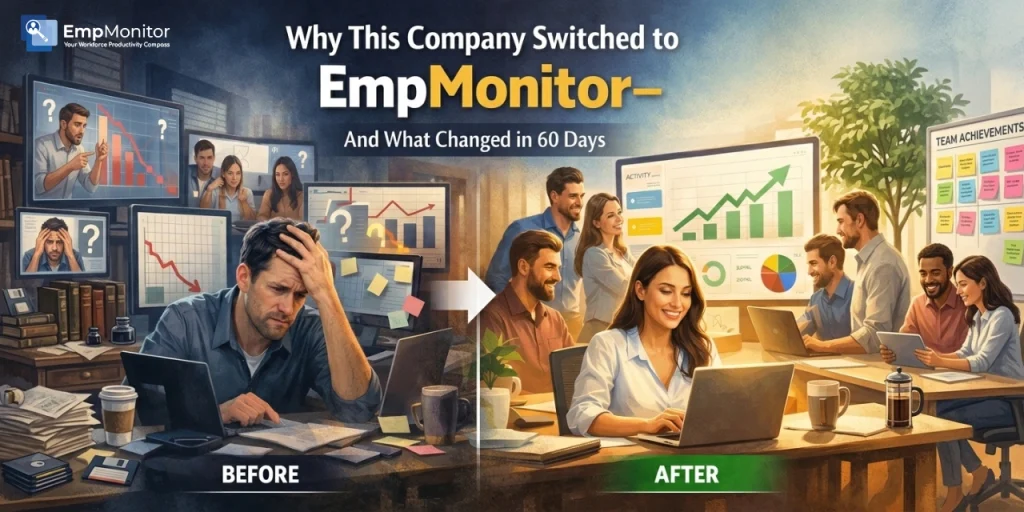
Before vs After: What Actually Changed
Before Switching
- Limited visibility into daily work activity
- Decisions based on incomplete productivity data
- Frequent minor delays in project timelines
- Inefficiencies going unnoticed
- Managers relying heavily on follow-ups
After 60 Days with EmpMonitor
- Clear understanding of how work hours were spent
- Stronger alignment between effort and output
- Improved consistency in task completion
- Smoother workflows across teams
- Less need for constant check-ins

Beyond the Numbers
The improvements weren’t just about productivity metrics.
Day-to-day operations became more structured. Managers spent less time chasing updates and more time focusing on outcomes. Employees had a better sense of how their time was being used and where they could improve.
The work environment didn’t become stricter.
It became more intentional.
What About Trust?
One concern early on was whether employee monitoring would affect trust.
In reality, it had the opposite effect.
Because the company introduced the tool openly and explained its purpose, employees understood the intent. There were no surprises.
Top performers felt their efforts were more visible. Others had clearer feedback to work with.
When handled correctly, monitoring supports accountability without creating discomfort.
Read More!
The Takeaway
Switching tools didn’t just give the company more data. It gave them useful insight they could act on.
In remote and hybrid teams, the gap between hours worked and results delivered often comes down to visibility.
If your team seems busy but outcomes don’t consistently reflect that, the issue may not be effort; it may be a lack of clarity.
The right workforce management software can help close that gap.
For this company, EmpMonitor provided that missing layer. And within 60 days, the change wasn’t just noticeable, but it held up over time.
FAQs
1. What is employee monitoring in modern workplaces?
Employee monitoring involves using tools to understand how work hours are spent. It helps organizations improve productivity, streamline workflows, and maintain accountability.
2. What makes ethical employee monitoring different?
Ethical employee monitoring focuses on transparency and fairness. Employees are informed about what is being tracked and why, which helps maintain trust.
3. Why do companies switch workforce management software?
Businesses often switch when their current tools don’t provide enough insight into productivity or workflow efficiency.
4. Can monitoring really improve productivity?
Yes. When implemented thoughtfully, it increases awareness, reduces wasted time, and helps teams work more efficiently without constant supervision.