


Two employees ask for the same day off. One manager approves it without a second thought. The other says no, citing “team needs,” and nobody can explain why the answers differed.
This is what happens when workplace rules live only in someone’s head. Once a team grows past a handful of people, shared understanding stops being enough, and different managers start making different calls.
HR policies fix this by turning expectations into written, consistent rules everyone can point to. They protect the organization legally, but more importantly, they remove the guesswork from everyday decisions.
This guide covers what HR policies actually are, why they matter, the types most companies need, and how to build and maintain them without burying employees in paperwork.
Read Aloud!
What Are HR Policies?
HR policies are the formal guidelines an organization uses to define employee-related expectations, covering everything from conduct and attendance to leave, safety, and discipline. They tell employees what’s expected and give managers a consistent standard to apply, instead of deciding each situation individually.
What a policy actually does
A good policy isn’t a document nobody reads. It answers a specific question before that question turns into a dispute: what happens in this situation, and why. That clarity matters most around leave requests, conduct issues, and performance decisions, the moments where inconsistency causes real friction.
Policies vs. procedures
People often use these terms interchangeably, but they answer different questions. A policy explains what the organization expects and why. A procedure explains how that expectation gets carried out.
Take leave as an example. The policy states that employees receive a set number of paid days off each year. The procedure explains how to request that leave, who approves it, and how it gets recorded. Understanding hr policies and procedures as separate but connected pieces makes both easier to write and follow.
Why HR Policies Matter More as Companies Grow
A ten-person company can run on shared understanding. A two-hundred-person company can’t. Here’s what changes once clear policies exist.
Consistency. The same situation gets the same response, no matter which manager is involved.
Clear expectations. Employees know what’s expected before a problem comes up, not after the fact.
Lower risk. Documented standards make it easier to show decisions were fair and consistent, not personal.
A framework for managers. Nobody has to improvise HR decisions on the spot.
Trust. When rules are visible and applied evenly, uncertainty drops, and people settle into their roles faster.
The Most Important Types of HR Policies
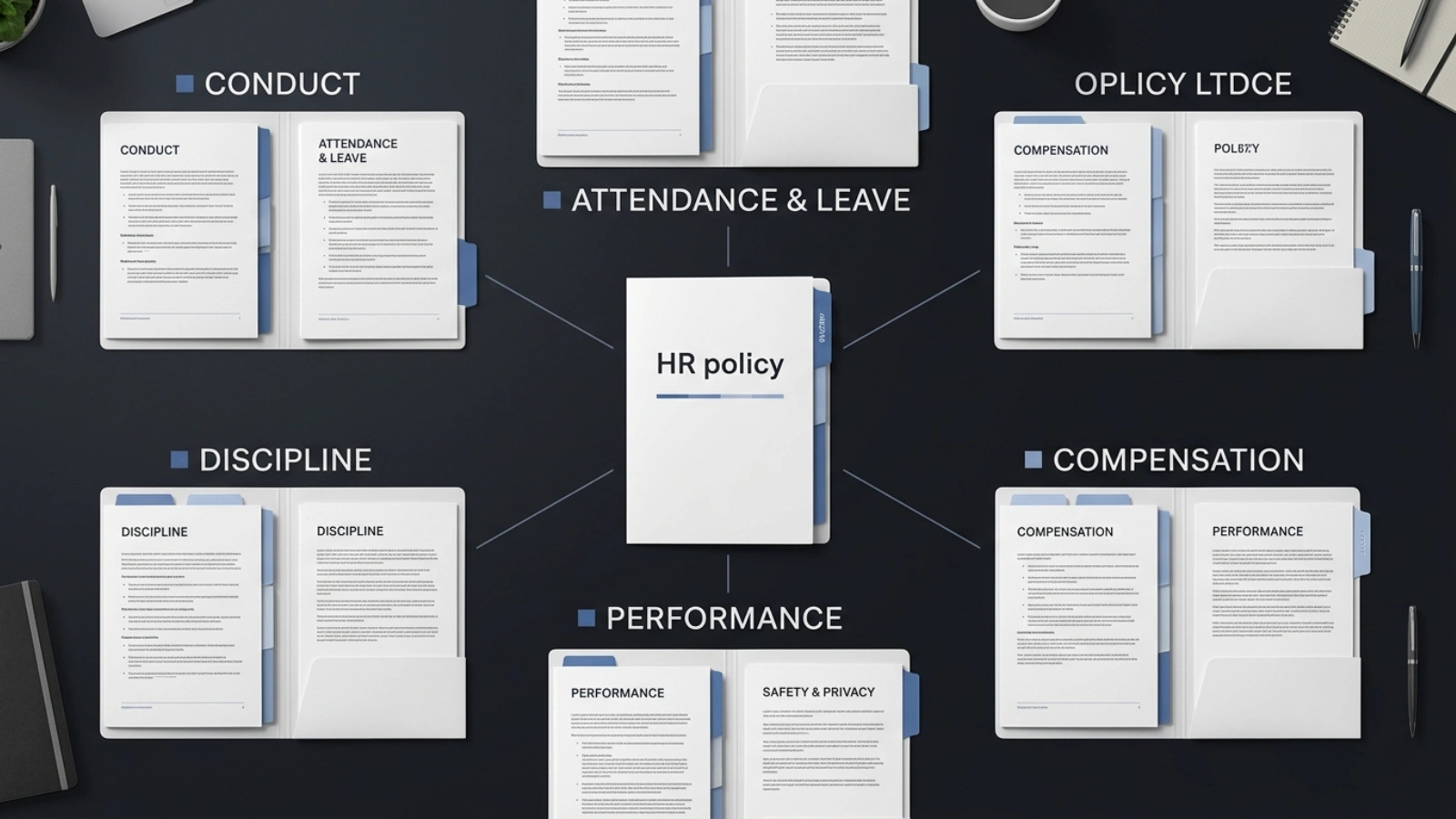

Trying to list every policy an organization could ever write isn’t useful. It helps more to group them by the problems they solve.
Workplace conduct and anti-harassment. Code of conduct, anti-harassment rules, non-discrimination standards, and how employees report concerns.
Attendance, leave, and working arrangements. Attendance expectations, working hours, leave entitlements, and remote or hybrid work rules. As flexible schedules become the norm, this category needs the most frequent updates.
Compensation and benefits. Pay practices, benefits, bonuses, and overtime rules. Employees shouldn’t have to guess how or when they’ll be paid.
Performance and development. How reviews work, how promotions get decided, and what training support looks like.
Safety, privacy, and security. Physical safety standards alongside newer concerns like data privacy and acceptable technology use.
Disciplinary and termination. How investigations happen, how grievances get handled, and what offboarding looks like.
Looking at real hr policies examples across these categories shows how broad the term actually is. It isn’t one document. It’s a connected set of rules covering nearly every stage of the employee relationship.
Read More!
HR Tracking Software: Your 2026 Guide To Smarter Workforce Management
HR Forensics: Using Digital Evidence in Employment Tribunals
What Are the Five Most Important HR Policies?
If an organization can only prioritize a handful of policies to start, five tend to matter most for reducing risk and creating fairness.
- Equal opportunity and non-discrimination
- Anti-harassment
- Code of conduct
- Attendance and leave
- Disciplinary and termination
These aren’t universally required everywhere. Exact obligations shift depending on location, industry, and company size. But when people ask what are the five most important hr policies are, these five come up consistently because they cover the areas most likely to create disputes or legal exposure if left undefined.
What Should an Effective HR Policy Include?
A policy that’s too vague fails almost as often as one that doesn’t exist. A workable policy generally covers seven parts:
- Purpose, why it exists
- Scope, who it applies to
- Policy statement, the actual rule
- Employee responsibilities
- Manager and HR responsibilities
- Reporting or escalation steps
- Review and update details
Skipping that last point is a common mistake. A policy without a review date tends to sit unchanged for years, even after laws or business practices shift underneath it.
How to Create and Implement HR Policies Without Creating More Red Tape

- Identify the problem. What decision or behavior actually needs consistency?
- Check legal requirements. Review relevant employment laws before drafting anything.
- Write the specifics. Vague language like “act professionally” doesn’t give managers enough to work with.
- Involve the right people. HR, leadership, relevant managers, and legal input where needed.
- Communicate and train. A policy nobody can find or understand won’t change behavior.
- Review it regularly. Set a schedule, and revisit sooner if laws or systems change.
Publishing a policy isn’t the finish line. Training, accessibility, and consistent enforcement are where the real work happens.
Mistakes That Create More Problems Than They Solve
Even well-intentioned policies fail when a few habits creep in.
Being too vague. “Behave professionally” means little without context or examples.
Copying templates without adapting them. A policy built for a different industry rarely fits cleanly.
Inconsistent enforcement. When managers ignore rules for some employees, trust erodes fast.
Burying policies in documents nobody reads. If employees can’t find it, it isn’t working.
Letting policies go stale. Laws change, teams change, and an unreviewed policy becomes a liability instead of protection.
How EmpMonitor Supports HR Policy Management
EmpMonitor helps organizations turn workplace policies into measurable, consistent practices. It gives HR teams and managers visibility into employee activity, attendance, and work patterns.
Key features include:
- Time and attendance tracking for monitoring working hours and attendance patterns
- Employee activity monitoring to understand work activity across teams
- Application and website tracking for visibility into digital work habits
- Productivity reports to identify trends and support informed decisions
- Screenshots and activity evidence for greater visibility where appropriate
- Centralized dashboards for easier HR and workforce management
With the right policies in place, EmpMonitor can help organizations maintain visibility and consistency across their teams.
The goal is not to replace HR policies, but to support them with actionable workplace insights.
Treat Policies as a Lifecycle, Not a Document
The strongest frameworks aren’t written once and forgotten. They move through a cycle: identify the issue, write the rule, communicate it, implement it, measure how it’s working, review it, update it.
Workforce changes, hybrid work, new technology, and shifting employment laws all demand regular attention. An organization that treats its handbook as a living framework rather than a static file stays ahead of the problems outdated rules tend to create.
Clear HR Policies Create a Clearer Workplace
Good HR policies were never really about adding more rules. They’re about removing the guesswork that creates unfair, inconsistent decisions in the first place.
Clear expectations lead to consistent decisions. Consistent decisions build trust. And trust, more than any single document, is what keeps a workplace functioning as it scales.
Take a look at how your organization currently documents, communicates, and reviews its policies. That’s usually where the biggest gaps show up first.
Frequently Asked Questions
What are HR policies?
Formal guidelines that define employee-related expectations, covering conduct, attendance, leave, safety, and discipline. They give employees clarity and give managers a consistent standard to apply.
Which policies should businesses prioritize first?
Equal opportunity, anti-harassment, code of conduct, attendance and leave, and disciplinary or termination policies are generally considered the essential starting point.
What’s the difference between policies and procedures?
A policy explains what the organization expects and why. A procedure explains how that expectation gets carried out step by step.
What are some common examples?
Code of conduct, anti-harassment policy, attendance policy, leave policy, remote work policy, and data privacy policy.
Are they legally required?
Some are, depending on jurisdiction, industry, and company size. It’s worth checking local labor laws rather than assuming something is optional.