

Only 23% of organizations express strong confidence in their ability to detect an insider threat before significant damage occurs, according to Cybersecurity Insiders’ 2025 Insider Risk Report. That number should bother every security lead reading this, because the other 77% are discovering breaches after the data is already gone.
Here is the uncomfortable truth most vendors will not say out loud: the gap is almost never caused by missing policy. It is caused by a monitoring blind spot between the perimeter firewall and the individual endpoint. Threat actors, whether malicious employees, negligent ones, or compromised accounts, operate in that gap every day.
EmpMonitor, used by 500,000+ employees across 15,000+ companies in 100+ countries, is built specifically to close that gap. This article is not a feature tour. It is a framework for using endpoint behavioral data to catch the three insider profiles that cost organizations the most, before they walk out the door with your data.
Listen To The Podcast Now!
Three Insider Profiles, Three Very Different Cost Structures
Not all insider incidents are equal in cost or detectability. Understanding the profile shapes your detection strategy.
Malicious insiders steal, sell, or sabotage deliberately, for financial gain, competitive advantage, or revenge. Negligent insiders are well-meaning but careless: they forward files to personal email to print them at home, sync a work folder to a private cloud “just temporarily,” or plug in a USB drive once. Compromised insiders never intended harm; an attacker took over their credentials or device.
The cost differences are stark. Negligent insiders cost organizations around $4.58 million per incident on average. Criminal or intentional insider incidents average $756K per incident, lower per event, but credential theft costs three times more per incident than accidental breaches when you account for remediation and regulatory exposure. Meanwhile, the average data breach cost reached $4.88 million globally in 2024, with insider activity and compromised credentials among the top contributors.
Most programs focus their attention on the malicious profile and neglect the negligent one. That is exactly backwards. Negligent insiders are far more common. Their “gray area” behaviors- forwarding work documents to personal email, uploading to personal cloud storage, copying to USB devices, sharing credentials with contractors– are invisible to perimeter tools. Those tools see network traffic. They do not see what is happening at the endpoint.
Why Formal Programs Still Miss Breaches
64% of organizations had a formal insider threat defense program in place in 2025. 67% of security teams plan to enhance their insider threat detection and mitigation efforts in the next 12 months. Having a program is not the same as having detection that works at the endpoint level.
Traditional security stacks- firewalls, CASB, email filtering- operate on data in transit. They catch things leaving the network. They do not see an employee opening a sensitive file, spending 40 minutes in a personal Dropbox session, and copying nothing yet. Behavioral context- what the person was doing before the suspicious action- is what separates a real threat from noise. And that context only lives at the endpoint.
65% of organizations with dedicated insider risk programs report those programs were the only control that caught a potential breach early. The distinguishing factor is behavioral analytics and identity intelligence, moving from reactive clean-up to predicting exfiltration before data leaves.
A Five-Step Endpoint Monitoring Framework That Actually Works
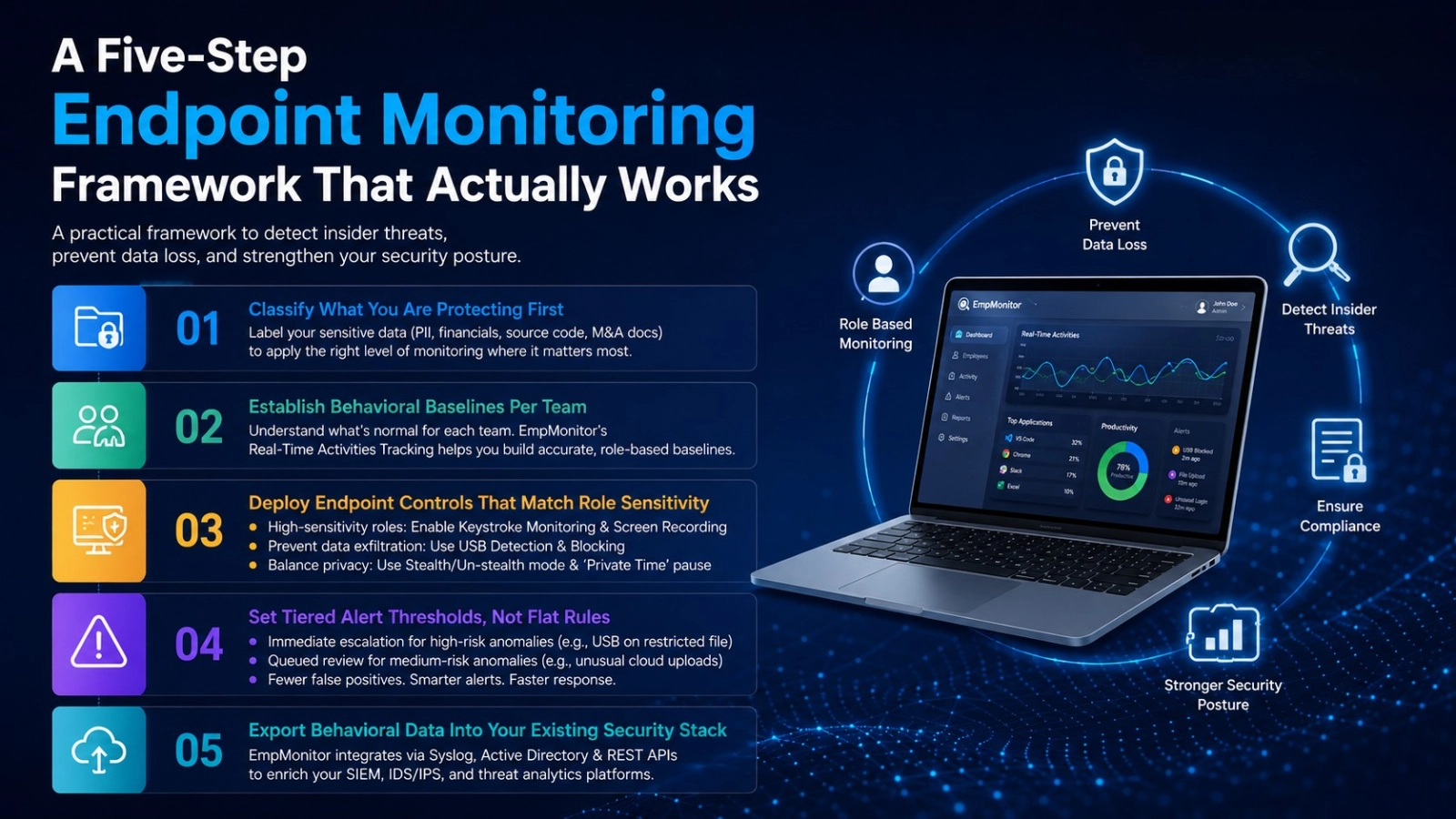

This is the operational sequence that works in practice. Each step builds on the one before it.
Step 1: Classify What You Are Protecting First
Monitoring without classification creates alert fatigue. Before configuring anything, label your sensitive data: PII, financial records, source code, M&A documents. This determines where you apply the most aggressive monitoring settings, and where you can afford to be lighter-touch.
Step 2: Establish Behavioral Baselines Per Team
A developer accessing source code at 10 PM is normal. An accounts-payable clerk doing the same is an anomaly. EmpMonitor’s Real-Time Activities Tracking, filterable by employee, time, or task, gives you the granularity to build team-specific baselines, not just company-wide averages that flatten meaningful deviations.
Step 3: Deploy Endpoint Controls That Match Role Sensitivity
For high-sensitivity roles- finance, legal, executive assistants- enable Keystroke Monitoring and Screen Recording. These create an evidentiary record that is admissible when you need to demonstrate intent. For detecting data exfiltration, USB Detection & Blocking is non-negotiable: physical media moves data entirely outside your network visibility. One plugged-in thumb drive that your SIEM never sees is all it takes.
For roles where privacy concerns are legitimate, junior staff, non-privileged roles, EmpMonitor’s Stealth/Un-stealth mode and optional “private time” pause let employees step out of monitoring during personal breaks. That reduces legal and morale friction considerably.
Step 4: Set Tiered Alert Thresholds, Not Flat Rules
Not every anomaly deserves a page-the-SOC-a2 AMAM alert. A reasonable tiered approach: a single blocked USB attempt on a high-risk file warrants immediate escalation. Five cloud uploads in one hour from a role that normally uploads zero files in a day warrants a queued review. Flat rules generate so many false positives that analysts start ignoring them, which is how breaches survive undetected for weeks.
Step 5: Export Behavioral Data Into Your Existing Security Stack
Endpoint behavioral signals become vastly more powerful when correlated with your SIEM, IDS/IPS, or threat analytics platforms. EmpMonitor exports data via Syslog and integrates with Active Directory and REST-based APIs for security orchestration. This means the behavioral baseline you built in Step 2 can feed into your existing threat intelligence workflow; you are not creating a separate silo, you are enriching what your SOC already sees.
The Banking Use Case: Why Insider Threats Hit Harder There
Banking deserves its own mention. Research published in the Journal of Cyber Security Research and Applications (2025) identifies insider threats in banking as a category-defining risk. Privileged access to financial systems, customer PII, and transaction records means a single malicious insider can cause regulatory and reputational damage far beyond the direct financial loss.
The specific behavioral signals to watch in financial services: unusual bulk data access outside business hours, access to client records not associated with the current caseload, and USB activity on workstations that handle wire transfer approvals. EmpMonitor’s Insider Threat Prevention feature is built around exactly this profile, catching the behavioral precursors, not just the exfiltration event itself.
Regulatory exposure amplifies the cost. GDPR allows fines up to €20 million or 4% of global annual turnover for serious violations. More than half of data-breaching complaints are never reported externally, which means the liability sits on the organization’s books, hidden but real, until an audit surfaces it.
What Most Teams Get Wrong When They Deploy This
Two mistakes show up repeatedly.
Monitoring too broadly, too fast. Rolling out full keystroke logging to 200 people on day one, without classifying sensitive roles first, overwhelms analysts and creates employee relations problems before you see a single real threat. Start with your highest-risk roles and expand from there.
Treating endpoint monitoring as a standalone tool. The teams that catch breaches early feed endpoint behavioral data into their broader security intelligence stack. Syslog export and API integration are not optional extras; they are what turns monitoring data into actionable threat intelligence. Read our deeper guide on insider threat and data loss prevention for remote teams and the 2026 update on insider threat trends for more on how the threat landscape is shifting.
The Confidence Gap Is Solvable
The 23% confidence figure is not inevitable. It reflects a specific gap: organizations with perimeter security but no endpoint behavioral visibility. That gap is closable with the right controls deployed in the right sequence.
54% of organizations are now using AI to detect insider risks, with 70% reporting faster response times. The organizations that close the confidence gap fastest pair AI-driven analytics with real endpoint behavioral data, not just network logs and access records. The endpoint is where behavior actually happens. That is where you catch it.
If your current stack can tell you that data left the network but not what the employee was doing in the 30 minutes before it left, that is a blind spot. No formal program compensates for it.
Start your free EmpMonitor trial and close that gap before the next incident report requires you to explain why you didn’t see it coming.