


Listen To The Podcast Now!
What Is Source Code?
Source code is the human-readable set of instructions developers write using programming languages like Python, Java, C++, or JavaScript. It is the foundation behind every digital product, every feature, every function, and every piece of logic your software runs on lives inside it. For any tech company, this code represents years of work, thousands of development hours, and significant financial investment.
Losing it means a competitor can replicate your product in a fraction of the time it took you to build it. That is why it is such a high-value target for bad actors. To prevent IP theft, businesses must first understand the value of their source code and why it is so crucial to protect it. Protecting it is not just a technical responsibility; it is a business-critical one, and every effort made in this direction is an effort to protect the company’s long-term future.
How to See the Source Code of a Website, And Why It Matters?
Many people are surprised by just how easy it is to learn how to see the source code of a website. Right-clicking on any webpage and selecting “View Page Source,” or pressing Ctrl+U on most browsers, immediately reveals the HTML, CSS, and JavaScript that make up the page. This transparency is intentional for frontend code, but it gives malicious actors a significant head start.
By studying publicly visible code patterns, they gain a clearer picture of how your systems are structured and can target your backend far more precisely. It is a reminder that exposure begins at the surface level. Businesses focused on efforts to prevent source code theft cannot only focus on server-side protections. Front-end visibility, combined with weak internal controls, creates a pathway that is often overlooked until real damage has already been done.
Why Developers Steal Source Code?
Not every case of source code theft involves a calculated criminal. Sometimes, a developer copies snippets they wrote to a personal drive out of habit and never considers the legal implications. Other times, it is entirely deliberate; a disgruntled employee plans their exit weeks, copies the full codebase, and uses it to launch a competing product or sell it to a third party.
Contractors who have limited long-term loyalty to a company present another common risk. They access sensitive modules, finish their engagement, and carry valuable logic with them. Research consistently shows that insider threats are behind a significant share of data breaches across the tech sector. Understanding these motivations is not about assuming the worst of your team; it is about recognizing where gaps exist and putting the right safeguards in place to prevent source code theft from both accidental and malicious actors.
Red Flags That Source Code May Be at Risk:
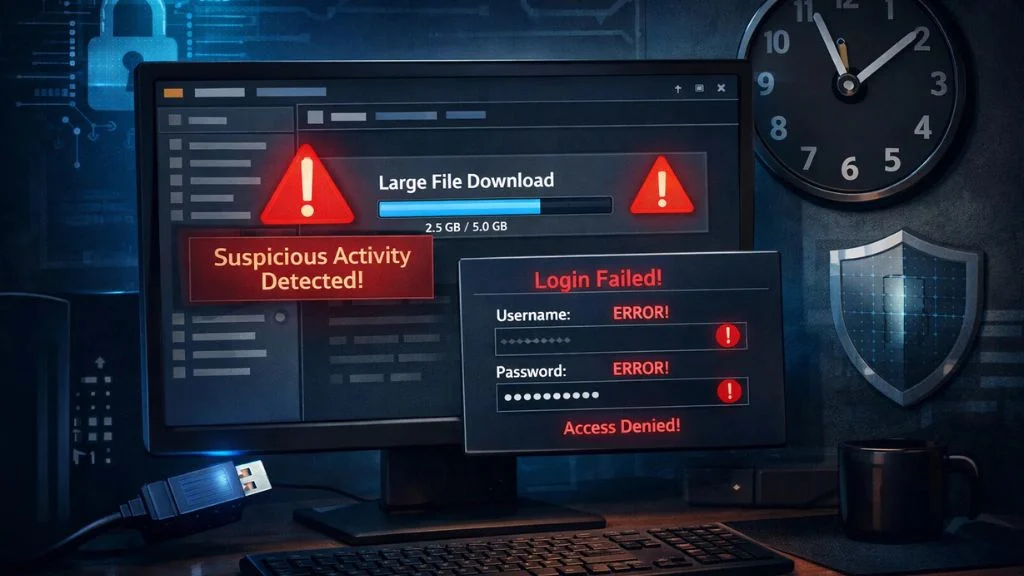

Catching suspicious activity early can be the difference between a minor incident and a full-scale breach. Several warning signs deserve immediate attention. Unusual after-hours access to code repositories is one of the clearest indicators that developers rarely need to clone an entire codebase at 2 AM.
Large file downloads in the days leading up to a resignation should raise concern. Repeated failed login attempts on your version control system, sudden interest in projects outside a developer’s regular scope, or unexplained USB connections to work machines are all signals that deserve investigation without delay. If the goal is to prevent source code theft before it causes real damage, monitoring for these behaviors needs to be a proactive habit, not a reactive response triggered only after something has already gone wrong.
Implement Strong Access Controls:
One of the most direct ways to prevent source code theft is to make sure not everyone on your team has access to everything. Role-based access control (RBAC) is a straightforward but powerful concept; developers should only see the parts of the codebase relevant to their assigned tasks.
Applying the principle of least privilege across tools like GitHub, GitLab, or Bitbucket reduces the number of people who can clone, download, or export sensitive code. Reviewing and updating permissions regularly is just as important as setting them up initially. When a developer changes roles or leaves the company, access should be revoked right away, not after an offboarding checklist eventually reaches that step.
Delayed access removal has been the root cause of many preventable incidents. A consistent approach to access management is one of the most reliable strategies to prevent source code theft at the organizational level.
Secure Your Code Repositories:
Your code repository is where your intellectual property lives, and it needs to be protected accordingly. Use private repositories with multi-factor authentication (MFA) enabled for every contributor. Avoid storing API keys, credentials, or business-critical logic in shared or public branches.
Enforce branch protection rules that require peer review before any merge into the main codebase. Audit logs are non-negotiable; every commit, clone, and export should be traceable back to a specific user and timestamp. Setting up real-time alerts for bulk cloning or unusual download volumes gives your team the chance to act before data leaves your systems.
These repository-level controls create a transparent, monitored environment that makes it far harder for a bad actor to operate undetected. Combined with strict access controls, they form one of the strongest layers you can build to protect your codebase and keep your development infrastructure secure.
Use Code Signing and Digital Watermarking:
An underused but highly effective approach to prevent source code theft is embedding unique identifiers directly into the codebase. Code signing verifies that code has not been tampered with and confirms its origin, making it possible to detect unauthorized modifications.
Digital watermarking goes a step further by placing invisible markers inside your code that can identify the source of a leak if your proprietary files surface somewhere they should not. These techniques serve a dual purpose. They act as a strong deterrent for potential thieves who know traceability is baked in, and they provide forensic evidence if legal action becomes necessary.
If your code ever shows up in a competitor’s product, watermarks give you a concrete way to prove ownership. Pairing this with access controls and monitoring creates a well-rounded strategy to prevent source code theft at both the prevention and accountability levels.
Legal Safeguards Every Business Needs:

Technology alone will not fully prevent source code theft; the legal layer matters just as much. Before any developer, contractor, or third-party vendor touches your code, they should sign a solid Non-Disclosure Agreement (NDA). Intellectual Property Assignment clauses in employment contracts ensure that any code written on company time belongs to the company, not the individual who wrote it.
Non-compete agreements, where legally enforceable, add another layer of protection by limiting what departing employees can do with knowledge gained on the job. If theft does occur, having these documents in place is what makes legal action viable.
Without them, proving ownership and pursuing damages becomes significantly harder. Building a strong legal framework around your development processes is one of the most important long-term investments to protect your intellectual property and safeguard your business interests across any jurisdiction.
Train Your Team on Security Awareness:
Security tools and legal contracts only hold up when the people using them understand what they are protecting. A developer who stores code on a personal cloud account, shares credentials over a messaging app, or connects a personal USB drive to a work machine can undo all your technical safeguards in minutes, often without any bad intent whatsoever. Regular security training sessions help your team understand the specific behaviors that put company IP at risk.
Cover safe file-sharing practices, phishing awareness, the risks of working on public networks without a VPN, and what responsible offboarding looks like from a security standpoint. When your entire team, from junior developers to senior engineers, understands their role in keeping code secure, it becomes significantly easier to prevent source code theft from the inside out. A security-conscious team is one of your strongest lines of defense.
Also Read:
How To Prevent IP Theft and Protect Your Business Assets?
Top 5 Intellectual Property Theft Cases and What We Can Learn From Them?
How EmpMonitor Helps You Prevent Source Code Theft?

EmpMonitor is an employee monitoring and insider threat prevention platform trusted by over 15,000 companies across 100+ countries. For businesses serious about efforts to prevent source code theft from within, EmpMonitor provides real-time visibility into developer activity, before a breach has a chance to happen.
Key features that help prevent source code theft:
- User Activity Monitoring Tracks apps and websites accessed during work hours, flagging unauthorized use of code-sharing platforms.
- Screenshot Monitoring captures periodic on-screen images to provide visual evidence of developer activity in real time.
- Keystroke Tracking Logs keystrokes to detect unauthorized credential use or suspicious inputs.
- USB Detection & Blocking: Detects and blocks unauthorized USB connections, stopping code from being copied to external drives.
- Behavioral Alerts sends instant notifications when unusual activity patterns are identified.
- Browser History Tracking identifies attempts to upload code to external platforms or unauthorized storage sites.
- Discreet Monitoring operates silently in the background, ensuring full surveillance without disrupting developer workflow.
Establish a Thorough Offboarding Process:
Most companies put considerable thought into onboarding, but overlook the risks that come when a developer walks out the door. A weak offboarding process is one of the easiest vulnerabilities for a departing employee to exploit.
The moment a resignation is received ora termination is decided, access to all repositories, cloud accounts, internal systems, and project management tools should be cut off immediately, not at the end of a notice period. An IT audit should be conducted to review file transfer logs from the days leading up to departure.
Company devices should be collected and verified to ensure no unauthorized copies of the codebase were made. Wiping local development environments on company machines before reissuing them is also a necessary step. A disciplined offboarding process is one of the most overlooked yet effective measures to prevent source code theft.
Monitor Third-Party and Contractor Access:
Outsourcing development is common, but it introduces a layer of risk that many companies manage poorly. Unlike full-time employees, contractors often have less loyalty to the organization and fewer restrictions on what they do with code they encounter. To prevent source code theft from external contributors, always use isolated development environments, give contractors access only to the specific modules needed for their assigned work, never the full codebase.
Use time-limited access tokens that expire automatically at the end of a contract. Require NDAs with clearly defined IP ownership terms before any work begins. Monitor contractor activity with the same level of scrutiny applied to internal team members. Treating every external contributor with a healthy level of caution is not distrust; it is responsible risk management and a critical step to prevent source code theft.
Conclusion:
Source code is the most valuable asset many tech companies own, and one of the most frequently targeted. From access controls and legal agreements to employee monitoring and careful offboarding, protecting IP requires a layered approach. Tools like EmpMonitor add real-time visibility that makes it possible to catch insider threats before they escalate. The goal to prevent source code theft is not a one-time task; it is an ongoing commitment that needs to be woven into how your company operates at every level of development.
FAQ’s:
Q1. Can companies legally monitor developers to prevent source code theft?
Ans: Yes, in most regions, as long as employees are informed and consent is properly documented. The rules vary by jurisdiction, so always verify local requirements.
Q2. What are the most common methods developers use to steal code?
Ans: Copying files to personal cloud storage, USB transfers, emailing code snippets, and cloning private repositories to personal accounts are among the most frequently used methods.
Q3. How does EmpMonitor help prevent source code theft?
Ans: EmpMonitor monitors user activity, blocks unauthorized USB connections, sends behavioral alerts, and captures screenshots, giving companies real-time insight into what developers are doing.
Q4. Do contractors need NDAs to prevent source code theft?
Ans: Absolutely. Every external contributor should sign an NDA and an IP assignment agreement before accessing any part of the codebase.