

If you have ever wondered how to measure team productivity in a way that actually drives real results, you are not alone. Most managers track hours worked and call it a day, but that tells you very little about actual output, efficiency, or overall team health. True productivity measurement goes much deeper than surface-level activity. It looks at outcomes, quality, collaboration, and engagement all at once. In this guide, we break down 10 key metrics that give you a clear and accurate picture of how your team is truly performing every single day, and what practical steps you can take to start improving performance right now.
Listen To The Podcast Now!
Why You Need to Know How to Measure Team Productivity Correctly?


Metric 1: Goal Completion Rate:
One of the most reliable starting points when thinking about how to measure team productivity is tracking goal completion rate. This metric captures the percentage of assigned tasks or objectives completed within a set timeframe, directly connecting individual daily effort to broader business results.
Set SMART goals, Specific, Measurable, Achievable, Relevant, and Time-bound, and review completion rates on a weekly or monthly basis. A consistently low completion rate usually signals unclear priorities, resource shortfalls, or deeper process inefficiencies. A rate that stays near 100% without real challenge may mean your targets are simply set too low. Either way, this metric opens the door to more honest, data-backed performance conversations that drive genuine and lasting improvement across the team over time.
Metric 2: Output Quality:
Quantity without quality is always a false measure of success. When thinking about how to measure team productivity, output quality must sit right alongside volume at all times. Track error rates, revision cycles, rework frequency, and client feedback scores to understand not just how much your team is producing, but how consistently well they are delivering their work.
A team churning out high volumes of substandard work ultimately costs the organization far more in corrections, wasted time, delays, and reputational damage than a smaller but high-quality output ever would.
Build clear review checkpoints into existing workflows, encourage regular peer feedback, and set specific quality standards from the very beginning of each project. When people know exactly what excellent work looks like in practice, both accuracy and speed improve naturally without needing additional pressure from leadership.
Metric 3: Time-to-Completion:
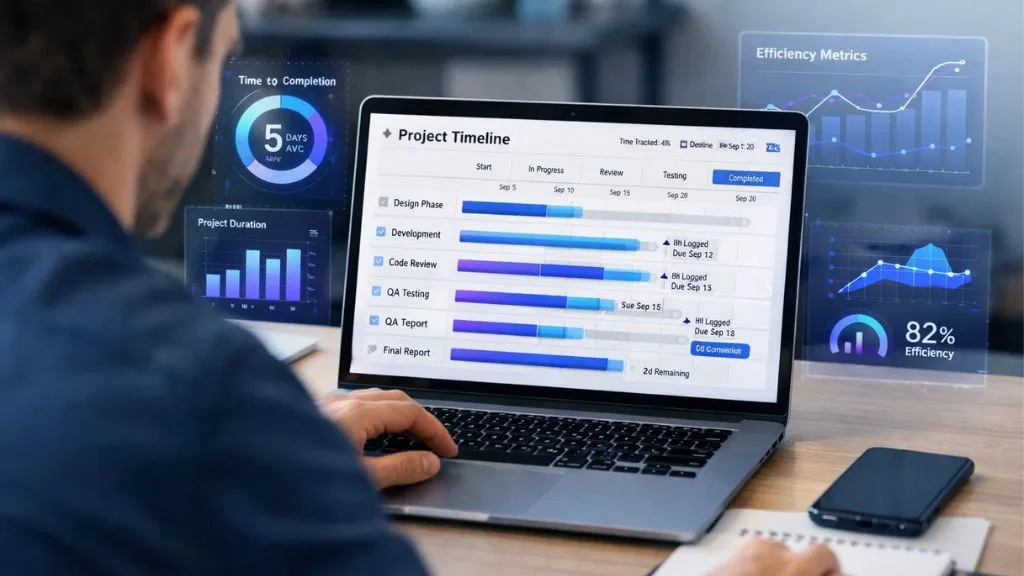
Time-to-completion tracks exactly how long your team takes to move a task or full project from start to finish. It is a critical part of how to measure team productivity because it exposes workflow inefficiencies, approval bottlenecks, and skill gaps that might otherwise stay completely invisible until an important deadline is suddenly missed.
Compare actual completion times against planned estimates regularly and track where delays repeat themselves most often. Recurring slowdowns almost always point to unclear task requirements, missing tools, over-reliance on specific individuals, or team members who need additional training or support. Over time, this data helps you build far more accurate project timelines, which significantly reduces last-minute pressure, improves team morale, and makes your overall planning process much more reliable and consistent for everyone involved.
Metric 4: Active Work Time vs. Idle Time:
Understanding how much of the workday your team spends on focused, meaningful tasks versus idle or off-task activity gives you an honest and unfiltered window into where attention and energy actually go each day. Using a productivity tracker provides real-time visibility into active work patterns across your entire team without requiring constant manual oversight. This is not about micromanaging individuals or creating a culture of distrust; it is about identifying consistent patterns that point to systemic issues.
If idle time spikes regularly at certain hours or for certain team members, it often signals unclear task assignments, excessive meeting loads, or early signs of disengagement. Use this data constructively to restructure workflows, cut unnecessary interruptions, and ensure every team member always has a clear, manageable task queue that keeps them consistently focused and productive throughout the day.
Metric 5: Employee Utilization Rate:

Utilization rate measures the percentage of an employee’s available work time that is actually spent on productive or billable tasks. It is especially valuable for service-based businesses, agencies, and consulting teams where every hour of focused time directly translates into revenue, client value, and profit margin.
To calculate it, divide productive hours by total available hours and multiply by 100. Rates consistently sitting above 85–90% put teams at serious risk of burnout and disengagement over time. Very low utilization rates suggest poor task distribution or significant underutilization of available talent. Anyone exploring how to measure team productivity through a financial lens will find this metric particularly eye-opening, as it connects workforce capacity directly to the bottom line in a way that is easy to present to senior leadership and stakeholders.
In remote work settings, especially when employees participate in online exams or certifications, ensuring focus and integrity is important. Using remote exam proctoring software can help monitor the testing process, making sure that the assessment remains fair and secure. These tools typically track behaviors such as screen activity and eye movement, providing insights that help identify potential distractions or cheating. As remote work and online learning become more common, these technologies can be useful for maintaining a productive and trustworthy environment during assessments.
Metric 6: Collaboration and Communication Effectiveness:
Team productivity is never purely an individual achievement; it is deeply shaped by how well people communicate, share information, and work together toward shared goals every single day. Measure collaboration effectiveness through meeting quality scores, task handoff times, cross-functional project success rates, and structured peer feedback sessions conducted regularly throughout the year.
Poor communication creates friction that quietly slows down every part of the workflow. Productivity monitoring helps reveal whether your team is connecting at the right moments, using the right tools, and passing critical information between members clearly and efficiently.
When collaboration truly works well, it does not simply add individual outputs together; it multiplies them in ways that would not be possible through solo effort alone. Building this into your approach to how to measure team productivity ensures you are capturing the full and real picture of performance.
Metric 7: Absenteeism and Attendance Patterns:

Attendance data tells you far more than simply who showed up to work on a given day. Rising absenteeism is frequently one of the earliest indicators of growing burnout, disengagement, unmanageable workloads, or deeply unclear role expectations within a team. Understanding how to measure team productivity means treating attendance patterns as a genuine performance signal rather than a routine administrative record.
Track both planned and unplanned absences consistently over time and look carefully for emerging trends across individuals, teams, or entire departments. When clear patterns appear, address them directly through honest, supportive conversations rather than jumping to assumptions.
Small and low-cost adjustments, redistributing tasks more fairly, clarifying priorities, or offering modest scheduling flexibility, are often enough to re-engage a struggling team member before absenteeism becomes a far more expensive and disruptive talent retention problem for the organization.
Metric 8: Revenue Per Employee:
Revenue per employee is a clean and straightforward financial metric that directly connects overall workforce size to total business output and value generated. Divide your total company revenue by the number of full-time employees to arrive at this figure. While it does not reflect individual performance in granular detail, it serves as a highly useful benchmark for tracking broad productivity trends and comparing your organization against industry standards.
When you track productivity using this metric alongside all the others, it helps leadership answer one of the most critical strategic questions any growing business faces: Is team expansion actually generating proportional returns? If headcount keeps rising but revenue per employee keeps declining, that signals onboarding inefficiencies, unclear role definitions, or systemic process breakdowns that need urgent attention. Including this in how to measure team productivity gives your analysis a strong financial grounding that resonates with decision-makers at every level of the organization.
Metric 9: Employee Engagement Score:
Engaged employees consistently and significantly outperform disengaged peers across virtually every industry and role type. Use quarterly surveys, regular short pulse checks, and structured one-on-one conversations to measure how connected, genuinely valued, and motivated your team members feel in their day-to-day roles within the organization.
Ask meaningful questions about role clarity, manager support, available growth opportunities, overall team culture, and perceived fairness of workload distribution. A key insight when learning how to measure team productivity is that engagement data fills the crucial gap that hard output metrics alone simply cannot address on their own.
It tells you whether your team has the genuine motivation and not just the raw skill, to sustain strong performance consistently over time. Without this, even the most capable teams gradually underperform as disengagement quietly erodes their commitment and drive.
Metric 10: Customer Satisfaction Score (CSAT):
For teams with customer-facing responsibilities, CSAT is one of the clearest and most direct external signals of whether your internal productivity is translating into real, meaningful value for the people your business serves. Timely, high-quality work almost always produces satisfied, loyal customers. Declining satisfaction scores, however, almost always trace back to identifiable internal issues, slow or broken workflows, poor task handoffs, inconsistent quality standards, or communication breakdowns between departments.
Gather CSAT data regularly through post-interaction surveys, Net Promoter Scores, and support ticket resolution feedback. Many managers overlook CSAT entirely when figuring out how to measure team productivity, yet it is one of the most powerful reality checks available. If your team is working hard but customer satisfaction scores are still falling, something in the process urgently needs to be identified and fixed before it damages client relationships and business reputation further.
Also Read:
How EmpMonitor Helps You Measure and Improve Team Productivity?

Managing a distributed team shouldn’t mean flying blind. EmpMonitor gives managers real-time workforce visibility and accurate, actionable data that drives smarter decisions across in-office, remote, and hybrid environments
Rather than relying on assumptions or incomplete information, EmpMonitor replaces guesswork with clear, immediately actionable workforce insights that make it significantly easier to understand how to measure team productivity on a day-to-day basis. Here is what it brings to the table:
- Real-Time Activity Tracking: Monitor active and idle time across all employees through intuitive live dashboards that update automatically and continuously throughout the day.
- Productivity Calculation: Automatically classify apps and websites as productive or unproductive to generate precise, consistent, and reliable team productivity scores at every level.
- Time Tracking Software: Record work hours, breaks, and shift patterns accurately for dependable reporting, project billing, and smooth payroll processing.
- Workforce Productivity & Engagement Reports: Generate detailed, comprehensive reports to identify performance trends, spot disengagement early, and address productivity gaps before they grow into larger problems.
- Screenshot Monitoring: Capture periodic screen activity to verify task focus and alignment without creating an uncomfortable surveillance environment for your team.
- Attendance Tracking: Automate attendance management completely, eliminate manual errors, and maintain clean and accurate records with minimal daily administrative effort.
- Insider Threat Prevention: Detect unusual or suspicious user behavior patterns early and protect sensitive business data proactively before a serious security breach can occur.
Visit EmpMonitor to explore the complete feature set and claim your free trial today.
Conclusion:
Knowing how to measure team productivity is one of the highest-value skills any manager or team leader can deliberately build over time. The 10 metrics in this guide, spanning goal completion, output quality, utilization, engagement, and customer satisfaction, work together to give you a genuinely complete and honest view of your team’s real performance.
No single number ever tells the whole story, but the right combination of metrics gives you something clear, reliable, and confident to act on every day. Add a purpose-built tool like EmpMonitor alongside these metrics, and you have everything required to shift from reactive management to consistent, data-driven leadership that delivers real and lasting results for your team and your entire business.
FAQ’s:
Q1: Why is it important to know how to measure team productivity?
Ans: Without a clear measurement system, managers have no reliable way to identify performance gaps, set fair expectations, or make informed resource decisions. Knowing how to measure team productivity gives leaders the data they need to drive consistent improvement.
Q2: What are the best metrics for measuring team productivity?
Ans: Goal completion rate, output quality, time-to-completion, utilization rate, and employee engagement scores are among the most effective. Using a combination of these metrics gives you a well-rounded and accurate view of overall team performance.
Q3: Can small businesses also benefit from learning how to measure team productivity?
Ans: Absolutely. In fact, small businesses benefit even more because every team member’s contribution carries greater weight. Tracking the right productivity metrics early helps small teams grow efficiently and avoid costly performance issues down the road.
Q4: How does EmpMonitor help with productivity monitoring?
Ans: EmpMonitor provides real-time activity tracking, productivity calculation, time tracking, attendance management, and detailed workforce reports all in one platform. It makes it significantly easier for managers to monitor, analyze, and improve team productivity across any work environment.
Q5: How frequently should managers review productivity metrics?
Ans: Operational metrics such as active work time and task completion are best reviewed weekly. Strategic metrics like engagement scores and revenue per employee are better assessed on a monthly or quarterly basis for meaningful trend analysis.