

A first-person account of what actually changed, in productivity, accountability, and team morale, after rolling out EmpMonitor across a 70-person distributed workforce.
| Industry: IT Services / Software Development
Company Size: 70 employees Work Model: 100% Remote (across 6 countries) Challenge: No visibility into productivity, attendance gaps, and rising project delays Solution: EmpMonitor: Employee Monitoring & Workforce Productivity Suite Results: 34% productivity increase | 96% attendance accuracy | Project delays down by 38% |
When our remote team crossed 60 members spread across six countries, we knew our existing tools were no longer enough. Managing a growing, distributed workforce with spreadsheets and weekly check-ins had stopped working months ago.
This is a first-person account of what actually happened, the good, the difficult, and the genuinely surprising, after we implemented EmpMonitor across our entire operation. We did not know what to expect going in. What we found changed the way we think about managing distributed work entirely.
The Background: A Remote-First Company With a Visibility Problem
We built our company as remote-first from day one. No offices, no commutes, just talented people working from home offices, co-working spaces, and occasionally different time zones. For the first couple of years, it worked well. The team was small, communication was tight, and everyone knew their role.
But when our remote team scaled past 50 people, the informal systems started to crack. Project managers were spending more time chasing updates than actually managing work. HR had no clean way to verify attendance. Leadership was making decisions based on assumptions rather than data.
We needed a solution built specifically for remote team management, one that gave us structure without turning us into a surveillance operation.
The Problem: Three Things We Could Not See:


Before implementing EmpMonitor, our remote team was operating largely on trust and self-reporting. That worked when everyone knew each other personally. At scale, it created three persistent problems:
- No productivity visibility: We had no real way to know whether people were actively working or simply online. Task completion rates told us some of the story, but never enough to act on.
- Attendance was unreliable: We used an honor-based check-in system. By the time payroll came around, discrepancies between reported and actual hours were frustratingly common.
- Project delays were increasing: Missed handoffs, unclear workload distribution, and zero idle-time data meant bottlenecks built up silently until they became full project delays.
These were not problems caused by bad employees. There were systemic gaps that naturally emerge when a remote team grows without the right monitoring infrastructure in place.
The Discovery: Finding EmpMonitor:
We evaluated four platforms before settling on EmpMonitor. What set it apart was not just the feature list; it was the approach. EmpMonitor is built around remote workforce monitoring that gives managers real data without creating a culture of suspicion.
The features that stood out immediately:
- Real-time dashboard with live employee activity status
- Automated attendance tracking with verified clock-in and clock-out
- URL and application usage monitoring
- Productivity scoring for individuals and teams
- Screenshot monitoring, triggered on demand or automatically
- Insider threat prevention for data security
The platform supported Windows, Mac, and Linux, which mattered for our remote team that uses a mixed device environment. Pricing was straightforward and scalable with no hidden fees as we grew.
The Implementation: Honesty Made It Work:
We have seen other companies bungle monitoring rollouts by treating them as a top-down decision. We took a different approach. Before installing anything, we told our remote team exactly what we were doing and why.
We hosted a live all-hands call and walked through what EmpMonitor tracks, what it does not track, why we needed it, and how the data would be used.
The response surprised us. Several team members said they were relieved and frustrated that their effort was invisible and that lower-performing colleagues faced no real accountability. Transparency turned what could have been a trust issue into a genuine trust-builder. Deployment took less than a week. Within 48 hours, the dashboard was live, and the first baselines were coming in.
What We Saw in the First 30 Days:
The first month of remote work tracking data was eye-opening in ways we did not anticipate.
Our remote team averaged 4.6 hours of active, productive work per eight-hour day. That number was not shockingly low, but now we actually knew it, and we could work with it. URL tracking revealed that a significant portion of working hours was being lost to non-work browsing during core hours. Application monitoring showed excessive context switching between tools, losing productivity not to laziness but to poor workflow design.
Attendance data also exposed a pattern: employees in certain time zones were logging hours inconsistently, creating payroll reconciliation problems that HR had been quietly absorbing for months. We did not use any of this to punish anyone. We used it to redesign how our remote team worked.
Month 2: From Observation to Optimization:
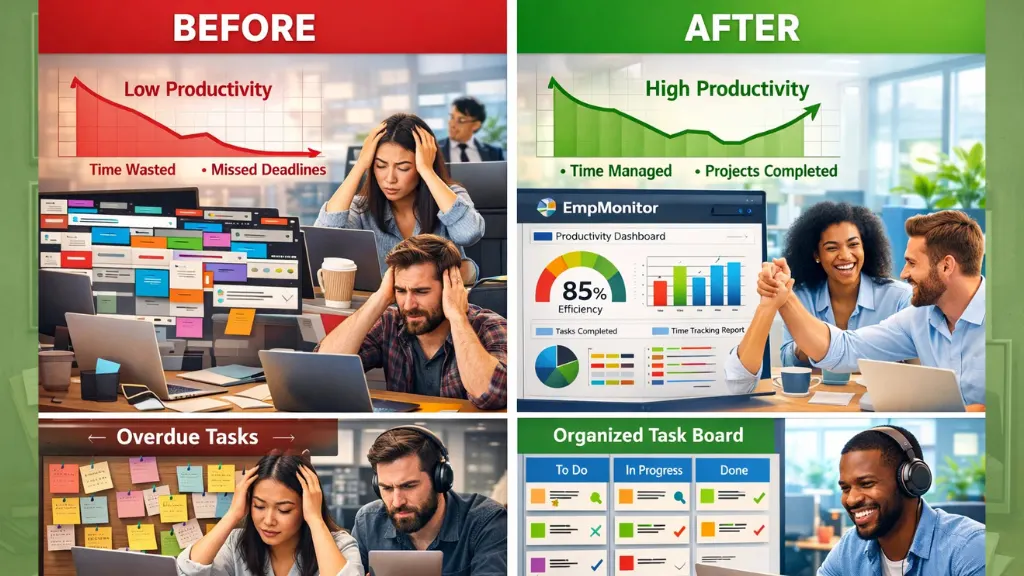
With 30 days of baseline data, we made targeted changes across three areas.
- Workflow redesign: We identified the top three tools causing excessive context-switching and consolidated our stack. Average active time climbed from 4.6 to 5.9 hours within three weeks.
- Workload rebalancing: EmpMonitor’s individual reports made it clear that two senior developers were absorbing a disproportionate share of urgent tasks. We redistributed responsibilities, and the quality of their output improved noticeably.
- Attendance standardization: We set clear core-hour expectations per time zone and used EmpMonitor’s automated tracking to enforce them consistently. Payroll disputes dropped to near zero within the first full payroll cycle.
Our remote team did not just become more productive; it became more fairly managed. And that made a measurable difference to morale.
The Results: 90 Days Later
|
Metric |
Result |
| Productivity Increase |
34% |
|
Attendance Accuracy |
96% |
| Project Delays Reduced |
38% |
| Payroll Disputes |
Near Zero |
| HR Hours Saved Monthly |
22 hrs |
The numbers reflected something deeper than efficiency gains. Our remote team had more clarity about expectations, more confidence that their effort was visible, and more trust in how performance was being measured.
Project delivery tightened significantly. The 38% reduction in delays came not from pressure, but from better data; managers could now spot a bottleneck forming before it became a crisis. One result we genuinely did not expect: employee satisfaction scores went up. The structure EmpMonitor provided made people feel more supported, not more watched.
EmpMonitor Features That Drove the Change:
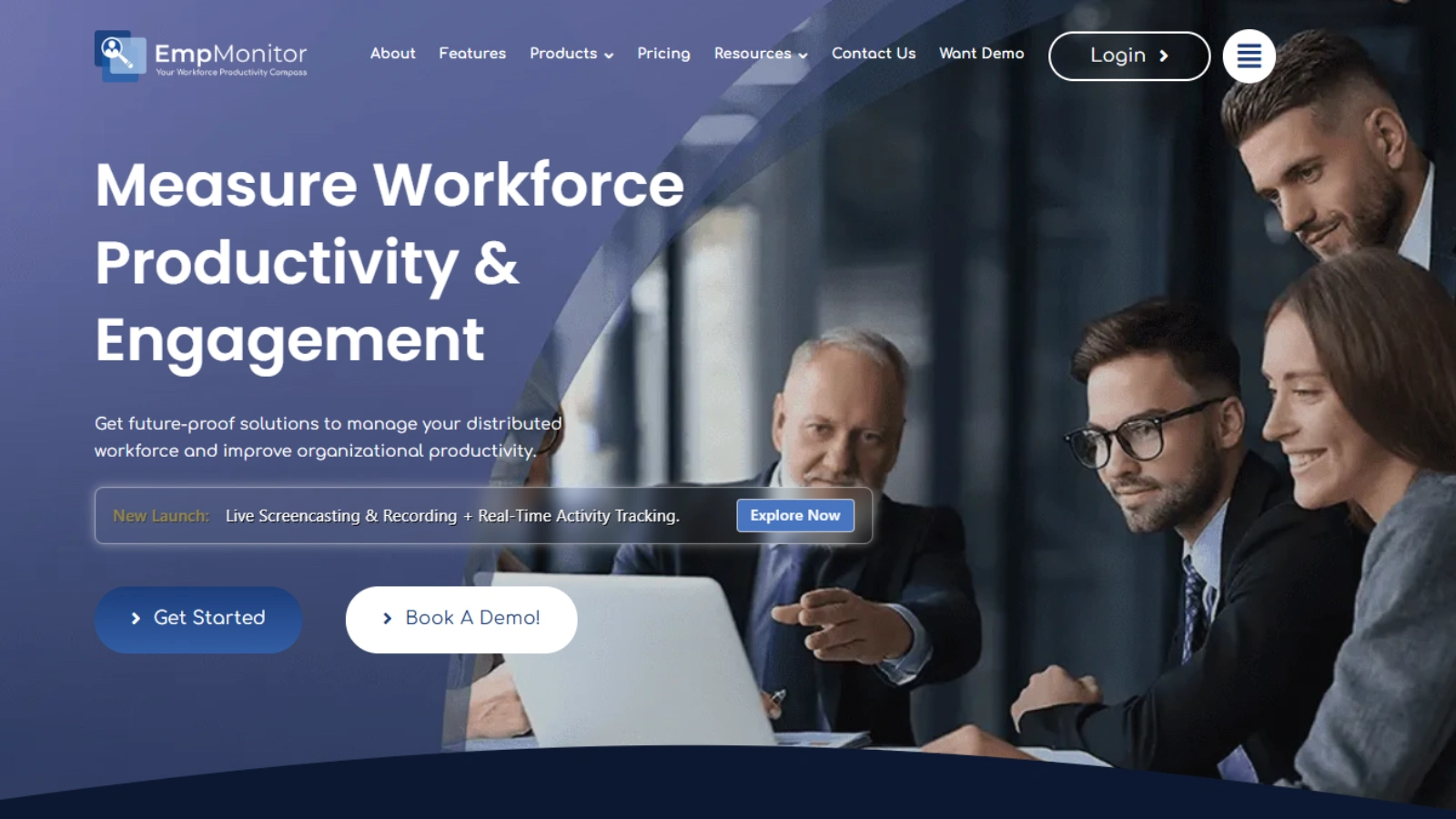

The feature that made the biggest impact in EmpMonitor was its activity tracking with productivity insights. It gave the company a clear view of active vs. idle time and how employees spent their hours across apps and websites. This helped uncover real issues like context switching, non-work browsing, and uneven workloads, not as assumptions, but as actionable data.
With this clarity, the team could redesign workflows, rebalance tasks, and standardize attendance, leading to measurable gains in productivity and fairness. Supporting features like application tracking and automated reports helped, but it was this core visibility that enabled smarter, data-driven decisions.
Alongside this, EmpMonitor’s other supporting features helped strengthen the results:
- Application & URL tracking: Identified distractions and optimized tool usage.
- Attendance monitoring: Ensured consistent work hours across time zones.
- Automated reports & dashboards: Enabled quick insights and faster decision-making.
- Individual performance reports: Helped balance workloads more fairly.
These features supported the core activity tracking by turning insights into consistent improvements.
What We Would Tell Other Remote-First Companies?
If your remote team has grown past 20 people and you are still relying on self-reporting and trust alone, you are probably operating with a significant visibility gap, and you likely do not know how large it is.
EmpMonitor did not fix our people problems. It revealed that most of what we thought were people problems were actually process and visibility problems. That distinction matters enormously.
The tool works best when you lead with transparency, use the data for improvement rather than punishment, and treat your remote team as partners in the process. Done right, monitoring does not erode trust; it actively builds it.
The Takeaway:
Scaling a remote team without the right infrastructure is like navigating without a map. You might reach your destination eventually, but you will take a lot of costly wrong turns along the way.
EmpMonitor gave us the map. It showed us where time was going, who was carrying too much weight, and where our systems were letting good people down. The result was a more productive, more fairly managed, and genuinely happier team and a leadership group that could finally make decisions based on data rather than assumptions.
FAQ’s:
Q1. Is EmpMonitor suitable for fully remote or hybrid teams?
Ans: Yes. EmpMonitor is designed for distributed teams, offering cross-platform support (Windows, Mac, etc.) and a real-time dashboard that works from anywhere. It helps managers track productivity, attendance, and workflows without needing a physical office setup.
Q2. Does employee monitoring reduce trust or harm team morale?
Ans: Not if implemented transparently. When employees understand what is being tracked and why, monitoring often improves fairness. It ensures high performers are recognized and workloads are balanced, which can actually boost morale and accountability.
Q3. How quickly can EmpMonitor be set up and start showing results?
Ans: Deployment is fast and straightforward. Most teams can be onboarded within a week, with initial data and insights available within 24–48 hours. Meaningful improvements in productivity and workflow can often be seen within the first 30 days.
Q4. What kind of data does EmpMonitor track?
Ans: EmpMonitor tracks active vs. idle time, application and website usage, attendance, and overall productivity trends. It focuses on work-related insights rather than intrusive monitoring, helping teams improve efficiency without micromanagement.
Q5. Is EmpMonitor legal and compliant with privacy regulations?
Ans: Yes, when used responsibly. EmpMonitor is designed to support transparent monitoring practices. Companies should inform employees, define clear policies, and ensure compliance with local labor and data privacy laws for ethical use.