


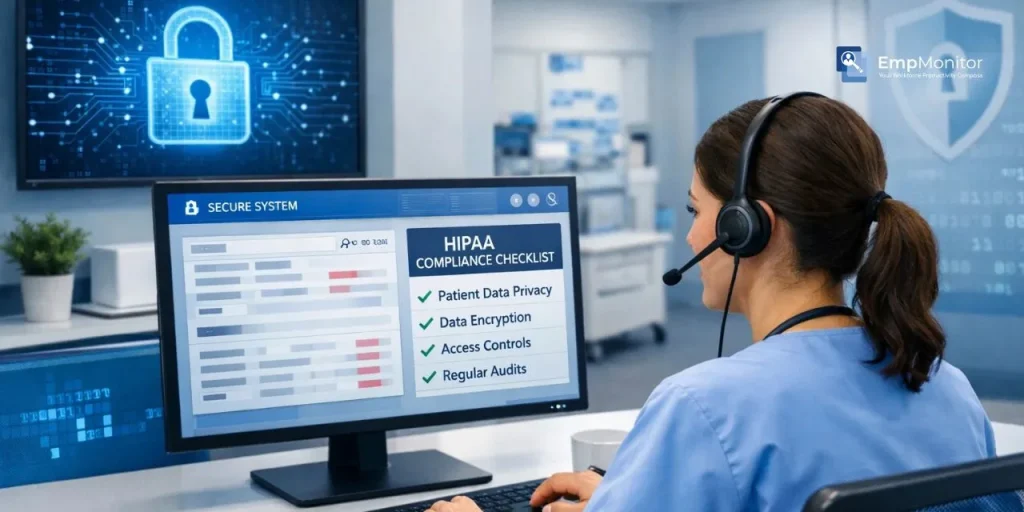
In the healthcare industry, data privacy isn’t just a best practice; it’s a legal obligation that every organization must take seriously. When organizations implement HIPAA compliant employee monitoring, they must ensure that every tool, process, and policy aligns with federal regulations specifically designed to protect sensitive patient information. A single compliance gap can lead to devastating financial penalties, long-lasting reputational damage, and most importantly, a serious breach of patient trust that can take years to rebuild.
As more healthcare teams shift to hybrid and remote work models, the pressure to balance meaningful productivity oversight with strict data privacy rules has never been greater. This guide breaks down what HIPAA compliant employee monitoring truly means, what risks healthcare organizations commonly face, and how to build a monitoring strategy that keeps your organization both productive and fully protected.
Listen To The Podcast Now!
What Is HIPAA and Why Does It Matter for Employee Monitoring?
The Three Core HIPAA Rules That Directly Impact Monitoring:
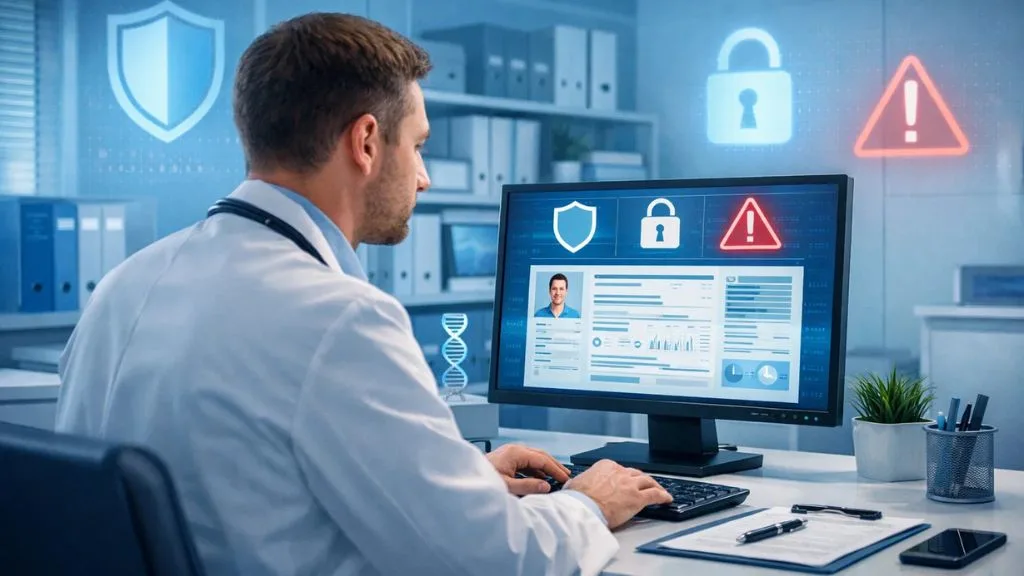

To build a genuinely compliant monitoring program, healthcare organizations need to understand the three foundational HIPAA rules that directly affect how employee activity can be tracked and managed.
- The Privacy Rule governs the use and disclosure of PHI. In the context of workforce oversight, this means your employee monitoring software should never inadvertently capture, log, or transmit patient data without proper authorization. Every monitoring configuration decision should be reviewed through the lens of this rule.
- The Security Rule focuses specifically on electronic PHI, or ePHI. It requires organizations to implement administrative, physical, and technical safeguards to protect electronic data. This means your HIPAA compliant employee monitoring solution must include strong access controls, detailed audit trails, and end-to-end encryption to fully satisfy this requirement.
- The Breach Notification Rule requires organizations to promptly notify affected individuals and relevant authorities if a data breach occurs. This makes it absolutely critical to have monitoring systems capable of detecting and documenting any unauthorized access to sensitive data in real time, so your response can be swift and documented.
Understanding these three pillars helps healthcare organizations evaluate whether their current HIPAA compliant employee monitoring tools and policies are truly aligned with what HIPAA demands, not just on paper, but in day-to-day practice.
Common Monitoring Risks That Put Healthcare Organizations in Danger:
Healthcare organizations face a distinct set of monitoring risks that most other industries simply don’t encounter. Identifying these risks early is the first step toward building a stronger HIPAA compliant employee monitoring posture.
- Uncontrolled access to ePHI remains one of the most prevalent and serious risks. Without proper role-based access controls, any staff member, or even a monitoring tool itself, could potentially view or log patient information that has no relevance to their job function.
- Poorly configured screenshot and keystroke tracking tools can inadvertently capture PHI if not set up with healthcare environments in mind. Monitoring employee software that captures screenshots at random intervals might unknowingly record an open patient file, a prescription screen, or a billing record containing sensitive identifiers.
- Missing or incomplete audit trails represent another significant compliance gap. HIPAA explicitly requires organizations to track who accessed what data and at what time. If your remote employee monitoring software doesn’t generate granular, time-stamped activity logs, your organization is already operating below the compliance threshold.
- Unvetted third-party vendors are a risk that is frequently underestimated. If your monitoring tool provider hasn’t signed a Business Associate Agreement, or BAA, using their software in a healthcare environment may itself constitute a HIPAA violation, regardless of how careful your internal practices are.
What Features Should a HIPAA-Compliant Monitoring Tool Include?
Not all employee computer monitoring software is designed with healthcare compliance requirements in mind. When evaluating tools for your HIPAA compliant employee monitoring program, several features are non-negotiable.
Your chosen solution must offer role-based access control so that only authorized personnel, such as HR managers or compliance officers, can review monitoring data. It must provide encrypted data storage and transmission to prevent any unauthorized interception of activity records or screenshots.
Comprehensive, immutable audit logs are essential. Every login event, access attempt, and monitored interaction must be timestamped and permanently recorded in a format that can be produced during an audit or investigation. The tool should also make it easy to generate compliance reports on demand without requiring extensive manual effort from your IT or compliance team.
Configurable monitoring policies are equally important for any HIPAA compliant employee monitoring setup. Healthcare organizations need the flexibility to define precisely what gets tracked, for example, excluding specific applications that routinely handle ePHI from screenshot capture while still maintaining meaningful and actionable oversight of how employees are spending their time and using organizational resources.
How to Build a HIPAA-Compliant Employee Monitoring Policy From Scratch:
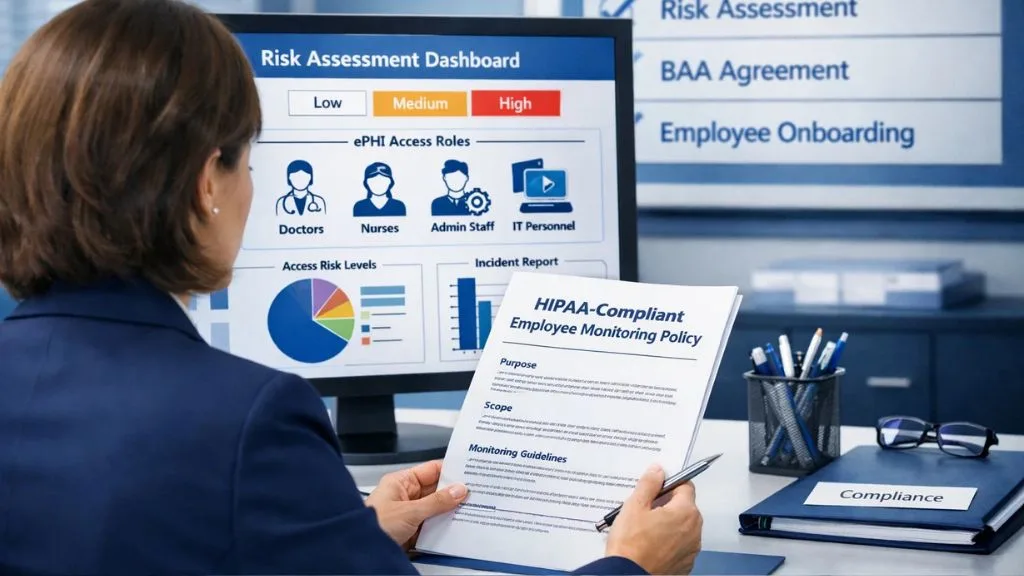
Having the right technology in place is only half the equation. Your organization also needs a clearly defined, well-documented HIPAA compliant employee monitoring policy that explicitly aligns with HIPAA’s requirements and reflects your organization’s unique risk profile.
Begin with a formal risk assessment. Identify which roles have routine access to ePHI, and determine the appropriate level of monitoring for each role. HIPAA compliant employee monitoring is not a one-size-fits-all approach; a clinical data analyst requires a very different oversight framework than a scheduling coordinator or front-desk receptionist.
Next, draft a written monitoring policy and incorporate it into your employee onboarding process. Transparency is not just legally smart, it is ethically necessary. Employees should understand exactly what is being monitored, why it is being monitored, and how that data will be used and protected. Informed employees are also more compliant employees.
Engage your legal or compliance team to confirm that your monitoring vendor has signed a current and comprehensive BAA. Without this agreement in place, even a well-intentioned HIPAA compliant employee monitoring program can collapse under regulatory scrutiny. Review the BAA annually to ensure it still reflects your actual use case and any changes in your monitoring setup.
Remote and Hybrid Work: Why Compliance Just Got More Complicated:
The widespread shift to remote and hybrid work has introduced significant new complexity into the already demanding world of HIPAA compliance. When healthcare employees access ePHI from home networks, shared devices, or unsecured Wi-Fi connections, the potential for a data breach increases dramatically.
This is precisely where remote employee monitoring software plays a vital and strategic role. It gives healthcare organizations the visibility they need to manage a distributed workforce without losing control over data security. However, the tool you select and the way it is configured can make a substantial difference in your compliance exposure.
HIPAA compliant employee monitoring in remote environments requires a layered set of safeguards. These include VPN enforcement for all remote access to clinical or administrative systems, mandatory device-level encryption for any endpoint used to access ePHI, and granular application-specific monitoring controls that prevent accidental capture of patient data in home environments.
Organizations should also establish clear, written policies about which devices and networks are approved for accessing any system containing protected health information. A remote employee who connects to a patient database from an unprotected public Wi-Fi network is a compliance problem, and a HIPAA compliant employee monitoring program that doesn’t flag this behavior is a compliance gap.
Also Read:
EmpMonitor: Built for Organizations That Take Compliance Seriously:

When healthcare organizations search for a monitoring platform that combines robust productivity insights with responsible data security, EmpMonitor is a solution worth serious consideration. Trusted by over 15,000 companies across 100+ countries and tracking more than 500,000 employees globally, EmpMonitor offers the depth of functionality that compliance-driven environments require.
Here’s how EmpMonitor supports HIPAA compliant employee monitoring across your workforce:
- Real-Time Activity Monitoring: Track application and website usage in real time, enabling managers to identify policy violations as they happen rather than after the fact.
- Screenshot Recording, Capture configurable periodic screenshots to maintain a visual record of employee activity, with flexible settings to avoid capturing sensitive screens.
- User Activity Monitoring: Gain granular visibility into how employees interact with systems, helping detect unusual access patterns or potential insider threats early.
- Attendance & Time Tracking: Accurately log work hours for on-site and remote employees, reducing time fraud and supporting payroll accuracy.
- Data Loss Prevention (DLP) proactively detects and blocks unauthorized data transfers that could put ePHI or other sensitive information at risk.
- Insider Threat Prevention: Identify behavioral anomalies that may signal an internal data breach before serious damage occurs.
- Detailed Reports & Audit Logs: Generate comprehensive, time-stamped activity reports that support compliance documentation, internal investigations, and regulatory audits.
EmpMonitor is compatible with Windows, Mac, and Linux/Ubuntu environments, making it flexible enough for the diverse technology ecosystems found in most healthcare organizations.
Staff Training: The Human Side of Compliance:
No technology solution, no matter how advanced, can substitute for a well-trained and compliance-aware workforce. Your employees are both your greatest asset and, if not properly educated, your greatest compliance vulnerability.
Staff training programs should cover what PHI and ePHI actually are, how your organization uses employee monitoring, and what specific behaviors could put both patients and the organization at legal and financial risk. When employees understand that HIPAA compliant employee monitoring exists to protect patients, not to micromanage their every move, they are far more likely to embrace it.
Training should also address how to report suspicious activity, what steps to follow if a potential privacy breach is observed, and the personal and organizational consequences of non-compliance. Refresher sessions should be scheduled at least annually and whenever significant changes are made to your monitoring policies or tools.
When your workforce is genuinely informed and engaged, your HIPAA compliant employee monitoring program transforms from a surveillance mechanism into a shared commitment to patient safety and organizational integrity.
Conducting Compliance Audits on Your Monitoring Program:
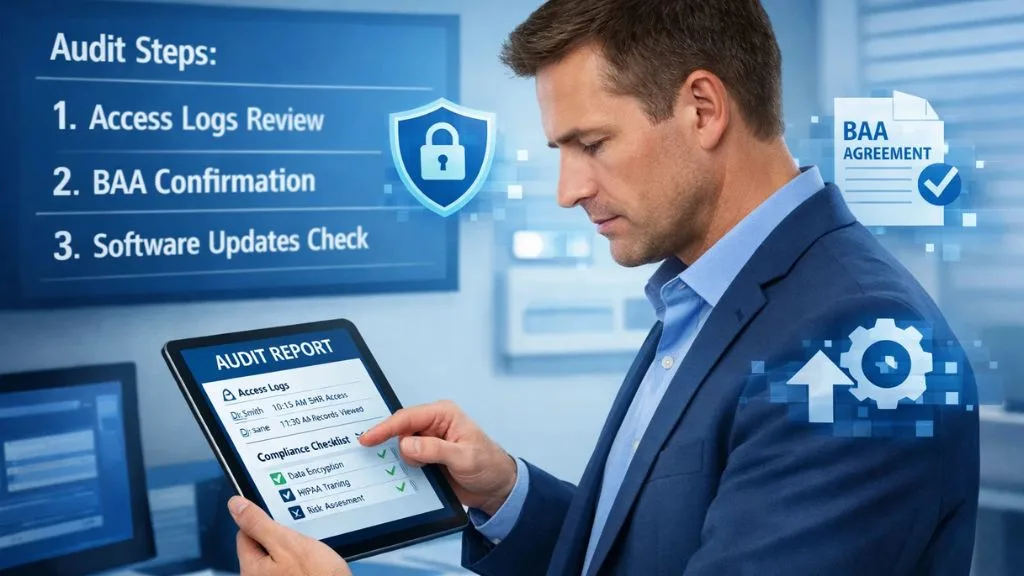
A monitoring strategy that goes unreviewed is a liability waiting to surface. Healthcare organizations that are serious about HIPAA compliant employee monitoring should schedule regular, structured audits of their systems to verify that everything is functioning as intended and that no new compliance risks have quietly emerged.
During each audit, review access logs to confirm that your HIPAA compliant employee monitoring setup only allows authorized users to view sensitive data. Verify that your vendor’s BAA is current and accurately reflects your current monitoring scope. Examine whether any recent software updates or configuration changes have introduced new data collection behaviors that may conflict with HIPAA’s requirements.
Also, assess whether your overall HIPAA compliant employee monitoring strategy still fits your workforce reality. If your team has grown significantly, adopted new clinical software, or expanded remote operations, your monitoring approach may need to be updated accordingly. Treating compliance as a living, evolving commitment, rather than a one-time checkbox, is what separates organizations that stay protected from those that don’t.
Conclusion:
Monitoring employees in healthcare is not optional, but it must be done thoughtfully and responsibly. HIPAA compliant employee monitoring demands the right combination of compliant technology, well-structured policies, transparent communication with staff, and consistent ongoing review. As patient data continues to be one of the most targeted and valuable commodities in cybersecurity, healthcare organizations that invest in compliance today will be far better positioned to avoid regulatory penalties, protect their patients, and preserve the institutional trust that defines their mission.
FAQ’s:
Q1. Does implementing employee monitoring automatically violate HIPAA?
Ans: Not at all. When properly configured, secured, and supported by a signed BAA with your vendor, HIPAA compliant employee monitoring can be conducted in a manner that fully satisfies regulatory requirements.
Q2. What is a Business Associate Agreement (BAA) and why is it required?
Ans: A BAA is a legally binding contract between a healthcare organization and a third-party vendor that handles or could encounter PHI. It defines each party’s responsibilities in protecting that data and is a mandatory requirement under HIPAA.
Q3. Can healthcare organizations legally monitor remote employees?
Ans: Yes. However, remote employee monitoring software must be carefully configured to avoid capturing ePHI and should be deployed alongside complementary safeguards like device encryption and VPN policies.
Q4. How frequently should a HIPAA monitoring policy be reviewed?
Ans: At a minimum, once annually. Additionally, any significant change to your workforce size, technology environment, or applicable regulations should trigger an immediate policy review.