



Introduction: Why “Flexible” Doesn’t Automatically Mean “Effective”
A flex schedule sounds like the perfect solution to rigid work hours. More freedom, happier employees, better balance. That’s the expectation most companies start with.
But reality often looks different. Teams struggle with coordination, deadlines slip, and managers feel like they’ve lost visibility. What was meant to improve productivity sometimes creates confusion instead.
The problem isn’t flexibility itself. It’s how that flexibility is designed. Without structure, a schedule can quickly turn into inconsistency.
This guide focuses on what actually works. Not just theory, but practical ways to build a system that supports both employees and business outcomes.
Quick Answer: What Is a Flex Schedule & How Do You Design One?
A flex schedule is a work arrangement that allows employees to choose when, and sometimes where, they work instead of following fixed hours.
Designing one effectively comes down to balance. Employees need autonomy, but the business still needs structure, alignment, and accountability.
The Real Goal of a Flex Schedule (Most Companies Get This Wrong)
Many organizations treat a flex work schedule as a perk. Something that gives employees more freedom and improves satisfaction. That’s only part of the picture.
The real goal is controlled flexibility. You want employees to work in a way that suits them, without disrupting team performance.
A well-designed system focuses on three things:
- Productivity: Work gets done efficiently, regardless of timing
- Retention: Employees stay because the system fits their lives
- Accountability: Everyone knows what is expected and delivers on it
Flexibility without boundaries creates gaps. Deadlines become unclear, collaboration weakens, and performance becomes harder to measure.
A schedule works best when it feels flexible to employees but is still predictable for the business.
The Building Blocks of a Smart Flex Work Schedule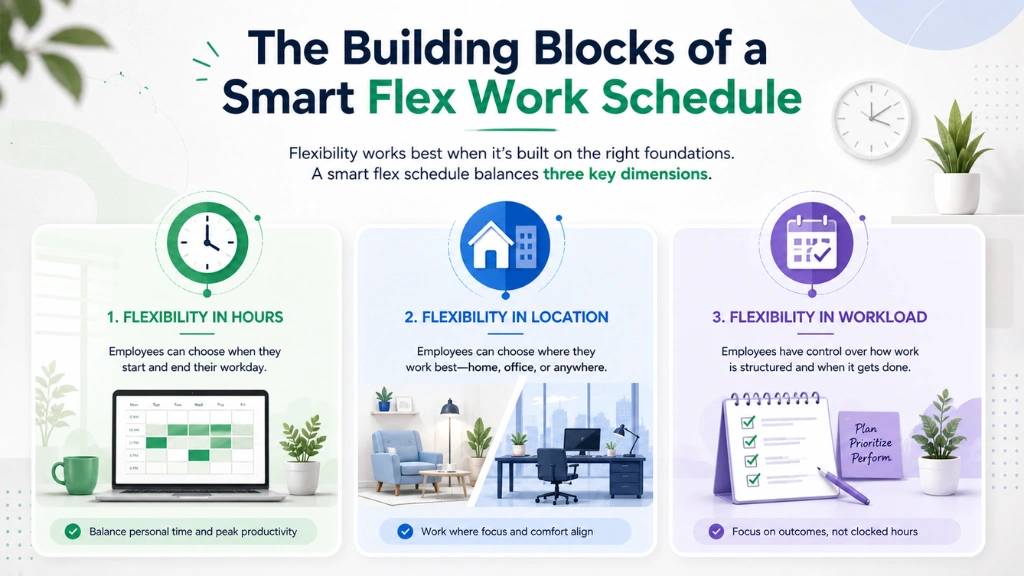

Before designing anything, it helps to break a flex time work schedule into simple components. Most flexibility comes from three areas.
Flexibility in Hours (Flextime)
This is the most common form. Employees can adjust when they start and end their day.
For example, one person may work from 7 AM to 3 PM, while another works from 11 AM to 7 PM. Both complete the same hours, just at different times.
Many companies add “core hours,” a set window where everyone must be available. This keeps collaboration intact while still allowing flexibility.
Flexibility in Location
Work is no longer tied to one place. Employees may work remotely, in a hybrid setup, or fully in-office.
Location flexibility often pairs with a flex schedule. It reduces commuting stress and allows people to work where they feel most productive.
However, it also requires stronger communication systems. Without them, teams can quickly lose alignment.
Flexibility in Workload Structure
Not all flexibility is about daily hours. Sometimes it’s about how work is distributed.
This includes:
- Compressed workweeks (longer days, fewer days)
- Part-time roles
- Job sharing between employees
Each option serves a different purpose. The key is matching the structure to the role, not forcing a single model across the organization.
Types of Flex Schedules You Can Actually Use (With Real Scenarios)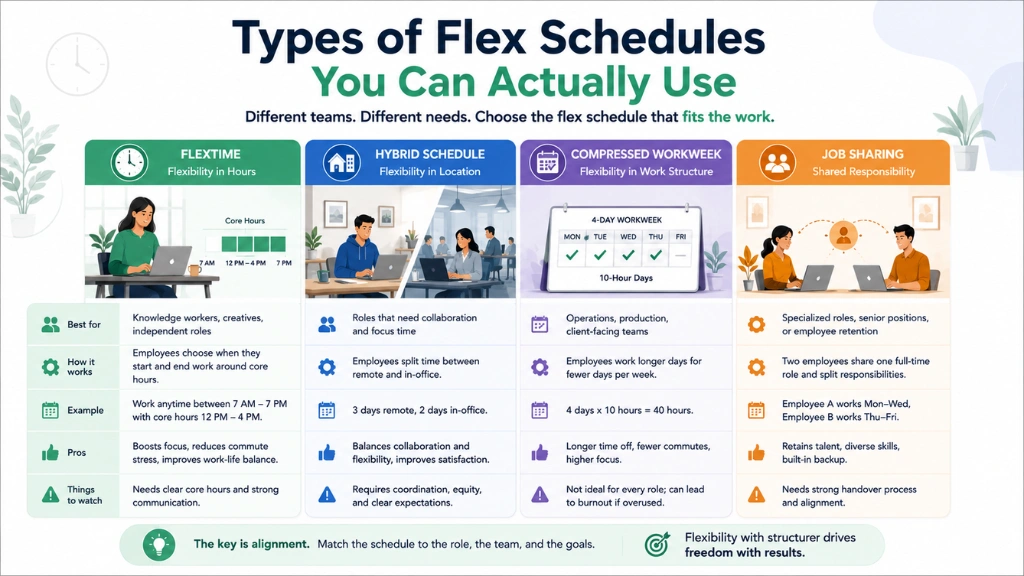
Not every flex work schedule fits every team. The best approach depends on the nature of the work and how teams collaborate.
Flextime for Knowledge Workers
This works well for roles like developers, marketers, or designers. Their output matters more than fixed hours.
Employees choose their schedule while staying available during core hours.
Best when: work is independent and outcome-driven
Not ideal when: constant real-time coordination is needed
Compressed Workweeks for Operations Teams
Employees work longer days but fewer days in a week. A common setup is four 10-hour days.
This reduces commuting and gives extended time off.
Best when: tasks are structured and predictable
Not ideal when: workload varies daily
Hybrid Schedules for Collaboration-Heavy Roles
Some roles need in-person interaction. Hybrid models allow employees to split time between office and remote work.
Best when: teamwork and meetings are essential
Not ideal when: schedules are highly unpredictable
Job Sharing for Specialized Roles
Two employees share one full-time role. This works well when expertise is critical, but full-time availability isn’t required.
Best when: tasks can be clearly divided
Not ideal when: continuity is crucial
Step-by-Step Framework to Design Your Ideal Flex Schedule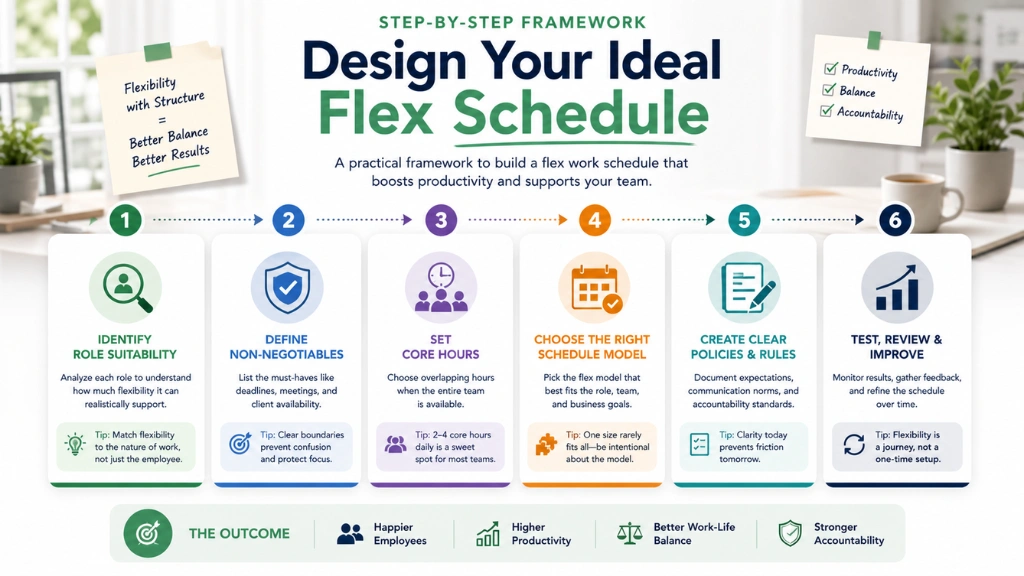
Creating a flex schedule without a plan leads to inconsistency. A structured approach makes all the difference.
Step 1 – Identify Role Suitability
Not every role can be flexible in the same way. Start by analyzing job responsibilities.
Ask:
- Does this role require fixed hours?
- How much collaboration is needed?
- Can outcomes be measured easily?
Step 2 – Define Non-Negotiables
Every business has certain requirements that cannot change.
These may include:
- deadlines
- team meetings
- client availability
Clear boundaries prevent confusion later.
Step 3 – Set Core Hours
Even flexible teams need overlap. Core hours ensure everyone is available at the same time for collaboration.
This keeps communication smooth without removing flexibility.
Step 4 – Choose the Right Schedule Model
Match the schedule type to the role. A one-size approach rarely works.
For example, a flex time work schedule may suit creative roles, while hybrid schedules fit management teams better.
Step 5 – Create a Clear Flex Work Schedule Policy
A strong flex work schedule policy sets expectations.
It should define:
- Who is eligible
- working hour guidelines
- communication rules
- performance expectations
Without this, flexibility becomes inconsistent across teams.
Step 6 – Test, Measure, and Adjust
No system is perfect from day one. Monitor performance, gather feedback, and refine the approach.
Flexibility should evolve based on what works, not assumptions.
Real-World Use Cases: How Different Companies Apply Flex Schedules
A flex schedule looks different depending on the organization.
A startup might allow complete flexibility with minimal structure. Employees manage their own time as long as results are delivered.
A remote-first company often relies on core hours. This ensures team alignment despite different time zones.
A traditional business transitioning to flexibility may start small. For example, allowing flexible start times before moving to hybrid models.
Each approach reflects business needs, not trends.
Common Mistakes That Break Flex Schedules
Even a well-planned flex work schedule can fail if common mistakes aren’t addressed.
Too Much Freedom, No Structure
Without clear rules, employees interpret flexibility differently. This leads to inconsistency.
No Clear Communication Rules
Teams struggle when expectations around availability are unclear.
Ignoring Team Coordination
Flexibility should not disrupt collaboration. Overlap is essential.
Measuring Hours Instead of Outcomes
Focusing only on time reduces the value of flexibility.
Lack of Accountability Systems
Without tracking performance, it becomes difficult to maintain standards.
How to Implement a Flex Work Schedule Policy That Actually Works
A flex work schedule policy turns ideas into a repeatable system.
Start with eligibility. Not all roles may qualify, and that’s okay. Transparency matters more than uniformity.
Define working hour guidelines clearly. Even flexible schedules need boundaries.
Set communication expectations. When should employees be available? How quickly should they respond?
Finally, focus on performance tracking. Outcomes should be measurable and visible.
A good policy removes ambiguity. It helps managers manage, and employees perform with confidence.
How EmpMonitor Simplifies Flex Schedule Management

Managing a flex schedule can quickly become complicated when employees work at different times or locations. Without the right system, visibility and coordination start to slip.
EmpMonitor helps bring clarity without reducing flexibility. It allows teams to stay aligned while still working on their own schedules.
Key benefits include:
- Time tracking across flexible hours
Monitor work hours even when schedules vary. - Visibility into employee activity
See how work is progressing in real time. - Balanced workload distribution
Ensure tasks are shared fairly across the team. - Easy schedule coordination
Keep track of availability and avoid conflicts. - Performance analytics
Focus on output, not just hours worked.
With the right support, a flex work schedule becomes easier to manage and more effective overall.
Advanced Insight: The Psychology Behind Successful Flex Schedules
A flex work schedule works because it taps into autonomy. When people control their time, motivation often increases.
But too much freedom can have the opposite effect. Without structure, discipline drops and productivity suffers.
The balance lies in guided flexibility. Employees feel trusted, but expectations remain clear.
This balance is what separates successful systems from failed ones.
Also read:
The Future of Flex Work: Where Workplace Scheduling Is Headed
The flex schedule is no longer a trend. It is becoming a standard expectation.
More companies are shifting toward hybrid-first models. Employees expect flexibility, not as a perk, but as a baseline.
Work is also moving toward outcome-based evaluation. Time spent is becoming less important than results delivered.
Organizations that adapt early will have a clear advantage in attracting and retaining talent.
Conclusion: Designing Flexibility That Actually Works
A flex schedule is not just about giving employees freedom. It’s about creating a system that works for everyone involved.
The most effective setups combine flexibility with clarity. Employees know what they can control and what they must deliver.
Start small. Test what works. Refine the process over time.
When designed thoughtfully, flexibility stops being a risk and becomes a real advantage.
FAQs
What is flex work schedule in simple terms?
It allows employees to choose their working hours or location instead of following a fixed schedule.
What are the different types of flexible schedules?
Common types include flextime, hybrid work, remote work, compressed workweeks, and job sharing.
How do you create a flex work schedule policy?
Define eligibility, working rules, communication expectations, and performance tracking methods.
What are the disadvantages of a flex schedule?
Poor coordination, lack of accountability, and unclear expectations can reduce productivity.
Is flex time the same as remote work?
No. Flex time focuses on hours, while remote work focuses on location.