


Employee monitoring policies often read like contracts created by attorneys who have never managed a team. They are usually very broad and vague, with very little of the information in the contract relevant to how an employee is being monitored. They are set up primarily to limit the corporation’s liability; thus, employees snag the contract before they read it. Consequently, HR receives criticism for monitoring employees if they feel they are being monitored, resulting in resentment toward the monitoring policy instead of having the employee monitoring policy serve as an accountability tool to help drive productivity, protect the organization’s data, and maintain trust with the employees.
By providing an accurate employee monitoring policy, ethical employee monitoring can be performed that drives productivity, secures the organization’s data, and maintains trust between employer and employee; therefore, an employee monitoring policy must establish clarity, be transparent, and develop a commitment to using the tracking of employees as a support system rather than a tactic for monitoring employee performance.
This blog will walk through what an effective employee monitoring policy is and explains how to set up employee tracking so that employees can accept it without issue.
Listen To The Podcast
What Makes an Employee Monitoring Policy ‘Ethical’?


The word ‘ethical’ gets thrown around a lot in discussions about workplace monitoring, but what does it actually mean in practice? Ethical employee monitoring isn’t just about following the law, though that’s obviously non-negotiable. It’s about operating in a way that respects employee autonomy and dignity while still giving the business the visibility it needs.
An ethical monitoring policy has three core characteristics. First, it’s transparent. Employees know exactly what’s being tracked, how the data will be used, and who has access to it. There are no hidden systems, no covert surveillance, no surprises. If a screenshot is being captured or an email is being logged, the policy says so explicitly.
Second, it’s proportionate. The scope of monitoring matches the legitimate business need. If you need to ensure compliance with client contracts, you monitor the specific activity relevant to that compliance, not every keystroke, every website visit, and every private message sent during lunch. Proportionality means you’re not collecting data just because you can; you’re collecting it because there’s a defined reason that justifies it.
Third, it’s purposeful. The monitoring serves a clear business objective: productivity optimization, cybersecurity, compliance, capacity planning and the data is used in ways that align with that objective. Ethical monitoring doesn’t weaponize data to build cases against underperformers or punish employees for taking breaks. It uses data to identify systemic problems, support better resourcing decisions, and protect the business from genuine risks.
If your policy ticks those three boxes transparent, proportionate, purposeful, you’re in a far better position than most organizations.
Also Read
What Your Employee Monitoring Policy Must Include
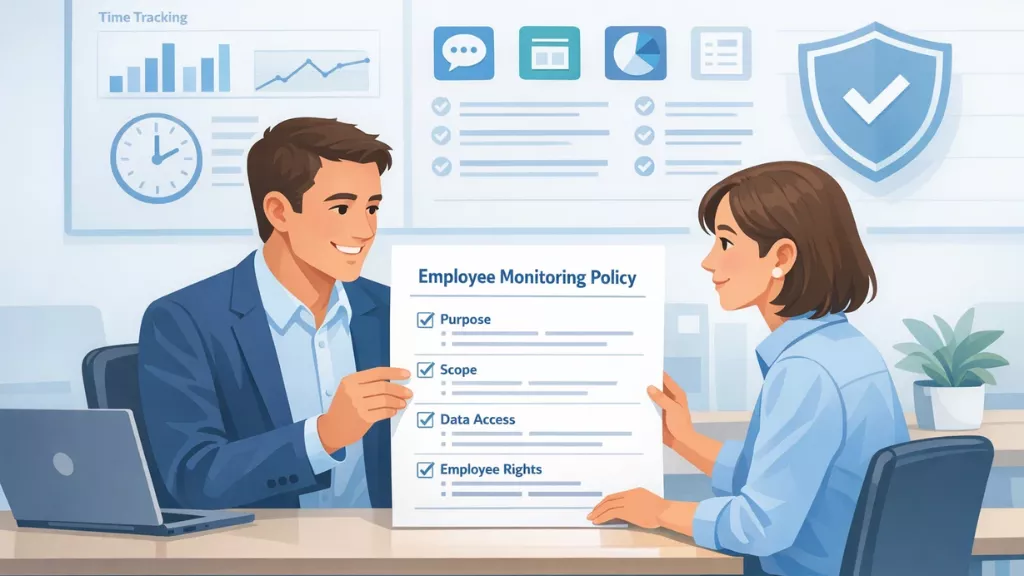
A complete employee monitoring policy needs to answer every question an employee might reasonably ask about how tracking works. Vagueness breeds distrust. Specificity builds confidence. Here’s what that looks like in practice.
Clear Statement of Purpose
Start by explaining why monitoring exists. Don’t bury this in the third paragraph or hide it in legal language. Lead with it. Are you monitoring to protect client data? Ensure remote work accountability? Identify capacity bottlenecks? Whatever the reason, state it clearly and honestly. If there are multiple reasons, list them all.
Good example: ‘This monitoring policy exists to ensure compliance with client confidentiality agreements, protect company data from cybersecurity threats, and provide managers with the visibility needed to allocate work fairly across teams.’
Scope of Monitoring: What’s Tracked and What Isn’t
This is the section employees will read most carefully, so it needs to be exhaustive. Specify exactly what’s being monitored: work hours, application usage, websites visited, email content, file transfers, keystrokes, screenshots, location data. If something’s not being tracked, say that explicitly too. ‘We do not monitor personal social media accounts, private messages sent outside work platforms, or activity on personal devices.’
Ambiguity here is a trust-killer. If employees don’t know whether their personal email is being read or their location is being tracked, they’ll assume the worst.
Devices and Networks Covered
Clarify which devices are subject to monitoring: company-owned laptops, desktops, phones, tablets. If personal devices are monitored for example, through a BYOD policy explain the scope of that monitoring and the consent requirements. If monitoring only applies when employees are connected to the company network or VPN, state that clearly.
Data Usage and Access Controls
Employees need to know how the data will be used and who can see it. Will it be reviewed daily by managers? Weekly in aggregate? Only accessed when there’s a specific performance or security concern? Is the data used in performance reviews, disciplinary actions, or promotion decisions?
Also specify who has access. Is it limited to direct managers and HR? Does IT have access for security purposes? Are there audit trails showing who viewed what data and when? The more specific you are about access controls, the more credible the policy becomes.
Employee Rights and Limitations
What rights do employees have regarding their monitoring data? Can they request access to see what’s been collected? Can they contest inaccuracies or raise concerns about how the data is being used? Are there categories of data health information, union activity, protected communications that are explicitly off-limits?
Including this section signals that the policy isn’t just about what the company can do. It’s also about what employees are entitled to.
Monitoring Hours and Boundaries
Does monitoring run 24/7 on company devices, or only during designated work hours? Can employees pause monitoring during breaks or when handling personal matters? If remote employees are being tracked via geolocation, does that monitoring stop when the workday ends?
Clear boundaries around when monitoring is active help employees understand that they’re not under constant surveillance, which makes the entire system feel less invasive.
Consequences of Policy Violations
If monitoring reveals a policy violation accessing prohibited websites, sharing confidential data, excessive personal use during work hours what happens next? Outline the disciplinary process clearly: verbal warning, written warning, suspension, termination. Employees should know that monitoring data can be used in disciplinary actions, but they should also know that the process is fair and consistent.
Also Read
How To Maintain Employee Monitoring Ethics At Workplace In 2025?
Employee Monitoring Policy Example (Real-World Template)
Here’s a condensed employee monitoring policy template that covers the essentials. This isn’t exhaustive your legal team will need to adapt it to your jurisdiction and business needs but it provides a framework that balances transparency with enforceability.
Purpose: We monitor employee activity on company-owned devices and networks to ensure data security, maintain compliance with client agreements, and support fair workload allocation across teams.
Scope: We track active work hours, application usage, websites visited during work hours, email sent and received through company accounts, and file transfers involving company data. We do not monitor personal social media accounts, private messages on non-work platforms, or activity on personal devices unless explicitly covered under a signed BYOD agreement.
Devices Covered: Monitoring applies to all company-owned laptops, desktops, mobile devices, and tablets. Personal devices are only monitored if enrolled in our BYOD program with signed consent.
Data Access: Monitoring data is accessible to direct managers, HR leadership, and IT security personnel on a need-to-know basis. All access is logged. Data is reviewed weekly in aggregate and accessed individually only when a specific performance or security concern arises.
Employee Rights: You may request a summary of your monitoring data at any time by contacting HR. If you believe data has been used unfairly or inaccurately, you may file a formal complaint through our grievance process.
Monitoring Hours: Monitoring is active during designated work hours only. For remote employees working flexible schedules, monitoring begins when you log into company systems and ends when you log out.
Violations: Misuse of company systems, including accessing prohibited content, sharing confidential data, or excessive personal use during work hours may result in disciplinary action up to and including termination, in accordance with our progressive discipline policy.
How EmpMonitor Supports Ethical Employee Monitoring

Ethical employee monitoring works best when it is positioned as a tool for clarity rather than control. Modern solutions like EmpMonitor are designed to give organizations a balanced view of work activity without crossing into intrusive surveillance.
Ethical employee monitoring is about visibility not surveillance. When implemented transparently, it helps organizations improve productivity, protect company resources, and support employees with clear performance insights.
The key is structured oversight that respects privacy while promoting accountability.
Real-Time Activity View
Monitor app and website usage, along with active and idle time, from a centralized dashboard. This provides clarity on how work hours are spent without micromanaging.
Screen Record Access
Securely review recorded screen sessions when needed for compliance, workflow validation, or dispute resolution — used responsibly and purposefully.
Live Screen Monitoring
Access live screen visibility during critical tasks to enhance transparency and maintain workflow efficiency.
Remote Support (Screencast)
Connect securely to employee systems for troubleshooting and real-time guidance, reducing downtime and improving efficiency.
Accurate Time Tracking
Track work hours precisely to eliminate unnecessary time gaps and identify productivity trends.
Automated Screenshots
Capture workflow snapshots at customized intervals to evaluate task engagement without constant oversight.
Chat & App Usage Insights
Measure time spent on messaging and social apps to encourage focus and reduce digital distractions.
Conclusion
An Employee Monitoring Policy, in addition to its primary function as a legal protection for the employer, is also an effective tool for protecting employees. A well-written policy clearly defines which types of data are being collected by the employer, the reason(s) for collecting that data, and how the employer plans to use the data. An effective employee monitoring policy will eliminate ambiguity, set clear expectations, and ensure that monitoring will serve a legitimate business purpose, rather than simply acting as a tool for indiscriminately monitoring employees.
Effective employee monitoring policies are those that the employee can read, understand, and use to meet organizational needs with employee monitoring ethics. There is no need to use complex legal language or convoluted phrasing to comply with legal requirements. A clear explanation of why the employer is monitoring employee work, before discussing what the employee is being monitored for, can provide an effective basis for recognizing that monitoring is intended to help make better decisions, rather than to identify misdeeds.
When HR’s employee monitoring policies are transparent and relevant, they can effectively defend their employee monitoring policy and employees will be able to accept the purpose of monitoring. When a monitoring policy has these characteristics, it can be considered an ethical means of “functional accountability” for employee behaviour, distinguishing the two categories described earlier.
Frequently Asked Questions
Should I obtain legal clearance prior to executing an employee surveillance plan?
Certainly! Employment laws concerning monitoring are widely different among various jurisdictions, meaning that if you don’t get it right, you could have significant legal risks to your organization. It is essential that you have your monitoring policy reviewed by an attorney prior to implementing it – particularly if your company operates in multiple states or countries where there may be differences in requirements regarding privacy. The attorney will inform you whether or not you are in compliance with federal laws, including the Electronic Communications Privacy Act (ECPA) in the US, as well as what state and international requirements you must comply with.
Should I require employees to sign the monitoring policy?
Yes. Requiring a signature, physical or electronic, creates a clear record that the employee was informed about monitoring and acknowledged the policy. This is critical if you ever need to defend a disciplinary action based on monitoring data. The signature doesn’t have to mean the employee agrees with the policy; it just confirms they’ve read and understood it. Store signed copies in employee files and make the policy easily accessible for future reference.
What’s the difference between monitoring and surveillance?
The primary difference is intent and scope. Monitoring is targeted, transparent, and tied to a legitimate business purpos:e productivity, security, and compliance. Surveillance is covert, excessive, or punitive, used primarily to catch people doing something wrong rather than to support business operations. A well-designed employee monitoring policy should make it clear that what you’re doing is monitoring, not surveillance. If employees feel surveilled rather than supported, your policy and implementation need to be reevaluated.
Can I use monitoring data in performance reviews or disciplinary actions?
Yes, but only if your policy explicitly states that monitoring data may be used this way. If your policy says monitoring is ‘for capacity planning and process improvement only,’ and then you use it to write someone up for low productivity, you’ve destroyed trust and potentially opened yourself to legal challenge. Be honest upfront about how the data will be used. If it’s going into performance evaluations, say that clearly. If it won’t be, stick to that commitment.