


Employee communication plays a direct role in how people feel, perform, and stay within an organization. In 2026, when teams are hybrid, remote, desk-based, and frontline at the same time, clear and consistent workforce communication is no longer optional.
Research highlights a critical gap: while most leaders believe they communicate enough, less than half of employees agree. This disconnect affects engagement, productivity, and retention. Bridging that gap starts with understanding what employee communication really means today and how to improve it step by step.
Listen To The Podcast Now!
What Is Employee Communication?


It includes:
- Leadership updates and announcements
- Policy and process communication
- Day-to-day operational information
- Feedback, surveys, and employee voice
When employees internal communication works well, people feel informed and involved. When it doesn’t, confusion and disengagement follow. Understanding its impact helps explain why this area deserves focused attention.
Why Employee Communication Matters More Than Ever
The quality of employee communication affects nearly every part of the business. Its influence is both cultural and financial.
Key business impacts
- Employee engagement: Employees feel valued when information is shared openly and clearly.
- Productivity: Clear communication reduces rework, errors, and misunderstandings.
- Company culture: Consistent messaging reinforces values and shared goals.
- Retention: Employees who feel heard are less likely to leave.
Poor communication costs organizations time and money. Leaders report losing several hours each week to misunderstandings, while businesses lose thousands annually per employee due to communication breakdowns.
These outcomes make one thing clear: improving employee communication is a business priority, not just an HR initiative.
What Good Employee Communication Looks Like in 2026
In 2026, employee communication is no longer just about sharing updates or announcements. It’s about creating clarity, trust, and connection across a workforce that may be remote, hybrid, frontline, or globally distributed. Effective communication follows a clear set of principles that guide how messages are created, delivered, and received. Each principle builds on the next, creating a communication system employees can rely on.
Core Principles of Effective Employee Communication
Transparent
Transparency means leaders don’t just announce decisions; they explain the reasoning behind them. When employees understand why something is happening, they’re more likely to trust leadership and support change. Transparent communication reduces rumors, minimizes resistance, and helps employees see how decisions align with company goals.
Easy to Understand
Clear communication avoids complex language, jargon, or internal acronyms that confuse employees. Messages should be simple, direct, and structured so the most important information is immediately visible. When employees understand what’s expected of them without clarification, work moves faster and mistakes decrease.
Consistent
Consistency builds reliability. Employees should know where to find updates and how often communication will occur. When messaging is predictable and steady, employees are more likely to pay attention and engage, rather than treating communication as noise.
Relevant
Not every message applies to everyone. Effective employee communication is tailored to roles, teams, and locations. When employees receive information that directly affects their work, they’re more likely to read it, remember it, and act on it.
Empathetic
Modern communication recognizes that employees are people first. During periods of change, uncertainty, or high workload, empathetic messaging acknowledges employee concerns and emotions. This human approach strengthens relationships and reinforces a supportive company culture.
Accessible
Communication tools must be accessible to all employees, regardless of where or how they work. In 2026, this often means mobile-friendly platforms that frontline and remote employees can access without relying on company email or desktop systems.
Two-way
Effective communication isn’t just top-down. Employees should be able to ask questions, share feedback, and participate in conversations. Two-way communication creates a sense of involvement and ensures leadership stays connected to real employee needs.
Timely
Timing matters as much as content. Employees need information when it’s relevant not after decisions are finalized or issues escalate. Timely communication helps teams act quickly and prevents confusion or misinformation.
Once these principles are firmly in place, organizations can focus on structuring communication in a way that supports long-term clarity and alignment.
Employee Communication vs. Internal Communication
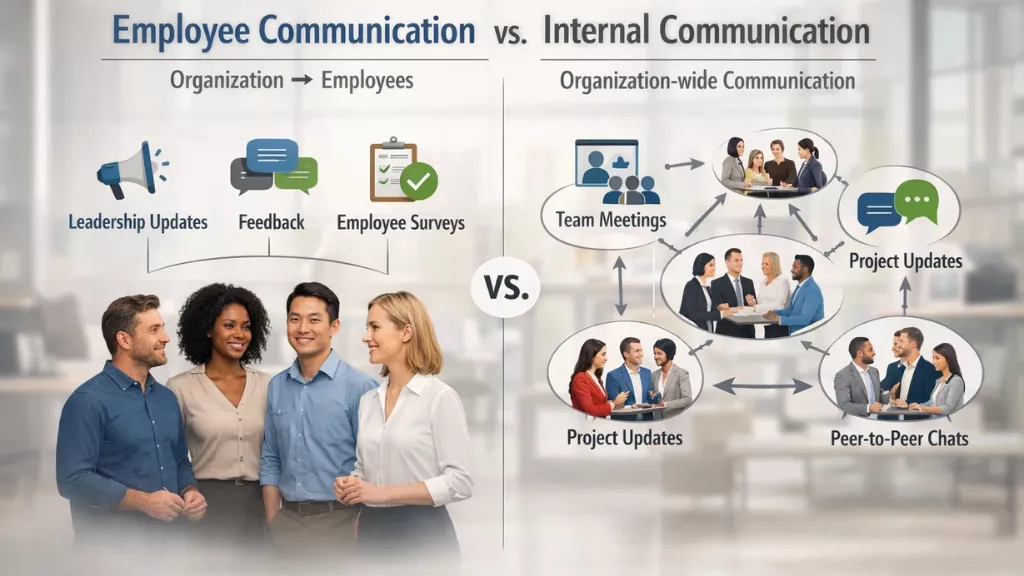
Key Differences Explained
Internal communication
Internal communication includes all interactions that happen within an organization. This covers peer-to-peer conversations, team discussions, department updates, and cross-functional collaboration.
Internal Communication Examples
Internal communication focuses on how information flows within an organization. When done right, it keeps employees aligned, informed, and engaged.
Team Updates
Sharing weekly or monthly updates about project progress, deadlines, and priorities through emails, dashboards, or internal tools helps teams stay on the same page.
Manager–Employee Check-ins
One-on-one meetings, performance reviews, and feedback sessions allow managers to clarify expectations, address challenges, and guide employees effectively.
Company Announcements
Messages about policy changes, new hires, organizational goals, or leadership updates ensure transparency and build trust across teams.
Task and Workflow Communication
Assigning tasks, sharing instructions, or providing real-time updates through collaboration platforms helps reduce confusion and delays.
Training and Knowledge Sharing
Internal documentation, onboarding guides, video tutorials, and learning sessions ensure employees have access to the information they need to perform well. Existing guides can also be turned into a flipping book with Publuu, making them easy to share and read online
Employee communication
Employee communication specifically focuses on how the organization communicates with employees. This includes leadership messages, company updates, policies, feedback mechanisms, and employee engagement initiatives.
Think of employee communication as a focused subset of internal communication. It directly influences trust, alignment, and how employees perceive leadership decisions. Understanding this distinction helps organizations design communication strategies that are intentional rather than scattered.
Also Read
Why Workplace Communication Is Important Now More Than Ever?
Employee Monitoring vs. Micromanagement: How to Track Performance Without Killing Motivation?
External Communication Examples
External communication covers how an organization interacts with people outside the company, shaping its brand image and relationships.
Client Communication
Emails, meetings, and progress reports that keep clients informed about timelines, deliverables, and updates help build credibility and long-term trust.
Customer Support Interactions
Responses through chat, email, or support tickets address customer concerns, resolve issues, and improve overall satisfaction.
Marketing and Promotional Messages
Social media posts, advertisements, newsletters, and website content communicate brand value and attract potential customers.
Partner and Vendor Communication
Regular coordination with vendors or business partners through emails, calls, or shared platforms ensures smooth collaboration and alignment.
Types of Employee Communication Styles
The style an organization uses to communicate has a major impact on how messages are received and acted upon. Most workplace communication styles fall into one of the following categories.
Passive Communication
Passive communication avoids confrontation and difficult conversations. Leaders using this style often withhold opinions or delay decisions to keep the peace.
- Problems remain unresolved
- Employees lack direction and clarity
- Teams feel disengaged due to unclear leadership
Passive-Aggressive Communication
Passive-aggressive communication appears cooperative on the surface but expresses dissatisfaction indirectly. This can include sarcasm, unclear feedback, or mixed signals.
- Creates confusion and mistrust
- Employees hesitate to ask questions
- Morale and collaboration suffer
Aggressive Communication
Aggressive communication prioritizes results over people. Messages are forceful, one-sided, and often blame-focused.
- Creates fear-driven environments
- Leads to higher turnover
- Discourages honest feedback
Assertive Communication (Most Effective)
Assertive communication balances clarity with respect. Leaders communicate expectations clearly while remaining open to dialogue and employee input.
- Encourages trust and transparency
- Provides clear direction and constructive feedback
- Strengthens relationships between employees and leadership
As workforce expectations evolve, more organizations are shifting toward assertive communication because it supports engagement, accountability, and long-term performance.
Employee Communication Channels: What Works and What Doesn’t
Even the best message can fail if it’s delivered through the wrong channel. Communication channels determine how well information is received, understood, and acted upon.
Traditional (Analog) Communication Channels
These channels were once the backbone of workplace communication:
- Memos, posters, and printed newsletters
- In-person meetings
Limitations of analog channels:
- Mostly one-way communication
- No reliable way to track engagement
- Limited reach for remote or frontline employees
As workforces become more distributed, these limitations have pushed organizations to adopt digital alternatives.
Digital Communication Channels
Digital tools allow organizations to communicate faster, track engagement, and support two-way interaction.
Intranet platforms
Modern intranets centralize company news, resources, and collaboration tools. Employees can access updates, participate in surveys, and communicate with teams from one place.
Employee apps
Employee apps extend communication beyond the desk. With mobile-first access, frontline and remote workers can stay informed without needing a company email address.
Email
Email remains familiar but often struggles with low engagement due to inbox overload. It works best for formal or external communication rather than daily employee updates.
Internal videos
Videos humanize leadership communication and make complex topics easier to understand. They’re especially effective for announcements, strategy updates, and onboarding. An AI clip generator from video can help extract key moments from longer recordings, ensuring important updates are delivered clearly while maintaining audience attention.
Instant messaging
Real-time messaging supports quick collaboration but requires clear guidelines to avoid constant interruptions and information overload.
Video conferencing
Essential for hybrid and remote teams, video conferencing enables face-to-face interaction, live discussions, and Q&A sessions.
Internal social feeds
Social-style feeds encourage interaction through likes, comments, and shares. When paired with audience segmentation, they reduce information overload.
Content hubs
Content hubs act as a single source of truth for documents, policies, and resources, reducing repeated questions and confusion.
Each channel serves a purpose. Problems arise when organizations use too many tools without a clear structure or strategy.
Internal Communication Best Practices For 2025
Strong employee communication relies on consistency and intentional design.
Best Practices to Follow
- Use fewer platforms, but use them effectively
- Segment audiences to ensure relevance
- Mix formats to maintain engagement
- Encourage feedback and respond to it
- Train leaders to communicate clearly and empathetically
When applied consistently, these practices improve clarity, trust, and employee engagement across the organization.
How To Improve Employee Communication: A Practical Framework
Improving employee communication requires structure rather than reactive fixes.
Step-by-Step Approach
- Assess current communication gaps and pain points
- Define clear goals and measurable KPIs
- Decide what content should be shared and where
- Choose accessible communication tools
- Segment employees by role, team, and location
- Create a communication calendar
- Train leaders and content creators
- Track performance and refine continuously
Following this framework helps organizations evolve from fragmented communication to a strategic, employee-focused approach.
Measuring Success: Employee Communication KPIs
Without measurement, improvement is guesswork.
Key metrics to track
- Message open and engagement rates
- Feedback response time
- Platform adoption rates
- Employee engagement scores
- Leadership visibility
- Employee sentiment
- Retention trends
These metrics help connect communication efforts to business outcomes.
Common Employee Communication Mistakes (and How to Fix Them)
Even well-managed organizations struggle with employee communication at times. The issue is rarely a lack of effort, it’s usually the result of habits that develop over time. Recognizing these mistakes is the first step toward building a clearer, more effective communication system.
Sharing too much information at once
When leaders try to communicate everything in a single message, employees often feel overwhelmed. Important updates get buried under excessive details, causing confusion or disengagement.
How to fix it:
Focus on the most critical message first. Break large announcements into smaller updates and deliver them in a logical sequence so employees can absorb information more easily.
Using only text-based communication
Relying solely on written messages makes it harder to capture attention and explain complex topics. Text-heavy communication can feel impersonal and is often skipped or misunderstood.
How to fix it:
Use a mix of formats such as short videos, visuals, charts, or polls. Visual and interactive content keeps employees engaged and helps reinforce key messages more effectively.
Sending the same message to everyone
Not every update is relevant to every employee. When people repeatedly receive irrelevant messages, they start ignoring communication altogether.
How to fix it:
Segment communication based on roles, teams, or locations. Targeted messaging ensures employees receive information that directly impacts their work, improving relevance and response rates.
Ignoring employee feedback
When employees share feedback but see no action taken, trust erodes. Over time, they stop participating in conversations altogether.
How to fix it:
Actively acknowledge feedback and close the loop by explaining what will change, or why it won’t. This reinforces the value of two-way communication and encourages continued participation.
Using disconnected platforms
Using too many tools for communication leads to scattered information. Employees struggle to know where updates live, resulting in missed messages and repeated questions.
How to fix it:
Centralize communication using a unified platform. When updates, insights, and performance data live in one place, communication becomes clearer and easier to manage.
Fixing these habits creates immediate improvements in clarity, engagement, and trust. However, sustaining better communication also requires visibility into how work actually happens. That’s where tools like EmpMonitor help organizations connect communication with real-time insights and action, something we’ll explore next.
How EmpMonitor Strengthens Employee Communication and Visibility

Modern employee communication depends heavily on visibility, clarity, and accountability. When leaders understand how work is progressing, communication becomes more contextual, timely, and effective. EmpMonitor supports this by giving organizations real-time insights into employee activity without disrupting workflows. Instead of relying on assumptions or delayed reports, managers can base conversations on accurate data, helping teams stay aligned, productive, and informed. By combining employee monitoring, time tracking, and reporting into a single platform, EmpMonitor enables organizations to communicate expectations clearly and address issues before they escalate.
Key EmpMonitor Features Explained
Real-Time Monitoring
EmpMonitor provides instant visibility into employee activity through a centralized dashboard. Managers can view live application and website usage, along with active and idle status, as work happens. This helps leaders understand how time is being spent and allows for timely communication when productivity drops or support is needed.
Screen Recordings
With screen recording, managers can review recorded employee sessions to understand workflows, verify task completion, and ensure compliance. These recordings offer clear context during performance reviews or audits, reducing guesswork and improving transparency in employee communication.
Screencast
The screencast feature allows secure, real-time access to employee devices. Managers or IT teams can troubleshoot issues, guide employees through tasks, and resolve problems instantly. This hands-on support strengthens collaboration and minimizes delays caused by miscommunication.
Live Screen Monitoring
Live screen monitoring enables managers to view employee screens in real time from a single unified panel. This feature enhances accountability and allows leaders to identify bottlenecks early, making communication more proactive rather than reactive.
Time Tracking
EmpMonitor tracks every minute of an employee’s working hours, highlighting productive time and unnecessary gaps. These insights help managers have data-backed conversations about workload distribution, time management, and performance improvement.
Automated Screenshots
Automated screenshots captured at customizable intervals provide a visual overview of employee workflows. Managers can quickly review task progress without interrupting employees, supporting fair evaluations and clearer feedback discussions.
Chat Monitoring
Chat monitoring tracks time spent on messaging and social applications during working hours. This helps organizations identify distractions, set clear communication boundaries, and encourage focused work without completely restricting collaboration tools.
Insightful Reports
EmpMonitor’s graphical reports and automated timesheets present employee activity data in an easy-to-understand format. These reports support accurate performance analysis, informed decision-making, and more meaningful one-on-one or team communication.
Final Thoughts: Building Strong Employee Communication
Employee communication is a continuous process, not a one-time initiative. When organizations invest in clear messaging, accessible tools, and two-way dialogue, employees feel informed and valued.
In 2026, the most successful organizations treat employee communication as a strategic advantage, one that strengthens culture, performance, and retention over time.