


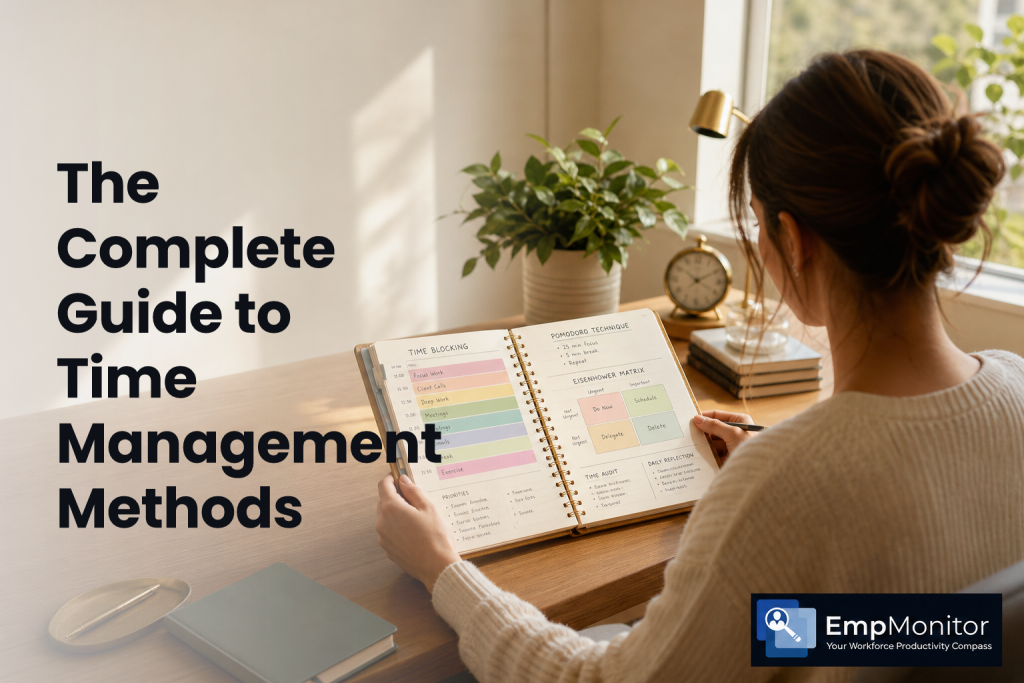
Pick one method that fits your work type and energy, block a week to run it as written, and use simple data to judge it; then keep what works and drop the rest. That’s the fastest way to manage your time in 2026. This complete guide time management methods will help you match a method to your work and test it fast.
Most people don’t have a time problem. They have an attention plan problem.
You’ll see seven clear options below. Each one is a small set of rules for when and how to focus. The right pick depends on your mix of deep work and reactive work, your role’s demands, and your personal quirks. You’ll also get fixes for the five traps that cause most plans to fail and a one-week field test so you can see real gains without guesswork.
For context, time management is about how you plan, rank, and split your hours and attention (Wikipedia on time management). The methods here are proven, simple, and flexible. Use them as written for a week. Then tweak.
What Are Time Management Methods and Why Do Most People Choose the Wrong One?
Time management methods are structured frameworks for how you place your attention, not just your tasks. They give you rules for when to focus, what to do first, and how long to work before you pause. Used well, they reduce choice fatigue and protect your best hours for the work that moves the needle.
However, the “best” method is personal. If your day is packed with deep work (writing, coding, design), you need long, quiet blocks. If you’re in a reactive role (support, sales, ops), you need simple triage rules and short bursts.
Your energy curve matters too. Morning larks do creative work early; night owls flip it. Most people pick the wrong framework because they copy a trend, not a match.
In practice, you should factor three variables:
- Work type: deep
- Role demands: maker
- Personality: energy peaks, tolerance for structure, and need for variety
Specifically, this complete guide time management methods covers seven proven options:
- Pomodoro Technique
- Time Blocking
- Eisenhower Matrix
- Getting Things Done (GTD)
- Eat the Frog
- Pareto Principle (80/20)
- Timeboxing
Moreover, you’ll see who each helps most and where each breaks. As a result, you can shortlist with confidence and skip months of trial and error.
7 Proven Time Management Methods: How Each Works Step by Step
Below you’ll find the seven methods, each with quick steps, best-fit roles, and a concrete, real-world example.
Pomodoro Technique
Pomodoro uses short, focused sprints with breaks to fight fatigue and procrastination.
- Set a 25-minute timer and focus on one task.
- Take a 5-minute break; after four rounds, take 15–30 minutes.
- Track how many rounds a task needs to improve estimates.
Best for: People who procrastinate on start, or work in noisy spaces.
Example: A marketer drafts ad copy in two rounds, edits in one, and queues posts after the long break.
Time Blocking
Time Blocking reserves fixed calendar blocks for themes or tasks to protect deep work.
- Map your week by roles or themes (e.g., writing, meetings, admin).
- Place 60–120 minute deep-work blocks in your peak-energy slots.
- Guard them like meetings; move, don’t delete, if life changes.
Best for: Makers, ICs, and leaders who need long focus windows.
Example: A software engineer books 9–11 a.m. for coding on Mon/Wed/Fri and moves stand-ups to the afternoon.
Eisenhower Matrix
The Eisenhower Matrix ranks tasks by urgency and importance so you act, schedule, delegate, or delete.
- List tasks; tag each as Urgent/Not Urgent and Important/Not Important.
- Do urgent/important, schedule important/not urgent, delegate urgent/not important, delete not urgent/not important.
- Review daily to keep the queue clean.
Best for: Managers, ops teams, and anyone drowning in requests.
Example: A support lead does outage fixes now, schedules training content, hands off low-level reports, and cancels a vanity project.
Getting Things Done (GTD)
GTD clears your head by capturing everything, then clarifying next actions and contexts.
- Capture every open loop into one inbox (notes app, paper, or tool).
- Clarify each: if it takes <2 minutes, do it; else assign a project, next action, and context.
- Review weekly to stay current and calm.
Best for: Knowledge workers with many projects and handoffs.
Example: A product manager logs ideas, turns “launch prep” into a project, and sets next actions by context like “@Desk” or “@Call.
Eat the Frog
Eat the Frog means do the highest-impact, hardest task first thing.
- Pick your “frog” the day before (one task that moves your main goal).
- Do it before checking email or chat.
- Stop when it’s done; the rest of the day gets easier.
Best for: People who lose mornings to inboxes or meetings.
Example: A founder writes the investor update at 8 a.m., then opens Slack at 9:30 a.m.
Pareto Principle (80/20)
The 80/20 rule finds the small set of inputs that drive most results.
- List projects and the result they produce (revenue, leads, code shipped).
- Identify the top 20% that drive 80% of outcomes.
- Double time on the winners; reduce or cut the rest.
Best for: Anyone with too many projects and not enough runway.
Example: A creator sees 3 of 15 videos drive 82% of views and films follow-ups in that niche.
Timeboxing
Timeboxing sets a hard stop for a task to force focus and ship faster.
- Set a fixed box (e.g., 90 minutes) for a task with a clear “definition of done.
- Work only on that task; stop at the buzzer and assess.
- If needed, open a new box with a tighter scope.
Best for: Perfectionists and teams that over-polish.
Example: A designer timeboxes a landing page draft to 90 minutes and ships a Version 1 by lunch.


Also Read!
The Complete Guide to Flex Time: How It Works, Types, and How to Implement It
5 Common Time Management Mistakes That Sabotage Your Productivity
You can have a great plan and still stall. These five mistakes do most of the damage. Fix them, and your method will start to work this week.
Mistake 1: Switching Methods Too Often
Chasing a new framework every few days resets your habits and hides the real issue. Commit to one for a full week.
Fix: Set a 7-day trial window and a simple scorecard (output, stress level, spillover).
Mistake 2: Not Tracking Where Time Actually Goes
Without data, you guess. Guesses bias toward what felt busy, not what worked.
Fix: Use a basic timer or automatic logs for five days. Then compare plan vs. reality by hour, not by vibe.
Mistake 3: Overplanning the Calendar
Overpacked calendars break at the first surprise. Then you blame the method.
Fix: Leave 20–30% white space daily. Place “move, don’t delete” rules on deep blocks and stack meetings back-to-back.
Mistake 4: Ignoring Energy Cycles
You can’t brute-force a 2 p.m. creative sprint if your brain dips then.
Fix: Pair deep tasks with peak hours and shallow tasks with valleys. Re-test your curve each quarter.
Mistake 5: Treating All Tasks as Equal
Inbox zero can feel like progress while key work sits idle.
Fix: Pick one daily “frog” or use the Eisenhower Matrix. Tie it to a visible goal so you feel the win.
Moreover, revisit these fixes monthly. As a result, you’ll stop fighting your calendar and start trusting it.
Tools and Resources to Put These Methods Into Practice
You only need a few tools to get real gains. Start simple, then add data.
- Physical planners: Great for visual thinkers. A weekly spread helps with Time Blocking and Eat the Frog. Use sticky flags to “move, don’t delete.
- Free digital timers: A plain 25/5 timer or a menu bar stopwatch is enough for Pomodoro and Timeboxing.
- Calendar apps: Color-code deep work vs. meetings. Set buffer alerts 5 minutes before each block to switch with less friction.
- Automated time-tracking for teams: For data-driven insights, tools like EmpMonitor offer Automated time tracking, Productivity measurement, Real-time insights, and Idle time tracking across your org. It is used by 15,000+ companies across 100+ countries, and it’s GDPR compliant. There’s a Free 15-day trial available, so you can test without risk.
“EmpMonitor does one thing really well: it saves us time!” — Education Career Counsellor
Furthermore, if you prefer point tools, you can mention Toggl for timers, Notion for capture and weekly reviews, and Google Calendar for Time Blocking. However, for a manager view or to align a team on focus, a single source of time truth helps more than patchwork logs in 2026.
**Get instant productivity insights →
What to Do This Week: Picking and Testing Your First Method
You learn by running a short, honest test. Give one framework a full week. No mixing. No cherry-picking. Here’s a five-day plan that works.
- Day 1 — Audit: Write your top three goals for the week. Track your time for one full day (timer or auto-tracking). Mark hours as deep or reactive. Note your energy highs and lows.
- Day 2 — Pick: Choose ONE method that fits your work and energy. Makers choose Time Blocking or Timeboxing. Reactive roles pick Eisenhower or GTD. If you stall on starts, choose Pomodoro or Eat the Frog.
- Day 3 — Run: Follow the method by the book. Protect deep blocks. Do the daily review if your method calls for it. Keep notes on stress, spillover, and wins.
- Day 4 — Adjust: Keep the core rules. Tweak length (e.g., 50/10 instead of 25/5) or block timing to fit your real energy.
- Day 5 — Evaluate: Score the week 1–10 on output, calm, and control. If your score is 7+ on two of three, keep the method for another week. If not, swap to your next-best match and repeat.
Moreover, write one sentence you’ll use to guide next week, like “Protect 9–11 a.m. for deep work” or “Start with the frog before email.” In 2026, small, steady changes beat a perfect plan you won’t keep.

Key Takeaways
Picking the right framework is less about trends and more about fit. You want a method that respects your work type, role, and energy. Then you test it with simple rules and real data.
- Match method to work: Deep work favors Time Blocking or Timeboxing; reactive work favors Eisenhower or GTD.
- Guard mornings for impact: Eat the Frog turns one hard win into momentum for the rest of the day.
- Track reality: A five-day log beats guesses. Use automatic tracking where you can to see plan vs. reality in minutes.
- Fix the big five: Stop method-hopping, leave white space, work with your energy, and don’t treat all tasks the same.
- Test in short cycles: One week per method in 2026 is enough to learn, score, and decide without burning out.
As a result, you’ll spend more hours on the work that matters and fewer on calendar Tetris. Start small. Then build a routine you trust.
**Try automated tracking free →
References
For a broad overview of the discipline, see Wikipedia: Time management.