

At first, the leadership team noticed something was off. Productivity was inconsistent, communication gaps were growing, and managers were struggling to understand where time and effort were actually going. The idea of introducing employee monitoring came up, but it was met with hesitation. For many on the team, it felt like surveillance, micromanagement, or a sign of distrust. And to be fair, those concerns were not unfounded. In many organizations, poorly implemented monitoring creates tension, lowers morale, and drives people away.
But this organization chose to take a different path.
Instead of using monitoring as a control mechanism, they saw an opportunity to rethink how work visibility could strengthen their culture. They decided to focus on transparency, making sure employees clearly understood what was being tracked, why it mattered, and how it would benefit them as much as the business.
What followed was an unexpected shift. As openness replaced uncertainty, teams began to communicate more effectively, take greater ownership of their work, and build stronger trust with leadership. This case study explores how a simple change in approach turned employee monitoring from a point of resistance into a driver of productivity, accountability, and collaboration.
You can listen to this Blog here.
The Challenge: Growing Team, Declining Visibility

The company in this case was a mid-sized service-based organization with around 70 employees. As they expanded, they shifted to a hybrid work model—some employees worked remotely, while others remained in-office.
At first, everything seemed fine.
But over time, cracks started to appear:
- Managers struggled to understand how time was being spent
- Project delays became more frequent
- High performers felt overlooked
- Some employees felt others weren’t pulling their weight
Ironically, the issue wasn’t productivity it was visibility.
Without clear insights into daily work patterns, managers began relying on assumptions. And assumptions, as expected, led to frustration on both sides.
That’s when leadership began exploring employee monitoring solutions.
The Initial Resistance from Employees
When the idea of employee monitoring was first introduced, the reaction wasn’t positive.
Employees had concerns like:
- “Will my screen be watched all day?”
- “Is the company spying on us?”
- “Does this mean they don’t trust us?”
These concerns are common whenever monitoring is introduced without context. Employees often associate it with control rather than support.
The leadership quickly realized something important:
👉 The problem wasn’t the tool; it was how it was being communicated.
Instead of pushing forward immediately, they paused implementation and reworked their approach around transparent employee monitoring.
The Shift: Choosing Workplace Transparency First
Rather than rolling out employee monitoring silently or strictly, the company decided to take a completely different route: full transparency.
Here’s what they changed:
1. Open Communication
They held team-wide meetings explaining:
- Why was employee monitoring being introduced
- What data would (and wouldn’t) be tracked
- How the information would be used
Nothing was hidden.
2. Clear Boundaries
They explicitly clarified:
- No webcam or audio recording
- No tracking outside working hours
- No invasive or personal data collection
This helped reduce fear and speculation.
3. Shared Access to Data
One of the biggest shifts was giving employees access to their own productivity data.
Instead of monitoring being something “done to them,” it became something they could use themselves.
4. Focus on Improvement, Not Policing
Managers were trained to use insights for:
- Identifying bottlenecks
- Supporting struggling team members
- Recognizing high performers
Not for micromanagement.
This approach turned employee monitoring into a collaborative tool, not a controlling one.
Implementation: Rolling Out Transparent Monitoring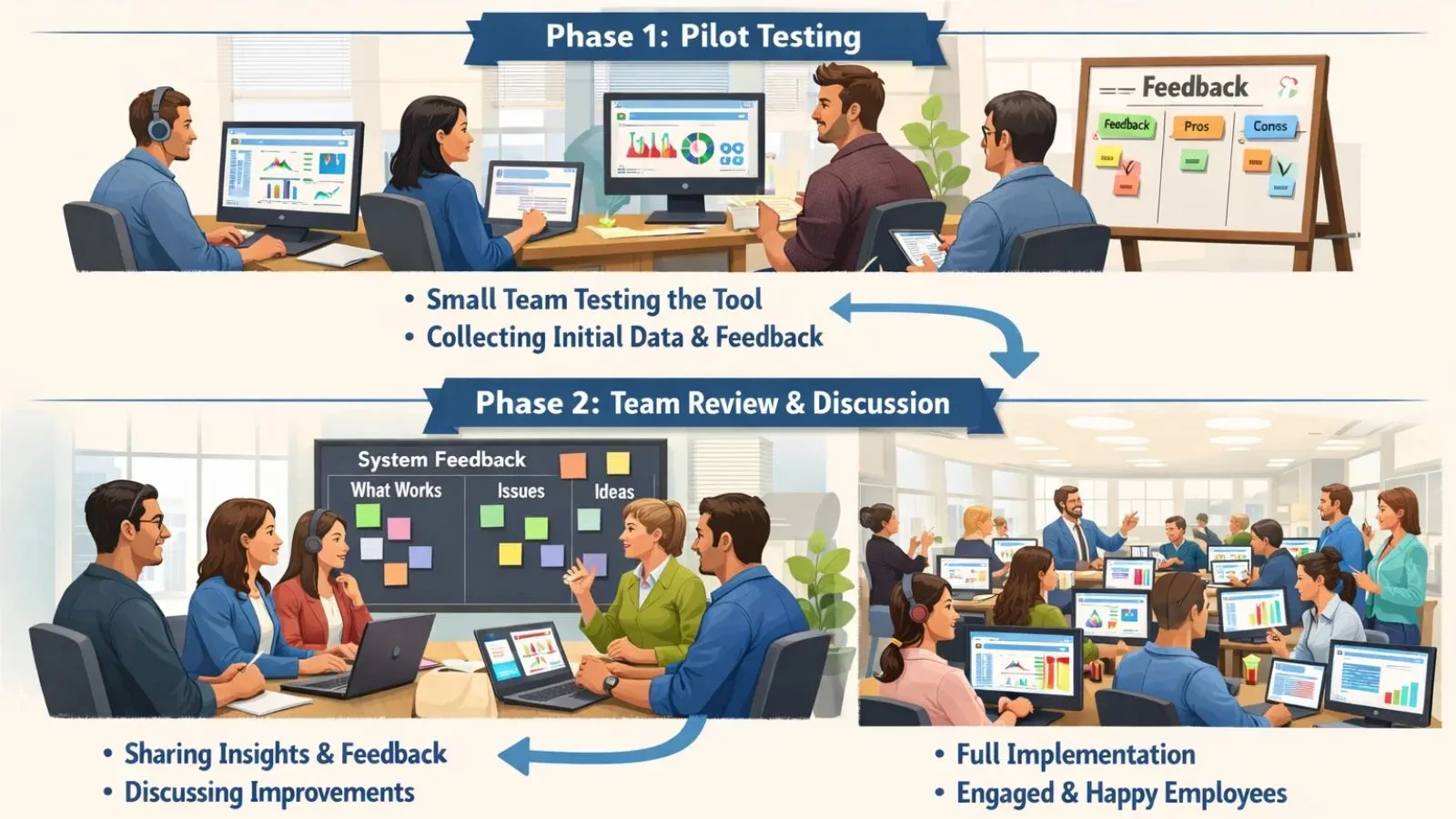
Once the groundwork was set, the company implemented its monitoring system in phases.
Phase 1: Pilot Team
They started with a small team that volunteered to participate. This allowed leadership to:
- Test the tool in real conditions
- Collect feedback
- Address concerns early
Phase 2: Feedback Loop
Employees in the pilot shared insights like:
- What felt useful
- What felt unnecessary
- What needed more clarity
This feedback directly shaped the final rollout.
Phase 3: Company-Wide Adoption
By the time the system expanded across the organization, most concerns had already been addressed.
Because of the transparent approach, adoption was much smoother than expected.
The Results: Trust Increased, Not Decreased
This is where things got interesting.
Instead of creating tension, employee monitoring actually strengthened workplace relationships.
1. Improved Accountability
With clear visibility, everyone became more aware of how they spent their time.
There was less room for ambiguity and fewer conflicts about “who did what.”
2. Better Recognition of Effort
Managers could now see:
- Who was consistently productive
- Who was going above and beyond
This led to more accurate recognition and rewards.
3. Reduced Micromanagement
Ironically, employee monitoring reduced the need for constant check-ins.
Managers didn’t have to ask, “What are you working on?” All the time, they could already see the bigger picture.
4. Increased Employee Trust
Because the system was transparent, employees didn’t feel watched; they felt included.
Trust improved because:
- Nothing was hidden
- Data was shared
- Intentions were clear
Key Takeaways from This Case
This case highlights an important truth:
👉 Employee monitoring isn’t inherently good or bad—it depends on how you implement it.
Here are the biggest lessons:
- Transparency eliminates fear
- Communication is more important than the tool itself
- Employees accept monitoring when they understand its purpose
- Shared data builds accountability
- Trust comes from openness, not control
Organizations that treat monitoring as a partnership, not surveillance see the best results.
Use EmpMonitor for Transparent Employee Monitoring
For companies looking to implement this approach, tools like EmpMonitor can make the process easier.
EmpMonitor is designed to support transparent employee monitoring while maintaining a balance between visibility and trust.
With features like:
- Real-time activity tracking
- Productivity insights and reports
- Time tracking and attendance monitoring
- Application and website usage analytics
It helps organizations understand work patterns without becoming intrusive.
More importantly, when used correctly, EmpMonitor supports workplace transparency by allowing teams to:
- Share productivity insights openly
- Identify inefficiencies together
- Make data-driven decisions
The key, as seen in the case above, is not just using the tool but using it transparently.
Also Read,
The Role Of Employee Monitoring Software In Successful Workplaces
How EmpMonitor Created Transparency Across Multi-Location Teams
Conclusion
Employee monitoring doesn’t have to create tension.
When introduced with secrecy, it often does. But when built on workplace transparency, it can have the opposite effect.
This case proves that with the right approach:
- Monitoring can build trust
- Data can empower employees
- Visibility can improve collaboration
At the end of the day, it’s not about watching employees, it’s about helping them succeed with clarity and support.
FAQs
1. Does employee monitoring actually improve productivity?
Yes, but only when implemented thoughtfully. Monitoring helps identify time leaks, inefficient workflows, and bottlenecks. However, productivity improves most when insights are used for support and optimization, not constant supervision. If employees feel trusted and understand the purpose, they are more likely to stay focused and accountable.
2. What are the best practices for implementing employee monitoring without harming morale?
Successful implementation depends on transparency and balance. Key practices include:
- Clearly communicating what is being tracked and why
- Avoiding invasive tracking like constant screen recording
- Focusing on productivity trends instead of individual mistakes
- Using data for coaching, not punishment
- Giving employees access to their own performance insights
This approach ensures monitoring feels fair rather than controlling.
3. What are the risks of employee monitoring?
If done poorly, employee monitoring can lead to:
- Decreased trust between employees and management
- Lower morale and engagement
- Increased stress or pressure
- Higher employee turnover
These risks usually arise when monitoring is secretive, overly intrusive, or used as a disciplinary tool instead of a productivity aid.
4. How do employees feel about being monitored at work?
Employee reactions vary. Most employees are open to monitoring if:
- They are informed in advance
- The purpose is clearly explained
- It is not overly invasive
Resistance typically comes from lack of transparency or fear of misuse. When done right, many employees actually appreciate the clarity it brings to expectations and performance.
5. What is the difference between employee monitoring and employee surveillance?
Employee monitoring focuses on improving productivity and workflow visibility through aggregated data and insights.
Employee surveillance, on the other hand, implies excessive tracking such as constant video recording, keystroke logging, or spying without consent.
The key difference lies in intent and transparency. Monitoring is collaborative, while surveillance feels controlling.