


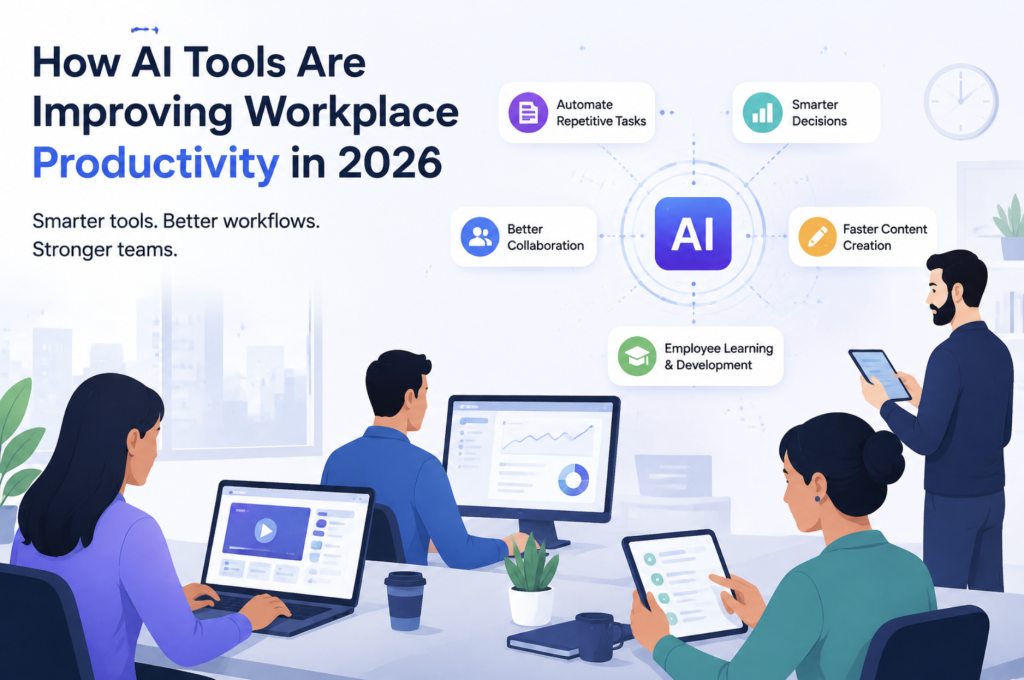
Workplace productivity has always been about helping teams achieve more with limited time and resources. However, as businesses become more distributed and digital workflows become more complex, traditional productivity methods are no longer enough.
In 2026, companies are increasingly turning to AI tools to reduce repetitive work, improve collaboration, and help employees focus on higher-value tasks. AI is no longer limited to simple automation. It is becoming part of everyday workflows across marketing, operations, customer support, human resources, and creative teams.
The biggest shift is that AI tools are helping employees complete entire workflows faster. From analysing information and managing communication to creating content and improving decision-making, AI is changing how modern teams work.
For businesses, productivity is no longer only about doing tasks faster. It is about creating smarter systems where employees can spend more time on strategy, creativity, and problem-solving.
The Evolution of Workplace Productivity With AI
Earlier productivity tools focused mainly on organising work. Calendars, project management platforms, communication tools, and automation software helped teams manage tasks more efficiently.
AI is taking this further by helping employees complete parts of their work directly.
Modern AI tools can understand information, generate content, summarise documents, analyse data, and assist with decision-making. Instead of simply tracking tasks, they can actively support employees throughout their workflows.
For example, a marketing team can use AI to analyse customer insights, create campaign ideas, draft content, and prepare visual assets. A customer support team can use AI to summarise conversations and suggest responses.
This shift allows employees to spend less time on repetitive activities and more time on work that requires human judgement.
How AI Reduces Repetitive Tasks Across Teams
One of the biggest benefits of AI in the workplace is reducing manual work.
Many employees spend hours handling repetitive processes such as organising information, creating reports, responding to common questions, and preparing documents.
AI tools can help automate these activities by processing information faster and providing useful outputs.
For example:
- HR teams can use AI to organise employee information and improve recruitment workflows.
- Sales teams can use AI to summarise customer interactions and identify opportunities.
- Operations teams can use AI to analyse workflows and improve efficiency.
- Marketing teams can use AI to create and optimise content faster.
By reducing repetitive tasks, AI allows employees to focus on more strategic responsibilities.
AI Is Improving Collaboration for Remote and Hybrid Teams
Remote and hybrid work have changed how teams communicate. Employees often work across different locations, time zones, and schedules, making collaboration more challenging.
AI tools are helping teams work together more effectively by improving information sharing and reducing communication gaps.
AI-powered meeting assistants can summarise discussions, identify important decisions, and create follow-up notes. Knowledge management tools can help employees find relevant information faster instead of searching through large amounts of documentation.
For distributed teams, these capabilities help create smoother workflows and ensure important information is not lost.
AI-Powered Content Creation Is Improving Marketing Productivity
Content creation is one area where AI is creating significant productivity improvements.
Marketing teams often need to produce large amounts of content, including blog posts, social media updates, advertisements, presentations, and videos. Creating these assets manually can take considerable time.
AI tools are helping marketers speed up content production by supporting research, writing, design, creative development, and AI-powered video generation. Teams can use AI models to generate video content faster, explore different creative directions, and create visual assets for campaigns without starting every project from scratch.
Beyond task automation, AI is also helping teams reduce the time required for content creation. Marketing and communication teams can use AI-powered workflows to transform ideas, documents, and briefs into complete videos for internal and external communication.
For example, invideo Agent helps teams move from concepts, scripts, and references to complete video projects through a connected workflow. This can be useful for businesses creating product videos, internal communication content, training materials, or marketing campaigns where multiple creative elements need to work together.
With InVideo Agent Two, larger teams can handle more complex video projects by bringing together different parts of the creative process, including visual planning, storytelling, and production choices, while ensuring consistency across multiple content pieces.
AI Is Helping Teams Make Better Decisions
Productivity is not only about completing tasks faster. It is also about making better decisions.
AI tools are helping businesses analyse information, identify patterns, and provide insights that support decision-making.
For example, business teams can use AI to:
- Analyse customer feedback
- Identify market trends
- Review performance data
- Summarise research
- Generate strategic recommendations
Instead of spending hours collecting and organising information, employees can use AI to quickly understand important insights and focus on taking action.
AI Tools Are Transforming Employee Training and Learning
Employee development is another area where AI is improving productivity.
Traditional training methods often require significant planning, documentation, and coordination. AI tools are helping companies create more accessible and personalised learning experiences.
Businesses can use AI to develop training materials, create educational content, and provide employees with faster access to information.
For example, companies can create onboarding videos, product tutorials, and internal learning resources more efficiently using AI-powered content workflows.
This helps organisations train employees faster while maintaining consistent learning experiences across teams.
Improving Customer Experience With AI
Customer-facing teams are also benefiting from AI productivity tools.
Customer support teams can use AI to handle routine questions, summarise customer conversations, and provide faster assistance. Sales teams can use AI to understand customer needs and prepare more personalised communication.
By reducing administrative work, employees can focus on building stronger customer relationships.
AI does not replace human interaction. Instead, it helps teams spend more time on conversations and problems that require empathy and creativity.
The Rise of AI Agents in Workplace Workflows
A major development in AI productivity is the rise of AI agents.
Unlike traditional AI tools that complete individual tasks, AI agents can support broader workflows by understanding goals, managing context, and assisting across multiple steps.
This is changing how teams approach productivity.
Instead of asking employees to use several separate tools for research, content creation, planning, and execution, AI agents can help connect these activities into a smoother workflow.
For businesses, this means productivity improvements are moving beyond automation toward intelligent collaboration between employees and AI systems.
Challenges Businesses Should Consider When Adopting AI Tools
While AI offers significant productivity benefits, companies need to implement it thoughtfully.
Businesses should consider:
- Data privacy and security
- Employee training
- Workflow integration
- Maintaining human oversight
AI works best when it supports employees rather than replacing human decision-making.
Companies that successfully adopt AI are usually those that identify specific challenges and introduce tools that solve real workflow problems.
Read More!
A New Trend Hitting Workplace Productivity – “Bare Minimum Mondays”
9 Tips To Create A Feedback Culture That Fosters Productivity In Your Workplace
How Businesses Can Prepare for an AI-Powered Workplace
The most effective AI adoption strategies focus on gradual improvement rather than replacing existing systems immediately.
Businesses can start by identifying repetitive tasks, understanding where employees spend the most time, and testing AI tools in specific workflows.
Teams should also encourage employees to develop AI skills. Understanding how to work effectively with AI will become an important workplace capability in the coming years.
Organisations that combine AI technology with human creativity and expertise will have a stronger advantage.
Final Thoughts
AI tools are changing workplace productivity in 2026 by helping teams work smarter, reduce repetitive tasks, and improve collaboration.
From content creation and communication to decision-making and employee training, AI is becoming an important part of modern business workflows.
The future of productivity will not be defined only by how quickly tasks are completed. It will be defined by how effectively humans and AI can work together to create better outcomes.