


Remote work in India went from an occasional perk to a full-scale operational model almost overnight. By 2026, an estimated 60–90 million Indians are expected to work at least part of the time. That’s a significant chunk of the workforce operating outside traditional office walls and for employers, it’s created an entirely new set of legal and compliance questions.
One of the most complicated: what are employers actually allowed to monitor when their teams work from home? Surveillance laws in India don’t offer a single, clear answer. There’s no comprehensive legislation dedicated to remote work monitoring. Instead, the rules are spread across older statutes, the Information Technology Act, the Telegraph Act, various labor laws combined with recent regulatory updates like the Digital Personal Data Protection Act (DPDP Act) that fundamentally change how employee data must be handled.
This guide breaks down what Indian surveillance laws currently allow, what work from home laws require from employers, and how platforms like EmpMonitor help businesses monitor productivity and compliance without crossing legal or ethical lines.
What Indian Surveillance Laws Actually Say About Employee Monitoring?
India doesn’t have a single, dedicated surveillance law governing workplace surveillance. Instead, the legal framework is a patchwork of older legislation that was written long before remote work became standard, combined with more recent privacy-focused updates that apply broadly to how personal data — including employee data — must be treated.
Section 69 of the Information Technology Act, 2000, allows employers to intercept, monitor, or decrypt information transmitted, received, or stored on company devices — provided there’s a legitimate business purpose and the monitoring doesn’t intrude unreasonably into personal privacy. Similarly, Section 5 of the Telegraph Act, 1885, permits monitoring of communications over company-owned infrastructure.
Together, these provisions establish the basic principle: if the device or network belongs to the employer, and the monitoring serves a legitimate business interest, surveillance laws is generally permitted. But that permission isn’t unlimited. The DPDP Act, which came into effect recently, introduces stricter requirements around data collection, notice, and proportionality. Employers now need to justify why they’re collecting specific data, clearly disclose what’s being monitored, and ensure that the scope of monitoring is proportionate to the business need.
In practical terms, that means continuous keystroke logging, full-screen recording throughout the workday, and covert monitoring without employee knowledge are increasingly viewed as legally risky — even if older statutes technically permit them. The shift in 2026 is toward transparency, necessity, and defined purpose.
What Employers Can (and Can’t) Monitor Under Current Work From Home Laws?


Understanding what’s legally permitted is the first step. Here’s the current state of play under Indian employee laws for remote monitoring.
Company-Owned Devices and Networks
Employers have broad legal authority to monitor activity on company-issued equipment — laptops, desktops, phones — and over company-controlled networks. This includes internet usage, application activity, emails sent and received, files accessed or downloaded, and time spent on various tasks. Section 69B of the IT Act explicitly permits monitoring and control of traffic data generated, transmitted, received, or stored in any computer resource owned by the company.
The surveillance laws are owned. When the device or network belongs to the employer, employees have a significantly reduced expectation of privacy. That said, even on company equipment, monitoring must be disclosed in advance, and the scope should be tied to productivity, security, or compliance objectives.
Personal Devices Used for Work
Monitoring personal devices — an employee’s own laptop or phone used for work tasks — requires explicit, informed consent. The Information Technology Act prohibits accessing, copying, or downloading data from a device without the owner’s permission. In a work-from-home context, this means employers can’t install monitoring software on a personal device unless the employee has clearly agreed to it, and even then, the monitoring must be limited strictly to work-related activity.
This is where many employers run into trouble. A blanket policy that says ‘we can monitor anything you use for work’ isn’t enough. The consent must be specific, the scope must be defined, and the monitoring should be technically restricted to work applications or hours.
Email, Messages, and Communications
Employers are permitted to monitor work email accounts, internal messaging platforms, and phone conversations conducted over company systems. This is particularly relevant for industries with compliance or security requirements — financial services, legal, healthcare — where client communications may need to be audited or recorded.
However, monitoring private messages or personal email accessed during work hours on company devices sits in a grey area. While technically permissible if disclosed upfront, employers should tread carefully. The DPDP Act’s emphasis on necessity and proportionality means that routine monitoring of private communications could be challenged as excessive.
Continuous Surveillance Laws and Practices to Avoid
The 2026 legal landscape increasingly treats certain monitoring practices as disproportionate and high-risk. These include continuous keystroke logging without a specific security justification, full-screen recording throughout an entire workday, covert monitoring without clear employee notice, and unrestricted access to raw monitoring data without role-based controls. If your monitoring approach involves any of these, it’s worth reconsidering.
Also Read:
7 Workplace Monitoring Laws Of Different Countries: Legal Restrictions & Best Practices
12 Top Most Enquired Questions About Employee Monitoring Laws
What a Law Firm Work From Home Policy Should Include?

Law firms and any organization handling sensitive client data — face heightened compliance obligations when it comes to remote work monitoring. A law firm work from home policy needs to balance client confidentiality requirements, regulatory obligations, employee privacy rights, and applicable surveillance laws.
At minimum, the policy should clearly define what will be monitored, why it’s necessary, and how the data will be used. This includes specifying which devices and applications are subject to monitoring, what types of activity are tracked, who has access to the monitoring data, and how long it will be retained. Employees should be required to acknowledge the policy in writing, confirming they understand what’s being monitored and have consented where necessary.
For law firms specifically, the policy should address client confidentiality protections ensuring that monitoring doesn’t inadvertently expose privileged communications compliance with sectoral regulations like those from the Bar Council of India, and alignment with relevant surveillance laws. Many firms also include provisions around secure file handling, VPN usage requirements, and restrictions on using personal devices for client work.
The key is documentation. If a monitoring practice is ever challenged — by an employee, a regulator, or in litigation — having a clear, written policy that was communicated in advance and signed by employees is your first line of defense.
How EmpMonitor Helps Employers Stay Compliant with Surveillance Laws?
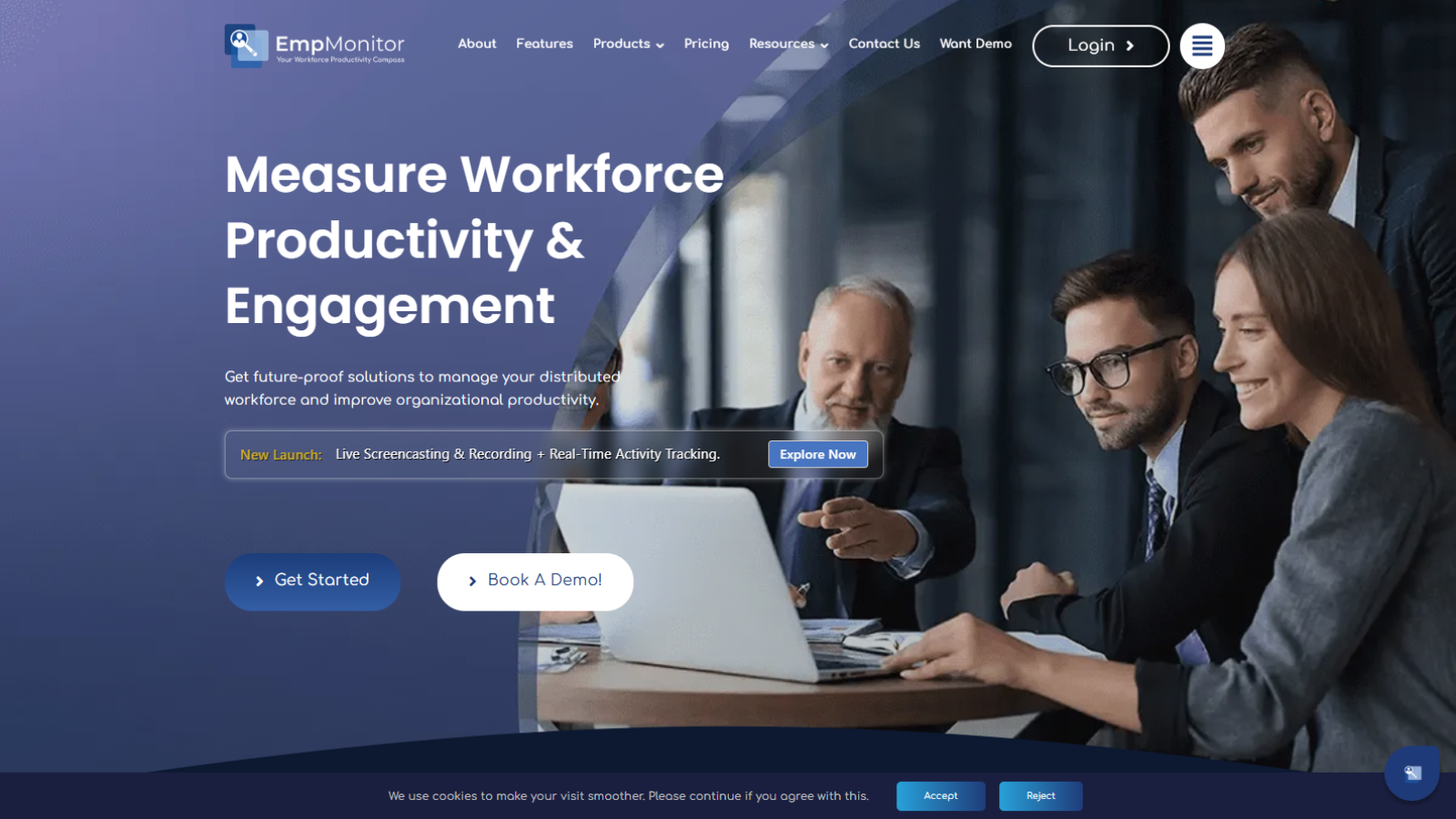

EmpMonitor is a workforce management and employee monitoring platform designed specifically to help businesses track productivity, attendance, and compliance — while staying within the boundaries of Indian surveillance laws and work-from-home laws.
Transparent Time Tracking and Attendance Monitoring
EmpMonitor automatically records when employees start and stop working, tracks active hours, and flags attendance anomalies. This gives employers the visibility they need for payroll accuracy and capacity planning without requiring invasive, real-time surveillance. Employees know what’s being tracked because the system operates transparently, which aligns with the DPDP Act’s notice requirements.
Application and Website Usage Monitoring
One of EmpMonitor’s core features is tracking which applications and websites employees use during work hours, categorizing them as productive or non-productive. This is legally permissible under Section 69B of the IT Act when done on company devices for legitimate productivity and security purposes. The data helps managers identify where attention is drifting — excessive social media use, extended time on non-work sites — without requiring continuous screen recording or keystroke logging.
Screenshot Capture with Access Controls
For organizations that require deeper activity verification, EmpMonitor’s screenshot feature captures periodic visual records during work hours. Screenshots are stored securely and accessible only to authorized personnel, maintaining role-based access controls that comply with data protection requirements. This is particularly useful for client-facing roles, sensitive projects, or regulated industries where output quality needs to be verifiable.
Compliance-Focused Data Handling
EmpMonitor’s monitoring functions apply only during designated work hours, with clear audit trails showing who accessed what data and when. The platform supports the data minimization and purpose limitation principles required under the DPDP Act — you’re only collecting what’s necessary for defined business purposes, and access is restricted accordingly.
Conclusion:
In 2026, the Indian surveillance laws will no longer be a free-for-all. The DPDP Act, along with the way courts interpret the older laws, has established a privacy-based framework in which employers must demonstrate that they need to monitor their employees, tell employees how they will monitor them and avoid continued or excessive monitoring with no specific business purpose.
This means that going forward, transparency, proportionality and documentation must be provided by employers. Employers who monitor remotely without documented policies, informed consent from the employee and an acceptable reason for doing so will incur substantial potential legal and reputational risk.
Fortunately, businesses compliant with the law can utilize a variety of tools designed specifically to allow employers to see how their employees are performing – including attendance, productivity and security at the same time as adhering to the legal requirements established by Indian employment law and the laws pertaining to telecommuting. When monitoring is done correctly, it can create an environment conducive to team growth rather than an environment conducive to monitoring.
Frequently Asked Questions:
-
Do I need to obtain permission from my employees before monitoring their work from home in India?
Typically, yes. Under Indian surveillance laws, legislation authorizes the monitoring of company-owned devices or networks without explicit prior approval in some cases, but employees must be notified in advance that monitoring will occur and the reasons for it. Indian surveillance laws emphasize transparency and proportionality. Personal devices used for work must receive explicit, informed consent from employees to ensure compliance with surveillance laws and data protection requirements. You should create and have each employee sign a written monitoring policy outlining the scope, purpose, and terms of monitoring as part of employment conditions. -
Can I monitor my employees’ personal email accounts and/or personal messages if they access them during work hours?
Technically speaking, yes — but only if the employee is using a company-owned device and/or computer, and if you have clearly disclosed your intent to monitor in the official policy. However, because the DPDP Act requires that monitoring be necessary and proportionate, any form of monitoring of an employee’s private communication may be challenged in court if it violates surveillance laws principles of necessity and proportionality. It is legally safer to monitor work-related activity only and discourage personal usage of company devices within your formal monitoring policy. - What will happen if I do not have a written work from home monitoring policy?
You are placing yourself at serious legal risk. Without a documented work from home monitoring policy, an employee may claim that they were not made aware of the monitoring, therefore making it impossible for you to legally justify conducting the monitoring under Indian employee monitoring law.