


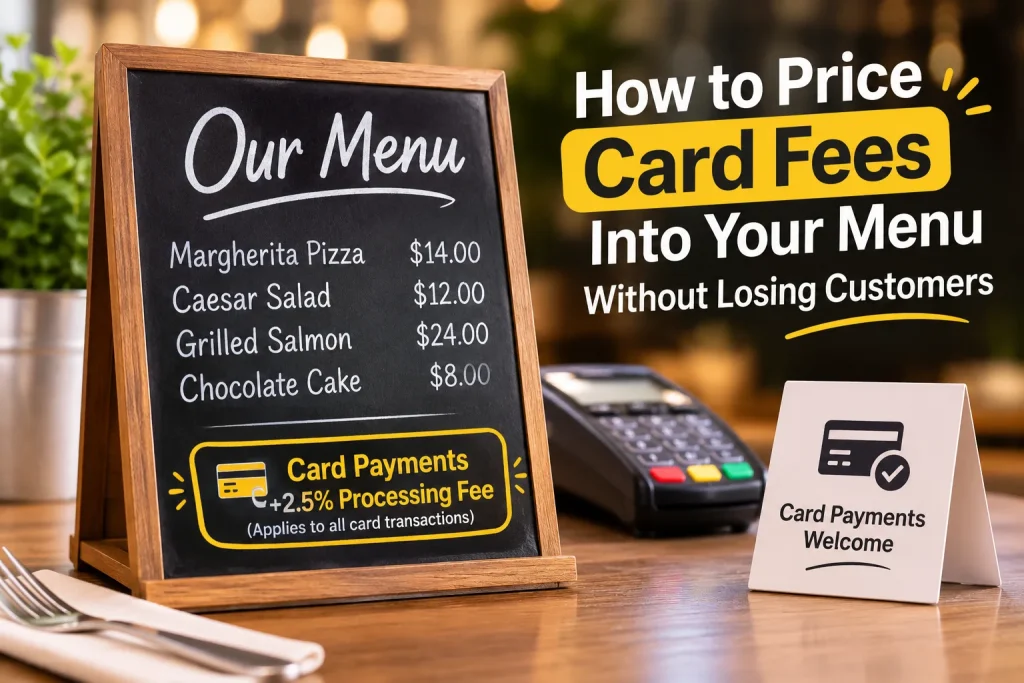
A $4 coffee can cost you more to accept in plastic than to pour. That sentence annoys owners, and it should, because most of us price a plate on food cost and rent, then watch a chunk of every $20 tab walk out the door as processing cost. You don’t have to raise prices across the board, and you don’t have to eat the difference either. You need a method.
Here’s the core idea: treat card acceptance as a cost of goods, not a mysterious monthly bill. Once you know your effective rate, it becomes a number you can fold into menu math the same way you fold in bread cost. If you’re still shopping for a provider to run those numbers against, it helps to compare plans like the ones at small business credit card processing before you build a pricing model, because your rate determines everything downstream.
Card fees are only one line in your cost structure. For most food and service businesses, labor is the other big one, and it’s the one most owners estimate rather than measure. The same habit that helps you find your real card rate, using actual data instead of assumptions, applies to staff hours too. Keep that in mind as you read on, because we’ll come back to it.
Start with your real effective rate, not the advertised one
Grab three months of statements and divide total fees by total card sales. That’s your effective rate, and it’s almost always higher than the headline percentage because it folds in gateway charges, statement fees, and the interchange on rewards cards. Most small shops land somewhere well above the base interchange figure, and that gap is normal. The Federal Reserve oversees the debit interchange standards that shape part of every transaction, and the rest comes from network fees and your provider’s markup. Knowing which portion you can influence keeps you from fighting the wrong battle.
One owner I talked to had been quoting his sales rep’s “2.4%” for two years. His actual number was closer to 3.1%. That’s roughly $700 a month on his volume, and it had been quietly shrinking his margin the whole time. Pull the statements. Do the division. That number, not the pitch, is what you price into the menu.
The three-bucket framework
I use a simple test with clients, and I’d bet most operators who price this badly skip it. Split every dollar of card cost into three buckets: unavoidable interchange, provider markup, and behavior cost (what you pay because customers tap premium rewards cards or dispute charges). Then decide where to act.
- Interchange: you can’t negotiate it, so it becomes a permanent line in your menu math.
- Markup: this is where comparison shopping pays. A few tenths of a point across a year is real money.
- Behavior cost: sometimes you influence it with how you present payment options, sometimes you just absorb it.
I’d pick a provider with transparent, flat pricing over one that hides markup in tiers, every time. Chasing the lowest advertised rate is how people end up in a three year contract with an early termination fee that eats a year of savings.
How to spread the cost across a menu without a visible hike
You have four levers, and most owners only pull the first one. Raise everything, adjust the highest volume item, nudge the items with the best margin headroom, or change how you present payment choices. The trick is matching the lever to your customer’s habits.
A $3.25 drip coffee with a 40 cent fee looks ugly as an 8 cent price increase. A $16 sandwich with the same fee absorbs a 10 cent bump and nobody notices. Price the pennies into items people buy without thinking, not the ones where they compare prices.
| Item type | Typical ticket | Suggested move |
| High-volume, low ticket | Under $5 | Absorb into price or bundle |
| Core menu items | $10 to $20 | Small across-the-board bump |
| Premium or add-ons | $25 and up | Add a modest service line |
| Custom or special orders | Variable | Quote card cost into the estimate |
If you run a coffee shop, your menu is where this gets tight. If you run a service business or a food truck, most of your tickets land in the middle where a rounding adjustment covers the fee without a conversation.
What the regulators and your customers expect
Surprise fees get you reviewed badly, and some of them invite legal trouble. The Federal Trade Commission enforces rules against deceptive pricing, which includes hiding a surcharge that shows up only at checkout. If you go the surcharge route, post it at the door, on the menu, and at the register. No exceptions.
My honest read: build card cost into your listed prices and skip the surcharge entirely. Customers in 2026 have seen too many surprise fees at checkout, and a visible add-on reads as a penalty even when the math is identical. You get the same margin and none of the friction.
Step by step: run this in one afternoon
- Pull three months of card statements.
- Divide total fees by total card sales to get your effective rate.
- Multiply your average ticket by that rate. That’s your per-transaction cost.
- List your ten best-selling items and rank them by margin.
- Add the cost to your two highest volume items first, rounding up to a clean price point.
- Rewrite the menu, keep old prices nowhere, and track weekly sales for a month.
- Recheck your rate quarterly. Rates drift, and your number should move with them.
Do a small test if you’re nervous. Bump three items, hold the rest, and watch the mix for two weeks. Most owners find demand barely moves on small increments, which tells you more than any spreadsheet forecast can.
One bonus step for the same afternoon: pull three months of staff hours and lay them next to your busiest sales windows. If you’re paying for idle hours at 2 p.m. and running short at lunch, that gap hits your margin as hard as the processing fee does. Time-tracking tools can show you where the hours actually go, so you’re pricing and scheduling off data instead of gut feel.
The numbers owners forget to add
There’s a whole cluster of costs sitting next to your processing rate: chargebacks, refunds, equipment, and the labor spent reconciling books at month end. The Small Business Administration frames these as part of your operating cost of doing business, and lumping them together is how you get a true picture of what accepting cards really costs.
Chargebacks are the sneaky one. A single dispute can wipe out the margin on a dozen transactions, and online ordering makes disputes more likely because the card isn’t present. Build a small buffer into your pricing for it. Owners who ignore this line item end up eating it later without knowing why.
Reconciliation, dispute handling, and refund processing all cost staff time, and most owners never measure it. Track how many hours go to these admin tasks each month, and a vague annoyance becomes a number you can price in or shrink with better workflows. This is where time-tracking and workforce analytics data earn their keep: once you can see the hours, you can decide whether to automate the task, reassign it, or build it into your pricing.
Fewer errors, fewer disputes
A lot of chargebacks and refunds start at the counter, not at the card network. A wrong order, a missed modifier, or a refund handled three different ways by three different shifts all turn into disputes later. The fix is mostly process: clear ownership of who handles refunds, a short checklist for order confirmation, and regular check-ins on where errors cluster. Activity and workload insights help here, not as a way to watch people, but as a way to spot which shifts are stretched thin and where a little training or a schedule change would prevent the mistake. Teams that feel supported and clear on their process make fewer errors, and every error you prevent is a dispute you never have to absorb.
Wrap up the pricing question
You don’t need a pricing consultant. You need three months of statements, a division problem, and the willingness to spread a few pennies across the items your customers buy without thinking. The margin you recover covers equipment, chargeback buffers, and the slow quarter you didn’t see coming. Pull those statements today and calculate your effective rate. Then tell me what the number was compared to what you assumed. Most owners are surprised, and that surprise is the start of the whole fix.
Margin is a two-sided problem
Recovering margin from card fees is half the job. The other half is making sure the labor you’re paying for is productive, well scheduled, and engaged. If you want visibility into that side, EmpMonitor helps you track time, understand workload, and keep your team on the same page, so the margin you win back on pricing isn’t lost on the schedule.