

A landscaping company can finish the physical work on time and still lose money in the last 15 minutes. That happens when the crew leaves the site, marks the job “done,” and the office still has to chase photos, material changes, labor time, customer approval, and follow-up notes. A weak landscaping job handoff turns one finished visit into extra admin time, slower invoicing, billing disputes, and avoidable callbacks.
A familiar scene: the crew wraps up a mulch refresh, trims the hedges, loads the trailer, and sends one text – “done.” Back in the office, someone still has five unanswered questions. Was the full scope completed? Did the crew use all planned materials? Did the client ask for anything extra? Was there a gate issue? Are there photos to prove the result? That gap is where profit starts to leak.
For many companies, the fix is not another long meeting. It is a shorter, tighter, repeatable landscaping job handoff process that turns field activity into office-ready records before the truck leaves the property. In practice, that usually means using landscaping business software that helps crews close out jobs with photos, notes, material updates, and next steps while the details are still fresh.
Why The Handoff Problem In Landscaping Keeps Repeating?
The handoff problem usually comes from process drift. Crews work fast. Office staff work from records. When those two habits are disconnected, each side thinks the other side “already knows” what happened. The crew thinks, “We were there, it’s obvious.” The office thinks, “If it isn’t written down, I can’t invoice it, prove it, or schedule the next step.”
Here is where the gap often starts:
- Job notes live in three places: paper sheets, texts, and memory.
- “Completed” means one thing to the field and another to admin.
- Photos exist, but nobody ties them to the exact work order.
- Extra work gets done on-site, but nobody prices it before billing.
- The office hears about issues only when the client replies later.
That is why landscaping job handoff should be treated as part of the job itself, not as an afterthought after the job.
What The Crew Sees Vs. What The Office Needs?
| Crew says | Office still needs | Why it matters |
| “We finished.” | Scope confirmation | Billing and client proof |
| “We used extra mulch.” | Quantity and reason | Margin tracking |
| “Customer was happy.” | Signed approval or message | Fewer disputes |
| “There was a gate issue.” | Written note and photo | Follow-up and liability record |
A company can do excellent field work and still create office friction if this table is never translated into a simple closeout routine.
When The Crew Finishes The Work, What The Office Still Needs
The office usually needs a very short set of details, but it needs them every time.
A workable crew-to-office handoff should answer these questions before the job is marked complete:
- Was the full scope finished as sold?
- What changed on-site?
- How much labor and material was actually used?
- Are there before-and-after photos?
- Did the client approve the result or request a return visit?
- Does the next team need a note for maintenance, warranty, or follow-up?
That is a small list. Yet when even one item is missing, the office starts reconstructing the job from scraps.
The Five Fields That Save The Most Office Time
| Field | Example | Office result |
| Completion status | Full / partial / blocked | Correct next action |
| Variance note | “Added 8 bags of brown mulch” | Cleaner billing |
| Time on site | 2 techs, 3.5 hours | Labor tracking |
| Photo set | 4 after photos attached | Service verification |
| Customer note | “Asked for bed edging quote” | Sales follow-up |
The Handoff Problem In Landscaping Costs More Than One Missed Note
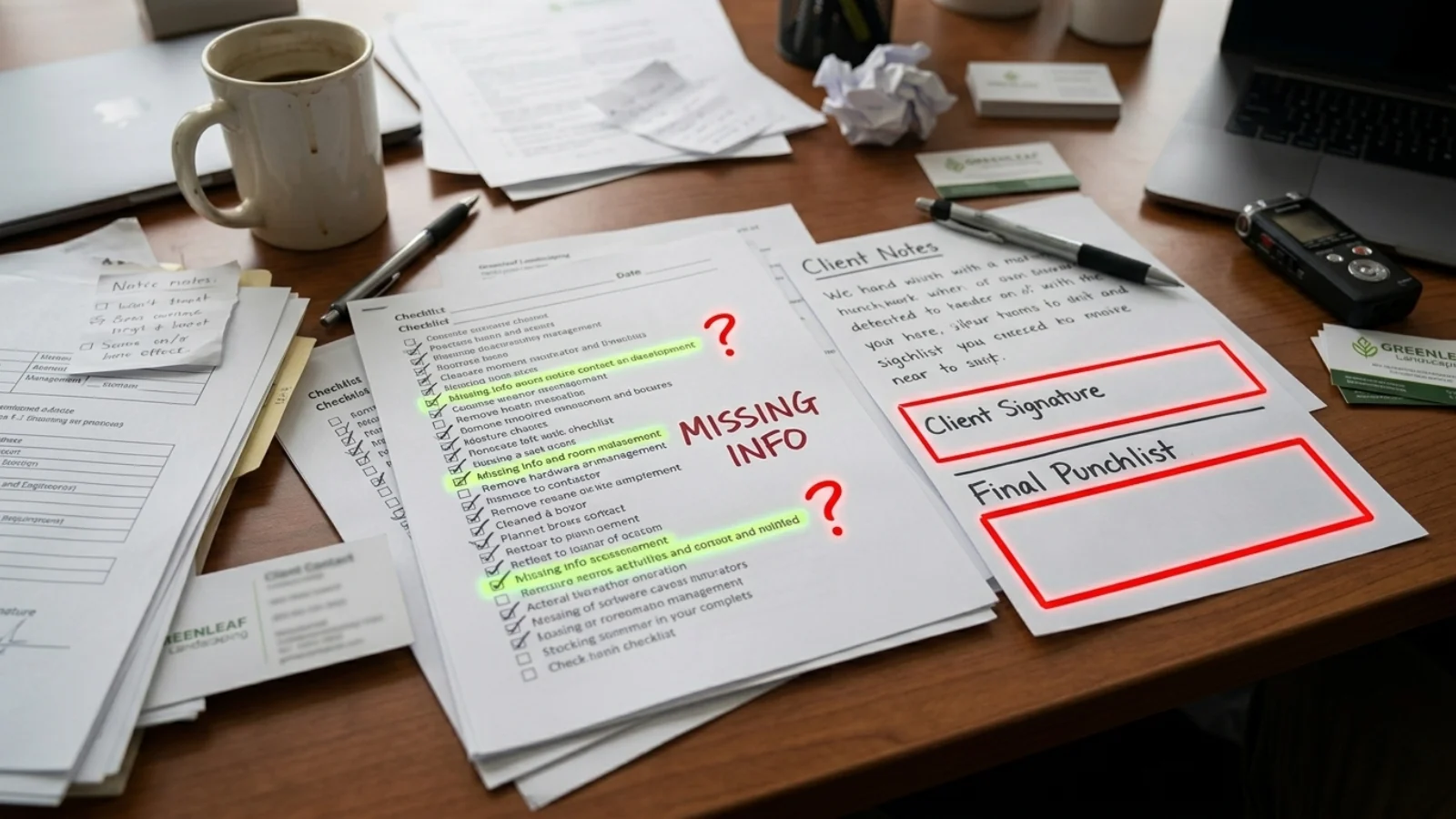

A missed detail rarely stays small. Here is a simple model for a six-crew company. This is an illustrative operations exercise, not an outside benchmark.
- 6 crews.
- 3 jobs per crew per day.
- 18 jobs per day.
- 8 minutes of office cleanup per job when handoff details are incomplete.
- 18 × 8 = 144 minutes a day.
- That equals 2.4 office hours per day.
- Over 22 workdays, that becomes 52.8 office hours per month.
If admin time costs $28 an hour fully loaded, that is about $1,478.40 per month spent reconstructing work that was already done.
And that still leaves out the harder costs:
- Delayed invoices.
- Underbilled change work.
- Return visits caused by vague notes.
- Customer friction when proof is missing.
- Slower quote turnaround for add-on requests.
The real issue is not the note itself. The real issue is the chain reaction after the note goes missing.
A Micro-Story From Daily Operations
A crew installs seasonal flowers at a commercial property. During the visit, the site manager asks them to refresh one extra bed near the front sign. The crew agrees. They do the work. They leave.
No photo of the extra bed.
No note on extra soil.
No note on added labor.
No line item update.
Three days later, the invoice reaches the customer. The office bills only the original scope because nobody can prove the extra work. The company gave away labor and materials. The customer would probably have paid – if the office had received the details in time.
That is the handoff problem in one scene: good work, weak record, thinner margin.
A Simple Landscaping Job Handoff Workflow That Closes The Gap
Field crews often finish the work before the office has what it needs to bill, follow up, or schedule the next visit. A short handoff process gives each job a clear status, proof of work, and one next action before details get lost.
Step 1 – Mark The Job With One Real Status
Avoid vague labels like “done” or “handled.”
Use statuses such as:
- Complete.
- Partially complete.
- Blocked.
- Needs office follow-up.
That one change helps work order status updates stay useful.
Step 2 – Require One Variance Note
If anything changed, the crew adds one short note in plain language.
Examples:
- “Customer approved 12 extra feet of edging.”
- “Could not access side gate; rear bed postponed.”
- “Used 10 extra bags of black mulch due to thin base.”
This strengthens job documentation without asking the crew to write a report.
Step 3 – Attach Proof Before Leaving The Site
Require:
- One site-wide after photo.
- One close-up photo for any corrected issue.
- One photo for extra work.
- One photo when work is blocked or incomplete.
Photos are often the fastest form of service verification.
Step 4 – Capture Labor And Material While It Is Fresh
Do not wait until the end of the day. By then, one visit blends into the next.
A good landscaping job hand-off records actual hours, crew count, and material changes right after the last walkthrough.
Step 5 – Push One Next Action To The Office
Every completed job should end with one of these:
- Invoice now.
- Schedule revisit.
- Quote add-on.
- Call customer.
- Hold for manager review.
That keeps admin workflow clear and short.
When The Office Still Lacks The Details, These Mistakes Show Up First

Most companies do not fail at handoff all at once. They fail in patterns.
Watch for these warning signs:
- The office calls crew leads after hours for missing notes.
- Invoices are delayed because photos are missing.
- Add-on work gets remembered but never billed.
- Customers dispute “incomplete” jobs because nobody attached proof.
- Return visits happen because the next team cannot read what happened last time.
These are not random errors. They usually point to one missing closeout standard.
Old Closeout Vs. Handoff-Ready Closeout
| Old habit | Handoff-ready habit | Likely result |
| “Done” text message | Structured closeout form | Fewer admin callbacks |
| Photos in camera roll | Photos attached to work order | Faster proof retrieval |
| Extra work told later | Extra work logged on-site | Better billing capture |
| Memory-based follow-up | Next action selected before exit | Less delay |
The Handoff Problem In Landscaping Gets Worse As The Company Grows
A two-crew business can survive on memory longer than it should. A ten-crew business usually cannot.
Growth adds distance between the people doing the work and the people turning that work into invoices, reports, schedules, and customer updates. Once that gap widens, even a decent team starts wasting time.
That is why the strongest systems are short, repeatable, and visible. The office should know what “complete” means. The crew should know the exact five items required before the job closes. Nobody should rely on end-of-day recall.
A Simple Fix For Missed Job Details
The handoff problem in landscaping is simple to describe: the crew finishes the work, but the office still lacks the details. The fix is just as clear. Make the closeout part of the job, keep the required fields short, and tie every completed visit to proof, variance notes, and next action.
A better landscaping job handoff does more than tidy paperwork. It protects margin, shortens admin time, speeds invoicing, and gives the office a record it can actually use. When the record is finished at the same time as the work, the job is truly complete.