


Every organization sits on a goldmine of sensitive data, customer records, financial reports, intellectual property, and confidential communications. When that data starts moving in the wrong direction, the damage can be catastrophic. Knowing how to detect data exfiltration before it ever leaves your network is no longer optional; it is the cornerstone of any serious cybersecurity strategy.
The window between a breach starting and data being fully stolen is often dangerously narrow. According to IBM, the average global cost of a data breach has surpassed $4.45 million, and 60% of breaches are linked to insider threats. Organizations that catch exfiltration early are the ones that have built the right detection habits, tools, and processes, and this guide shows you exactly how to do that.
What Is Data Exfiltration And Why Is It So Dangerous?
Before diving into detection, it helps to understand what we are actually dealing with. Data exfiltration, also referred to as data theft or unauthorized data transfer, occurs when data is copied, transferred, or retrieved from a system without authorization. Attackers use a wide variety of methods: DNS tunneling, HTTP/S-based transfers, email forwarding to personal accounts, cloud sync abuse, and even physical methods like USB drives. Understanding these attack paths is the first step in learning how to detect data exfiltration effectively.
What makes exfiltration particularly dangerous is that it often mimics legitimate traffic. Attackers move data slowly, in small chunks, through channels that look completely normal to the untrained eye. By the time a breach is discovered, the industry average is 207 days, and sensitive data has long since left the building. This is precisely why knowing how to detect data exfiltration in real time matters so much. Organizations that prioritize strategies focused on how to detect data exfiltration proactively are far better positioned to reduce dwell time and minimize financial and reputational damage. Reactive security simply is not enough anymore.
Common Channels Attackers Use For Data Exfiltration:
To effectively detect data exfiltration, you first need to know where to look. Attackers typically exploit multiple channels to move stolen data out of a network:
- Email and personal webmail accounts are used to forward large batches of files or sensitive documents to external recipients.
- Cloud storage services like Google Drive, Dropbox, or OneDrive, where data is quietly synchronized to attacker-controlled accounts.
- DNS tunneling, where data is encoded and sent through DNS queries to an attacker-controlled domain, is one of the harder-to-spot techniques. Security teams can also use a EasyDMARC DNS checker to inspect a domain’s DNS records and identify configuration details that may help during an initial investigation.
- USB and removable media are especially useful in environments where physical access to endpoints is poorly controlled.
- Encrypted HTTPS channels that bypass traditional content inspection tools and hide the true nature of the traffic.
- FTP or SFTP connections to external servers that appear legitimate on the surface but are staging grounds for stolen data.
Knowing these channels helps security teams prioritize monitoring efforts. The goal is not to block all outbound traffic, that would cripple operations, but to create visibility into what is normal and flag what is not. This distinction sits at the heart of how to detect data exfiltration effectively.
Key Indicators Of Data Exfiltration You Should Never Ignore:
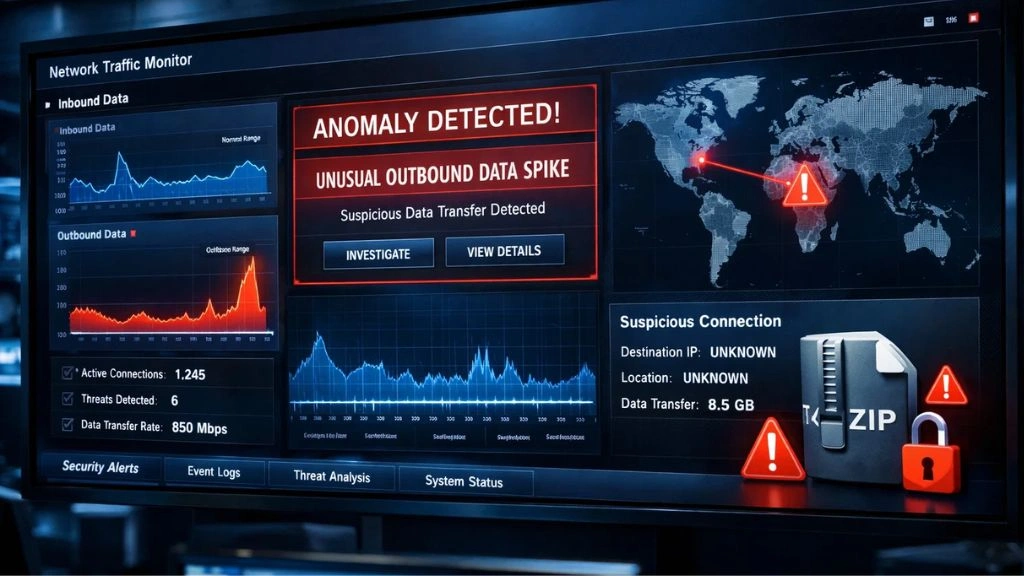

One of the most critical cybersecurity skills is recognizing the early warning signs of a data exfiltration attempt. These indicators do not always scream “breach”; they whisper. Here are the key behavioral and technical red flags to watch for:
- Unusual outbound data volumes: A sudden spike in outbound traffic, especially outside business hours, is a textbook sign of how to detect data exfiltration in progress. Normal baseline deviations of more than 20–30% should trigger an investigation immediately.
- Access to unusual file types or directories: A user suddenly accessing HR files, financial databases, or R&D directories they have never touched before is a strong and consistent signal worth investigating.
- Large file compression: Attackers frequently compress data into ZIP or RAR archives before exfiltrating. Watch for bulk compression activity, especially on sensitive directories where files are not typically archived.
- Connections to unknown external IPs: Outbound connections to unfamiliar geographies, newly registered domains, or IP addresses with poor reputation scores deserve immediate scrutiny.
- Abnormal login patterns: Logins from unusual locations, at odd hours, or preceded by multiple failed authentication attempts can indicate a compromised credential being used to stage data for theft.
How To Detect Data Exfiltration Using Network Monitoring?

Network-level monitoring is your first major line of defense. When it comes to how to detect data exfiltration, watching what is happening at the packet and flow level gives you unparalleled visibility into what data is moving and where it is going.
NetFlow analysis is particularly powerful. By capturing metadata about all network conversations, source, destination, protocols, volume, and duration, security teams can establish behavioral baselines and detect deviations the moment they occur. Tools like Zeek (formerly Bro) and Darktrace use machine learning to automatically surface anomalies that human analysts might otherwise miss in the noise.
Deploying a Network Detection and Response (NDR) solution adds another critical layer. NDR tools continuously monitor east-west traffic (internal network movement) as well as north-south traffic (traffic leaving the network perimeter). Pay special attention to data leaving through encrypted channels; TLS inspection capabilities can help unmask suspicious content within HTTPS flows without compromising legitimate privacy protections.
How to detect data exfiltration in Kubernetes?
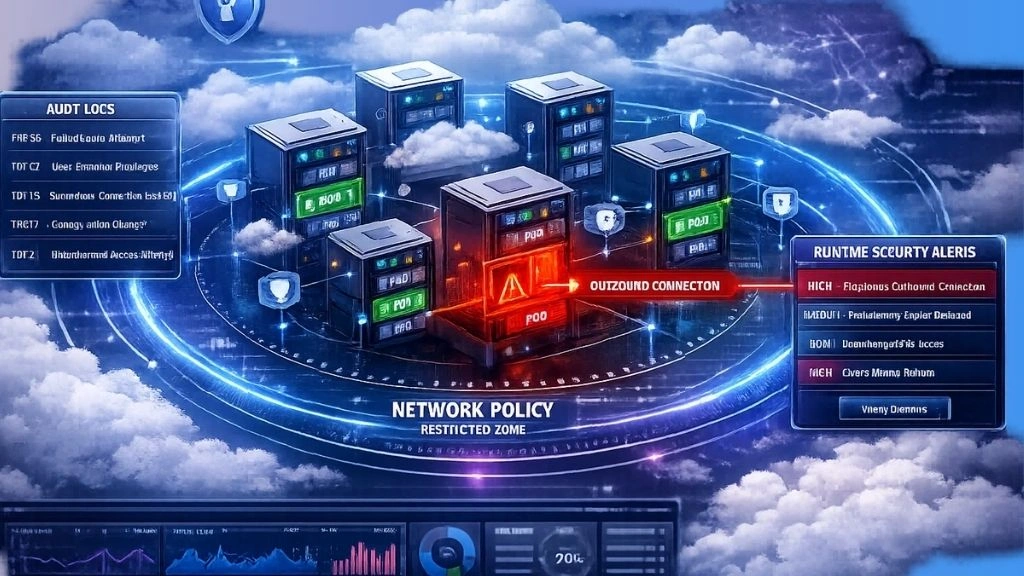
Security teams working in containerized infrastructure often search for guidance on How to detect data exfiltration in Kubernetes environments present, and for good reason, the challenges here are unlike anything you face in a traditional network. The dynamic, ephemeral nature of Kubernetes means containers spin up and down rapidly, making perimeter-based security models largely ineffective. Every new pod is a potential blind spot if you are not watching closely, which is exactly why understanding How to detect data exfiltration in containerized systems is critical. For organizations managing complex Kubernetes environments, Best kubernetes consulting services can also help strengthen security architecture and improve visibility across containerized workloads.
Here is a practical approach to strengthening detection in Kubernetes and improving your strategy for How to detect data exfiltration:
- Enable Kubernetes Audit Logs to capture every API call made within the cluster. Unusual API activity, such as listing secrets, accessing ConfigMaps, or creating new service accounts, can indicate an attacker moving laterally or actively preparing for exfiltration.
- Enforce Network Policies to restrict pod-to-pod communication and limit which pods can make external network calls. Any violation of these policies is a strong and actionable exfiltration signal.
- Deploy runtime security tools like Falco, which monitors system calls at the kernel level and fires alerts when containers behave abnormally, such as making unexpected outbound connections or reading sensitive configuration files.
- Use a service mesh like Istio to monitor egress traffic. A service mesh provides mTLS encryption between services while also delivering rich telemetry data to identify suspicious outbound flows at a granular level.
- Integrate Kubernetes logs with your SIEM platform for centralized correlation. Isolated pod logs are hard to act on in isolation; centralized analysis reveals attack patterns across the entire cluster and further strengthens your approach to How to detect data exfiltration effectively.
- Kubernetes-native security platforms like Aqua Security, Sysdig Secure, and Prisma Cloud offer comprehensive runtime protection and network visibility designed specifically for containerized workloads and are worth evaluating for production environments.
Also Read:
How To Use UEBA To Detect Insider Threats Effectively?
Insider Threat Detection: How to Identify & Prevent Internal Risks In 2025?
How To Detect Data Exfiltration Splunk?
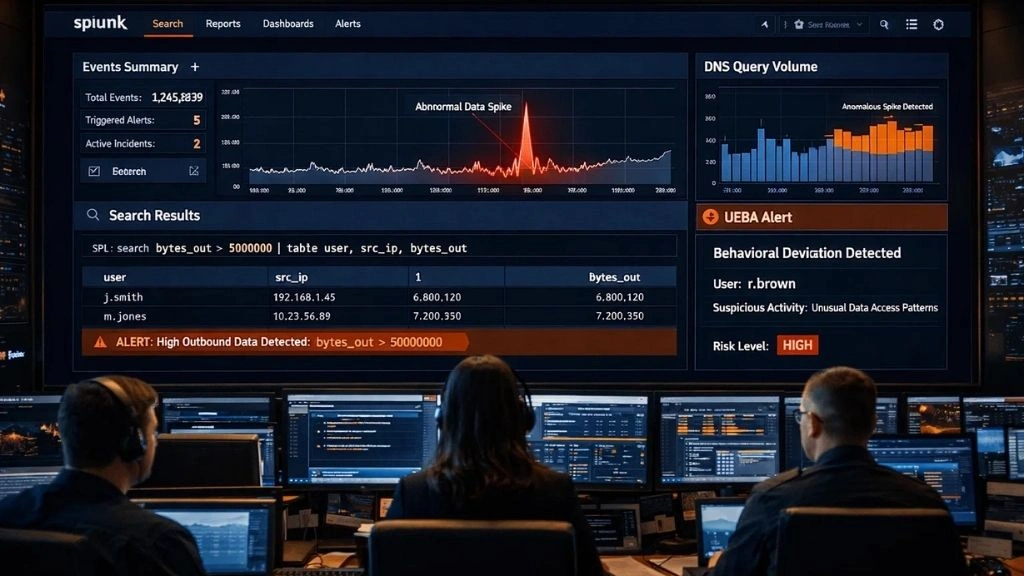
Among enterprise security platforms, few questions come up more frequently than how to detect data exfiltration. Splunk users can act quickly, and it makes sense because Splunk gives analysts enormous power to build, tune, and automate detection logic directly on top of their existing data. The key is knowing which queries, correlation searches, and behavioral models to put in place.
Here is how to use Splunk effectively for exfiltration detection:
- Build baseline SPL queries: Use Splunk’s Search Processing Language (SPL) to establish outbound traffic baselines per user, device, or department. A simple query filtering for bytes_out exceeding threshold values per source IP can quickly surface machines sending unusually large volumes of data outside business hours.
- Create correlation searches in Splunk Enterprise Security (ES): Combine data from endpoint logs, DLP alerts, proxy logs, and network flows into multi-signal detection rules. A single indicator is rarely enough; it is the combination of signals that tells the real story.
- Leverage Splunk UEBA (User and Entity Behavior Analytics): UEBA applies machine learning to user behavior data and flags individuals whose activity deviates significantly from their historical norms, one of the most reliable methods for detecting data exfiltration, especially for insider threats operating under valid credentials.
- Monitor DNS query volumes: Attackers using DNS tunneling generate unusually high volumes of DNS queries to a single domain. A Splunk search on DNS logs filtered for query frequency per destination can surface this technique in minutes.
- Integrate DLP telemetry: Feeding DLP alerts into Splunk lets you correlate file access events with network transfer events, giving you a complete and timestamped picture of the exfiltration attempt from start to finish.
How EmpMonitor Helps You Detect Data Exfiltration From The Inside Out?


While network tools and SIEM platforms are essential, some of the most dangerous exfiltration happens not through network exploits, but through the everyday actions of people inside your organization. This is where EmpMonitor becomes an invaluable layer of protection.
EmpMonitor is an enterprise-grade employee monitoring and insider threat prevention platform trusted by 15,000+ companies across 100+ countries, tracking over 500,000 employees. It gives security teams real-time visibility into what employees are doing on their systems, making it one of the most effective tools for detecting data exfiltration that originates from within.
Key features that directly aid data exfiltration detection:
- USB Detection & Blocking: Identifies and blocks unauthorized USB connections in real time, stopping one of the most common physical exfiltration vectors before data leaves the endpoint.
- Website & App Usage Monitoring: Tracks every website visited and application used, making it easy to spot uploads to personal cloud storage, file-sharing sites, or suspicious external platforms.
- Screenshot Monitoring: Captures periodic screenshots of user activity to provide visual evidence of on-screen actions, particularly valuable during post-incident investigations.
- Behavioral Alerts: Sends instant notifications when unusual or policy-violating behavior is detected, giving security teams time to act before exfiltration completes.
- Keystroke Tracking: Logs keystrokes to detect suspicious activities such as copying credentials or composing emails with sensitive attachments to personal accounts.
- AI-Powered Reports: Delivers in-depth analytics and actionable threat intelligence to help identify patterns and emerging exfiltration risks before they escalate.
EmpMonitor works discreetly in the background and supports both on-premises and remote work environments, giving you consistent coverage no matter where your employees operate.
Building A Proactive Data Exfiltration Detection Strategy:
Understanding how to detect data exfiltration is one thing; embedding that detection into your organization’s daily operations is another. A strategy that actually works requires more than tools. It requires a framework that brings people, processes, and technology together cohesively.
- Establish clear data classification policies: You cannot protect what you cannot identify. Classify all data assets by sensitivity level and tie DLP policies directly to those classifications so protection scales automatically with risk.
- Define and monitor your data egress points: Every legitimate pathway data should use to leave your network needs to be documented and actively monitored. Anything outside those documented pathways is an anomaly worth investigating immediately.
- Implement the principle of least privilege: Limit each user’s data access to only what they need to perform their specific role. Overprivileged accounts are one of the most exploited conditions during exfiltration attacks, particularly involving compromised credentials.
- Run regular threat-hunting exercises: Proactive threat hunting involves systematically analyzing historical data to find evidence of exfiltration that automated tools may have missed. A structured threat-hunting program significantly reduces your average dwell time.
- Test your detection capabilities: Red team exercises and data exfiltration simulations help validate whether your detection systems actually catch real exfiltration attempts. Many organizations discover critical gaps only through simulation, not during a live breach when the cost is already mounting.
The Role Of User Behavior Analytics In Exfiltration Detection:
No conversation about how to detect data exfiltration is complete without discussing User and Entity Behavior Analytics (UEBA). When organizations evaluate how to detect data exfiltration effectively, they quickly realize that traditional security tools look for known attack signatures. UEBA, by contrast, learns what normal looks like for each user and entity on your network, then flags anything that deviates from that established baseline.
UEBA systems continuously score each user based on cumulative risk factors, high-volume downloads, after-hours activity, access to sensitive resources, and lateral movement. When the risk score crosses a configured threshold, security teams receive an automated alert for investigation. This behavioral scoring model plays a critical role in modern strategies focused on how to detect data exfiltration before large-scale damage occurs.
This is particularly powerful for catching insider threats. A trusted employee who begins downloading large volumes of data before resigning, or a contractor who suddenly starts accessing systems outside their project scope, may not trigger a signature-based alert. But UEBA catches it because the behavior deviates sharply from that person’s norm, strengthening your overall framework for how to detect data exfiltration in complex environments.
Conclusion:
Data exfiltration is not a problem that resolves itself; it evolves. Attackers constantly develop new techniques to move sensitive information out of networks without being detected. The organizations that stay ahead are the ones that treat detection as an ongoing capability, not a one-time setup. Knowing how to detect data exfiltration requires a layered approach: network monitoring, advanced SIEM use cases in Splunk, specialized runtime security in Kubernetes, and a human-behavior layer powered by tools like EmpMonitor.
FAQ’s:
Q1: What is the fastest way to detect data exfiltration in real time?
Ans: When understanding how to detect data exfiltration in real time, the fastest method combines network traffic anomaly detection with endpoint monitoring. EmpMonitor provides behavioral alerts the moment suspicious activity occurs on an endpoint, while Network Detection and Response (NDR) tools flag unusual outbound traffic simultaneously for immediate response. This layered approach ensures you can detect data exfiltration before significant damage occurs.
Q2: Can data exfiltration happen through encrypted traffic?
Ans: Yes. When researching how to detect data exfiltration, it is essential to account for encrypted channels. Attackers frequently use HTTPS or TLS to conceal exfiltration. TLS inspection capabilities and User and Entity Behavior Analytics (UEBA) are essential to detect data exfiltration hidden within encrypted traffic. These tools analyze traffic volume, frequency, and behavioral anomalies rather than relying solely on content inspection.
Q3: Is it possible to detect data exfiltration in a remote work setup?
Ans: Absolutely. A critical part of understanding how to detect data exfiltration in today’s environment involves securing remote endpoints. Tools like EmpMonitor provide deep visibility into remote devices, offering the same monitoring strength as on-premises systems. Cloud-native SIEM and NDR solutions also enhance your ability to detect data exfiltration across distributed teams and hybrid infrastructures.