
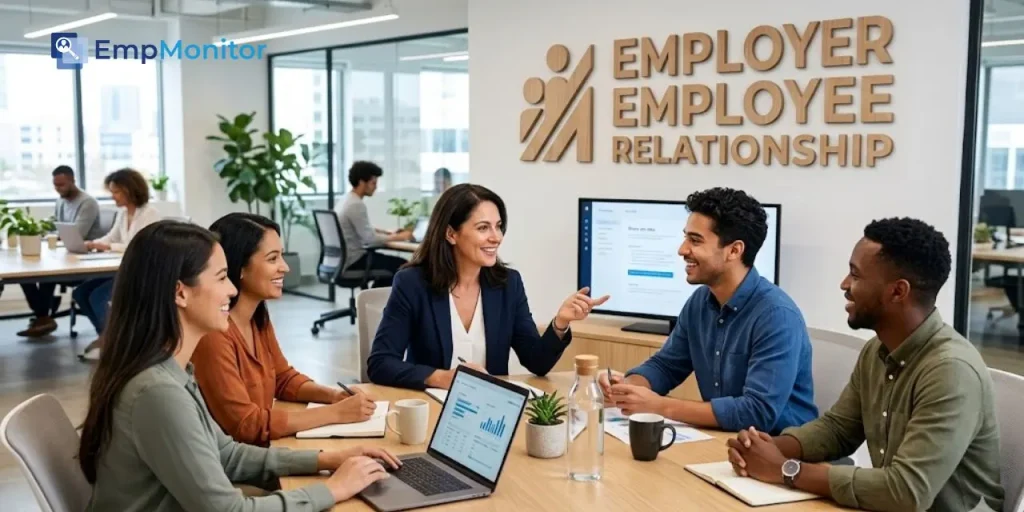
Building a strong employer employee relationship is one of the most important investments any organization can make. When a company brings someone on board, it is not merely filling a vacancy it is entering a professional relationship that will shape productivity, culture, and long-term growth. The employer-employee relationship has always been the backbone of a thriving workplace, but the dynamics have shifted significantly. With distributed teams, hybrid work models, AI-augmented workflows, and a workforce that increasingly prioritizes purpose and well-being, building this relationship intentionally has never been more critical.
A healthy employer employee relationship drives engagement, reduces turnover, and creates the psychological safety that enables people to do their best work. Organizations that invest in this bond consistently outperform those that treat it as an afterthought.
Listen To The Blog Post
What the Employer Employee Relationship Really Means Today?


The employer employee relationship is no longer defined by a simple exchange of labor for pay. The traditional top-down model — where employers set the rules and employees comply — has largely given way to something far more collaborative. Today’s workplace is built on mutual accountability. Employees expect transparency, autonomy, and meaning from their work. Employers, in turn, expect commitment, adaptability, and results.
This shift in the employer-employee relationship is not just cultural — it is structural. The rise of remote and hybrid work means that managers can no longer rely on physical proximity to gauge engagement or productivity. The relationship must be deliberately cultivated through consistent communication, trust, and the right organizational systems. Companies that fail to adapt their approach to the modern employer-employee relationship risk disengagement, high attrition, and a weakened workplace culture.
Laying the Foundation: Policies That Support a Strong Employer-Employee Relationship
The starting point for any healthy employer employee relationship is a clear, fair, and human-centered policy framework. Policies should not just be compliance documents — they should actively communicate the organization’s values and set the tone for how people treat one another at work.
Effective workplace policies that support the employer-employee relationship today include:
- Flexible and hybrid work arrangements — giving employees agency over where and, within reason, when they work
- Psychological safety and anti-harassment standards — going beyond legal minimums to create genuinely inclusive environments
- Clear performance expectations — so employees know what success looks like and how they will be evaluated
- Mental health and well-being support — including access to counseling, adequate leave, and workload protections
- Transparent compensation and growth pathways — removing ambiguity around pay, promotions, and career development
Critically, one size does not fit all when it comes to the employer-employee relationship. A policy that works for a 10-person startup may be entirely inappropriate for a 5,000-person enterprise. Policies must be adapted to the company’s size, culture, industry, and the specific needs of its workforce to genuinely serve the relationship they are meant to support.
Why the Employer Employee Relationship Matters: The Real Benefits?

Fewer Workplace Conflicts
A strong employer employee relationship creates a workplace where people feel heard and respected, resulting in far fewer interpersonal conflicts. When issues do arise — and they will — a culture of open communication means they get resolved quickly rather than festering into larger organizational problems.
Higher Productivity and Quality of Work
Employees who feel valued bring discretionary effort to their work — the extra initiative that goes beyond the job description. Research consistently shows that engaged employees are significantly more productive than disengaged ones. The employer-employee relationship is one of the most powerful levers for unlocking that engagement and sustaining high performance over time.
Stronger Employee Retention
Replacing an employee is expensive — estimates typically range from half to twice the annual salary, accounting for recruitment, onboarding, and lost productivity. A strong employer-employee relationship is one of the most effective retention strategies available, particularly in competitive talent markets where skilled workers have plenty of options.
Better Innovation
Psychological safety the confidence that you can speak up, share ideas, or flag mistakes without fear of punishment is the foundation of innovative teams. It grows directly from the quality of the employer-employee relationship. When people trust their employer, they take the creative risks that drive meaningful progress.
Organizational Resilience
When disruption hits a market downturn, a restructure, a strategic pivot organizations with a strong employer-employee relationship adapt faster. Trust built during stable periods pays real dividends when things get hard, holding teams together when uncertainty might otherwise pull them apart.
Managing the Employer-Employee Relationship in a Hybrid World
The shift to hybrid and remote work has fundamentally changed how the employer-employee relationship is maintained day to day. Physical proximity can no longer be relied upon to create connection — it must be built deliberately and consistently across distributed teams.
Communication cadence matters. Regular one-on-ones between managers and employees — not just all-hands meetings are essential to a healthy employer-employee relationship. These conversations should go beyond task updates to include career development, challenges, and personal well-being.
Visibility should not be confused with trust. A common mistake that damages the employer-employee relationship is conflating physical presence with productivity. Outcome-based performance management — focusing on results rather than hours logged — is both fairer and more effective in hybrid environments.
Technology enables, but does not replace, human connection. Collaboration tools and communication platforms make distributed work possible, but they are infrastructure, not relationship-builders. Leaders who genuinely invest in the employer-employee relationship create deliberate opportunities for human connection — through team rituals, virtual check-ins, or periodic in-person gatherings.
The Role of Technology in Supporting the Employer-Employee Relationship

Technology, when used thoughtfully, can meaningfully support the employer employee relationship — but it must be deployed with transparency and respect.
Workforce management tools that help track productivity, manage schedules, or analyze workload distribution can provide genuinely useful data for managers. The key to using these tools without harming the employer-employee relationship is consent and transparency. Employees should always know what is being monitored, why, and how that data will be used. Covert or punitive monitoring erodes trust — which is the very foundation of a healthy employer-employee relationship and tends to backfire in the long run.
The most effective use of workforce technology is not surveillance but insight. Data can help managers identify burnout before it becomes a crisis, recognize high-performers who deserve acknowledgment, and distribute work more equitably across a team all of which actively strengthen the employer-employee relationship.
How EmpMonitor Helps Strengthen the Employer-Employee Relationship?
One tool that organizations are using to support workforce visibility while maintaining a healthy employer employee relationship is EmpMonitor, a comprehensive employee monitoring and productivity management platform designed for the demands of modern, distributed teams.
What sets EmpMonitor apart is its focus on data-driven insight rather than surveillance. Here is how its updated features directly support a stronger employer-employee relationship:
Real-Time Productivity Analytics
EmpMonitor provides managers with a live dashboard showing each team member’s productive and idle hours, active application usage, and overall output. Rather than micromanaging, managers get a clear picture of workload distribution, allowing them to step in with support before burnout sets in, not after. This kind of proactive management is a cornerstone of a healthy employer-employee relationship.
AI-Powered Productivity Scoring
EmpMonitor’s AI layer goes beyond raw data to generate intelligent productivity scores for each employee. It factors in task patterns, application usage, and work rhythms to provide a fair, contextual assessment — removing the guesswork from performance conversations and making feedback in the employer-employee relationship more objective and data-backed.
Automated Attendance and Shift Management
The platform tracks login and logout times, break durations, and shift adherence automatically — eliminating manual timesheets and reducing disputes. For hybrid teams especially, this creates a reliable record that supports fairness and transparency in the employer-employee relationship.
Insider Threat and Data Security Alerts
EmpMonitor now includes intelligent alerts for unusual activity such as large file transfers, unauthorized application use, or access to restricted data. This protects both the organization and its employees, creating a safer digital workplace that supports trust on both sides of the employer-employee relationship.
Detailed App and Website Usage Reports
Managers can view categorized reports of the websites and applications accessed during work hours, helping identify productivity gaps and misuse of company time while also surfacing patterns that can inform better workflow design and tool adoption across teams.
Cloud-Based Centralized Dashboard
All data is stored and accessible through a secure, cloud-based dashboard. Whether managing a team of five or five hundred, employers can monitor activity, generate reports, and track trends from a single interface — making workforce management scalable without adding administrative burden.
Project and Task-Level Tracking
EmpMonitor’s updated project tracking feature allows managers to assign tasks, monitor progress, and measure time spent per project. This level of visibility supports outcome-based management — one of the most important shifts in the modern employer-employee relationship by tying performance insights directly to business goals.
Used transparently and ethically, EmpMonitor gives employers the visibility they need to support their teams effectively, while giving employees confidence that performance is being measured fairly. That balance is precisely what a strong employer-employee relationship in a hybrid world requires.
Who Is Responsible for the Employer-Employee Relationship?
The short answer: everyone. But different roles carry different responsibilities when it comes to maintaining a healthy employer employee relationship.
HR professionals play a critical coordination role — designing policies, mediating conflicts, supporting onboarding, and ensuring legal compliance. They are the architects of the systems that shape the employer-employee relationship at an organizational level.
Senior leaders set the tone. When leaders model transparency, accountability, and genuine care for their people, those values cascade through the organization and define what the employer-employee relationship looks and feels like in practice. No HR initiative can compensate for leadership that fails to walk the talk.
Managers are the most direct influence on the day-to-day employer-employee relationship. Every interaction — a piece of feedback, a missed recognition, a candid conversation — either builds or erodes the bond between employer and employee.
Employees themselves also have a role. Bringing professionalism, honesty, and a collaborative spirit to the relationship creates the conditions for it to thrive on both sides.
Practical Steps to Strengthen the Employer-Employee Relationship
- Invest in manager development. The single biggest driver of the employee experience — and the employer-employee relationship — is the direct manager. Train managers not just on technical skills, but on empathy, feedback, and coaching.
- Create genuine feedback loops. Regular engagement surveys, stay interviews, and open-door policies only strengthen the employer-employee relationship when leaders actually listen and act on what they hear.
- Recognize contributions meaningfully. Specific, timely, and public acknowledgment of good work reinforces a positive employer-employee relationship far more effectively than vague or delayed praise.
- Be transparent about the business. Employees who understand the company’s direction, challenges, and goals feel more connected to their work and more invested in the employer-employee relationship as a whole.
- Support career growth. One of the fastest ways to weaken the employer-employee relationship is to leave people feeling stuck. Create clear development pathways and give people the resources to grow within the organization.
- Protect work-life balance. Chronic overwork damages the employer-employee relationship over time. Leaders who model healthy boundaries signal to their teams that their well-being genuinely matters.
Frequently Asked Questions (FAQs)
Q1. What is the employer employee relationship?
The employer employee relationship is the formal and informal connection between a person who hires (the employer) and the person who works for them (the employee). It encompasses everything from legal obligations like contracts and compensation, to day-to-day dynamics like communication, trust, and mutual respect. A healthy employer-employee relationship benefits both parties — employees feel valued and motivated, while employers gain a committed and productive workforce.
Q2. Why is the employer-employee relationship important?
A strong employer employee relationship directly impacts employee engagement, productivity, retention, and overall workplace culture. Organizations that invest in this relationship experience lower turnover, fewer conflicts, and higher-quality work. It also shapes a company’s reputation as an employer, influencing its ability to attract top talent in a competitive market.
Q3. What are the most common causes of a poor employer employee relationship?
The most frequent causes of a damaged employer employee relationship include lack of communication, unclear expectations, inconsistent or unfair treatment, absence of recognition, micromanagement, and limited growth opportunities. In hybrid and remote settings, physical disconnection can further weaken the relationship if not actively managed.
Q4. How can employers improve their relationship with employees?
Improving the employer employee relationship starts with the basics: communicate openly and consistently, set clear expectations, recognize contributions, and genuinely listen to feedback. Beyond that, invest in manager training, create real career development pathways, and build a culture of psychological safety where people feel comfortable speaking up.
Final Thought
The employer employee relationship is not a program to implement; it is a culture to cultivate. It requires consistent attention, honest communication, and a genuine commitment from both sides. Organizations that invest in building a strong employer-employee relationship do not just retain good people; they create the conditions where good people become exceptional ones.
That, more than any tool or policy, is the real competitive advantage.