

Teramind is a capable, well-built platform. But capable and right-sized are two different things, and for a growing number of small and mid-sized businesses, Teramind’s price tag and complexity have started to outpace what they actually need from an employee monitoring tool.
If your core requirements are time tracking, activity screen monitoring, productivity insights, and screenshot visibility, you don’t need enterprise-grade data loss prevention and insider threat detection baked into the package. There are several employee monitoring software options cheaper than Teramind that handle the essentials cleanly, without the overhead.
This guide covers four of the strongest alternatives, EmpMonitor, Hubstaff, ActivTrak, and Insightful, with an honest look at what each does well, what it doesn’t, and who it’s best suited for. We’ll also cover when staying with Teramind still makes sense, because for some businesses, it genuinely does.
In a hurry? Listen to the blog instead:
Why Companies Look for Employee Monitoring Software Cheaper Than Teramind
Teramind pricing starts at around $15 per user per month on its entry plan and climbs considerably for teams that need advanced features or on-premise deployment. For an enterprise security team managing insider threat risk in a regulated industry, that cost is justifiable. For a 30-person startup that mainly wants to know how its remote team is spending the workday, it’s a hard number to defend.
The businesses most likely to start shopping for affordable employee monitoring software tend to share a few common characteristics. They’re scaling quickly and watching per-user costs multiply. They’re using basic monitoring features while enterprise-level capabilities sit unused. Their IT resources are limited, and Teramind’s setup and configuration demands more technical bandwidth than they have. Or they’ve simply done a software audit and realized they’re paying a premium for a tool built for a security use case they don’t have.
Remote and hybrid team growth has also pushed more SMBs into the employee monitoring market for the first time, and many of them are coming in with budget constraints that make Teramind’s pricing a non-starter from the beginning.
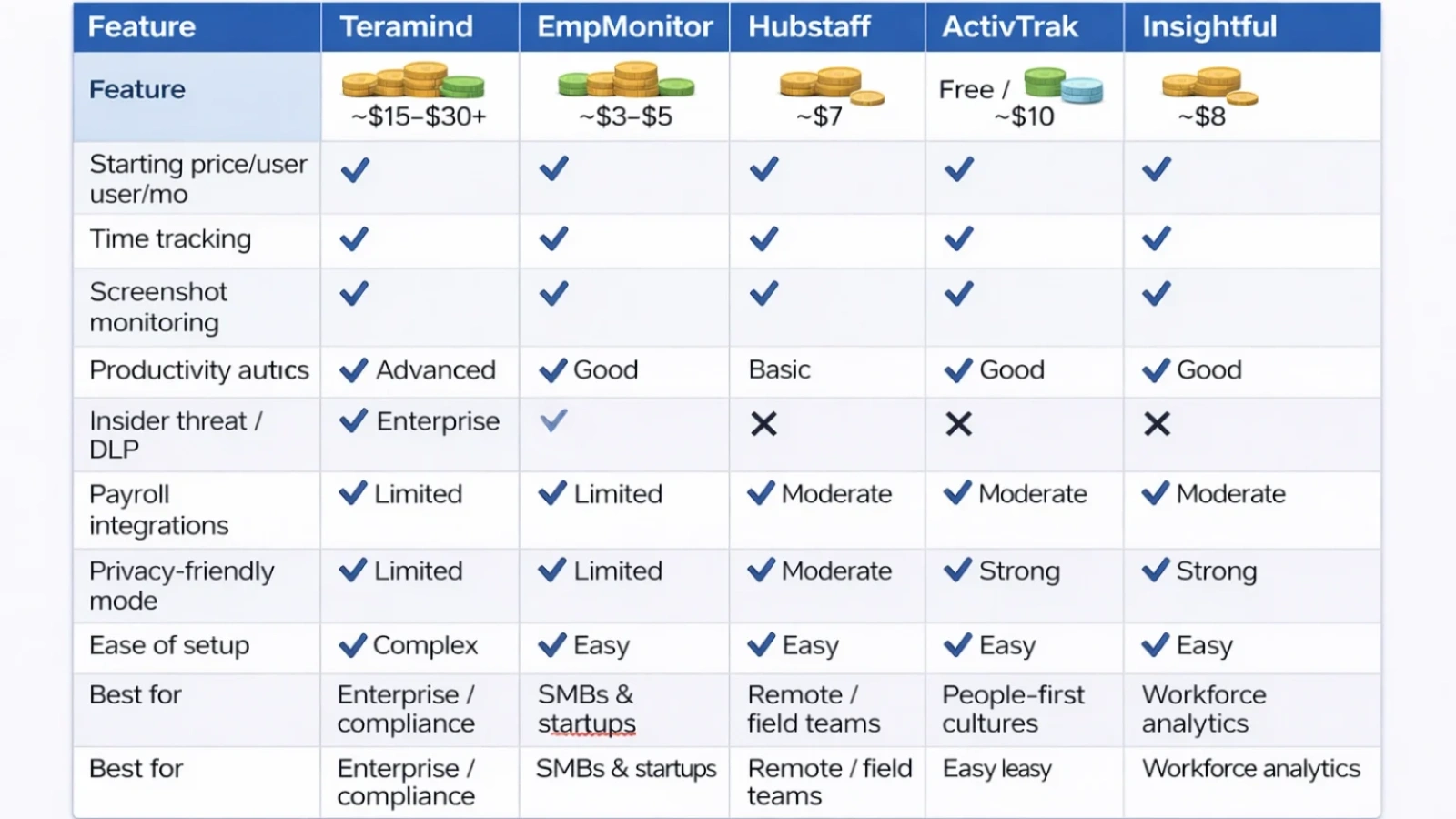
Teramind vs Other Alternatives: Feature and Pricing Snapshot
Before getting into the details on each tool, here’s a quick side-by-side overview. This gives you a reference point for the comparisons that follow.
Note: Pricing figures are estimates based on publicly available information at the time of writing. Software pricing changes frequently; always verify current rates directly with each vendor before making a purchasing decision.
What to Look for in a Cost-Effective Teramind Alternative
Cheaper doesn’t automatically mean better value. Before switching, it’s worth being specific about what your business actually needs, and honest about what it doesn’t.

For most SMBs, the core monitoring requirements are time tracking and timesheets, screenshot monitoring at configurable intervals, app and website usage reporting, and basic productivity analytics. If you have field or contract workers, GPS tracking and payroll integration may also matter. These are the features that drive day-to-day value for the majority of non-enterprise teams.
Beyond features, pay attention to ease of setup. A monitoring tool that requires a dedicated IT project to deploy is a hidden cost that doesn’t show up in the per-user price. The alternatives on this list are all meaningfully simpler to get running than Teramind.
Transparent pricing is also worth prioritizing. Some tools in this space advertise low entry prices and then require add-ons to access features that should be standard. Look for vendors who publish their full pricing clearly and don’t bury key features behind escalating tiers.
Finally, think about the privacy and culture fit. There’s a meaningful spectrum between productivity insight tools and full surveillance platforms. Where you land on that spectrum should reflect your team culture, not just your feature checklist.
Read More!
4 Employee Monitoring Software Options Cheaper Than Teramind
Each of these tools covers the core monitoring requirements for SMBs and remote teams at a lower price point than Teramind. They differ in their emphasis, time tracking depth, analytics quality, privacy approach, and integrations, so the right pick depends on what matters most to your business.
1. EmpMonitor: Affordable Employee Monitoring Software with Strong Core Features
EmpMonitor is a solid, straightforward employee monitoring platform built with SMBs and growing teams in mind. It covers the core feature set that most non-enterprise businesses actually need: time tracking, screenshot capture, app and website usage monitoring, keystroke logging, and productivity reporting, all presented through a clean dashboard that doesn’t require significant technical expertise to use or interpret.
What makes EmpMonitor stand out in this comparison is its pricing. Starting at around $3 to $5 per user per month, depending on the plan and team size, it’s one of the most affordable options in the market that still delivers a complete monitoring feature set. For a 50-person team, that difference versus Teramind can translate to thousands of dollars saved annually without sacrificing the day-to-day visibility managers actually need.
The platform handles remote employee monitoring well, with real-time activity tracking and reporting that gives managers a clear picture of productivity across distributed teams. Its productivity analysis features categorize time as productive or unproductive based on app and website usage and generate reports that can be shared with team leads or used in performance conversations.
EmpMonitor is best suited for SMBs that want comprehensive monitoring without a complex setup process, growing teams that need to scale monitoring affordably, and businesses that don’t have dedicated IT resources to manage an enterprise-level deployment. It won’t replace Teramind for organizations with serious DLP or insider threat requirements, but for the majority of businesses that don’t have those requirements, it covers the ground that actually matters.
-
- Best for: SMBs, startups, growing remote teams
- Standout feature: Comprehensive core monitoring at a very competitive price point
- Starting price: ~$3–$5/user/month
- What it lacks vs Teramind: No DLP, no insider threat detection, lighter compliance tooling
2. Hubstaff: Budget-Friendly Time Tracking and Workforce Management
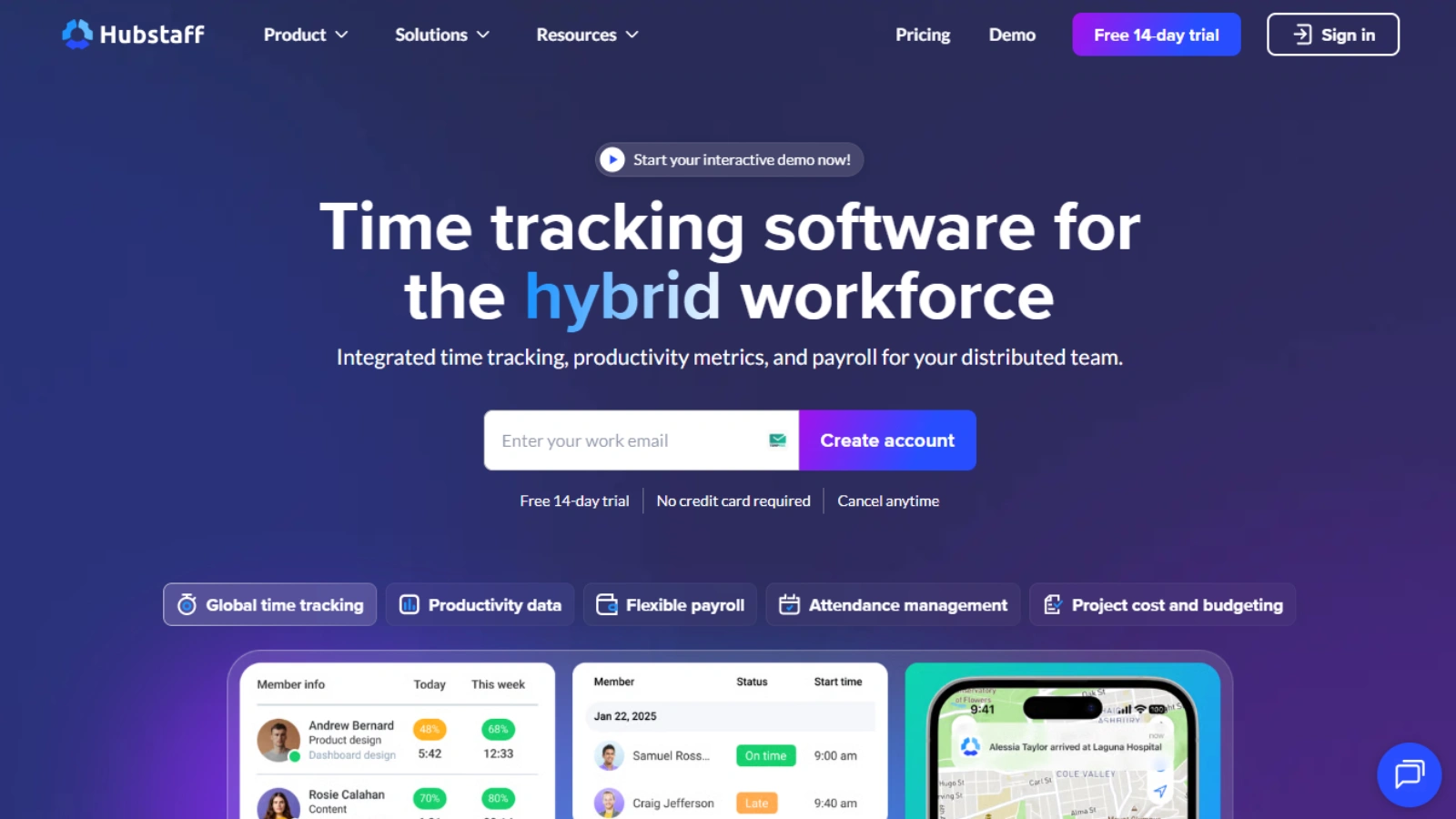
Hubstaff has built a strong reputation in the remote work space by focusing on what distributed teams need most: reliable time tracking, GPS monitoring for field workers, and integrations with project management and payroll platforms. It’s not trying to be a security tool; it’s a workforce management platform, and it does that job well.
Time tracking in Hubstaff is its strongest feature. Employees clock in and out via a desktop or mobile app, and the platform captures optional screenshots, activity levels, and app usage data alongside the time records. Payroll integrations with tools like Gusto, QuickBooks, and Bitwage make it easy to move from tracked time to processed payments without manual data entry.
At around $7 per user per month, Hubstaff is significantly cheaper than Teramind for most team configurations. The free plan is limited to one user, but the paid entry tier is generous enough for most small teams to get genuine value from day one.
Hubstaff is the strongest fit for agencies that bill by the hour and need accurate time records, remote-first companies that manage contractors across multiple time zones, and field service businesses that need GPS tracking alongside time data.
-
- Best for: Agencies, remote teams, field service businesses
- Standout feature: GPS tracking and payroll integrations
- Starting price: ~$7/user/month
- What it lacks vs Teramind: No security features, lighter productivity analytics, and no screenshot AI analysis
3. ActivTrak: Productivity Monitoring with a Privacy-First Approach
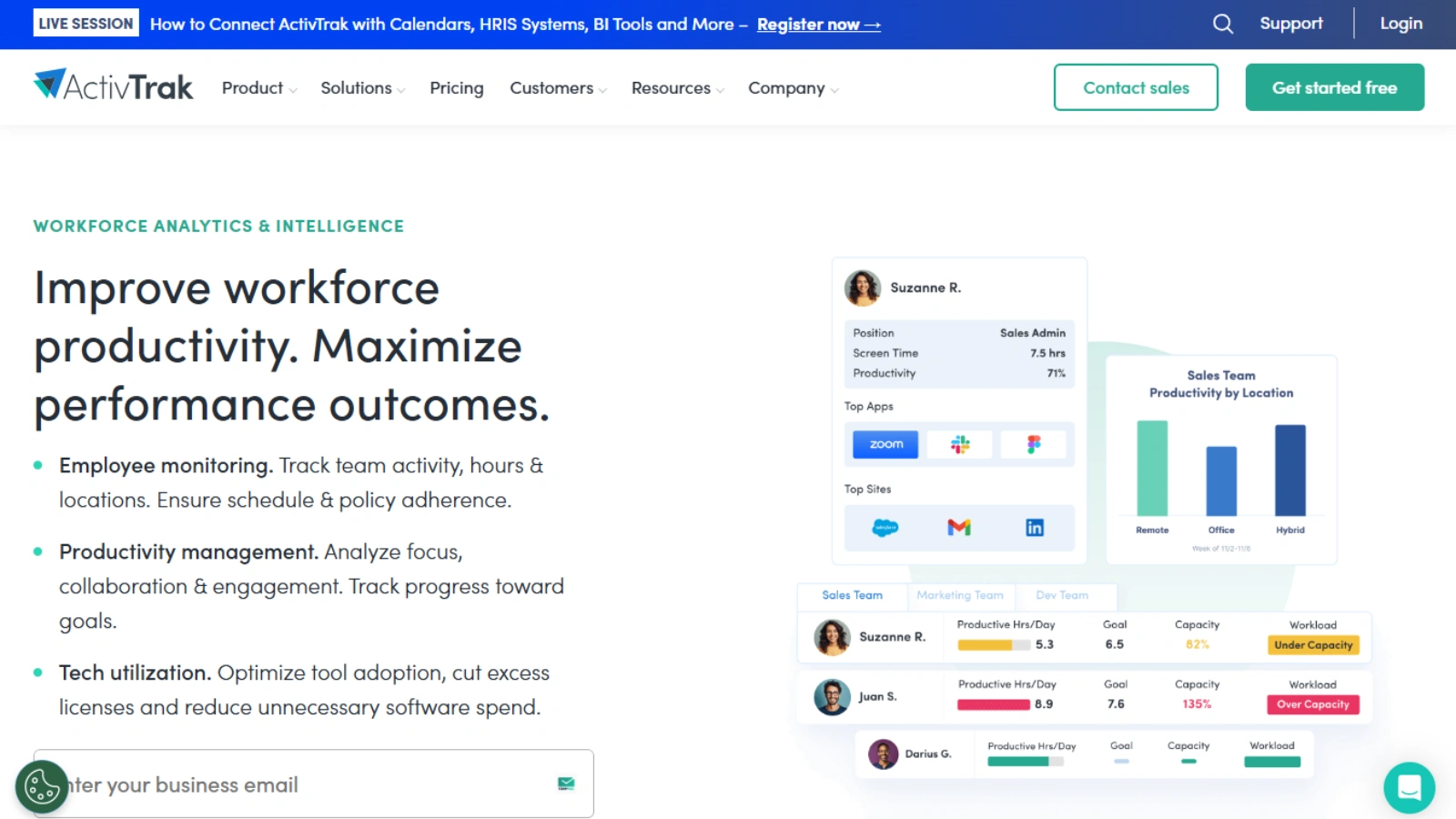
ActivTrak takes a deliberately different philosophy to employee monitoring. While most tools in this space default to maximum visibility, ActivTrak is designed to generate productivity insights rather than surveillance data. It tracks app usage, website activity, and time allocation, then surfaces that information through workforce analytics dashboards that help managers understand patterns and bottlenecks at a team level, not just flag individual behavior.
This framing matters in practice. Businesses that are conscious of employee trust, particularly those transitioning from fully in-office to hybrid or remote work, often find ActivTrak easier to introduce to their teams than more invasive monitoring tools. The data it collects is the same: app usage, active time, website visits, but the way it presents and contextualizes that data feels less like surveillance and more like a management tool.
ActivTrak offers a free plan for up to three users, which makes it the lowest-cost entry point on this list for very small teams. Paid plans start at around $10 per user per month. Its workload balance reporting is a genuinely useful feature that goes beyond basic productivity tracking. It can identify when specific employees or teams are consistently overloaded, which is valuable for capacity planning as well as performance management.
-
- Best for: People-first cultures, growing SMBs, hybrid teams
- Standout feature: Workforce analytics and workload balance reporting
- Starting price: Free up to 3 users / ~$10/user/month paid
- What it lacks vs Teramind: No threat detection, limited screenshot frequency control, and no DLP
4. Insightful: Cost-Effective Workforce Analytics for Remote Teams
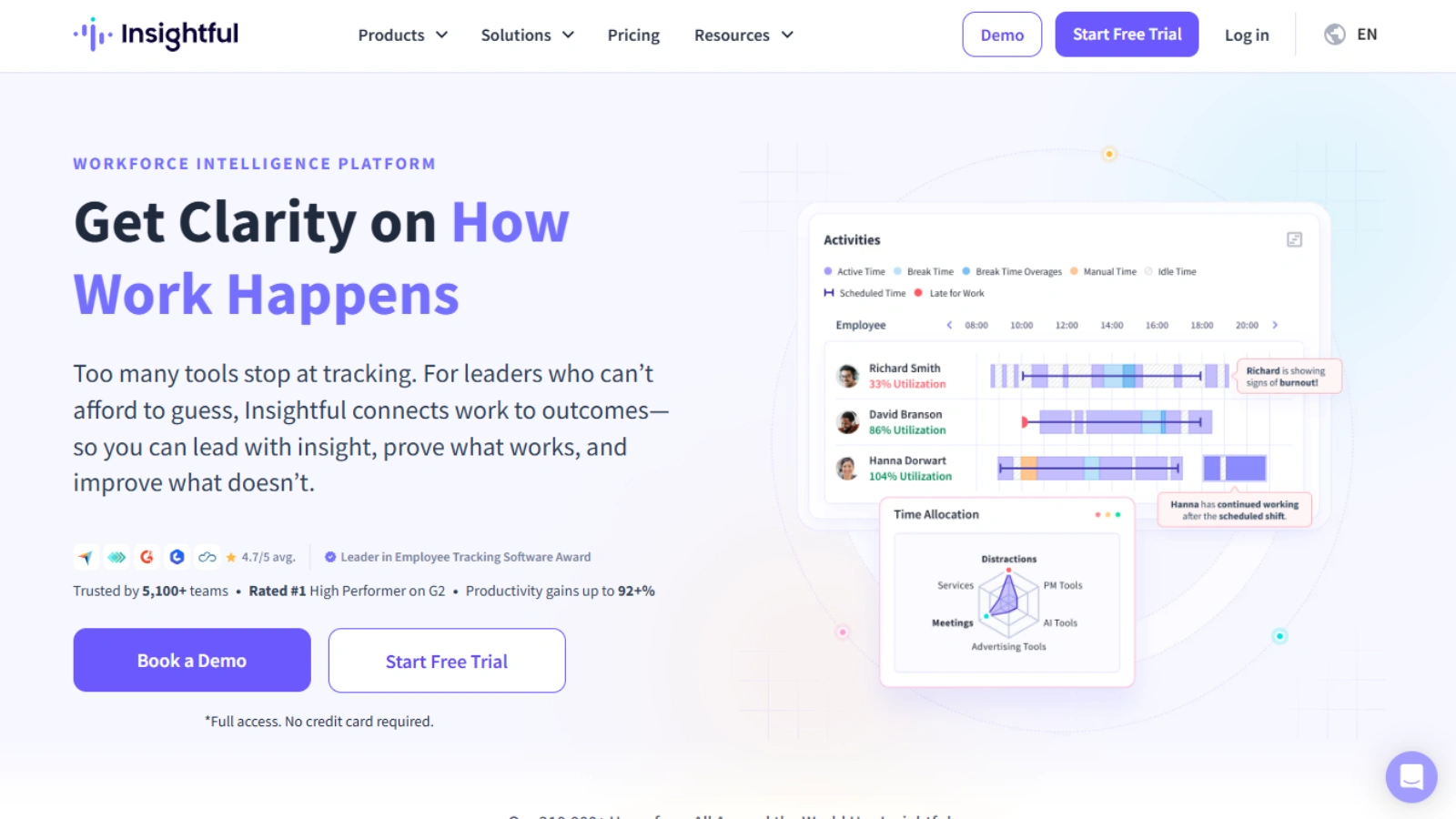
Insightful (formerly Workpuls) positions itself as a workforce analytics platform rather than a monitoring tool, and the distinction shows in how it handles data. It tracks active and idle time, uses AI to categorize apps and websites as productive or unproductive, and generates team-level productivity reports that managers can use for coaching conversations rather than just compliance checks.
One feature that sets Insightful apart from the others on this list is its flexible deployment model. Both cloud-hosted and on-premise options are available, which matters for businesses that have data residency requirements but don’t need Teramind’s full enterprise security stack to meet them. If your concern is keeping employee data on your own infrastructure rather than a third-party cloud, Insightful gives you that option at a much lower price point than Teramind.
Pricing starts at around $8 per user per month. The AI productivity categorization is one of its most practical features; rather than presenting raw usage data and leaving managers to make sense of it, Insightful does much of the classification work automatically, which reduces the time investment required to get value from the platform.
-
- Best for: Remote teams, businesses with data residency needs, analytics-led management
- Standout feature: AI productivity categorization and on-premise deployment option
- Starting price: ~$8/user/month
- What it lacks vs Teramind: No DLP or insider threat detection, smaller integration ecosystem
When It Still Makes Sense to Stay with Teramind
This guide is about alternatives, but a genuinely useful comparison has to acknowledge when the original tool is the right answer.
Teramind is built for environments where employee monitoring overlaps with security and compliance. If your organization operates in a regulated industry, such as financial services, healthcare, legal, government contracting, and you have real obligations around data handling, audit trails, and insider threat documentation, Teramind’s DLP and behavioral analytics capabilities exist for good reason. A cheaper tool that can’t meet those requirements isn’t actually cheaper when you factor in compliance risk.
Similarly, if you have an active IT security function that uses behavioral monitoring as part of its threat detection workflow, or if your organization has experienced data incidents in the past, the depth of Teramind’s detection and forensics tooling is difficult to replicate with productivity-focused alternatives.
The decision framework is straightforward: if you’re primarily paying for time tracking, activity monitoring, and productivity reporting, and the security layer is going unused, a switch to one of the four tools above is likely to save money without meaningful trade-offs. If you’re actively using Teramind’s security features, or if your compliance environment requires them, the cost is probably justified.
When Does It Make Sense to Switch from Teramind?
A few clear signals suggest that switching is worth evaluating seriously.
Your per-user costs are scaling painfully as the team grows, and most of the advanced features go unused
Set up and ongoing configuration are consuming IT bandwidth that could be better spent elsewhere
Your monitoring needs are fundamentally about productivity and time tracking, not security or compliance
You’re an SMB or startup operating without dedicated security or compliance teams
Employee feedback suggests the current monitoring approach feels disproportionately invasive for the culture you’re trying to build
If two or more of these apply, the case for switching is strong. The tools on this list can typically be evaluated on free trials, so the switching risk is low, and you can test before committing.
Final Thoughts: Finding the Right Employee Monitoring Software Cheaper Than Teramind
The most expensive monitoring tool is rarely the most appropriate one. Teramind built its reputation on enterprise-grade security and compliance features, and for the organizations that genuinely need those capabilities, it earns its price. But the majority of growing businesses don’t need that level of depth. They need reliable time tracking, clear productivity visibility, and a tool their teams can actually use without friction.
EmpMonitor covers the core monitoring feature set at a price point that’s hard to argue with, making it a strong starting point for most SMBs. Hubstaff is the better fit for agencies and field teams that need payroll integration alongside monitoring. ActivTrak suits teams where employee trust and privacy culture are a priority. Insightful works well for remote-first businesses that want AI-assisted analytics or need on-premise data control.
Before committing to any switch, take advantage of free trials to test the tool against your actual workflow. Compare pricing across your expected team size over a 12-month horizon, not just the monthly per-user rate. And be clear internally about what you’re actually using Teramind for today, that answer will tell you which alternative, if any, is the right move.
Frequently Asked Questions
What is the cheapest employee monitoring software?
EmpMonitor is one of the most affordable options with a full feature set, starting at around $3 to $5 per user per month. ActivTrak offers a free plan for teams of up to three users, making it the lowest-cost entry point for very small teams. Hubstaff and Insightful both start at around $7 to $8 per user per month, which is still significantly below Teramind’s entry pricing.
Are there free Teramind alternatives?
Yes. ActivTrak has a free plan that supports up to three users and includes app tracking, website monitoring, and basic productivity reporting. It won’t replicate Teramind’s security or compliance features, but for a small team that needs basic activity visibility at no cost, it’s a legitimate option worth trying.
Do cheaper monitoring tools compromise security?
For productivity monitoring purposes, no. EmpMonitor, Hubstaff, ActivTrak, and Insightful are all reputable platforms with standard data security practices. Where they differ from Teramind is in advanced security-specific features like data loss prevention, insider threat behavioral analytics, and forensic audit trails. If your business genuinely needs those capabilities, a cheaper tool is not an adequate substitute. If you don’t need them, which is true for most SMBs, you’re not giving up anything that matters to your day-to-day operations.
Is Teramind worth the price for small businesses?
For most small businesses, no. Teramind’s advanced feature set is engineered for enterprise security environments with dedicated IT and compliance teams. Small businesses that primarily need time tracking, screenshot monitoring, and productivity reporting are paying a significant premium for capabilities they’re unlikely to use. The four alternatives in this guide cover the realistic monitoring needs of most SMBs at a fraction of the cost.