


A lead that comes in through a call is always a visibility gap for a marketer. A form submission on a website includes a conversion, a timestamp, and UTM parameters. A call doesn’t carry any of that by default.
Someone sees the ad, lands on the page, and calls directly: the vendor’s call centre handling remote sales if an affiliate is driving the traffic, or the company’s own sales department if an in-house marketer is running the campaign.
In both cases, whoever owns the traffic stays blind after the click. Yet marketing and sales teams are judged precisely on the quality of those calls. So how do you measure performance for something happening outside marketers’ funnel?
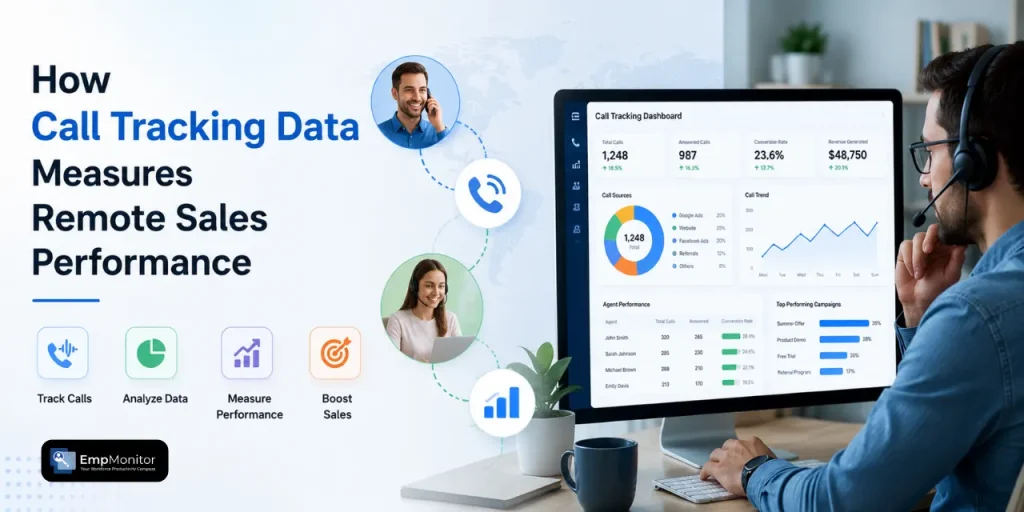
You can do it using call tracking software, which can log which channel, campaign, or even keyword led to a specific call. By analysing it, you can identify the most effective campaigns and what to scale.
Read on to learn more about call tracking & how it can help measure remote sales performance.
What Is Call Tracking Software?
Call tracking software is a type of marketing attribution software that assigns (swaps) unique phone numbers to different traffic sources and logs which channel, campaign, or even keyword led to a specific call. The technology is called dynamic number insertion (DNI).
That’s why one business ends up with a separate number for organic traffic, another for a paid Facebook campaign, and another for email or offline advertising, even though calls from all of them eventually land on the same line or the same call center.
Technically, DNI runs on two levels:
- Static numbers are assigned to large, long-running channels: one number covers all organic search, one covers all email marketing, and one covers offline advertising like billboards, print, or radio.
- Dynamic numbers are typically swapped by session. Advertisers typically give affiliates multiple dynamic numbers. Publishers can assign each channel or even campaign a specific dynamic number.
Pool size comes down to a tradeoff between cost and precision. The more sessions you want to distinguish, the larger the pool of active numbers must be. The downside of this is the increased setup cost. On the other hand, granular data may enable more precise predictive call analytics if you decide to simulate future campaigns based on current performance.
In practice, the platform associates the call with the campaign parameters captured during the visitor’s session and can pass that attribution data into CRM, Google Analytics, Google Ads, Meta Ads, or other reporting systems.
What Call Tracking Software Actually Captures for Affiliates and In-House Teams
Call tracking software can help you define where the call came from without capturing the substance of the conversation itself. This process is known as call attribution. When someone calls that number from the DNI pool, the system logs:
- the traffic source
- the campaign ID
- sometimes the keyword that brought the visitor to the page
- call duration
- time of day
- geography
This layer of call tracking data allows an affiliate to say something more useful than “we got 40 calls this week.” Instead: “35 calls came from Google Ads campaign X, average duration 3 minutes, 8 of them under 30 seconds.” Short duration already signals a low-quality lead, before any feedback comes back from the advertiser.
For an affiliate, this call tracking data is close to the only source available for judging how a campaign is actually performing. The advertiser’s remote sales team doesn’t report back what happened on the call itself, so the affiliate ends up analyzing their own traffic as a self-service check on quality.
For an in-house team, understanding the traffic matters too, but they have more room to work with. Marketing and sales sit inside the same company, so the team can go further and analyze the calls themselves: the most common objections, the language customers use on the call, patterns worth checking against the rep’s script.
Predictive Call Analytics: Reading the Signal Before the Sale Closes
The problem is that the affiliate doesn’t see how a call ended until the advertiser sends feedback. And it can come days or even weeks later.
Predictive call analytics helps narrow that gap. It adds an analytical layer to call tracking data. Based on the call’s parameters (source, duration, time of day, historical conversion patterns for that specific source or specific number), it generates a probability score for how closely a given call resembles the calls that have been converted in the past. It is an early indicator of lead quality, not a replacement for the advertiser’s final conversion data.
In niches with long sales cycles, that lag between lead generation and sale can stretch into weeks. Here’s how predictive analytics, layered on top of the same call tracking data, helps marketers:
- For the affiliate, this score helps avoid depending entirely on a report from the remote sales team on the other end. They can see that traffic from source A consistently produces calls with a high predictive score, while source B produces calls with a low one, before any official feedback arrives.
- For the in-house team, the situation looks different. The same call tracking data feeds a layer further along, giving early signals so campaigns can be adjusted in real time.
This makes predictive score a useful early optimization metric. Combined with call volume, call duration, qualified call rate, and other call tracking data, it can help marketers spot changes in traffic quality before those changes become visible in final conversion figures.
The Key Performance Indicators (KPIs) for Call-Based Traffic
This rolls up into the metrics pulled from call tracking data and used in marketing reporting. The list is the same both for affiliates and in-house teams, but the weight and meaning of each metric shift depending on who’s counting it.
Qualified call rate
This metric shows how many calls pass a basic quality filter right away (correct service area, unique number, real lead), all visible straight from the call tracking data. Worth tracking alongside reject rate, since together they give a fuller picture of a channel.
In the affiliate model, this metric is worth calculating independently, so you have something concrete to point to in the conversation with the advertiser. For in-house teams, it works as an early health check on a channel before leads move further into the sales process.
Duplicate/repeat call rate
By examining it, you’ll know how many calls from the same number repeat within a short period. While a high repeat-call rate can indicate poor traffic quality, it may also point to a DNI or tracking issue, but it can also happen when a customer calls back after a disconnected call, wants to clarify something, or needs to speak with the sales team again.
For affiliates, separating duplicate calls helps maintain a clear picture of campaign performance and ensures duplicate contacts don’t distort lead volumes or quality metrics.
For in-house teams, the metric can reveal operational issues, such as missed calls or customers needing multiple attempts to reach the sales team.
Reject rate
Advertisers or sales teams use call management software to mark calls that do not meet the agreed lead criteria, such as contacts outside the service area, duplicate calls, and spam. The reject rate shows what share of incoming calls is ultimately excluded from the qualified lead count.
High rejection rates directly affect an affiliate’s earnings. It may point to targeting issues or a mismatch between the affiliate’s traffic and the advertiser’s expectations. In-house teams use this metric to check campaign health. A spike in rejected calls may signal targeting or ad messaging issues.
Return rate
It’s an affiliate-specific metric that measures calls that the advertiser sends back after the fact, including calls that initially passed the qualification filter. This makes it different from the reject rate.
A rejected call is excluded during the initial qualification process, while a returned call may pass the first filter and only be disqualified later. For affiliates, return rate is especially useful for identifying a gap between the traffic they consider qualified and what the advertiser ultimately accepts. For an in-house team, there is no equivalent because marketing and sales operate within the same organisation.
Average call duration
It shows how long calls from a particular traffic source typically last. It can serve as a proxy for lead quality. Very short calls (under 30 seconds) may indicate dropped calls, wrong numbers, or spam.
At the same time, interpret call duration in context, since a short call can be legitimate if the customer quickly gets the information and converts. Comparing duration across traffic sources is therefore more useful than treating any single duration threshold as a definitive quality measure.
Acquisition cost vs. lead payout by channel
This is where the affiliate and in-house models diverge most clearly. For an affiliate, the relevant comparison is between the cost of acquiring a lead and the payout the advertiser pays for an accepted lead. Looking at these figures by channel shows which traffic sources generate enough qualified calls to remain profitable.
For an in-house team, there is no separate third-party payout per lead. Instead, marketers typically track CAC (customer acquisition cost) and compare it with the revenue or LTV (lifetime value) generated by customers acquired through each channel.
Average predictive score by channel
It shows the average predictive score of calls generated by a particular traffic source or campaign. The score is based on call tracking data and historical conversion patterns.
Read More!
Internet Technologies That Support Data Analytics
Employee Time and Attendance Tracking in Healthcare
Conclusion
Calls are a blind spot for marketers. To improve sales performance, you need to know which campaigns generate calls, what happens to those calls after they come in, and where lead quality starts to drop. Call tracking provides the attribution layer that connects marketing activity with the calls handled by remote sales teams.
Without call tracking data, your sales team is working blind. Tracking software closes that gap through attribution, while predictive call analytics adds an early, probabilistic signal on top of that same data.